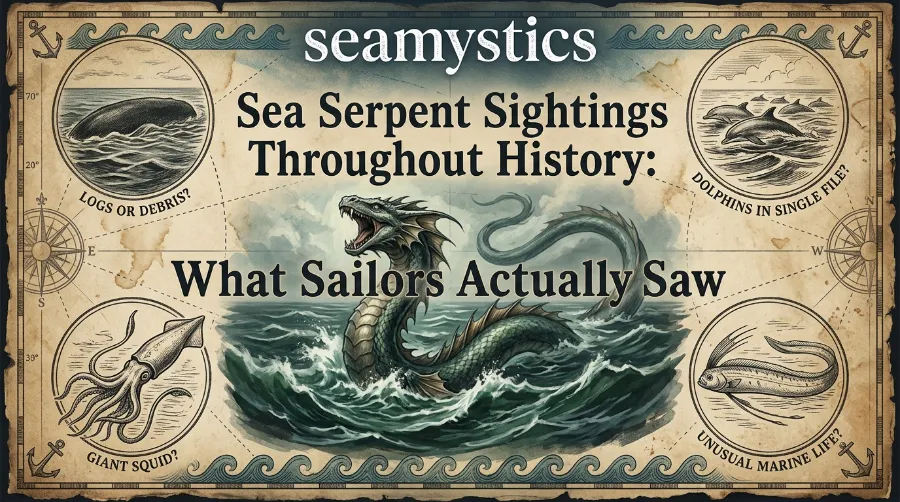

Picture a ship’s crew standing at the rail in 1848. They are watching something sixty feet long lift a horse shaped head above the waves. These were not drunk sailors, and they were not fools either. They were trained naval officers, and what they logged that day still shapes how we talk about sea serpent sightings today.
For more than four hundred years, sailors from Massachusetts to the North Sea have described the same strange humps. They have reported the same snake like heads, and the same undulating wakes. Meanwhile, modern marine science is finally catching up with an explanation for most of it.
This piece walks through the real, documented sea serpent sightings that built the legend. We will look at the sailors who reported them, and the biology that now accounts for what they saw. Along the way, we will cover historical sea serpent reports from Cape Ann to Norway, plus famous sea serpent sightings involving the Royal Navy. We will also unpack the ongoing sea serpent explanation science that connects oarfish, giant squid, and even ship wakes to centuries of sailor sea monster reports. If you have ever wondered whether something real sat behind these tales, you are in good company, and the answer turns out to be more interesting than a simple yes or no.
Key Takeaways
| Topic | What the Research Shows |
|---|---|
| Earliest documented case | 1639, Cape Ann, Massachusetts, recorded by colonist John Josselyn |
| Best documented sighting | HMS Daedalus, August 6, 1848, South Atlantic, filed as an official Royal Navy report |
| Peak reporting era | 1817 to 1819, Gloucester Harbor, Massachusetts, dozens of independent witnesses |
| Leading scientific explanation | Misidentified oarfish, giant squid, basking sharks, and whale pods |
| Verified correlation | Long necked sea monster reports rose sharply after plesiosaur fossils became public knowledge (Paxton and Naish, 2019) |
| Modern parallel | Oarfish strandings in California, 2024 to 2025, revived public interest in sea serpent lore |
| Total catalogued sightings | Cryptozoologist Bruce Champagne has logged more than 1,200 reported cases worldwide |
TL;DR: Sea serpent sightings are not new, and they do not spread evenly across history. Instead, they cluster around specific decades and specific coastlines, especially New England and the North Atlantic. Most documented cases trace back to real animals, such as oarfish, giant squid, and basking sharks, viewed under conditions that made them look far stranger than they were. Sailors were not lying. They were simply doing what any of us would do when looking at something unfamiliar from a moving deck.
A Timeline of Historical Sea Serpent Reports
Long before cryptozoology had a name, coastal communities were already trading stories about creatures in the water. Historical sea serpent reports did not appear at random. Instead, they followed shipping routes, fishing grounds, and the seasons when big fish and whales pass close to shore.
Early Colonial and European Cases
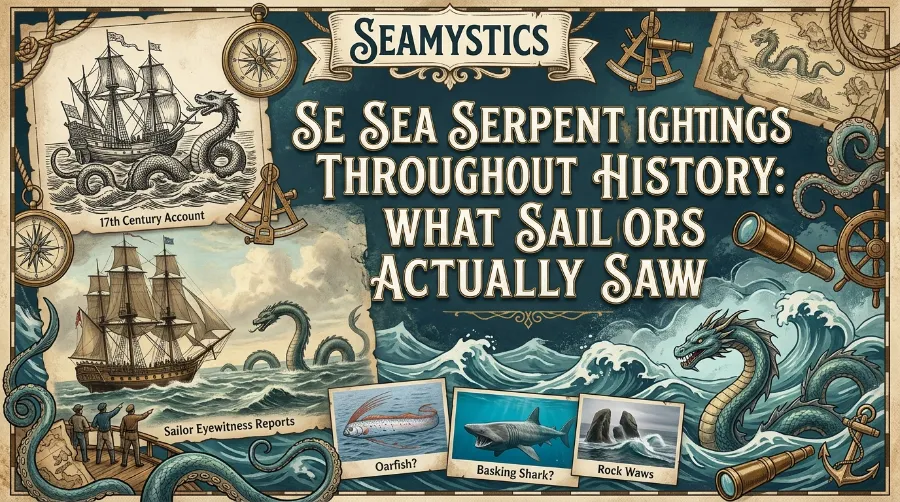
- 1639, Cape Ann, Massachusetts: The earliest recorded North American sighting. Colonist John Josselyn wrote that local sailors described a serpent “coiled up like a cable upon a rock.” That detail is so specific it has survived in maritime archives for nearly 400 years.
- 1734, Coast of Greenland: Hans Egede, a Danish missionary, recorded a crew’s account of a creature longer than their ship. It had a small head and enormous fins, and his journals carried the story to a wide European audience.
The Nineteenth Century Peak
- 1817 to 1819, Gloucester Harbor: Dozens of fishermen, shipmasters, and ordinary townsfolk reported a serpent with a horse like head. Its body was segmented and barrel thick, and the sightings were serious enough that the Linnaean Society of New England opened a formal investigation.
- August 6, 1848, South Atlantic: The crew of HMS Daedalus watched a creature for twenty minutes. They estimated at least sixty feet of its body above the surface, a case described in detail on the Mackinac State Historic Parks blog. Captain Peter M’Quhae’s official report is still one of the most cited documents in the field.
- Early 1900s, Cadboro Bay, British Columbia: Repeated sightings gave rise to “Caddy.” Regional naturalists say it appeared over 200 times, making it one of the most consistently reported cryptids in North America.
- 1905, Coast of Brazil: Naturalists aboard the yacht Valhalla, Michael Nicoll and E.G.B. Meade Waldo, reported a long necked, turtle headed animal with a large dorsal fin. The case still gets discussed because trained scientists made the report, not casual observers.
These historical sea serpent reports share a pattern worth noticing. They almost always come from multiple witnesses. They almost always happen in daylight, and they almost always describe humps or a long neck breaking the surface. That consistency is exactly what has kept researchers curious for two centuries.
Giant Squid Legends vs Reality: How the Myth Became Science
Famous Sea Serpent Sightings Sailors Still Talk About
Some cases became famous not just because of what people saw, but because of who reported it and how carefully they documented it. When people ask about famous sea serpent sightings, these four usually come up first.
The Cases That Built the Legend
- The HMS Daedalus encounter (1848). A Royal Navy frigate, a named captain, and a written report reached the London press within weeks. It remains the gold standard for a credible sailor sea monster report, since officers filed it through official military channels rather than a local newspaper chasing a good story.
- The Gloucester Sea Serpent (1817 to 1819). A scientific society collected more than a dozen sworn statements. This was an early attempt to apply formal methodology to a folklore subject.
- The Valhalla sighting (1905). Two professional naturalists, not fishermen unfamiliar with marine life, described an animal that still resists a clean explanation.
A Modern Echo
- The San Juan Islands sighting (2025). According to a report from Salish Current, two teenagers near Campbell River, British Columbia described a crocodile like creature with a spiked tail snatching a bird from the water. This proves the reports have never really stopped.
What connects a Royal Navy captain in 1848 to two teenagers on a dock in 2025 is not superstition. It is simply the fact that the ocean still holds animals most people never see up close. That gap between what lives in the water and what the public recognizes on sight is where sea serpent sightings are born.
Cadborosaurus: Canada’s Own Deep-Sea Cryptid Explained
Sea Serpent Explanation Science: What’s Actually Down There
Marine biology has slowly closed the gap between legend and identification. This is where the real value of sea serpent explanation science comes through, because most historical accounts can now be matched, with reasonable confidence, to specific animals or physical phenomena.
The Montauk Monster Identified: What Washed Up in 2008, and What It Really Was
The Oarfish Connection
The giant oarfish, Regalecus glesne, is very likely the single biggest contributor to sea serpent lore. It has a long, ribbon like silver body and a red crest along its head, and researchers say it can reach lengths of up to 36 feet. It normally lives in deep water and only surfaces when sick, injured, or dying. As a result, most people who encounter one are seeing something genuinely rare, so their surprise makes complete sense.
Giant Squid and Basking Sharks
Giant squid can reach over 40 feet including their tentacles. A squid swimming near the surface with its arms trailing could easily read as a serpentine body from a passing ship. Basking sharks add another layer to the puzzle. A decomposing basking shark carcass loses its jaw and gills first, leaving behind a small head, a long neck like section, and a body shape that resembles nothing so much as a classic sea monster.
Trunko Carcass Mystery: The Bizarre Carcass That Baffled the World
The Plesiosaur Effect
One fascinating finding comes from a 2019 study in Earth Sciences History by researchers Charles Paxton and Darren Naish. They cross referenced eyewitness sea monster reports against the timeline of plesiosaur fossil discoveries. They found that descriptions involving a long neck became far more common only after plesiosaur skeletons entered public knowledge in the 1850s. In other words, once people had a mental image of a long necked marine reptile, their brains started fitting ambiguous sightings into that shape.
Ship Wakes and Optical Illusions
Marine historian Adrian Shine has proposed that steamships added a new visual trigger. Steamship wakes can persist on the surface for twenty minutes or more, and their individual humps can look solid, dark, and animal like from a distance, especially in choppy water or fading light.
Globster Mystery Explained: The Unidentified Blobs That Wash Ashore
Why Sailors Report Sea Monsters: The Human Side
It is easy to assume every sailor sea monster report is either a hoax or a genuine cryptid encounter. However, the honest middle ground is far more interesting, and a few practical conditions explain why these reports cluster the way they do.
- Fatigue and dehydration. Long voyages before refrigeration and reliable navigation left crews physically exhausted, and exhaustion affects visual perception more than most people realize.
- Limited visibility tools. Before modern optics, sailors relied entirely on the naked eye at distance and in poor light, conditions where size and shape are notoriously hard to judge.
- Unfamiliar species. A sailor who has never seen an oarfish, a colossal squid, or a line of surfacing whales has no existing category for the sighting. So, the brain reaches for the closest cultural reference, which for centuries was “sea monster.”
- Social reinforcement. Once one crew member calls out a sighting, others tend to look for and confirm the same shape, a well documented effect in eyewitness psychology.
None of this means sailors were careless or dishonest. Rather, it means human perception under stress, distance, and unfamiliarity behaves in predictable ways, and that predictability is itself a useful scientific tool.
The Stronsay Beast Mystery: Scotland’s Sea Carcass That Fooled the Experts
What Modern Technology Is Finally Confirming
Recent years have given marine biologists tools that nineteenth century naturalists could only dream of, and the results are reshaping how we talk about sea serpent sightings.
- Between 2024 and 2025, a wave of oarfish strandings along the Southern California coast reignited public fascination, and local media outlets covered each new stranding as it happened.
- In 2025, researchers filmed a live colossal squid in its natural deep sea habitat for the first time, more than a century after scientists first described the species from washed up remains, according to our deep sea cryptids guide.
- NOAA continues to note that researchers have mapped less than a quarter of the world’s seafloor in detail. Therefore, new species, and new opportunities for a startling encounter, are still turning up every year.
This steady stream of new footage and new species is quietly doing what two centuries of debate could not. It is giving the public an expanding mental library of real deep sea animals. Consequently, a chance sighting today is far less likely to get filed under “monster” and far more likely to get correctly identified.
The Gloucester Sea Serpent: New England’s Most Famous Ocean Mystery
How Sea Serpents Connect to Other Ocean Mysteries
Sea serpent sightings do not exist in isolation. Instead, they sit alongside a much wider catalogue of ocean folklore that marine writers have spent decades untangling. If this topic interests you, our full deep sea cryptids guide covers similar cases, from the Bloop sound to the colossal squid. Similarly, our separate breakdown of the Loch Ness debate applies the same evidence based approach to freshwater sightings.
Readers who want the full picture of how these legends form and fade should start with the seamystics.com home page, where every case study follows the same principle. First, take the eyewitness account seriously. Then, test it against what marine science actually knows.
For readers who want to compare independent research on specific cases, two sources are worth a look. The National Wildlife Federation’s roundup of real sea serpent candidates and The Other Cape’s look at regional serpent lore both line up closely with the timeline covered here.
A Field Marine Biologist’s Take
I have spent years reviewing eyewitness logs, stranding reports, and old ship’s records for this publication, and one pattern stands out above every other theory. The most credible sea serpent sightings are almost never solitary. They involve a crew, a fixed reference point like a ship’s rail or a rock formation, and a viewing window long enough for someone to describe movement, not just a shape.
That combination filters out a huge share of the noise. It leaves behind a short list of cases genuinely worth studying, which is exactly the list this article has walked through. It also explains why a five second glimpse from a phone camera rarely settles anything, while a twenty minute observation from a Royal Navy deck in 1848 is still under discussion 175 years later.
Frequently Asked Questions
Are sea serpent sightings still reported today? Yes. Reports continue on a regular basis, including a widely covered case near Campbell River, British Columbia in 2025, alongside ongoing oarfish strandings that keep public interest high.
What is the most credible sea serpent sighting in history? Most marine historians point to the 1848 HMS Daedalus encounter. Officers filed it as an official Royal Navy report, and multiple trained crew members observed it over a twenty minute window.
What animal is most often mistaken for a sea serpent? The giant oarfish is the leading candidate. Giant squid and decomposing basking shark carcasses follow close behind, since a basking shark carcass loses its jaw and gills first and leaves behind a serpent like silhouette.
Do marine biologists believe sea serpents are real animals? Most working marine biologists believe the vast majority of sightings describe real, known species viewed under unusual conditions. They do not believe the evidence supports an undiscovered species of giant marine reptile.
Why do sea serpent sightings cluster around certain decades? Researchers have found a measurable link between reports of long necked creatures and the public release of plesiosaur fossil discoveries in the 1850s. This suggests cultural exposure shapes how people interpret an ambiguous sighting.
Test Your Knowledge: Sea Serpent Sightings Quiz
1. Where was the earliest recorded North American sea serpent sighting? A) Norfolk, England B) Cape Ann, Massachusetts C) Cadboro Bay, British Columbia D) Saint Helena Answer: B. The 1639 sighting near Cape Ann is the earliest documented case in North American waters.
2. Which ship’s crew produced the most cited official sea serpent report? A) HMS Daedalus B) The Caravan C) The Valhalla D) The Irada Answer: A. The 1848 HMS Daedalus report remains the most frequently referenced case in maritime history.
3. What is the leading scientific explanation for most sea serpent sightings? A) Ancient unclassified reptiles B) Optical illusions caused by fog alone C) Misidentified oarfish, giant squid, and basking sharks D) Deliberate hoaxes by sailors Answer: C. Marine biologists point to known species observed under unusual conditions as the leading explanation.
4. What did the 2019 Paxton and Naish study find? A) Sea serpent reports declined after 1850 B) Long necked descriptions increased after plesiosaur fossils became publicly known C) All sightings occurred at night D) Sightings were evenly distributed across every ocean Answer: B. The study found a measurable rise in long necked descriptions following public exposure to plesiosaur fossils.
5. What modern event has revived public interest in sea serpent lore? A) A new species of whale B) Oarfish strandings in California between 2024 and 2025 C) A new Loch Ness expedition D) A change in maritime law Answer: B. Repeated oarfish strandings along the Southern California coast between 2024 and 2025 brought fresh attention to old sea serpent legends.
Conclusion
Sea serpent sightings have never really been about monsters. Instead, they have always been about the gap between what the ocean actually holds and what any one person has had the chance to see with their own eyes. From a colonist’s account in 1639 to a Royal Navy captain’s report in 1848, and from Gloucester fishermen to two teenagers on a dock in 2025, the pattern holds steady. Real animals, unfamiliar conditions, and a very human instinct to reach for the most dramatic explanation available, that combination explains most of what we call a sea monster. As marine science keeps mapping more of the seafloor and filming species once known only from old carcasses, the line between legend and biology keeps getting clearer. Honestly, that makes the ocean more fascinating, not less.
References
- Josselyn, J. (1638). An Account of Two Voyages to New England.
- Mackinac State Historic Parks. “The Sea Serpent at Mackinac.” https://www.mackinacparks.com/blog/the-sea-serpent-at-mackinac/
- National Wildlife Federation. “Top 5 Real Sea Serpents (Sort Of).” https://blog.nwf.org/2011/08/top-5-real-sea-serpents-sort-of/
- The Other Cape. “Serpent.” https://www.theothercape.com/blog/serpent
- Paxton, C.G.M. and Naish, D. (2019). “Did nineteenth century marine vertebrate fossil discoveries influence sea serpent reports?” Earth Sciences History.
- Salish Current. “San Juan sea serpent spotting reported, again.” (2025) https://salish-current.org/2025/09/11/san-juan-sea-serpent-spotting-reported-again/
- Sea Mystics. “Deep Sea Cryptids: Real Sightings Behind Ocean Legends.” https://seamystics.com/deep-sea-cryptids/