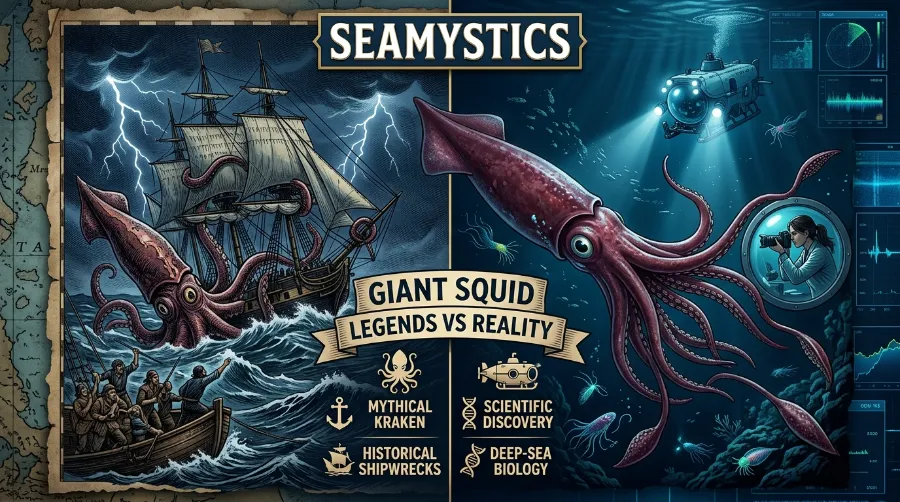

Sailors once swore that a beast the size of an island could rise from the black water and pull an entire ship under. For centuries nobody believed them, until the ocean proved them right. Ultimately, giant squid legends did not start as fiction. Instead, they started as eyewitness reports that science had not caught up to yet, and that gap between story and proof makes this one of the strangest true stories in marine biology.
Key takeaways
| Fact | Detail |
|---|---|
| Myth origin | Kraken first documented by Erik Pontoppidan in 1752 |
| First real encounter | French ship Alecton fought a giant squid off Tenerife in 1861 |
| First live photo | Taken in 2004 by Tsunemi Kubodera’s team in Japan |
| First natural-habitat video | Filmed in 2012 near the Bonin Islands |
| Newest discovery | A juvenile colossal squid was filmed alive for the first time on March 9, 2025 |
| Real size | Giant squid: up to 43 feet. Colossal squid: up to 23 feet but nearly 1,100 lbs |
TL;DR: Giant squid legends grew out of real but poorly understood sightings. In fact, it took over 250 years for science to catch up with the folklore. The Kraken myth traces back to 1752, and the first confirmed physical evidence followed in 1861. Even so, nobody photographed a live giant squid until 2004. Today, thanks to deep-sea robotics, we’ve gone from ghost stories to genuine giant squid facts, and scientists are still writing the story.
The Kraken Myth: Where Giant Squid Legends Really Began
Long before marine biology existed as a field, sailors in the North Atlantic told stories about a creature large enough that people mistook it for an island. This is the real root of giant squid history myth. Clearly, nobody invented it for entertainment. Rather, it was an attempt to explain something genuinely terrifying that people had actually seen.
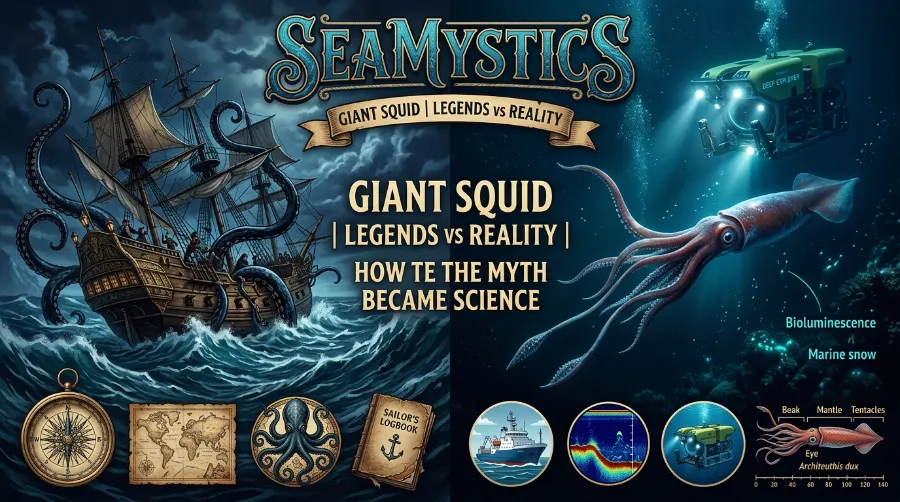
The Kraken first appears in writing through Danish bishop and naturalist Erik Pontoppidan. In his 1752 book The Natural History of Norway, he described a creature so massive that ships mistook it for an island. Even earlier, fragments of the legend go back further still, including a 12th-century account credited to King Sverre of Norway, who described a ship-swallowing sea monster. So this wasn’t a one-off tall tale. Instead, sailors passed the story down and reinforced it across generations because something out there kept confirming it.
For fishermen working cold Scandinavian waters, the legend also served a practical purpose. Specifically, communities near Norway and the North Atlantic noticed something: fishing often improved in the same waters where sailors reported the Kraken. Interestingly, that detail turns out to be scientifically accurate, since sperm whales hunt giant squid in those same feeding grounds. Therefore, a burst of fish activity near a squid encounter wasn’t superstition; it was ecology, described in the only language people had at the time.
Giant Squid vs Kraken: The First Real Evidence
The gap between legend and giant squid facts closed a little in November 1861. That month, the French naval corvette Alecton, commanded by Captain Frédéric Bouyer, spotted a massive creature near Tenerife in the Canary Islands. In response, the crew fired muskets and cannonballs at it and tried to lasso it with rope. Eventually, they tore off a section of its body, roughly 20 feet of tentacle, and preserved it for study.
Cadborosaurus: Canada’s Own Deep-Sea Cryptid Explained
Many historians treat this as the turning point in the giant squid vs Kraken debate. Later, American zoologist A.E. Verrill confirmed the tissue belonged to a real giant squid, not a mythical monster. As a result, scientists finally had hard evidence that Pontoppidan’s “island” wasn’t pure fantasy. Many also credit the Alecton encounter with inspiring Jules Verne, who published Twenty Thousand Leagues Under the Sea just nine years later in 1870, cementing the giant squid’s cultural image for generations. If you have read about other unexplained ocean encounters, the Loch Ness debate follows a similar arc of folklore colliding with partial physical evidence.
A second wave of proof arrived decades later off the coast of Newfoundland. There, fishermen recovered a giant squid tentacle nearly 19 feet long and brought it to naturalist Moses Harvey. Subsequently, Harvey documented and photographed the specimen, giving the wider scientific community its clearest confirmation yet that these animals really existed at the size sailors described. Similarly, other strange coastal finds appear in our globster mystery breakdown, where people mistook decomposed carcasses for entirely new species.
Giant Squid First Filmed: A 250-Year Wait Finally Ends
Here is where giant squid history myth stops being about torn tentacles and starts being about actual footage. Despite over a century of confirmed physical evidence, nobody had photographed a living giant squid in the wild until September 30, 2004. That day, Japanese zoologist Tsunemi Kubodera and his team captured the first still images of a live Architeuthis dux in its natural habitat, using a baited camera line suspended near sperm whale feeding routes.
That was only the beginning. Below is a short timeline of the milestones that followed:
- 2004 – First live photographs of a giant squid in its natural habitat, captured off Japan’s Ogasawara Islands.
- 2006 – First video of a live giant squid, a 24-foot female filmed after researchers pulled her to the surface.
- 2012 – First video of a giant squid in its natural habitat from a submersible, achieved off the Bonin Islands using Widder’s specially built “Medusa” camera system.
- 2019 – First live giant squid recorded in U.S. waters, filmed in the Gulf of Mexico.
The 2012 expedition is worth understanding because it explains why the wait took so long. Namely, giant squid live at depths past 3,000 feet where sunlight never reaches, and earlier attempts scared them off with bright lights and noisy propellers. Instead, Widder’s Medusa system used a jellyfish-shaped lure that glowed like bioluminescent prey. That approach finally coaxed a squid close enough to film. For more on how deep-sea explorers approach elusive animals, our guide on sea serpent sightings covers a similar detection problem from a different species.
The Montauk Monster Identified: What Washed Up in 2008, and What It Really Was
Giant Squid Facts Legend Got Wrong (and What’s Actually True)
Legends tend to round up. After all, sailors describing an “island-sized” monster weren’t lying; they were scared, and fear inflates memory. Even so, real giant squid facts are still impressive without the exaggeration, resting on measurements rather than campfire storytelling.
Here’s how the myth compares with verified reality:
- Size: Giant squid (Architeuthis dux) can reach roughly 43 feet including tentacles, according to the Natural History Museum, not the ship-sized creature Pontoppidan described.
- Weight: Adult giant squid typically weigh a few hundred kilograms. By comparison, their cousin the colossal squid weighs far more, up to 1,100 lbs, making it the heaviest invertebrate on the planet.
- Eyes: Giant and colossal squid carry the largest eyes of any known animal. In fact, a colossal squid’s eye measures around 27.5 centimeters across, roughly the size of a basketball.
- Behavior: Most documented squid-vessel contact looks like accidental entanglement rather than predatory aggression. For example, in 2003, a giant squid’s tentacle latched onto a racing yacht’s hull during the Jules Verne Trophy.
- Habitat: Overall, they live far below where light penetrates, generally past 1,000 feet, which is precisely why sightings stayed rare for so long.
If you enjoy separating exaggerated sea encounters from documented biology, the Montauk Monster case is a good companion read, since it shows how quickly an unfamiliar carcass can spiral into modern folklore.
The Stronsay Beast Mystery: Scotland’s Sea Carcass That Fooled the Experts
The Colossal Squid’s 2025 Breakthrough
Giant squid legends might be centuries old, but the mystery keeps unfolding. On March 9, 2025, an international team aboard the Schmidt Ocean Institute’s research vessel Falkor filmed a live colossal squid (Mesonychoteuthis hamiltoni) in its natural habitat for the first time ever, using the ROV SuBastian at roughly 600 meters depth near the South Sandwich Islands.
The Gloucester Sea Serpent: New England’s Most Famous Ocean Mystery
Notably, the squid they filmed was just 30 centimeters long, a translucent juvenile. Marine biologist Dr. Kat Bolstad of Auckland University of Technology noted that for a century, scientists had only encountered this species as prey remains in whale and seabird stomachs. Meanwhile, scientists had formally identified the colossal squid almost exactly 100 years before that sighting, so this moment closed another century-long gap between legend, evidence, and finally, direct observation.
Giant Squid vs Kraken: Comparing Myth and Modern Species
| Category | Kraken (legend) | Giant Squid (real) | Colossal Squid (real) |
|---|---|---|---|
| First documented | 1752, Pontoppidan | 1861, Alecton encounter | 1925, formal description |
| First seen alive | Never confirmed | 2004 | 2025 |
| Claimed/verified length | “Island-sized” | Up to ~43 ft | Up to ~23 ft |
| Behavior | Ship-sinking predator | Deep-sea hunter, avoids surface | Ambush predator, poorly studied |
| Habitat | Norwegian coastal waters (legend) | Global, 1,000+ ft deep | Southern Ocean, colder deep water |
For readers who want more on recent cephalopod discoveries, Oceanwide Expeditions’ writeup on the colossal squid of Antarctica digs deeper into that story, while this detailed account of the Alecton encounter does the same for 1861. Additionally, if you’d like a diver’s perspective on Kraken folklore, this piece from Dive Scotty is worth a read.
Globster Mystery Explained: The Unidentified Blobs That Wash Ashore
Why This Story Still Matters
Giant squid legends aren’t just fun maritime trivia. Rather, they’re a genuine case study in how folklore can encode real observations long before science has the tools to confirm them. After all, Scandinavian sailors weren’t wrong that something enormous lived in those waters; they simply lacked deep-sea cameras and submersibles.
Trunko Carcass Mystery: The Bizarre Carcass That Baffled the World
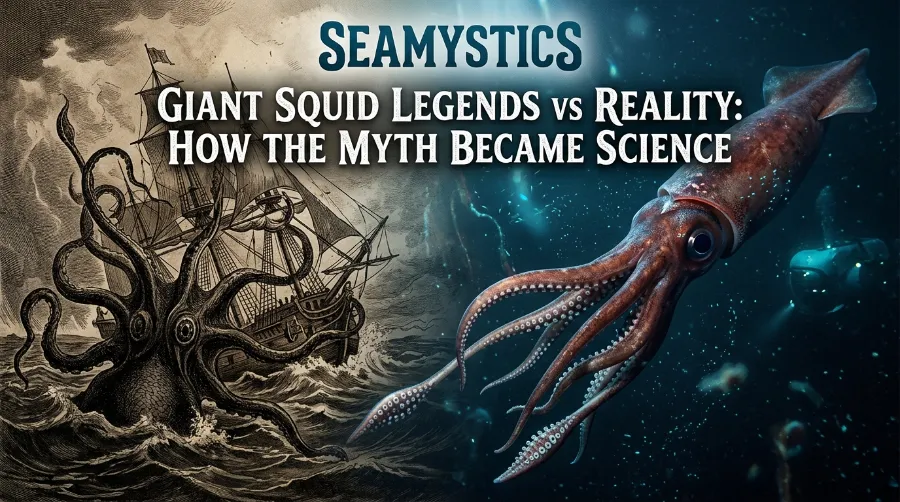
That pattern keeps repeating across ocean mythology, which is exactly why we cover it so often on this site. If this topic interests you, our deep sea cryptids hub rounds up several other cases where sailors’ stories turned out to hold more truth than anyone expected.
Frequently Asked Questions
Is the Kraken based on a real animal?
Most marine biologists agree that real encounters with giant squid, and possibly colossal squid, likely inspired the Kraken legend, since both animals are large enough and unfamiliar enough to explain centuries of sailor reports.
When was a giant squid first filmed alive?
The first live photographs came in 2004, followed by the first surface video in 2006. Eventually, the first footage in its natural deep-sea habitat came in 2012.
How big do giant squid actually get?
Giant squid can reach approximately 43 feet including their two long feeding tentacles, according to the Natural History Museum, though average specimens are considerably smaller.
What’s the difference between a giant squid and a colossal squid?
Giant squid are generally longer overall because of their longer tentacles, whereas colossal squid are heavier and bulkier, making them the heaviest invertebrate known at up to 1,100 pounds.
Has anyone ever seen a colossal squid alive in the wild?
Yes. A team captured the first confirmed footage of a live colossal squid in its natural habitat on March 9, 2025, nearly 100 years after scientists first identified the species.
Quick Quiz: Test Your Giant Squid Knowledge
- Who first documented the Kraken legend in writing?
a) Jules Verne
b) Erik Pontoppidan
c) Charles Darwin
Answer: b) Erik Pontoppidan, in his 1752 book The Natural History of Norway. - In what year was a giant squid first photographed alive in its natural habitat?
a) 1861
b) 1952
c) 2004
Answer: c) 2004, by Tsunemi Kubodera’s team in Japan. - Which ship had the first confirmed physical encounter with a giant squid?
a) The Alecton
b) The Beagle
c) The Titanic
Answer: a) The Alecton, in 1861 near Tenerife. - What made the 2025 colossal squid sighting significant?
a) It was the largest squid ever recorded
b) It was the first time the species was filmed alive in its natural habitat
c) It attacked a research vessel
Answer: b) It was the first live footage of a colossal squid in the wild, 100 years after its discovery. - What is the heaviest invertebrate on the planet?
a) Giant squid
b) Colossal squid
c) Giant Pacific octopus
Answer: b) Colossal squid, which can weigh up to 1,100 pounds.
References
- Natural History Museum, “Giant and colossal squid: revealing the secrets of the largest invertebrates,” nhm.ac.uk
- Smithsonian Ocean, “Caught on Video: Giant Squid,” ocean.si.edu
- Schmidt Ocean Institute, “First Confirmed Footage of a Colossal Squid,” schmidtocean.org
- ABC News, “Colossal squid filmed in deep-sea natural habitat for the first time,” April 2025
- Binghamton University Libraries, “Krakens and Squids”
- Wikipedia, “Kraken” and “Tsunemi Kubodera”