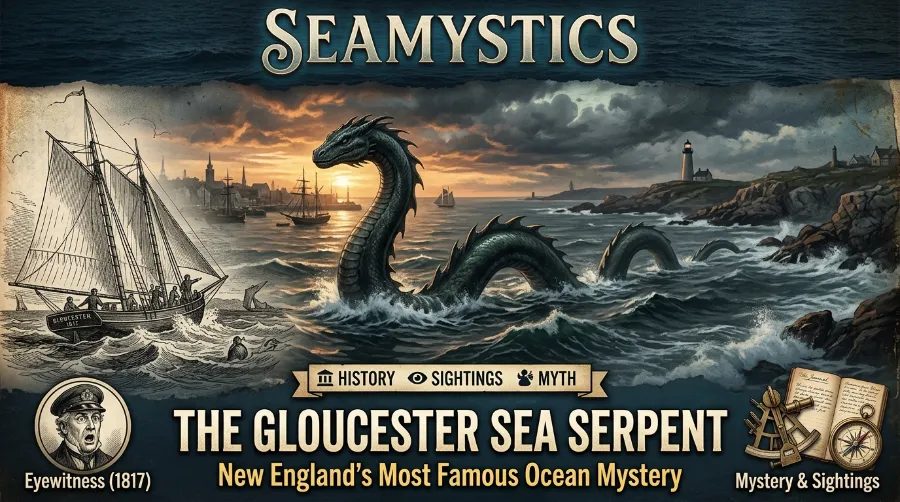

Picture a calm August morning in 1817. Fishermen in Gloucester Harbor spot something they cannot explain. A dark, humped body glides through the water, faster than any whale and longer than any boat. Within days, half of Cape Ann stands on the rocks with spyglasses. The Gloucester sea serpent becomes the talk of New England, and two centuries later, we are still trying to figure out what those witnesses actually saw.
I have spent two decades studying marine animal behavior and ocean folklore. The Gloucester case remains one of the best documented in American history. So instead of repeating the usual campfire version, this piece walks through the real timeline, the science, and the modern explanations, built on the original 1817 records.
Key Takeaways
| Aspect | Detail |
|---|---|
| First reported sighting | 1638, near Cape Ann, by colonist John Josselyn |
| Peak sighting period | August 1817 to 1819 |
| Estimated length | 40 to 100 feet, per various witnesses |
| Investigating body | Linnaean Society of New England |
| Scientific name proposed | Scoliophis Atlanticus |
| Leading modern theories | Oarfish, basking shark, misidentified whale, giant eel |
| Most recent reported sighting | 1962, off Marshfield, Massachusetts |
TL;DR: The Gloucester sea serpent was a supposed 40 to 100 foot creature reported in Gloucester Harbor starting in August 1817. Earlier sightings go back to 1638. Scientists formed a committee, gathered testimony, and even proposed a new species name, but nobody ever recovered physical proof. Most marine biologists today point to known animals such as oarfish or basking sharks, seen at a distance and misread by startled crews.
A Brief History of the Gloucester Sea Serpent
Most people know the 1817 story, but the Gloucester sea serpent history actually stretches back much further. English colonist John Josselyn recorded one of the earliest known reports in 1638. He described a serpent like creature near Cape Ann. That single sighting sat quietly in old journals for nearly two centuries, until the summer that made this case famous.
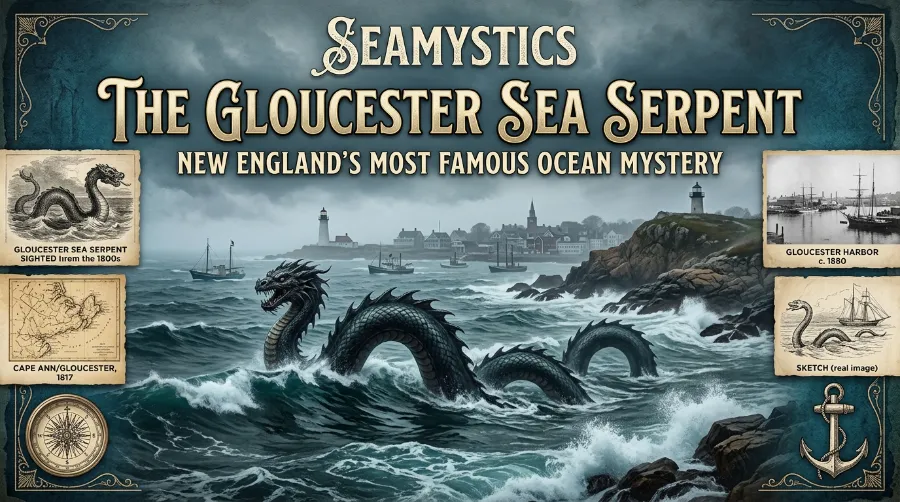
By early August 1817, sightings had grown frequent enough that local newspapers picked up the story. Fishermen and respected townspeople reported a dark, snake shaped animal moving through Gloucester Harbor. Witnesses noted a strange up and down, caterpillar like motion, unlike the side to side swimming of an eel or fish.
The August 1817 Sightings: A Closer Look
This is the heart of every serious 1817 sea serpent report. The details are worth walking through step by step:
- August 6 to 10, 1817: Mariner Amos Story reported one of the first clear sightings from shore. He described a long, dark body moving quickly through the harbor.
- August 12 to 14, 1817: Witness Solomon Allen watched the creature over several days. He noted its segmented, hump backed appearance and its unusual speed.
- August 14, 1817: Ship carpenter Matthew Gaffney had a close encounter and fired a shot at the animal as it passed near his boat. The creature submerged and reappeared roughly 100 yards away.
- Later that month: A crew aboard the schooner Caravan spotted a creature with a serpent like head swimming beside the vessel. They fired a cannon at it, again with no lasting effect.
What makes this Massachusetts sea monster sighting so unusual is not just the number of witnesses, but who they were. These were not drunken sailors telling tall tales. They were fishermen, ship captains, and local officials, and a scientific body took their testimony seriously.
When Science Got Involved: The Linnaean Society Investigation
In August 1817, the Linnaean Society of New England formed a special committee to gather evidence about the creature terrorizing Gloucester Harbor. Members interviewed witnesses directly. They compiled sworn statements, a genuinely rigorous approach for the era.
The society went a step further and proposed a scientific name for the animal: Scoliophis Atlanticus. They treated the sightings as evidence of an undiscovered species. That confidence took a hit soon after. Someone found a small, oddly humped snake on a beach near Gloucester, and locals assumed it was a juvenile sea serpent. Naturalists later identified it as an ordinary Eastern racer snake with spinal tumors. That mix up gave critics plenty of ammunition to mock the whole investigation.
Cadborosaurus: Canada’s Own Deep-Sea Cryptid Explained
Skeptics still bring up that mistake whenever someone questions the case. But it helps to separate the flawed specimen analysis from the actual eyewitness reports, which came from dozens of independent sources over several weeks.
For a broader sense of how this fits into New England folklore, our guide on sea serpent sightings covers similar cases from Maine down to Rhode Island.
What Did People Actually See? Descriptions and Patterns
Eyewitness accounts stayed remarkably consistent, even though many different people gave them. Most descriptions agreed on a few core features:
- A body length somewhere between 40 and 100 feet, though estimates varied by witness and distance.
- A series of humps along the back, giving it a segmented, almost buoy like look.
- A head compared to a horse, a turtle, or a serpent, often held several feet above the surface.
- A distinctive vertical, undulating swimming motion, unlike the horizontal movement of eels or fish.
- A dark brown or black color, sometimes described as scaly.
That vertical undulation detail matters a lot to marine biologists. It rules out several obvious suspects, since snakes and eels move side to side. Only a handful of ocean animals move in that up and down, caterpillar like pattern. That detail is a big part of why this New England sea monster case has stayed interesting to researchers, rather than getting dismissed outright.
The Leading Scientific Explanations
Two hundred years on, nobody can say for certain what people in Gloucester Harbor were looking at. But marine science has narrowed the field. A few explanations come up again and again among researchers who study the case.
Oarfish are the most commonly cited candidate. These deep sea fish can grow past 30 feet and have long, ribbon like bodies. They rarely surface, which would explain both the size estimates and the sense of mystery. A disoriented or dying oarfish rising into shallow water would look genuinely alien to an 1817 fisherman who had never seen one before.
Trunko Carcass Mystery: The Bizarre Carcass That Baffled the World
Basking sharks are another strong possibility. A large dorsal fin and a body breaking the surface in sections can create the illusion of humps when seen from shore. Researchers have also floated a pod of dolphins or porpoises surfacing in sequence as an explanation for some “humped” reports, since a line of arching backs can look like a single long body from a distance.
Author Joe Nickell has written extensively on unexplained sightings. He proposed that some reports describing a spear like protrusion from the creature’s head may actually describe a narwhal that wandered far south of its normal range, a rare but documented event in whale migration records.
None of these explanations account for every detail in every report. That gap is part of why the case has never fully closed. For a deeper look at how researchers weigh a case like this against more famous international sightings, see our breakdown of the Loch Ness debate.
Later Sightings: The Legend Continues
The Gloucester sea serpent did not vanish after 1819. Reports kept surfacing for well over a century:
| Year | Location | Notable Detail |
|---|---|---|
| 1817-1819 | Gloucester Harbor, Cape Ann | Peak sighting period, dozens of witnesses |
| 1859 | Gloucester coast | Reported encounter with the British vessel Banner |
| 1891 | Wells Beach and Flemish coast | Multiple newspaper reports from Gloucester fishermen |
| 1962 | Marshfield, Massachusetts | Most recent widely reported sighting |
| 1997 | Fortune Bay, Newfoundland | Similar description reported decades after the last confirmed New England sighting |
Author J.P. O’Neill wrote The Great New England Sea Serpent. He suggested that decades of overfishing may have pushed the animal behind these sightings away from Gloucester’s waters entirely. That theory helps explain why reports thinned out through the 20th century.
Gloucester is not the only place with a story like this. Our guide to globster mysteries covers a related category of unexplained ocean carcasses. Our piece on giant squid legends shows how deep sea animals fueled monster stories for centuries before we had submersibles to check.
The Stronsay Beast Mystery: Scotland’s Sea Carcass That Fooled the Experts
Why Gloucester Still Matters to Marine Science
Set aside the question of what people actually saw. The Gloucester case is genuinely valuable as a historical dataset. It shows how ordinary coastal communities responded to something outside their frame of reference. It also shows how a scientific society tried, imperfectly, to apply method to a folklore event.
That pattern repeats throughout ocean history. Strange carcasses wash ashore, communities panic, and scientists investigate. Eventually, a mundane explanation usually surfaces, though not always fast enough to stop the legend from spreading first. If you enjoy that pattern, our deep dive on the Montauk Monster covers a modern case from 2008 that followed almost the same arc.
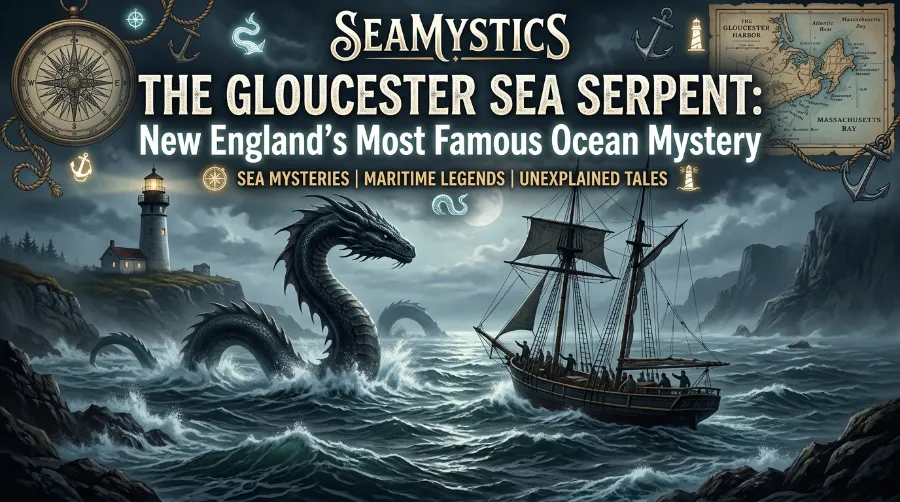
Gloucester’s relationship with the creature has softened over time too. The town no longer treats it as an embarrassment. Instead, it folds the sea serpent into local branding and tourism, rather than burying the story.
Frequently Asked Questions
Was the Gloucester sea serpent ever caught or physically confirmed?
No. Nobody ever recovered a physical specimen of the adult creature. The only physical evidence, a small snake found on a nearby beach in 1817, turned out to be an ordinary Eastern racer with spinal deformities, not a juvenile sea serpent.
How many people reported seeing the Gloucester sea serpent in 1817?
Historical accounts describe dozens of separate witnesses during August and September 1817 alone, including fishermen, ship captains, and Gloucester residents watching from shore.
What is the scientific name given to the creature?
The Linnaean Society of New England proposed the name Scoliophis Atlanticus in 1817. Later science never validated this designation.
Is the Gloucester sea serpent related to the Loch Ness Monster?
No, they come from different countries and eras. But both involve long, humped, serpent like creatures reported by credible witnesses, and both drew similar scientific scrutiny and skepticism over the decades.
Could a real, unidentified species explain the sightings?
Most marine biologists consider this unlikely, given how thoroughly modern ocean surveys have mapped large marine life. Still, they acknowledge that oarfish, basking sharks, and rare whale migrations can produce sightings dramatic enough to explain most historical reports.
Test Your Knowledge: Gloucester Sea Serpent Quiz
1. In what year did the most famous wave of Gloucester sea serpent sightings occur?
a) 1776
b) 1817
c) 1901
Answer: b) 1817
2. What scientific name did the Linnaean Society of New England propose for the creature?
a) Scoliophis Atlanticus
b) Serpentus Gigantus
c) Pelagia Monstrum
Answer: a) Scoliophis Atlanticus
3. Which modern sea creature is most commonly proposed as an explanation for the sightings?
a) Great white shark
b) Oarfish
c) Sea otter
Answer: b) Oarfish
4. Who recorded one of the earliest known sightings near Cape Ann, in 1638?
a) John Josselyn
b) Matthew Gaffney
c) Solomon Allen
Answer: a) John Josselyn
5. Where was the most recent widely reported sighting of the creature?
a) Nahant
b) Marshfield, Massachusetts
c) Boston Harbor
Answer: b) Marshfield, Massachusetts
Conclusion
The Gloucester sea serpent is not just a spooky story passed down through New England towns. It stands as one of the most thoroughly documented unexplained sighting events in American history, backed by sworn testimony, a genuine scientific inquiry, and a paper trail stretching back to 1638. Whatever moved through that harbor in 1817, whether it was a lost oarfish, a basking shark seen at a strange angle, or something science has yet to catalogue fully, it left behind a legend that Gloucester has carried proudly for more than two centuries. It still gives modern marine biologists something genuinely interesting to chew on.
References
- History of Massachusetts Blog, The Sea Serpent of Gloucester, Massachusetts
- Wikipedia, Gloucester Sea Serpent
- New England Historical Society, The Great New England Sea Serpent
- Smithsonian Magazine, Five “Real” Sea Monsters Brought to Life by Early Naturalists
- Amusing Planet, The Gloucester Sea Serpent
- Rauner Special Collections Library, Dartmouth College, A Sea Serpent Near Boston?