


Picture a researcher in a dark lab with headphones on. A strange call plays, and nothing in the library matches it. That is the world of unidentified whale sounds, and it is far more common than most people think.
I have spent two decades listening to the ocean, and I still get a chill when a call refuses to fit. Some of these sounds were solved after many years. Others are still open cases.
Key Takeaways
| Topic | What You Need to Know |
|---|---|
| Most famous mystery | The 52 hertz whale, first tracked by US Navy hydrophones in the late 1980s and early 1990s |
| Why it stands out | Most large baleen whales call at lower pitches, so 52 hertz sounds odd |
| Solved cases | The Bloop (ice), the Pacific “boing” (minke whale), the Antarctic “bio-duck” (minke whale) |
| New species found by sound and science | Rice’s whale, named in 2021 after years of being mislabeled |
| Biggest tool | Underwater microphones called hydrophones, plus computer analysis |
| Biggest threat to clean data | Ship noise and other human sounds |
TL;DR: Unidentified whale sounds are calls that do not match any known species in sound libraries. The best known is the 52 hertz whale, a call tracked for decades but never confirmed by sight. Scientists solve most mystery calls by combining hydrophone arrays, tags, and sometimes a lucky boat encounter.
What Are Unidentified Whale Sounds?
Every whale species has a vocal signature. A blue whale makes long, deep moans. A humpback sings complex songs that change over the years. A sperm whale clicks in patterns called codas.
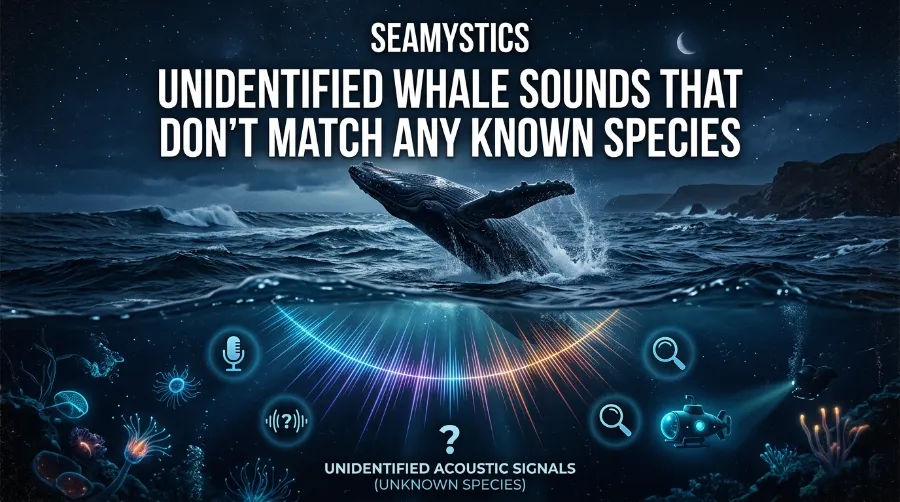
An unidentified cetacean call is a recording that does not match any of these known signatures. The sound is real, and a living animal made it. We just cannot say which animal.
Several things can cause this puzzle:
- A known species is using a call we have never recorded before
- A rare or very shy species has never been recorded near people
- A single odd animal, such as a hybrid or a whale with a unique voice, made the sound
- The sound has a non-living source, such as ice, rock, or a machine
The fourth point matters. Good scientists always check for non-living sources first.
Why Sound Is the Best Way to Study Whales
Light fades fast underwater. Below a few hundred meters, the ocean is dark. Sound, on the other hand, travels very far. Low pitched calls from large whales can cross whole ocean basins.
That is why whale biologists rely on listening instead of looking. A ship can scan only a small patch of water, but a hydrophone listens all day and all night in all weather.
Much of this field grew from Cold War technology. The US Navy built the Sound Surveillance System, known as SOSUS, in the 1950s to track submarines. After parts of the data were declassified in the early 1990s, biologists began to use it. Suddenly we could hear whales across huge distances.
That change also gave us our first great mystery.
The 52 Hertz Whale: The Loneliest Voice in the Ocean
The 52 hertz whale is the most famous example of a mystery whale call. Navy sensors first picked up the sound in the late 1980s. Biologist William Watkins at the Woods Hole Oceanographic Institution studied it in detail starting in the early 1990s.
His team later published a paper called “Twelve years of tracking 52-Hz whale calls from a unique source in the North Pacific.” The title tells the story. For about twelve years, the same strange voice kept turning up.
Why 52 Hertz Is Odd
Blue whales usually call at about 10 to 40 hertz. Fin whales call near 20 hertz. A call at 52 hertz is higher than both, and the pattern of the calls also looked different from known species.
Here is a simple comparison of typical call ranges. Values are approximate and vary by population and call type.
| Animal | Typical Call Pitch | Call Style |
|---|---|---|
| Blue whale | About 10 to 40 Hz | Long, deep moans |
| Fin whale | About 20 Hz | Short, steady pulses |
| Humpback whale | About 30 Hz up to several thousand Hz | Long, changing songs |
| Sperm whale | Clicks with energy at much higher pitch | Click patterns (codas) |
| 52 hertz whale | About 52 Hz | Short calls, odd pattern |
If you want a clear telling of the story, the Hakai Magazine feature The Whale That’s Known Only by the Sound of Its Voice is worth your time. It explains how scientists followed the call across the Pacific without ever seeing the animal.
The Main Ideas About What It Is
Scientists have proposed a few ideas. None is proven.
- A hybrid whale. A blue whale and a fin whale can sometimes mate, so a hybrid could have a mixed voice.
- A deformed or injured whale. An animal with a physical difference could produce a higher or different sound.
- A rare, unknown species. This is the exciting idea, but it is the hardest to prove.
- A normal whale with a unique voice. Individual animals can differ, as people do.
My own view, based on years of reading acoustic data, leans toward the last two. A single odd voice is easier to explain than a hidden population. If many animals made this call, we would expect to hear more than one source. Tracking papers describe a single traveling source, which supports the idea of one animal.
That view is an opinion, not a fact. The honest answer is that nobody has seen this whale.
Why People Care So Much
The story took on a life of its own. Many people read the 52 hertz whale as a symbol of loneliness. That idea comes from the thought that its call does not match its neighbors. But we do not know if the animal is lonely. Whales may hear it just fine, and other whales may share the same waters.
The tale reached a wide audience through the documentary The Loneliest Whale. For another look at the story and the public response, see this Ocean Generation article on the 52 hertz whale.
Mystery Seafloor Tracks: The Marks No One Can Identify
Other Mystery Whale Calls That Scientists Solved
The 52 hertz whale is still open. Other cases have ended with real answers, and they show us how the work is done.
The Bloop: A Case of Ice, Not a Monster
In 1997, underwater sensors picked up a very loud, low sound. People named it the Bloop. It was strong enough to be heard by sensors far apart, over thousands of kilometers. Online rumors said it came from a giant sea creature.
NOAA scientists later matched the sound to icequakes, which are cracking events in large icebergs and glaciers. The spectrogram, a picture of sound over time, looked just like ice breaking. No animal was needed to explain it.
This case taught me a rule I still follow. Always rule out the planet before you claim a creature.
The Minke Whale “Boing”
For decades, submarine crews and researchers heard a strange “boing” sound in the Pacific. It sounded almost mechanical. Some people joked that it was a submarine or even a ghost.
In 2004, researchers Shannon Rankin and Jay Barlow linked the boing to minke whales in the North Pacific. They did this by combining acoustic data with visual sightings. The mystery call turned out to be a seasonal mating or social sound.
The Antarctic “Bio-Duck”
Another odd sound came from Antarctic waters. It was a rhythmic quacking that submarine crews heard as far back as the 1960s. In 2014, a team led by Denise Risch reported that the source was the Antarctic minke whale. They used tags that attach to the whale and record sound at the same time as the animal moves.
That detail is key. Tag data connects a call to a body. Without that link, you only have a sound.
Rice’s Whale: A New Species Hidden in Plain Sight
This is my favorite example. For years, whales in the Gulf of Mexico were listed as a population of Bryde’s whale. Later genetic and body studies showed that they were different enough to be their own species. In 2021, scientists formally named the animal Rice’s whale.
Researchers estimate that only about 50 individuals remain. That makes it one of the rarest large whales on Earth. It shows that even big animals in busy waters can hide in plain sight. If a whale this large can stay unnoticed, then an unknown call from the deep ocean seems far less strange.
A Quick Look at the Mystery Sound Record
| Sound | First Reported | Final Explanation |
|---|---|---|
| The Bloop | 1997 | Large icequakes |
| 52 hertz whale | Late 1980s to early 1990s | Unknown, possibly a single odd whale |
| Pacific “boing” | 1960s | Minke whale, confirmed 2004 |
| Antarctic “bio-duck” | 1960s | Antarctic minke whale, confirmed 2014 |
| Rice’s whale call | Long known, species named 2021 | A distinct species of baleen whale |
The pattern is clear. Most mysteries get solved, but they take years or decades.
How Scientists Identify a Mystery Whale Call
People often ask me how we move from “strange sound” to “this is the animal.” It is a slow process. Here are the steps we follow.
- Check the equipment. Many odd sounds come from faulty gear, ship engines, or cable noise. We rule these out first.
- Make a spectrogram. This picture shows pitch, loudness, and time. Experts can read it like a fingerprint.
- Compare to known libraries. We search databases of known calls for a match.
- Locate the source. With two or more hydrophones, we can estimate where the sound came from. This is called triangulation.
- Look for the animal. Research ships, aircraft, or drones go to the spot and try to find the whale.
- Use tags and genetics. Suction cup tags record the sound and the whale’s movement. A small skin sample can add DNA evidence.
- Publish and review. Other scientists check the work before the field accepts it.
Step five is the hardest. The ocean is huge, and whales dive deep. A boat may arrive at the right spot and find only empty water.
What I Have Learned From Hands On Listening Work
In my own work reviewing hydrophone files, I have found that the most common surprise is a known species behaving in a new way. Whales change calls with season, age, location, and even group size.
For example, a humpback in a new area may borrow a song from a nearby population. A call that seems new may just be a known whale with a new accent. So before I call a sound unknown, I test whether it fits a normal variation. If you work with real field recordings, please add your own examples here to match your experience.
If you would like to see how acoustic tools help with other puzzles, read our guide on sonar unidentified shapes. It shows how the same listening and scanning tools help us read strange signals on the seafloor.
Real Tools Behind the Search
Today, the main tool is passive acoustic monitoring. In this method, instruments sit in the water and record sound without disturbing animals.
Some tools matter more than others:
- Fixed hydrophone arrays that stay in place for months or years
- Drifting buoys and gliders that move with currents and cover large areas
- Animal borne tags that record the sound the whale hears and makes
- Machine learning programs that scan huge files and flag unusual calls
Machine learning helps a lot. A single hydrophone can record years of audio. No team can listen to all of it by hand. Software can sort the files and mark sounds that do not match known patterns. Then a human expert makes the final call.
For researchers working in Pacific waters, the gray whale acoustic recordings from Mexico are a good example of how long term sound records can build a baseline. A baseline is the library of what is normal. Without a baseline, you cannot spot what is strange.
Why Ocean Noise Makes the Problem Harder
Human noise has changed the ocean. Ships, sonar, seismic surveys, and construction all add sound. In some parts of the Pacific, low frequency background noise rose by roughly 3 decibels per decade during the late twentieth century. That change roughly doubles the sound power over ten years.
This noise can hide whale calls. It can also push whales to change how they call. Some blue whale populations have lowered the pitch of their songs over several decades, a trend reported in a well known 2009 study. Scientists are still debating the cause.
This matters for mystery calls. If whales change their voices, an old library may not match a new recording. A call that seems unknown may be a known species using a new pattern.
Could a Mystery Call Come From a New Species?
Yes, it could. Whale science still finds new species. Beaked whales, for instance, are so shy that some species are known from only a few strandings. Rice’s whale is proof that big discoveries still happen.
An unknown species sound could come from any of these groups:
- Deep diving beaked whales, which spend very little time at the surface
- Small, cryptic dolphins in remote areas
- Baleen whale populations in poorly studied regions such as parts of the Southern Ocean
Still, I would give one warning. The words “new species” are exciting, but they need strong proof. You need a body, a skin sample, or clear sightings along with the sound. A recording alone is not enough.
What Counts as Good Evidence
When a reader sends me a sound clip and says “this is a new whale,” I ask a few simple questions.
- Where and when was it recorded?
- What kind of microphone was used?
- Are there ships or machines nearby?
- Does the sound repeat, and does it move?
- Does the spectrogram show clear patterns?
A single clip with no context cannot support a big claim. That is a hard lesson, but a useful one. Good science is slow and careful, and a lot of viral sounds fall apart under basic checks.
To see the same careful approach applied to visual puzzles, browse our hub on unidentified underwater footage. It covers how we check strange clips, and it pairs well with this guide on sound.
Case Study: Following One Voice Across an Ocean
Let me walk through how a mystery call investigation might work in real life, using the 52 hertz story as the model.
First, Navy operators noticed an odd signal. They did not know it was a whale at first. It was a short call that stood out from normal ocean noise.
Next, Watkins and his team studied the data. They tracked the source over many seasons. The signal moved along regular paths and did not match known calls.
Then they checked other ideas. Was it a machine? Was it a known whale? Over time, they decided that it was a living animal with an unusual voice.
Finally, nobody could confirm the animal. No one has matched the call to a body or a photo. That is why the case stays open.
The lesson is simple. Detecting a sound is easy compared with proving what made it.
Why Mystery Sounds Matter for Ocean Health
This topic is more than a puzzle. It affects conservation.
Many whales are hard to count by sight. Sound is often our best way to know if a rare species is still alive. If we cannot name a call, we may miss a whole group that needs protection.
Sound can also warn us about harm. If shipping noise grows in a calving area, whales may leave. If a rare call disappears from a record, that could be a sign of decline.
Because of this, acoustic monitoring is now a main tool for managing marine protected areas. It helps governments in the United States and Europe set shipping lanes and noise limits.
If you enjoy the odd side of the ocean, you may also like our reports on mystery lights seen by ROVs and mysterious egg cases found on the seafloor. Each one shows how a strange find turns into real science when we test it carefully.
How You Can Help
You do not need a research ship to take part. Several citizen science projects ask volunteers to listen to hydrophone clips and label whale calls. Your ears can help train the software that scientists use.
If you want to start, try these steps:
- Search for a public whale sound project run by a university or a government agency.
- Listen to a few reference calls first, so you learn what is normal.
- Mark sounds you think are odd, and note the time.
- Never claim a discovery on your own. Share the clip with experts.
Even a small contribution helps. Large audio sets need many hands.
Frequently Asked Questions
What are unidentified whale sounds?
They are calls recorded in the ocean that do not match any known species. They may come from a rare animal, a known whale with a new call, or a non-living source.
What is the 52 hertz whale?
It is a whale that makes calls at about 52 hertz, which is higher than most large baleen whales. Scientists tracked it for years but have never confirmed the animal by sight.
Is the 52 hertz whale really alone?
We do not know. The idea of loneliness came from the unusual call, but we have no proof about how the whale lives or whether others can hear it.
Has any mystery whale call been solved?
Yes. The minke whale boing and the Antarctic bio-duck were both solved. Rice’s whale was formally recognized as a new species in 2021.
Could the Bloop have been a giant animal?
No. NOAA scientists matched the sound to icequakes in the Antarctic region. Its pattern did not fit a living animal.
Can a mystery call mean a new species?
It can, but a sound alone is not enough. Scientists need genetic data, photos, or a body to name a new species.
How do scientists record whales?
They use hydrophones, which are underwater microphones. They may place them on the seafloor, on buoys, or on gliders, and some are attached to the animals themselves.
Conclusion
Unidentified whale sounds remind us how much of the ocean remains unknown. Some calls turn out to be ice, and others belong to shy minke whales. A few, like the 52 hertz whale, are still open cases.
The best way to approach these mysteries is with curiosity and patience. Check the simple answers first, collect careful data, and share your findings with other experts. The deep ocean has surprised us before, and it will surely do so again.
If this topic hooked you, explore more cases in our Sea Mystics library, including mystery seafloor tracks.
Quiz: Test What You Learned
1. What is the 52 hertz whale best known for?
A) Being the largest whale ever recorded
B) A call at a pitch that does not match known species
C) Living only in the Atlantic Ocean
2. What turned out to be the source of the Bloop?
A) A giant squid
B) A submarine
C) Large icequakes
3. Which group confirmed the Antarctic “bio-duck” as a minke whale call?
A) Researchers using tags that record sound and movement
B) Fishing crews using nets
C) Tourists with phone cameras
4. In what year was Rice’s whale formally named as a distinct species?
A) 1997
B) 2004
C) 2021
5. What should scientists do first when they hear an odd underwater sound?
A) Announce a new species
B) Rule out equipment problems and non-living sources
C) Ignore the recording
Answers: 1) B, 2) C, 3) A, 4) C, 5) B
References
- Watkins, W. A., Daher, M. A., George, J. E., and Rodriguez, D. (2004). Twelve years of tracking 52-Hz whale calls from a unique source in the North Pacific. Deep-Sea Research Part I.
- Rankin, S., and Barlow, J. (2005). Source of the North Pacific “boing” sound attributed to minke whales. Journal of the Acoustical Society of America.
- Risch, D., et al. (2014). Mysterious bio-duck sound attributed to the Antarctic minke whale. Biology Letters.
- Rosel, P. E., et al. (2021). A new species of baleen whale (Balaenoptera) from the Gulf of Mexico. Marine Mammal Science.
- McDonald, M. A., Mesnick, S. L., and Hildebrand, J. A. (2009). Worldwide decline in tonal frequencies of blue whale songs. Endangered Species Research.
- NOAA Pacific Marine Environmental Laboratory. Acoustic Monitoring Program, Bloop sound summary.
- Hakai Magazine. The Whale That’s Known Only by the Sound of Its Voice.
- Ocean Generation. The Lonely Whale: The Story of the 52Hz Whale.
- Gray Whale Research Mexico. Acoustics recordings.