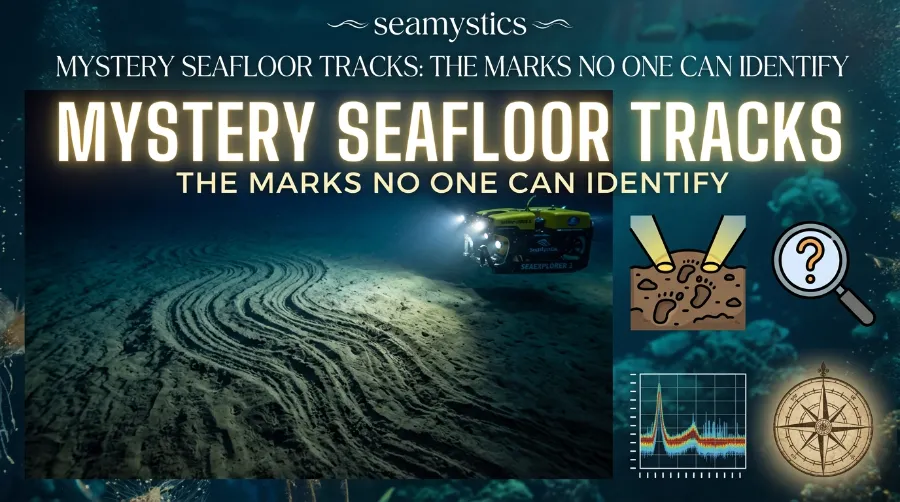

Picture a camera light sweeping across pale mud, 4,000 meters down. First, a long, straight groove appears. Then comes a spiral, followed by a honeycomb pattern that looks like a tiny city plan. Because nobody on the ship can say what made it, the room goes quiet. Scientists see mystery seafloor tracks like these on almost every deep dive, and some still have no clear answer.
TL;DR: Most marks on the deep seabed come from animals like sea cucumbers, sea stars, and worms. However, some come from human gear, such as mining test plows, trawl nets, and anchors, and these can last for decades. A few, like the honeycomb pattern called Paleodictyon, still have no agreed maker.
| Key Takeaway | What to Remember |
|---|---|
| Most tracks have a living maker | Sea cucumbers, urchins, sea stars, and worms leave trails, burrows, and spirals |
| Human tracks last a very long time | Plow tracks from a 1989 test were still clear 26 years later |
| Deep mud heals slowly | Sediment builds up so slowly that scars stay visible |
| Some marks have no answer | The honeycomb pattern Paleodictyon is still debated |
| Good clues solve most cases | Width, depth, shape, edges, and location tell the story |
| Mapping is still low | Only about 5% of the seabed was mapped in high detail in one 2023 review |
Why Mystery Seafloor Tracks Matter More Than You Think
At first glance, the ocean floor looks empty in most photos. In truth, it holds a record of everything that moved across it. A track in deep mud works like a footprint in fresh snow, except that the snow never melts.
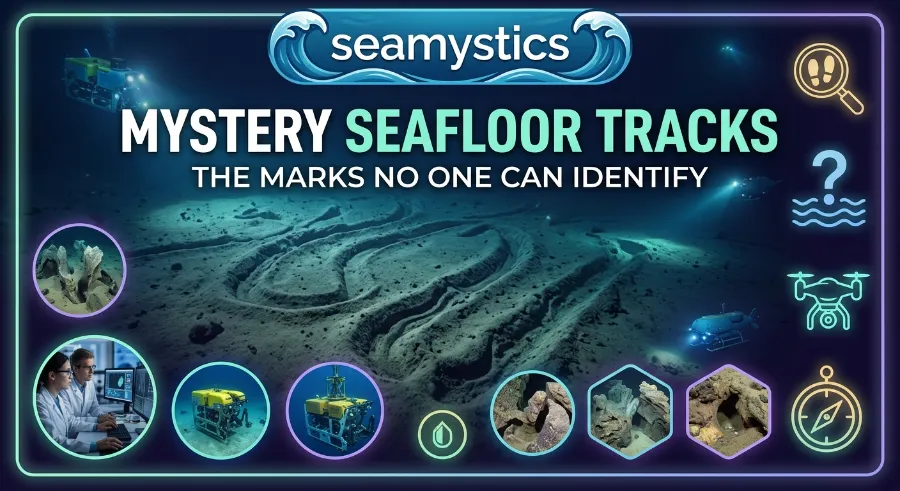
There are two main reasons this matters. First, tracks show us which animals live in places we rarely visit. Second, they show how much damage people leave behind. According to a research review on the mysteries of Earth’s ocean floor, sunlight reaches only about 200 meters into the sea. Meanwhile, about 72.6% of the seafloor lies between 3,000 and 5,750 meters deep, so cameras and sonar must do all the work.
Unidentified Whale Sounds That Don’t Match Any Known Species
For that reason, every unusual mark gets attention. One odd groove can mean a new behavior, a new species, or a new type of human impact. Our pillar guide on unidentified underwater footage shows how often a single frame starts a long debate.
Strange Tracks Deep Sea Cameras Keep Catching
Scientists use the word lebensspuren, German for “life traces,” to describe marks made by living animals. It covers trails, burrows, mounds, pits, and spirals. Although these marks are the most common, they are also the easiest to explain once you know what to look for.
Trails from sea cucumbers, urchins, and sea stars
A sea cucumber crawls slowly and eats mud as it goes. As a result, it leaves a shallow, wavy trail with small droppings beside it. Sea sea urchins, on the other hand, leave wider, shallower tracks with tiny dimples from their spines and tube feet.
Sea stars make a different mark. When they rest, their arms press the mud into a star shape. While they move, they smear a flat path behind them. In my own review work, a clean star print next to a drag mark is one of the fastest ways to close a case.
Spirals, rosettes, and honeycombs
Spirals draw the most attention. Some deep-sea worms graze in tight circles, so they leave a neat swirl in the mud. Likewise, rosettes can come from animals that feed in a star pattern around a central burrow.
Then there is Paleodictyon, the honeycomb pattern. Scientists have photographed it on deep seabeds around the world, and fossil versions are millions of years old. Even so, no one has seen the maker alive, which keeps the debate going. In my view, it reminds us that “mystery” in marine science often means “not yet solved.”
Unexplained Tracks Ocean Floor: The Man-Made Scars
Some tracks look like claw marks or deep troughs, yet no animal could make them. Richard Fisher wrote about this for the BBC in a feature on deep-sea mining tracks on the ocean floor. A summary on DSM Observer describes narrow troughs in pale Pacific silt, far from land. They look old because they are old, and the deep sea has nothing to wash them away.
The 1989 DISCOL test
The best-studied case is the DISCOL experiment in the Peru Basin. In 1989, German scientists dragged a plow-harrow over about 11 square kilometers of seabed, 4,150 meters down. Their goal was to copy what nodule mining might do. As Eos reports, the device cut and mixed the top 10 to 15 centimeters of sediment.
Later, a study in Biogeosciences mapped all 78 plough tracks from DISCOL using 2015 data. It also found that much of the blanketing came from settled plume sediment, not from normal slow deposition. In addition, a summary on Oceanbites explains that microbe numbers fell by about 50% in fresh tracks. Even after 26 years, they stayed about 30% below untouched mud.
[Place the DISCOL bar chart here: drop inside plow tracks versus untouched seafloor. Microbes in fresh tracks 50%, microbes at 26 years 30%, animal carbon stock at 26 years 46%, filter feeder respiration at 26 years 79.5%.]
This chart shows why the tracks matter. After 26 years, the animal carbon stock inside the plowed lines reached only 54% of the outside level. Likewise, filter and suspension feeders breathed 79.5% less there. Clearly, recovery takes far longer than a human lifetime.
| Measure | Result | Time After Plowing |
|---|---|---|
| Microbe numbers | About 50% lower | Fresh tracks |
| Microbe numbers | About 30% lower | 26 years |
| Animal carbon stock | 54% of outside level | 26 years |
| Filter feeder respiration | 79.5% lower | 26 years |
| Estimated microbe recovery | At least 50 years | Researcher estimate |
Seafloor Marks Mystery: Trawls, Anchors, and Ghost Gear
Not every human mark comes from mining. For example, bottom trawl doors leave long parallel furrows. Anchors, in contrast, leave deep pits with a drag line behind them. Cables and pipelines add straight, smooth grooves that even a beginner can spot on sonar.
Lost fishing gear adds another layer. Once ghost nets drift free, they snag on rocks and reefs. Then, as the water pushes them, they scrape and tangle across the bottom. I have seen net marks that looked like animal trails until the footage showed a loose line leading away from them.
So the lesson is simple: always check for a straight edge, regular spacing, or a loose object nearby. After all, animals rarely make perfectly straight lines for hundreds of meters. To see how odd lights and shapes get sorted out in the same footage, read our post on mystery lights seen by ROVs.
Unidentified Seabed Marks: How Scientists Work Out the Maker
Experts do not guess from a single photo. Instead, they follow a short routine that you can use on any deep-sea image.
- Measure the width and depth. A 2 centimeter trail points to a small worm or snail, but a 2 meter furrow points to gear.
- Check the edges. Sharp, clean walls mean a recent mark, while soft, rounded walls mean time has passed.
- Look for a maker nearby. Many trails end at the animal that made them.
- Study the pattern. Random wiggles often point to feeding. Straight, repeated lines, however, often point to machines.
- Weigh the location. Fishing grounds, cable routes, and mining test sites narrow the list fast.
- Compare with known catalogs. Researchers match new images to published examples before they call anything unknown.
The table below is a quick filter I use at the start of a review.
| Clue | Likely Animal | Likely Human Source |
|---|---|---|
| Wavy line with droppings | Sea cucumber | Rare |
| Star shaped print | Sea star | None |
| Straight parallel furrows | Very rare | Trawl doors or plows |
| Round pit with drag line | Rare | Anchor |
| Spiral in mud | Burrowing worm | None |
| Honeycomb pattern | Unknown | None known |
Sonar adds one more layer. Because side-scan images show raised edges and shadows, they help you judge depth without a camera. Our guide on unidentified shapes on sonar explains how those shapes can fool even trained eyes.
What Years of Footage Review Taught Me
After two decades of looking at deep-sea images, I rely on one habit more than any other. On the first pass, I never call a mark “unknown.” Instead, I label it “unresolved” and add notes on size, edge shape, and nearby objects.
That small step changes the outcome. Many marks I once filed as strange turned out to be bite marks, egg case drags, or simple resting spots. Eggs and cases, for instance, can create tracks that look like nothing else on the page. Our article on mystery egg cases shows this well.
Here are the lessons that hold up in real work:
- Look at the whole frame, since the answer often sits in a corner.
- Ask what the mud can hold, because soft sediment keeps prints while hard rock keeps almost none.
- Slow down on dramatic objects, as they can pull attention away from the track. Our write-up on the giant eyeball mystery is a good example.
- Share unclear images with other experts early, because two views beat one.
- Record the date, depth, and position every time, or a good image becomes nearly useless later.
A note on live creatures and tracks
Live video adds special value. When a camera follows an animal across the bottom, you can match the animal to its track in real time. Therefore, a single clip can settle a debate in minutes. Our post about a live creature seen by the Nautilus ROV shows how this works.
Why Deep-Sea Tracks Last So Long
Deep mud grows very slowly. Oceanbites notes that food particles on the abyssal seabed gather over tens of thousands of years. Since so little new material arrives, a groove has almost no chance to fill in.
Besides that, the deep sea has no waves, no wind, and very little current. Shallow beaches reset with every tide, but deep tracks can sit untouched for decades.
This also explains why researchers worry about mining. Recovery depends on the slow return of food and living space. Moreover, some animals cling to hard nodules that take millions of years to form. If the nodules go, the home is gone for a very long time.
Ghost Nets and the Tracks Nobody Plans
Ghost nets deserve a closer look because they link tracks to animal harm. A lost net can drift for months and trap fish, turtles, and sharks. After it sinks, it keeps dragging across the bottom with each change in the current.
Scientists often find these nets by their marks first. A tangled line, a straight scrape, and a pile of dead animals tell a clear story. Cleanup teams then use ROVs and divers to cut them out.
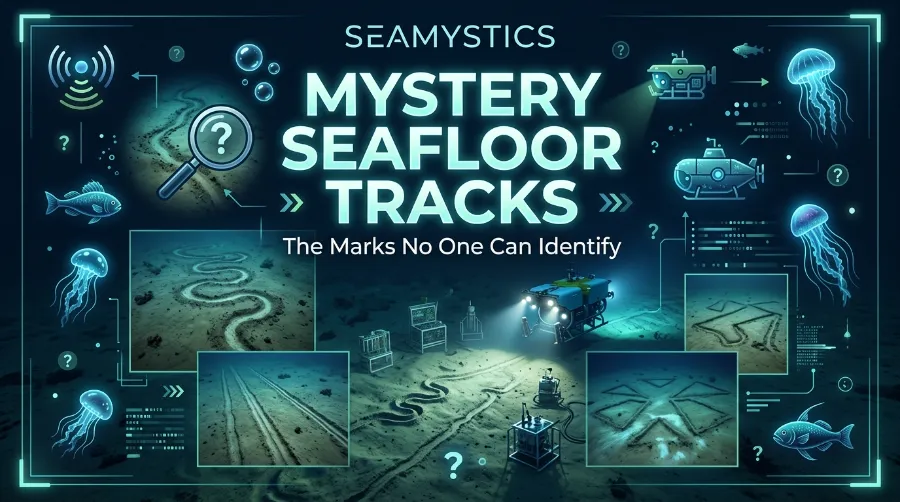
You can help at home too. For instance, you can support groups that recover lost gear and choose seafood from well-managed fisheries. If you dive, report any net you see. Because every net removed also removes future tracks, small steps add up.
Latest Facts at a Glance
| Fact | Number | Source Type |
|---|---|---|
| Deepest ocean point (Challenger Deep) | About 10,920 meters | Research review |
| Seabed share mapped in high detail (2023 review) | About 5% | Research review |
| Share of seafloor at 3,000 to 5,750 meters | 72.6% | Research review |
| DISCOL plow area | About 11 square kilometers | Eos report |
| Plow tracks mapped | 78 | Biogeosciences |
| Years until DISCOL revisit | 26 | Multiple studies |
| Depth of DISCOL site | 4,150 meters | Oceanbites |
Mapping numbers change often as new surveys come in. Therefore, check the latest figures from mapping groups before you quote them in a new piece.
Frequently Asked Questions
What are the strange tracks on the deep seafloor?
Most come from animals such as sea cucumbers, sea stars, urchins, and worms. Others come from human gear like mining test plows, trawl doors, and anchors. A small number, such as the honeycomb pattern Paleodictyon, still have no agreed maker.
Can seafloor tracks last for decades?
Yes, they can. In the DISCOL test, plow tracks from 1989 were still clear 26 years later. Because sediment builds up so slowly in the deep sea, grooves rarely fill in.
How do scientists tell animal tracks from human tracks?
They check width, depth, edge shape, pattern, and location. Straight, repeated lines often point to gear, whereas wavy or spiral shapes often point to animals.
Does deep-sea mining leave permanent marks?
The marks last for decades at least, and some effects may last much longer. Researchers estimate that microbial activity in plowed tracks needs at least 50 years to recover.
Can ordinary people help solve these cases?
Yes. Many research programs share ROV footage online and ask for public help. Clear notes on date, depth, and location make your input far more useful.
Quick Quiz: Test Your Seafloor Knowledge
1. Which animal group often leaves a wavy trail with droppings beside it?
a) Sea cucumbers
b) Sharks
c) Sea turtles
2. How long after the DISCOL test were plow tracks still clear?
a) 5 years
b) 26 years
c) 100 years
3. Which clue most often points to human gear?
a) A small spiral
b) A star shaped print
c) Long, straight, parallel furrows
4. True or false: The maker of the honeycomb pattern Paleodictyon is fully known.
5. True or false: Deep-sea mud fills in tracks quickly.
Answers: 1) a. 2) b. 3) c. 4) False. 5) False.
Conclusion
Mystery seafloor tracks look strange at first, yet most of them follow simple rules. Animals leave wavy trails, spirals, and prints. People, on the other hand, leave straight, deep, long-lasting scars. A few marks, like the honeycomb pattern, still keep their secret, which is a good reason to keep exploring.
Above all, the big message is about time. Tracks in the deep sea last because the water is quiet and the mud grows slowly. For this reason, careful study, good notes, and wise use of the deep ocean matter more than ever.
References
- Research Outreach. “Mysteries of Earth’s ocean floor.” February 2023.
- Fisher, Richard. “The unseen man-made tracks on the deep ocean floor.” BBC Future, December 2020.
- DSM Observer. “The unseen man-made tracks on the deep ocean floor.” December 2020.
- Gausepohl et al. “Scars in the abyss: reconstructing the 78 plough tracks of the 1989 DISCOL experiment.” Biogeosciences, 2020.
- Eos. “The long-lasting legacy of deep-sea mining.”
- Oceanbites. “Are we ready to mine the seafloor?” Summary of Vonnahme et al., Science Advances, 2020.
- University of Aveiro repository. “Abyssal plain faunal carbon flows remain depressed 26 years after a simulated deep-sea mining disturbance.”