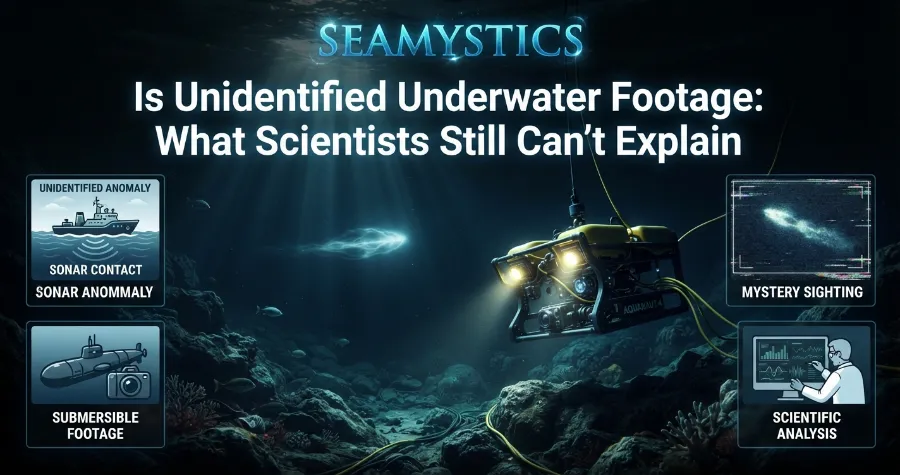

A grainy clip pops up online every few months. A pale shape drifts through the lights of a robot submersible, and the comments fill with theories about aliens, sea monsters, and secret military tech. Most of that talk fades within days. Yet some unidentified underwater footage stays unsolved for years, and the reasons are more interesting than the myths. This guide covers what the best-known clips turned out to be, what still has no answer, and how you can judge a new video on your own.
TL;DR: Most unidentified underwater footage turns out to be an animal, lost fishing gear, or a natural feature seen under strange light. A few clips stay open because nobody collected a specimen or sensor data. Only 28.7% of the seafloor has been mapped so far, so surprises in the deep are normal, not paranormal. Seabed 2030
| Key takeaway | What it means for you |
|---|---|
| Most “mystery” clips have a boring answer | Check for animals, nets, and debris first |
| Scale is the biggest trap | Without a size reference, a 10 cm jelly looks like a 10 m monster |
| A video alone rarely names a species | Scientists need a specimen, DNA, or a clear anatomy shot |
| Mapping is still incomplete | About 71% of the seafloor lacks modern, high-resolution maps |
| Ghost nets cause many odd sightings | Lost gear drifts, tangles, and looks alive on camera |
| User-submitted sighting databases count reports | Reports are not the same as verified objects |
Why Deep-Sea Clips Fool Even Trained Eyes
The deep ocean breaks the rules your eyes expect. Sunlight fades out around 1,000 meters, so every frame you see comes from the robot’s own lamps. That light creates harsh shadows, bright glare, and a blue or green cast that hides real colors.
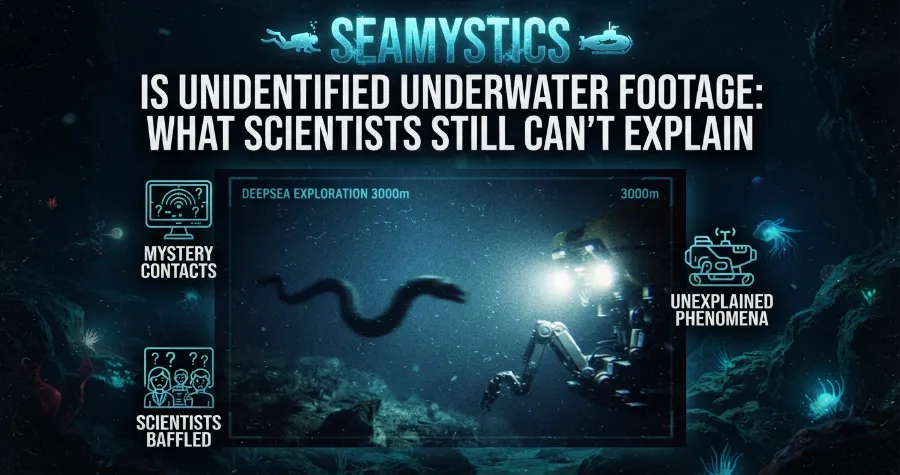
Because of this, the same animal can look gray, red, or white depending on the angle. A researcher who watches the clip live often gets a better read than someone who sees a compressed version later.
The Faceless Fish Rediscovery: Australia’s Strange Deep-Sea Find
Light, color, and scale
Most deep-sea animals make their own light. In one well-known 2017 survey, researchers found that about three quarters of the open-water animals they observed could produce bioluminescence. So a sudden flash on camera is often normal behavior, not a signal from something strange.
Scale causes even more trouble. A camera close to a small jelly can make it look huge. ROV teams fight this with two laser dots set a fixed distance apart, usually 10 cm. If a clip has no laser dots and no ruler, treat every size claim with suspicion.
Rare Abyssal Footage: Deep-Sea Creatures Caught on Camera Only Once
Marine snow and backscatter
Marine snow is a constant drizzle of dead plankton and waste that falls from above. It floats through lamp beams and looks like a storm of tiny stars. When a robot turns or stops, particles swirl, and the swirl can look like a moving body.
Backscatter adds more noise. Light bounces off particles back into the lens, so shapes appear to hover where nothing exists. Therefore, a shape that only shows up in one frame deserves caution.
Mystery Ocean Footage That Turned Out to Have an Answer
Some of the most famous cases ended with solid science. Looking at them helps you set a fair baseline for new ones.
| Case | Year | What people guessed | What science says |
|---|---|---|---|
| The Bloop sound | 1997 | A giant creature | NOAA linked it to icequakes from cracking icebergs |
| Yellow Brick Road, Hawaii | 2022 | A lost city | Researchers pointed to fractured volcanic rock |
| “Casper” ghost octopod | 2016 | A new ghost creature | Likely an undescribed species, still unconfirmed |
The Bloop was audio, not video, but it shows how a sound can fuel the same panic as a clip. Scientists matched its pattern to ice breaking apart, and the monster story lost steam.
The Yellow Brick Road looked like paved stone on the seafloor. Geologists explained that volcanic rock can crack into straight, tile-like blocks, so no builders were needed.
ROV Mystery Lights: Case Studies of Strange Glows Caught on Deep-Sea Cameras
These cases share a pattern. First, a visual puzzle appears. Next, experts check scale, geology, and biology. Finally, a plain explanation fits better than a wild one. That pattern covers most mystery ocean footage you will ever see.
Unexplained Deep Sea Video That Still Has No Final Answer
Not every case closes neatly. The best example is “Casper.” During a 2016 expedition near Necker Island in Hawaii, NOAA’s ROV Deep Discoverer filmed a pale octopod at more than 4,000 meters. The animal drew attention because scientists considered it almost certainly an undescribed species that might not fit any known genus. NOAA Ocean ExplorationNOAA Ocean Exploration
Here is why the story stayed open. The animal sat at 4,290 meters, which set a depth record for this kind of octopod. Yet the team had only video. A NOAA scientist told the Smithsonian that the footage was everything known about that species. Without a physical specimen, nobody can formally name it. ABC News
Mystery Egg Cases on the Ocean Floor: What Lays Them?
That detail matters for anyone who watches unexplained deep sea video. A clip can prove an animal exists. It rarely proves what the animal is. Taxonomists need tissue, DNA, and anatomy details that a camera cannot capture.
NOAA’s Michael Vecchione put the bigger picture bluntly, saying new deep-sea species are “a dime a dozen.” So when a new species appears, it is exciting, but it does not break science. It simply fills a gap that was always there.
Why the Ocean Still Hides So Much: The Mapping Gap
You cannot study what you cannot find. NOAA’s data center says nearly 80 percent of the ocean remains unexplored and unmapped. Mapping figures have improved fast, but they still leave huge blind spots. NOAA
In 2017, only about 6% of the seafloor had been mapped to modern standards. By June 2025, the Seabed 2030 project reported 27.3%. Then in April 2026 it announced 28.7%, with almost five million square kilometers added in one year. New Seafloor Map Only 25% Done, with 6 Years to Go – Eos +2
For a deeper look at those numbers, read our breakdown of how much of the ocean floor is mapped in 2026.The chart shows real progress, but the bars also show how much blank space remains. Each newly mapped patch reveals ridges, vents, and canyons that no one had seen before. Every one of those places can hold animals that nobody has filmed.
Sonar Unidentified Shapes: Real Cases From the Ocean Floor Explained
Strange ROV Footage Ocean Explorers Capture Every Year
Remotely operated vehicles do most of the heavy lifting in deep exploration. A ship at the surface sends a tethered robot down, and a crew in a control room watches the live feed. The pilots steer, the biologists call out what they see, and the team marks interesting frames in real time.
This setup explains why strange ROV footage ocean fans love often comes with expert commentary. Live narration records the first reactions, the doubts, and the guesses, so you can see science happening. For a closer look at the robots behind these dives, see our guide to ROV ocean discovery, and for the human side of deep diving, read our Sylvia Earle profile.
Three habits separate a good ROV team from a lucky one:
- They record scale lasers on every important shot.
- They log depth, temperature, and position with each clip.
- They try to collect a specimen when the vehicle and permits allow it.
Those habits matter because a clip without data becomes folklore within a week. A clip with data becomes a paper.
Deep Sea Camera Mystery: What the “Unidentified Objects” Debate Gets Wrong
Sometimes the mystery sits above the waterline. In October 2025, outlets such as the New York Post reported that a UFO-reporting app called Enigma had logged thousands of sightings of unidentified submersible objects near U.S. coasts. You can read the original coverage in the New York Post report.
Here is what the reporting says. Enigma launched in 2022 and has collected more than 30,000 reports of unidentified objects. Of those, roughly 9,000 sit within 10 miles of U.S. shorelines or major waterways. California leads with 389 reports, and Florida follows with 306.
Those numbers are real, but they measure reports, not proof. Think about how the data forms. People report what they see, and more people live and boat near the California and Florida coasts. So the map mostly shows where people look at the water. It does not show where strange objects gather.
The term itself also causes confusion. The U.S. Navy has long used “USO” for whales, sharks, and other sea life that can disturb sonar and ship handling, according to a Naval History Magazine article. Online communities use the same letters for craft that might move through water. When two groups share an acronym, headlines blur their meanings.
If you want the UFO-focused view, the Hangar 1 roundup of oceanic UFO sightings collects popular cases in one place. For a more grounded counterweight, H I Sutton’s Covert Shores tracks real naval hardware, including uncrewed submarines, surface drones, and narco subs. His recent posts show how many human-made vessels now roam the seas, and that fact alone explains many “unknown” sonar contacts.
In our view, the honest position sits in the middle. Some reports stay unexplained because the data is thin. That does not make them alien. It makes them incomplete.
The Giant Eyeball Mystery: What Really Washed Up on a Florida Beach
Ghost Nets: The Silent Killers Drifting Through the Deep Ocean
Ghost nets deserve their own section because they create real harm and also fuel many odd video clips. A ghost net is any abandoned, lost, or discarded fishing gear that keeps drifting and catching animals. Traps, lines, and hooks count too, and experts group them under the term ghost gear.
How big is the problem?
A 2022 study in Science Advances gave the first solid global estimate. Researchers found that fishing fleets lose about 2% of their gear each year. That sounds small until you scale it up. The same research estimated more than 25 million pots and traps and nearly 14 billion longline hooks lost annually.
You may have seen a bigger number: 640,000 tonnes of gear per year. The study’s authors note that this figure is imprecise and unsubstantiated, so treat it as a rough guide, not a fact. We prefer the survey-based numbers because the team interviewed 450 fishers across seven major fishing countries, including the United States, Peru, Indonesia, and Morocco.
The Nautilus Live Creature That Looked Alien: What It Really Was
Why ghost gear keeps killing
Lost gear does not know it is lost. A net keeps catching fish, and dead fish attract scavengers, which then tangle too. This cycle can repeat for years.
Here is a local example. The Virginia Institute of Marine Science estimated that ghost crab pots catch 1.25 million blue crabs each year in the Chesapeake Bay alone. That is a single bay in a single country.
Turtles, seabirds, sharks, and whales also suffer. WWF has estimated that ghost gear makes up about 46 percent of the Great Pacific Garbage Patch by mass, which shows how much of ocean plastic comes from fishing.
Why ghost nets show up in “mystery” footage
Here is where the two topics meet. A drifting net with floats, ropes, and trapped animals can look like a living thing on camera. Pale mesh glows in ROV lights. A tangled mass moves with the current and seems to breathe. Without a size reference, an observer can easily mistake it for a jellyfish bloom or a strange body.
This is our own interpretation, not a published statistic, but it matches how ROV scientists reason. When a clip shows a regular grid pattern, a straight rope, or a float, the first thing to rule out is gear.
A real cleanup story
In 2009, Dutch technical diver Pascal van Erp began recovering abandoned fishing gear that had snagged on North Sea wrecks. Teams of volunteer divers later hauled tons of net off the Dutch coast. The effort grew into what is now called the Ghost Diving Foundation, according to the Ghost net record on Wikipedia.
That story shows a simple truth. People can fix this problem, and the fix often starts with divers who care enough to cut nets loose.
Unidentified Whale Sounds That Don’t Match Any Known Species
What actually helps
Research points to a few practical steps:
- Mark gear so owners can be identified and tracked.
- Offer buyback programs for old nets and lower-cost loans for replacements.
- Place waste bins at ports so fishers can return worn gear.
- Support regular gear repair and maintenance.
These ideas come from the researchers behind the 2022 study, and they work best together. If you want to see the research firsthand, read the Science Advances paper or the plain-language summary from CSIRO.
How to Check Unidentified Underwater Footage Yourself
You do not need a lab to make a smart first call. Use this five-step check the next time a clip goes viral.
- Find the source. Look for the original ship, expedition, or institution. A clip with no source has no evidence trail.
- Look for scale. Search the frame for laser dots, a robot arm, or a known object. If nothing gives size, do not trust size claims.
- Rule out particles and glare. Check whether the shape appears in only a few frames. Marine snow and backscatter often cause one-frame wonders.
- Test for gear and debris. Look for straight lines, mesh, floats, or regular patterns. Nature rarely makes perfect grids.
- Ask what the team collected. A sample, a DNA record, or a sonar log turns a guess into data. If no one gathered anything, the case stays open.
If a clip survives all five steps, then it earns real curiosity. Otherwise, it is probably one of the many mundane cases that look wild for a moment.
We would add one thing that guides how we judge these stories. Excitement is fine, but a good explanation should beat a good story. When both fit the facts, pick the one that needs fewer new rules of physics.
What Needs to Change in Deep-Sea Exploration
Three changes would shrink the mystery fast.
First, teams should publish raw video with metadata, not just edited highlights. Open files let outside experts spot nets, animals, and artifacts that a short clip hides.
Second, expeditions need more sampling budget. A species described from a specimen outlasts any viral video. Casper shows why: years later, the animal still lacks a formal name because nobody collected it.
Mystery Seafloor Tracks: The Marks No One Can Identify
Third, mapping needs to keep its pace. Each year of new data from groups like Seabed 2030 turns blank areas into places with names, depths, and habitats. That shift moves the question from “what is down there?” to “what lives there?”
Frequently Asked Questions
What is unidentified underwater footage?
It is any video of an object, animal, or event in the sea that experts cannot name right away. Most cases get an answer after checking scale, species lists, and gear records.
Why do scientists struggle to explain some deep sea videos?
Video rarely shows enough detail for a formal species description. Scientists usually need a specimen, DNA, or measurements, and many ROV dives record only images.
Are unexplained deep sea clips proof of aliens or sea monsters?
No. Past cases such as the Bloop and the Yellow Brick Road ended with natural explanations. Unresolved cases mean missing data, not hidden civilizations.
What is a ghost net and why does it matter?
A ghost net is lost or abandoned fishing gear that keeps catching marine life. Researchers estimate that about 2% of fishing gear ends up lost each year.
How much of the ocean floor is mapped?
As of April 2026, 28.7% of the seafloor has been mapped to modern standards, up from about 6% in 2017.
Conclusion
Unidentified underwater footage fascinates us because the ocean is vast and mostly unseen. Yet the best cases teach us something practical. Light tricks the eye, scale fools the brain, and lost fishing gear can masquerade as a creature. Meanwhile, real discoveries like Casper remind us that new animals still wait in the dark. If you stay curious, check the source, and demand data, you will enjoy the deep sea more and fall for hoaxes less.
About the author: [Author name] is a marine biologist with [years] years of experience in deep-sea research and ocean science communication. [Add credentials and affiliations here.]
References
- NOAA Ocean Exploration, “Casper” Octopus
- Nippon Foundation-GEBCO Seabed 2030, Global seabed mapping reaches new milestone, April 2026
- NOAA National Centers for Environmental Information, Seabed 2030: Map the Gaps
- Richardson et al., Science Advances (2022), Global estimates of fishing gear lost to the ocean each year
- CSIRO, Abandoned fishing gear estimates
- U.S. Naval Institute, USOs Not UFOs Have Been the Greatest Threat to the Navy
- NewsNation, Enigma UFO tracker records thousands of USOs along US coasts
Quick Quiz: Test What You Learned
- (Multiple choice) What percentage of the seafloor had been mapped to modern standards by April 2026?
a) 12.4% b) 28.7% c) 55% d) 90% - (Multiple choice) Which detail helps viewers judge size in ROV footage?
a) Background music b) Laser dots set a fixed distance apart c) Video length d) Screen brightness - (Multiple choice) About what share of fishing gear do fleets lose each year, according to the 2022 Science Advances study?
a) 0.1% b) 2% c) 25% d) 50% - (True or false) A video alone is usually enough to formally name a new species.
- (True or false) Sighting databases such as Enigma count user reports, not verified objects.
Answers: 1) b. 2) b. 3) b. 4) False, scientists usually need a specimen or DNA. 5) True.