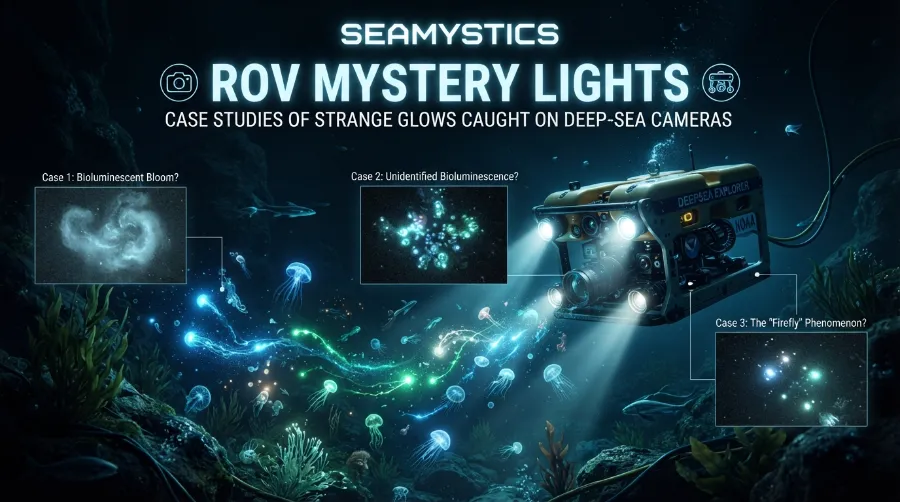

Picture a robot sinking through black water at 1,500 meters. Then a blue ring of light flickers on the screen, and the whole control room goes quiet. ROV mystery lights like this show up in research footage every year, and they spark wild guesses online. Most of them have a real, and often more amazing, explanation.
TL;DR: Most ROV mystery lights come from living animals that make their own light, called bioluminescence. A smaller share comes from the camera system, the vehicle’s own lamps, or glowing vents on the seafloor. This guide walks through real case studies and gives you a simple checklist to tell them apart.
Key Takeaways
| Question | Short answer |
|---|---|
| What causes most ROV mystery lights? | Bioluminescent animals such as jellyfish, squid, and fish |
| How common is deep-sea light? | About 76% of animals seen in one Monterey Bay study glowed |
| Can equipment fake a light? | Yes. Lens flare, backscatter, and marine snow often fool viewers |
| Do vents make light? | Yes. Hot vents give off a faint glow that special cameras can detect |
| Who should review strange footage? | A biologist and an ROV pilot, together |
What Are ROV Mystery Lights and Why Do They Confuse Us?
ROV mystery lights are flashes, glows, or moving points of light that appear in footage from remotely operated vehicles. Viewers often call them “unexplained” because the light has no clear source at first glance. Scientists call them data points, because every glow tells us something about life or physics at depth.
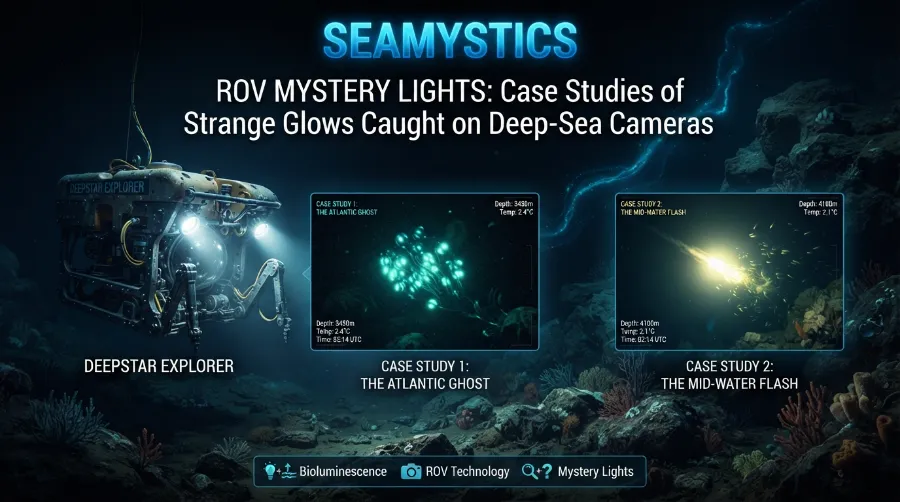
I have watched hundreds of hours of raw dive video. The first reaction in the room is nearly always the same. People lean in and ask, “What is that?” Then we slow down and work through the possibilities.
Why the Deep Sea Is Never Truly Dark
Sunlight fades fast in the ocean. Below about 200 meters, very little of it remains, and below roughly 1,000 meters, none reaches you at all. Yet the deep is not empty of light, because living things make their own.
This is the heart of deep sea lights explained in simple terms. Animals use light to hunt, hide, and find mates. In a world with no sun, light becomes a language.
Rare Abyssal Footage: Deep-Sea Creatures Caught on Camera Only Once
Deep Sea Lights Explained in Plain Words
Bioluminescence is light made by a chemical reaction inside an animal’s body. A molecule called luciferin reacts with oxygen, and an enzyme speeds up the process. The result is a cool light, usually blue or green, because blue travels farthest in seawater.
Some animals make the light themselves. Others host glowing bacteria in special pockets. Either way, the effect on camera looks the same: a pulse, a flash, or a slow shimmer.
The Faceless Fish Rediscovery: Australia’s Strange Deep-Sea Find
How ROV Cameras and Lights Shape What You See
An ROV does not simply record the ocean. It changes the scene. The vehicle brings bright lamps, spinning thrusters, and a camera with its own quirks. If you want to read ROV footage with confidence, you have to understand the machine first.
The Vehicle’s Own Lights
Most work-class and inspection ROVs carry LED lamps, often several thousand lumens each. Makers such as Blueye Robotics build compact camera and light systems for shallow and mid-depth work. Larger vehicles use high-output ROV lighting from companies like Invocean to light up the dark for science and industry.
These lamps matter for one reason. Light that bounces off particles can look like a glow where nothing glows. Buyers can compare many options in this directory of ROV light suppliers, and the lamp angle alone can change how “haunted” a clip looks.
Camera Artifacts That Look Like Ghosts
Cameras make their own false lights. Here are the most common ones I check first:
- Lens flare: A bright lamp hits the dome port and creates a ring or streak.
- Backscatter: Light bounces off floating specks and creates a hazy fog.
- Sensor noise: Low light makes random bright dots appear.
- Compression glitches: Video files can create small blocks or trails.
- Marine snow: Drifting bits of dead plankton sparkle in the lamp beam.
I treat any glow that appears only when the lamp is on, and in the same screen spot, as a camera issue until I can prove otherwise. That one habit removes more false alarms than any other.
Case Study 1: The Giant Squid and the Fake Jellyfish (2012)
In July 2012, researchers off Japan’s Ogasawara Islands filmed a live giant squid in its natural home for the first time. The team included marine biologist Edith Widder, whose camera system carried a lure called the e-jelly. It copies the blue flash of a jellyfish in distress, a signal that tells big predators a meal is nearby.
The squid came in to investigate. The footage showed it at roughly 630 meters, and it settled a question that had lasted for generations.
The lesson is useful. A mystery light in a video may not be a mystery at all. It may be a trick that animals use on each other, and the ROV is just a quiet witness.
Sonar Unidentified Shapes: Real Cases From the Ocean Floor Explained
This capture used a crewed submersible with a camera system, not an ROV. Still, the same idea now guides many ROV missions. A camera with a dim, red-free light can watch animals that would flee from bright white lamps.
Case Study 2: Vampire Squid and Glowing Mucus
The vampire squid does not squirt ink. When threatened, it releases a cloud of sticky, glowing mucus from the tips of its arms. Researchers using deep ROV footage in the Monterey Bay region have documented this display, and the glow can last for several minutes.
On screen, it looks like a drifting blue galaxy. To a hungry fish, it looks like a puzzle. The squid slips away in the dark while the predator chases sparks.
I like this case because it shows how one animal can produce a “mystery light” that scares and confuses both fish and viewers. The glowing cloud has no body and no shape, so many people assume it is something else.
Case Study 3: Glowing Vents on the Ocean Floor
In 1988, geologist and biologist Cindy Van Dover used a low-light camera on the submersible Alvin to study a hydrothermal vent. The camera picked up a faint glow that human eyes could not see. Hot rock and water at the vent give off light, much like a heated metal rod glows red.
Later work found an even stranger result. In 2005, a team reported a green sulfur bacterium living near a vent at about 2,400 meters on the East Pacific Rise. It appears to use that faint geothermal light to carry out a form of photosynthesis, which means life without sunlight.
These are true mystery lights ocean floor findings. They also remind us that not every glow comes from an animal.
Case Study 4: The Glowing Shark (2021)
In 2021, a team led by Jérôme Mallefet reported that the kitefin shark, which grows to about 180 centimeters, makes its own light. Researchers found it near New Zealand’s Chatham Rise. It became the largest known luminous vertebrate at the time.
The glow likely helps the shark hide. Light on its belly can match the faint light coming down from above, so the shark blends into the water.
Mystery Egg Cases on the Ocean Floor: What Lays Them?
This finding was based on collected animals, not live ROV video. I include it because it shows why we should never assume big animals are “too big” to glow. A slow, steady, belly-down glow on camera could very well be a large fish.
Case Study 5: Bioluminescence Everywhere in Monterey Bay
The best data on this topic comes from the Monterey Bay Aquarium Research Institute. A 2017 study by Séverine Martini and Steven Haddock used years of ROV video from the bay. They found that about 76% of the animals they counted could make light.
That number changes how we see mystery lights. If three out of four animals can glow, then a flash on camera is the normal state of the deep. A truly dark clip is the surprise.
You can learn more about this long-running work at MBARI, which publishes dives, video, and research for anyone to read.
Case Study 6: The ROV That Lit Up the Water by Itself
This one I see often in my own review work. A pilot pushes forward, the thrusters churn the water, and the screen fills with sparkles. Nothing is wrong. Tiny plankton glow when water moves across them, a reflex called mechanical stimulation.
The ROV, in other words, makes its own mystery lights. The trick is to watch whether the sparkles follow the vehicle’s motion. If they do, they probably come from plankton that the thrusters disturbed.
Unidentified Whale Sounds That Don’t Match Any Known Species
Summary Table of the Six Cases
| Case | Year | Depth or place | Light source | Verdict |
|---|---|---|---|---|
| Giant squid and e-jelly | 2012 | About 630 m, Japan | Lure copying jellyfish glow | Biological, lure-triggered |
| Vampire squid mucus | Ongoing records | Monterey Bay, deep water | Glowing mucus | Biological defense |
| Vent glow | 1988 | Mid-ocean ridge vents | Heat and rock | Physical glow |
| Green sulfur bacterium | 2005 | About 2,400 m, East Pacific Rise | Vent light used by bacteria | Physical and biological |
| Kitefin shark | 2021 | Near New Zealand | Belly photophores | Biological camouflage |
| Monterey Bay survey | 2017 | Monterey Bay | Many animals | 76% of animals glow |
ROV Footage Unexplained Lights: A Simple Checklist
When a clip shows something odd, I use the same short routine. It takes about ten minutes, and it keeps me honest. Here are the steps:
- Check the lamps. Note whether the vehicle’s lights were on, off, or dimmed at the moment.
- Look at the screen position. If the glow stays in one spot, it is likely a lens or sensor issue.
- Watch the motion. Animals drift, swim, or pulse. Dust and snow fall in a steady line.
- Check the color. Blue and green point to bioluminescence. White and gold often point to reflection.
- Note the depth and location. Vents, seamounts, and canyons each have known light sources.
- Replay at half speed. Short flashes reveal hidden patterns.
- Ask a second expert. A pilot and a biologist catch different mistakes.
This approach matches how most research teams work. It also gives you a clean, honest story to tell if you share the clip later.
Underwater Light Phenomenon Beyond Animals
Not every light is alive. An underwater light phenomenon can also come from rock, gas, or even sediment. Here are the main non-animal sources:
- Hot vents: Faint thermal glow from black smoker fluids.
- Reflective minerals: Quartz and metal fragments flash under lamp light.
- Gas bubbles: Methane seeps catch the beam and shine like silver.
- Man-made objects: Wrecks, glass floats, and plastic debris reflect strongly.
- Cable and sensor lights: Nearby equipment sometimes blinks on its own cycle.
A good habit is to compare your clip with known seep and vent sites. NOAA Ocean Exploration posts mission logs and video that show how teams label each type of feature.
The Nautilus Live Creature That Looked Alien: What It Really Was
Mystery Lights Ocean Floor: What Scientists Still Do Not Know
Honest science leaves room for doubt. We have explored only a small share of the deep seafloor in high detail. Because of that, some lights will stay unlabeled until a better camera or a second dive gives us more.
Here are the open questions I hear most from colleagues:
- Why do some deep jellyfish flash in complex chains, and who are they talking to?
- Do glowing animals use patterns that other species can read?
- How much deep light comes from microbes we have not yet named?
- Can low-light cameras reveal glows our eyes will never see?
Rare light can also mean a new species. Each year, research teams describe new deep-sea animals, and many of them first appear as an odd flash in a video. If you want a broader view of this wider field of strange footage, our guide to unidentified underwater footage covers how scientists sort fact from fiction.
The Giant Eyeball Mystery: What Really Washed Up on a Florida Beach
What I Have Learned From Reviewing Real Footage
After many years of reviewing dive video, a few lessons stand out. They are not in textbooks, and they come from the screen, not the library.
First, the best clues are small. A pilot’s note, such as “lamp dimmed at 14:02,” can solve a mystery that three biologists could not.
Second, raw video beats edited clips. Compression hides the faint flickers that tell you what you are seeing. I always ask for the original file.
Third, depth changes everything. Between 200 and 1,000 meters, a faint blue shimmer is nearly always animal life. At great depth, near vents, I think about heat and chemistry first. For a deeper look at how I weigh evidence, see our related guide on reading deep-sea footage.
Finally, humility matters. I have changed my mind on a clip after seeing ten more seconds of video. A good scientist says, “Here is what I think, and here is what would prove me wrong.”
Mystery Seafloor Tracks: The Marks No One Can Identify
Latest Research Snapshot
| Topic | What researchers report | Why it matters for ROV viewers |
|---|---|---|
| Share of glowing animals | About 76% in Monterey Bay video | Light is normal, not rare |
| Light color | Mostly blue, some green and red | Color helps sort animals from glare |
| Largest glowing fish | Kitefin shark, around 180 cm | Size does not rule out light |
| Vent light | Faint thermal glow at about 2,400 m sites | Not all light is living |
| Camera tech | Low-light sensors now record single flashes | More “mystery” clips will surface |
How to Share Footage So Scientists and Search Engines Trust It
If you hold a strange clip, share it in a way that others can check. Clear details build trust with scientists, editors, and readers alike. Here is what I suggest:
- State the date, depth, and place.
- Name the vehicle, the camera, and the lamp settings.
- Post the raw file, not only a trimmed version.
- Describe what you see before you guess what it is.
- Cite one or two sources that support your idea.
A short, direct answer near the top of your post helps readers and search tools find the point fast. Simple claims backed by real numbers tend to get quoted more than long, vague ones.
Frequently Asked Questions
What are ROV mystery lights?
They are glows or flashes in ROV video that are hard to explain at first. Most come from bioluminescent animals, and some come from equipment or vents.
Are ROV mystery lights ever alien or paranormal?
No evidence supports that. Every case reviewed by scientists so far has had a natural or technical cause.
Why does the deep sea glow?
Animals make light to hunt, escape, hide, and find mates. In the dark, light is a tool for survival.
How can I tell lens flare from a real glow?
Real lights move with the animal or the water. Flare stays fixed on the screen and often appears only when a lamp is on.
Can ROV lights harm deep-sea animals?
Bright lamps can startle or blind some species. Many teams now use dimmer, red or filtered light to reduce this.
What depth do most glowing animals live at?
They appear throughout the water column, but they are most common below about 200 meters, where sunlight fades.
Where can I see real ROV footage?
Public groups such as MBARI and NOAA post dive video and mission logs online.
Conclusion
ROV mystery lights feel strange because most of us have never seen a world that makes its own light. Once you learn the tools, the camera quirks, and the animals, the glow starts to make sense. Most clips end up as a jellyfish, a squid, a shark, or a trick of the lens.
Even so, a few stay open, and that is the best part of deep science. Keep asking questions, check your sources, and let each strange flash teach you something new. When you find a clip you cannot explain, share it carefully and let others help you solve it.
Quick Quiz: Test What You Learned
1. About how much of the animals counted in the Monterey Bay study could make light?
A) 16%
B) 46%
C) 76%
2. What is backscatter?
A) Light bouncing off floating particles
B) A glowing jellyfish
C) A type of ROV motor
3. Which of these is NOT a common camera artifact?
A) Lens flare
B) Sensor noise
C) A new animal species
4. What did the e-jelly lure copy?
A) A shark’s belly glow
B) A jellyfish’s distress flash
C) A vent’s heat
5. What is the first thing to check when you see an odd glow in ROV video?
A) Whether the vehicle’s lamps were on
B) The weather above the ship
C) The color of the ROV
Answers: 1) C, 2) A, 3) C, 4) B, 5) A
References
- Martini, S., and Haddock, S. H. D. (2017). Quantification of bioluminescence from the surface to the deep sea demonstrates its predominance as an ecological trait. Scientific Reports.
- Mallefet, J., et al. (2021). First observations of bioluminescence in the kitefin shark, the largest known luminous vertebrate. Frontiers in Marine Science.
- Beatty, J. T., et al. (2005). An obligately photosynthetic bacterial anaerobe from a deep-sea hydrothermal vent. Proceedings of the National Academy of Sciences.
- Van Dover, C. L., et al. (1988). Light at deep-sea hydrothermal vents. Earth and Planetary Science Letters.
- Widder, E. A. (2010). Bioluminescence in the ocean: Origins of biological, chemical, and ecological diversity. Science.
- Robison, B. H., et al. (2003). Vampyroteuthis infernalis, the vampire squid from hell. Marine Biology.
- MBARI (Monterey Bay Aquarium Research Institute). Deep-sea research and video archives.
- NOAA Ocean Exploration. Mission logs and expedition video.