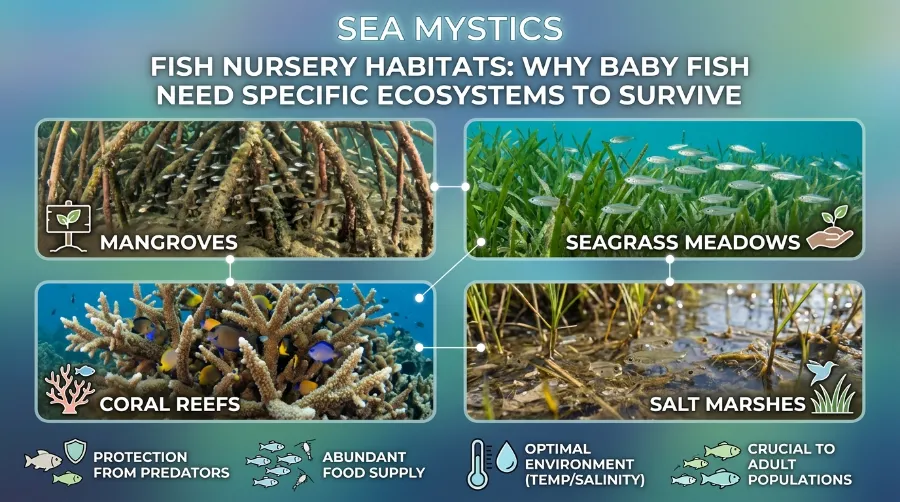

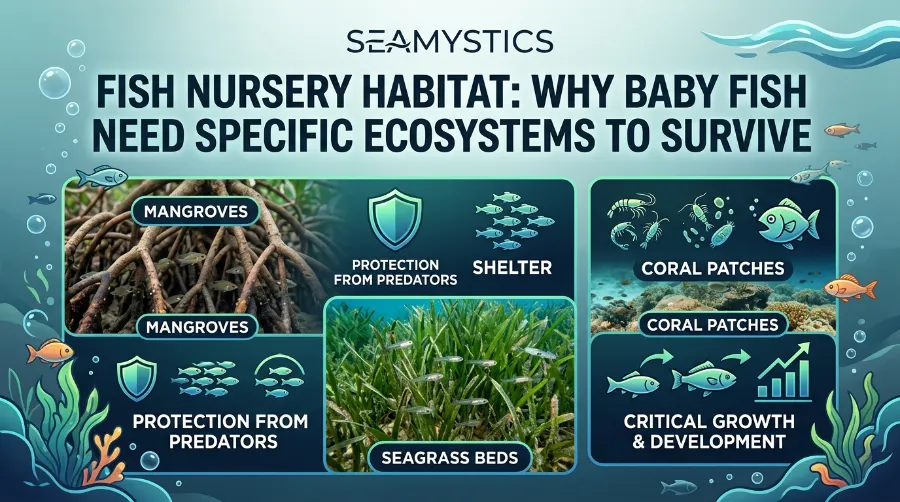
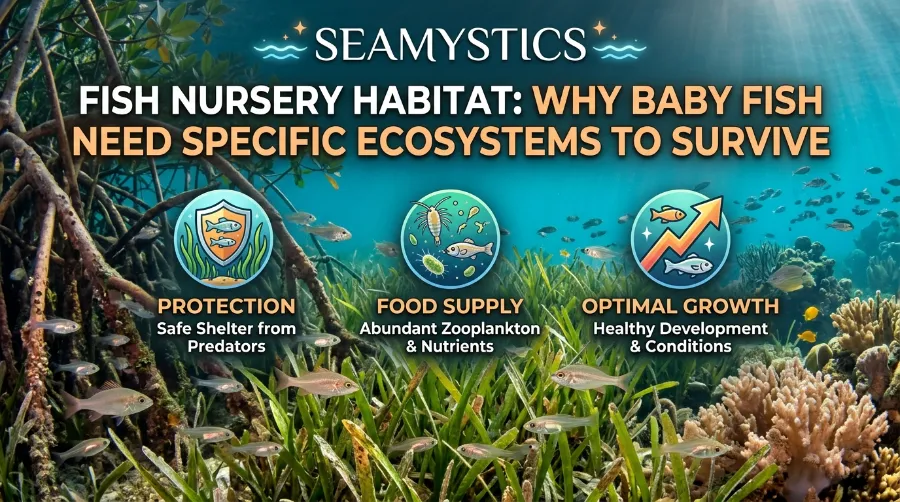
Fish Nursery Habitat: Why Baby Fish Need Specific Ecosystems to Survive
Imagine dropping a newborn in the middle of a busy highway. That is close to what happens to a baby fish born in open water. A single fish nursery habitat can decide whether thousands of young fish live or die in their first year. I have spent two decades watching this play out on tidal flats, reefs and kelp beds, and the pattern never changes. Where the nursery is healthy, the fishery thrives. Where it is gone, the fish follow.
This guide explains how nurseries work, where they sit, and what threatens them. You will also see real numbers, case studies from the US and Europe, and simple steps that help.
TL;DR
Baby fish need shallow, food-rich and well-hidden places such as mangroves, seagrass, salt marshes and kelp to grow safely. These places cut hunting losses and speed up growth. If we lose them, adult fish stocks fall years later, even when fishing is well managed.
Key Takeaways
| Question | Short answer |
|---|---|
| What is a fish nursery habitat? | A shallow, sheltered area where young fish find food and cover while they grow |
| Which ecosystems act as nurseries? | Mangroves, seagrass, salt marshes, estuaries, kelp forests, reefs and gravel beds |
| Why can’t juveniles live anywhere? | They are small, slow and easy to eat, so they need cover and plentiful food |
| How fast are nurseries disappearing? | Seagrass loss reached about 7 percent per year after 1990 |
| What helps most? | Protecting habitat, cutting pollution, removing lost gear and restoring damaged sites |
What Is a Fish Nursery Habitat and Why Does It Matter?
A fish nursery habitat is a place where young fish live for weeks, months or even years before they join the adult population. Scientists Michael Beck and colleagues gave the clearest test in 2001. A habitat counts as a nursery when it produces more adult fish per unit of area than other habitats do. That could be because of better food, better shelter or both.
Invasive Marine Species: How One Animal Can Wreck an Ocean Ecosystem
Think of it as a school zone for the ocean. Adults spawn in one place, the eggs and larvae drift, and the young settle in a different place that suits them. This trip often covers many miles.
The idea matters because adult fish get the attention. Fishers, managers and divers all focus on adults. However, the number of adults next year depends on how many juveniles survived this year. If the nursery fails, no catch limit can fix the problem.
Nurseries also feed the wider ocean food chain. Juvenile fish turn tiny plankton and small animals into bigger bodies, and those bodies feed seabirds, seals and larger fish. If you want the bigger picture, our pillar guide to the ocean food chain shows how each level depends on the one below it.
Why Baby Fish Cannot Live Just Anywhere
Young fish face three problems at once. They must eat enough, avoid being eaten, and stay in water that suits their bodies. Open water solves none of these. A nursery ecosystem ocean solves all three.
Food Comes First
Larval fish are tiny, so they need tiny prey. Shallow nurseries grow huge amounts of copepods, worms and small shrimp. Sunlight reaches the bottom, plants and algae grow fast, and small animals feed on them. This cycle starts with plankton, which you can read about in our guide to the phytoplankton bloom ecosystem.
Shelter Is the Second Need
A young fish has few defenses. Its best one is a place to hide. Mangrove roots, seagrass blades and kelp stalks break up the view of predators. Complex structure also slows big hunters, because they cannot turn quickly in tight spaces. As a result, a patch with more structure usually holds more survivors.
The Right Water Matters Too
Shallow nurseries are often warm and calm. Warm water speeds up growth, so juveniles reach a safer size sooner. Estuaries add a bonus because low salt keeps many large marine predators out. Young fish that tolerate brackish water get a safer home as a result.
The Main Nursery Ecosystems in the Ocean
No single habitat fits every species. Each fish picks a home that matches its body, its diet and its life cycle. Here are the major types.
Mangrove Forests
Mangroves grow in warm coastal zones, and their tangled roots form a maze. In 2004, Peter Mumby and a team published a study in the journal Nature. They compared Caribbean reefs near mangroves with reefs far from them. Reefs near healthy mangroves held more than double the biomass of some commercially important fish species, including snappers and grunts. You can read the original paper on the Nature website.
The same study found something sad. Where mangroves had been cut, the large rainbow parrotfish had nearly vanished from nearby reefs. That showed how deeply the two habitats connect.
Seagrass Meadows
Seagrass looks like simple underwater grass. For many species, it works as a full nursery. Researchers estimate that seagrass supports about 20 percent of the world’s 25 largest fisheries, including Atlantic cod and Alaska pollock. Young cod in the Gulf of Maine and around Europe often hide in eelgrass during their first summer.
Salt Marshes and Estuaries
Estuaries mix river water with seawater, and the mix is rich in nutrients. Salt marshes add grass, mud and tidal creeks. These areas feed juvenile striped bass, flounder, mullet and blue crabs. Our guide to marine nutrient cycling explains how those nutrients move and why estuaries are so productive.
Kelp Forests
Kelp grows in cold, rocky waters along the US West Coast, the UK and Norway. Its tall fronds form a canopy, and the space under it works like a forest floor. Juvenile rockfish, pollock and wrasse live here. You can place this habitat in the water column with our explainer on ocean zonation layers.
Coral Reefs and Hard Bottoms
Reefs cover less than 1 percent of the seafloor yet hold about a quarter of all marine fish species. Many young reef fish settle in crevices at night and stay close to home for weeks. Gravel and cobble beds matter too. Herring lay their eggs on clean gravel, and young cod hide among cobbles.
Marine Biodiversity Hotspots: The Richest Ecosystems in the Ocean
Nursery Habitat Comparison
| Habitat | Best known for | Typical juvenile species | Main threat |
|---|---|---|---|
| Mangroves | Root shelter and warm water | Snapper, grunts, barracuda | Clearing for farms and ponds |
| Seagrass | Food and cover | Cod, pollock, pipefish | Poor water quality |
| Salt marsh and estuary | Nutrients and low salinity | Striped bass, flounder, mullet | Dams, dredging and runoff |
| Kelp forest | Canopy cover | Rockfish, wrasse, pollock | Heatwaves and urchin booms |
| Coral reef | Crevices and complexity | Parrotfish, damselfish, grouper | Warming and bleaching |
| Gravel and cobble | Egg beds and hiding spots | Herring, young cod | Sand and trawling |
Fish Breeding Grounds and Nurseries: How They Connect
People often mix up fish breeding grounds with nurseries. They are different places that depend on each other. Breeding grounds are where adults gather to spawn. Nurseries are where the young grow up.
Consider a typical life cycle:
- Adults travel to a spawning area, often offshore or near a river mouth.
- Females release eggs, and males fertilize them in the water.
- Eggs and larvae drift with currents for days or weeks.
- Larvae settle into a shallow nursery, such as a marsh or seagrass bed.
- Juveniles feed and grow for months or years.
- Young adults move to deeper water and join the adult stock.
If any link in that chain breaks, the whole cycle suffers. A perfect breeding ground does nothing if no nursery receives the larvae. That is why managers now protect habitat connections and not just single sites. Many of these links sit in places that rank as marine biodiversity hotspots, where protection pays off the most.
Real Case Studies from the US and Europe
Numbers and stories make the idea concrete. These examples come from the published record and from my own field notes.
Chesapeake Bay, United States
The Chesapeake is the largest estuary in the US. Its rivers and underwater grass beds act as a nursery for striped bass, blue crabs and many other species. When underwater grass dropped sharply in the 1970s, juvenile numbers dropped with it. After decades of nutrient cuts and replanting, grass beds have recovered in several areas. That recovery gave nursery space back to young fish.
The Wadden Sea, Netherlands, Germany and Denmark
The Wadden Sea is often called the nursery of the North Sea. Its tidal flats feed millions of young plaice, sole, herring and shrimp each year. UNESCO lists it as a World Heritage Site, and you can read the official description on the UNESCO page for the Wadden Sea. Researchers have tracked plaice here for decades. Young plaice move onto the flats in spring, feed on worms and small shellfish, then leave for deeper water.
Bass Nursery Areas, United Kingdom
The UK took a very practical step. England and Wales set up dozens of bass nursery areas in estuaries and creeks. Fishing rules there protect young European sea bass. Bass grow slowly and mature late, so protecting juveniles gives the whole stock a better chance. This is a clear example of managers protecting the nursery and not just the adult fish.
Northern California Kelp Collapse
Between 2014 and 2016, a marine heatwave and a sea star disease hit the Northern California coast. Sea stars that ate urchins died off, and purple urchins exploded. The urchins ate bull kelp, and more than 90 percent of the canopy disappeared in several areas. Juvenile rockfish lost their cover, and local fisheries felt the effect. Scientists and divers now cull urchins and replant kelp in small zones.
Caribbean Mangrove and Reef Link
The Mumby study I mentioned earlier remains one of the best proof cases. Fish biomass rose sharply where mangroves met reefs. That finding changed how coastal managers think about planning. They now treat mangroves and reefs as one connected system.
Marine Nutrient Cycling Explained Simply: How the Ocean Feeds Itself
What I See in the Field
I am Dr. Rabica, and I have surveyed juvenile fish in shallow habitats for more than 20 years. My routine is simple. I lay a fixed transect, count every young fish within one meter on each side, and repeat the count monthly. This low-tech method has taught me more than any single paper.
Here are the patterns I see again and again:
- Dense seagrass holds far more juveniles than thin or patchy seagrass.
- Sites close to a mangrove or marsh edge hold more species than isolated patches.
- Young fish disappear first from stressed sites, often before adults show any decline.
- After a storm or a heatwave, the first signal is a drop in the smallest size classes.
My opinion, based on this work, is that managers should treat juvenile counts as an early warning system. Adult catches lag behind by two to five years. Juvenile counts show trouble much sooner. A simple monthly survey costs little and gives a head start.
I also learned a hard lesson about restoration. Planting alone rarely works. When water quality stays poor, new seagrass dies again. Therefore, I always clean up the cause first and plant second.
Why Nursery Habitats Are Disappearing
Nurseries sit in shallow coastal water, so they sit exactly where people live and build. That closeness puts them under pressure from many sides.
Phytoplankton Blooms Explained: The Engine Behind Ocean Life
Major Threats
| Threat | How it harms juveniles | Common location |
|---|---|---|
| Coastal development | Removes marsh, mangrove and seagrass | Estuaries and bays |
| Nutrient runoff | Triggers algae that block light and drain oxygen | River mouths |
| Warming water | Causes kelp loss and coral bleaching | Cold and tropical zones |
| Bottom trawling | Flattens structure and rips up plants | Shelf seas |
| Invasive species | Compete with or eat young fish | Estuaries and ports |
| Ghost fishing gear | Traps juveniles and smothers habitat | Reefs and rocky shores |
Chart: Seagrass Loss Rate per Year (Approximate)
Research by Michelle Waycott and colleagues in 2009 compared different time periods. The yearly loss rate climbed sharply.
Before 1940   █ 0.9%
Since 1990    ███████ 7.0%
That is nearly an eightfold jump. Total seagrass area has also fallen by roughly 29 percent since records began in 1879.
Chart: Bull Kelp Canopy on the Northern California Coast (Approximate)
Before 2014   ████████████████████ 100% (baseline)
After 2014    █ about 5% in hard-hit areas
The drop shows how fast a nursery can fail after one climate shock.
Ghost Gear and Invasive Species
Lost fishing nets and traps keep killing for years. Experts estimate that ghost gear makes up around 10 percent of all marine plastic litter. These nets drape over reefs, snag on seagrass and trap juveniles that cannot escape. If you want to understand how these hidden objects look on sonar, read our guide on unidentified shapes in sonar.
Invasive species add another layer of stress. Predators and competitors that arrive in ballast water can wipe out native juveniles. Our guide to invasive marine species covers the worst examples.
The Biological Carbon Pump Explained: How the Ocean Moves Carbon to the Deep
How Nurseries Support Bigger Ocean Systems
A healthy nursery does more than raise fish. It also stores carbon, filters water and protects shorelines. Seagrass and mangrove mud lock away carbon for centuries. This ties into the biological carbon pump, the process that moves carbon from the surface to the deep sea.
Nurseries also support top predators. Many keystone marine species start life in shallow water. If the nursery fails, those animals fail later, and the whole food web shifts. That is why one small habitat can shape an entire ocean region.
Ocean Zonation Layers: How Marine Life Is Layered by Depth
How to Protect Juvenile Fish Habitat
Protection works best when it combines science, rules and everyday choices. Here is a step-by-step plan that agencies and communities can follow.
- Map the nurseries. Use surveys and satellite data to find where juveniles live.
- Protect the best sites first. Marine protected areas and no-trawl zones give quick results.
- Cut pollution at the source. Fix sewage leaks and reduce farm runoff.
- Restore with care. Clean the water first, then replant seagrass, mangroves or kelp.
- Remove ghost gear. Run clean-up dives and offer gear recycling at ports.
- Track juveniles every year. Use simple counts as an early warning system.
What You Can Do
- Choose seafood with a credible sustainability label.
- Avoid fertilizer use right before rain if you live near the coast.
- Join local beach, marsh or dive clean-ups.
- Keep boats out of shallow seagrass beds, because propellers cut the plants.
- Report lost nets and traps to local authorities.
For a deeper dive into habitat basics, see this fish habitat basics guide from Pond King. The Conservation Gateway overview of coastal nursery habitat characteristics adds more science on fish recruitment. If you want practical tips on building structure for fish, the Mossback habitat articles are worth a look. For US rules and mapping, the NOAA essential fish habitat page explains how agencies identify and protect key areas.
Marine Trophic Cascade: What Happens When One Ocean Species Vanishes
Quick Answers for Busy Readers
What is a juvenile fish habitat? It is any shallow, sheltered place where young fish feed and hide until they grow large enough to join adult groups.
Why do fish need nurseries? Nurseries give young fish more food, less predation and warmer water. These factors raise survival rates sharply.
Which ecosystems matter most? Mangroves, seagrass, salt marshes, estuaries and kelp forests lead the list, along with reefs and gravel beds.
Frequently Asked Questions
1. What is the difference between a fish nursery and a spawning ground?
A spawning ground is where adults release eggs and sperm. A nursery is where the young fish settle and grow. They are often far apart, and currents connect them.
2. How long do young fish stay in a nursery?
It depends on the species. Some stay for a few weeks. Others, such as plaice and striped bass, stay for one to three years.
3. Do all fish use nurseries?
No. Some species, such as many sharks and live-bearing fish, give birth to larger young that need less protection. Even so, many of those species still use shallow water in their first months.
4. Can restoration bring a nursery back?
Yes, but it needs the right conditions. Clean water, stable sediment and nearby seed sources all matter. In my experience, sites that skip the cleanup step often fail within two years.
5. How does climate change affect nursery habitats?
Warming water kills kelp and bleaches corals. Rising seas can drown marshes if they cannot move inland. Stronger storms also tear up seagrass beds.
6. Why should people far from the coast care?
Fish from nurseries end up on dinner tables across the US and Europe. Nurseries also store carbon and protect coastlines from storms.
Test Your Knowledge: 5 Question Quiz
Question 1. Which habitat did Peter Mumby’s 2004 study link to higher fish biomass on Caribbean reefs?
A) Sand flats
B) Mangroves
C) Deep trenches
Question 2. What did seagrass loss rate become after 1990, according to Waycott and colleagues?
A) About 0.9 percent per year
B) About 3 percent per year
C) About 7 percent per year
Question 3. Which sea is often called the nursery of the North Sea?
A) The Wadden Sea
B) The Baltic Sea
C) The Black Sea
Question 4. True or false: A nursery is always in the same place as the spawning ground.
Question 5. True or false: Juvenile fish counts can warn of trouble before adult catches drop.
Answers: 1) B. 2) C. 3) A. 4) False, because larvae often drift many miles. 5) True, since juveniles respond first to stress.
Conclusion
A healthy fish nursery habitat is the quiet engine behind every strong fishery. Mangroves, seagrass, marshes, kelp and reefs give young fish food, cover and warm water at the moment they need it most. When we protect these places, we protect the whole ocean food chain, from tiny plankton to the largest predators.
The good news is that nurseries can recover. The Chesapeake grass beds, the UK bass areas and the new kelp projects all show real progress. Start small. Support clean water, choose responsible seafood, and share what you learned here. Every juvenile that survives makes the ocean a little stronger.
References
- Beck, M. W., et al. (2001). The identification, conservation, and management of estuarine and marine nurseries for fish and invertebrates. BioScience, 51(8).
- Mumby, P. J., et al. (2004). Mangroves enhance the biomass of coral reef fish communities in the Caribbean. Nature, 427.
- Waycott, M., et al. (2009). Accelerating loss of seagrasses across the globe threatens coastal ecosystems. Proceedings of the National Academy of Sciences, 106(30).
- Unsworth, R. K. F., et al. (2019). Global challenges for seagrass conservation. Ambio, 48.
- Rogers-Bennett, L., and Catton, C. (2019). Marine heat wave and multiple stressors tip bull kelp forest to sea urchin barrens. Scientific Reports, 9.
- UNESCO World Heritage Centre. Wadden Sea listing.
- NOAA Fisheries. Essential Fish Habitat program.