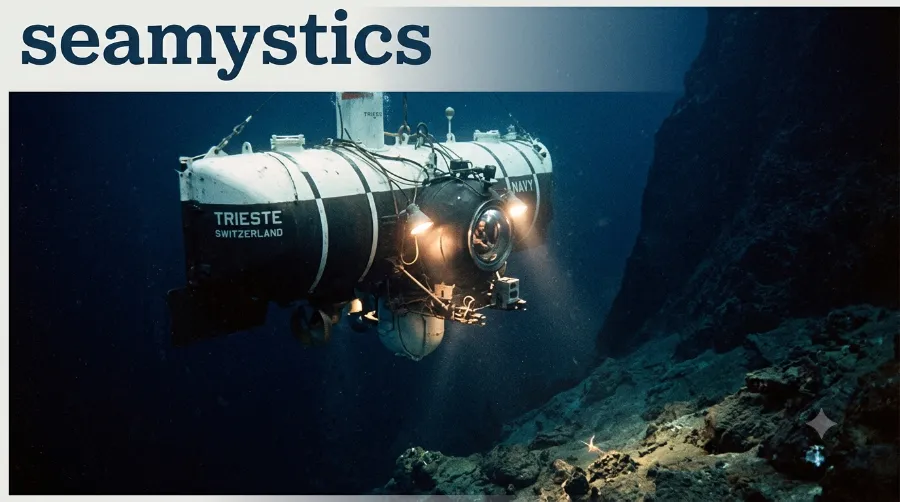

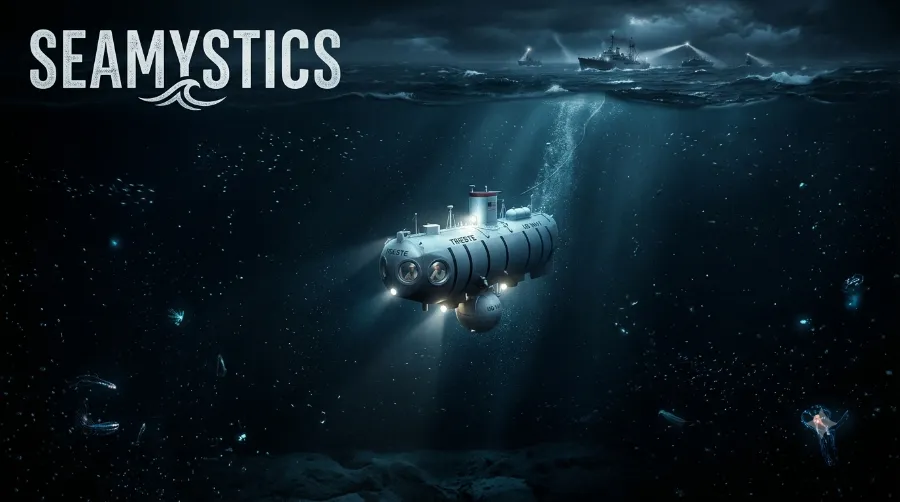
Imagine traveling to a place so deep that Mount Everest could fit inside it with room to spare. That incredible destination is the Challenger Deep in the Mariana Trench. More than six decades ago, one remarkable vessel made history by reaching this mysterious world. The bathyscaphe Trieste historic dive remains one of the greatest achievements in marine exploration. Even today, scientists continue to learn from the mission because it proved humans could safely reach Earth’s deepest known ocean.
Key Takeaways
| Topic | Key Information |
|---|---|
| Historic Dive Date | January 23, 1960 |
| Vessel | Bathyscaphe Trieste |
| Maximum Depth | Approximately 10,916 meters (35,814 feet) |
| Location | Challenger Deep, Mariana Trench |
| Crew | Jacques Piccard and U.S. Navy Lieutenant Don Walsh |
| Dive Duration | Nearly 9 hours total |
| Time on Seafloor | Around 20 minutes |
| Lasting Impact | Opened the door to modern deep-sea exploration |
Why the Bathyscaphe Trieste Changed Ocean Exploration
For centuries, people explored mountains, deserts, and even space in their imagination. However, the deep ocean remained largely unknown because of crushing pressure and complete darkness.
The Trieste changed that forever.
Instead of stopping where submarines failed, its special design allowed it to descend almost 11 kilometers beneath the sea surface. As a result, scientists gained confidence that human exploration could continue into Earth’s most extreme environments.
Today, many deep-sea vehicles trace their engineering roots back to Trieste.
What Was the Bathyscaphe Trieste?
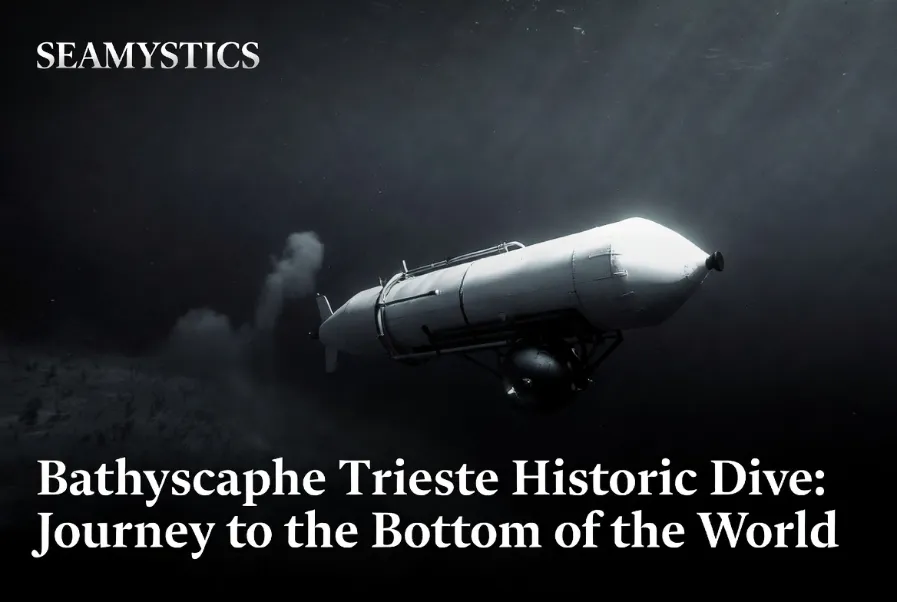
The Trieste was not a traditional submarine.
Instead, engineers designed it specifically for vertical exploration. The word “bathyscaphe” comes from Greek words meaning “deep” and “shipwrecks.”
Main Features
| Feature | Details |
| Builder | Auguste Piccard |
| Later Improved By | Jacques Piccard |
| Purchased By | U.S. Navy (1958) |
| Float | Gasoline-filled for buoyancy |
| Crew Sphere | Steel pressure sphere |
| Crew Capacity | Two people |
| Purpose | Extreme deep-ocean research |
Unlike submarines that travel horizontally for long distances, bathyscaphes mainly move up and down to explore the ocean floor.
Meet the Men Behind the Mission
Jacques Piccard
Jacques Piccard followed in his father Auguste Piccard’s footsteps. He spent years improving deep-sea technology before leading the record-breaking mission.
Don Walsh
U.S. Navy Lieutenant Don Walsh represented the United States during the expedition. His calm decision-making and technical expertise helped make the mission successful.
Together, they became the first humans to visit the deepest known place on Earth.
The Historic Dive to Challenger Deep
January 23, 1960
The Trieste began its descent in the western Pacific Ocean.
At first, sunlight reached the water around them. Soon afterward, darkness completely surrounded the vessel.
Hour after hour, the pressure increased dramatically.
By the time they reached the bottom, the outside pressure exceeded 1,000 times normal atmospheric pressure.
Even a tiny design flaw could have caused disaster.
Fortunately, the steel sphere protected both explorers.
Timeline of the Historic Mission
| Time | Event |
| Morning | Dive begins |
| Several Hours Later | Mid-water descent continues |
| Nearly 5 Hours | Reached Challenger Deep |
| About 20 Minutes | Scientific observations |
| Around 3 Hours | Returned to the surface |
How Deep Did Trieste Go?
The mission reached approximately 10,916 meters (35,814 feet).
Although newer measurements place Challenger Deep slightly deeper depending on location and technology, Trieste’s achievement remains historically extraordinary.
Depth Comparison
| Location | Approximate Depth |
| Olympic Swimming Pool | 2 meters |
| Average Ocean | 3,688 meters |
| Titanic Wreck | 3,800 meters |
| Challenger Deep | Nearly 11,000 meters |
Pressure at the Bottom of the Ocean
One of the biggest challenges was pressure.
At Challenger Deep:
- Pressure exceeded 16,000 pounds per square inch.
- Every square inch experienced enormous force.
- Most ordinary materials would collapse instantly.
Engineers solved this problem by building an extremely thick steel sphere.
Without it, survival would have been impossible.
What Did They See?
Many people imagine colorful coral reefs at every ocean depth.
However, Challenger Deep looks completely different.
Piccard and Walsh observed:
- Fine sediment covering the bottom
- Complete darkness
- Extremely cold temperatures
- Tiny marine organisms
- Suspended particles floating in the water
Although early reports mentioned a flatfish, later scientists questioned that observation because flatfish are unlikely to survive at such extreme depths.
Nevertheless, later expeditions confirmed that microbial life, amphipods, sea cucumbers, and other specialized organisms thrive in the deepest ocean.
Marine Life at Challenger Deep
Scientists now know that life survives under incredible pressure.
Examples include:
- Giant amphipods
- Xenophyophores
- Sea cucumbers
- Microbial communities
- Tiny crustaceans
These organisms have adapted over millions of years.
Their survival continues to surprise marine biologists.
Engineering Innovations That Made History
Several breakthroughs allowed Trieste to succeed.
1. Gasoline Float
Gasoline is lighter than water and remains relatively incompressible.
Therefore, engineers used thousands of gallons to create buoyancy.
2. Steel Crew Sphere
The crew compartment measured about 2.16 meters across but featured walls nearly 13 centimeters thick.
3. Iron Ballast
Iron pellets acted as ballast.
When released, they allowed the vessel to rise naturally.
Why the Mission Still Matters Today
The historic dive changed more than ocean exploration.
It influenced:
- Underwater engineering
- Pressure-resistant materials
- Scientific exploration methods
- Deep-sea biology
- Ocean conservation
Modern research submarines continue using principles first demonstrated during the Trieste mission.
Comparison with Modern Deep-Sea Vehicles
| Vehicle | Year | Maximum Depth |
| Trieste | 1960 | ~10,916 m |
| Deepsea Challenger | 2012 | ~10,908 m |
| Limiting Factor | 2019–Present | Repeated Full-Ocean Depth dives |
Modern vehicles carry advanced cameras, robotic arms, sonar systems, and digital mapping equipment.
However, Trieste achieved its record with far simpler technology.
Latest Deep Ocean Exploration
Today, exploration has entered a new era.
Scientists now use:
- High-definition cameras
- Artificial intelligence
- Autonomous underwater vehicles
- Advanced sonar mapping
- DNA sampling
- Remote-operated vehicles
As a result, researchers discover new species almost every year.
Oceanographers also study microplastics, climate change, and carbon storage deep beneath the sea.
Chart: Deep Ocean Exploration Milestones
| Year | Achievement |
| 1934 | First deep diving experiments by Piccard family |
| 1953 | Trieste launched |
| 1958 | Purchased by U.S. Navy |
| 1960 | Historic Challenger Deep dive |
| 2012 | Solo dive by filmmaker James Cameron |
| 2019 | First reusable full-ocean-depth vehicle begins repeated dives |
| 2024–2026 | Expanded scientific mapping and biodiversity research continues |
Lessons from the Bathyscaphe Trieste Historic Dive
The expedition teaches several important lessons.
- Human curiosity drives scientific progress.
- Engineering can overcome extreme challenges.
- Ocean exploration remains essential.
- Deep-sea ecosystems deserve protection.
- Many mysteries still wait below.
Bathyscaphe Trieste Historic Dive at a Glance
| Fact | Value |
| Record Dive | January 23, 1960 |
| Ocean | Pacific |
| Trench | Mariana |
| Deepest Point | Challenger Deep |
| Maximum Depth | ~10,916 meters |
| Crew Members | Jacques Piccard & Don Walsh |
| Time at Bottom | Around 20 minutes |
| Historical Importance | First human visit to Earth’s deepest known point |
Frequently Asked Questions
How deep did the bathyscaphe Trieste go?
Trieste reached approximately 10,916 meters (35,814 feet) in Challenger Deep on January 23, 1960.
Who piloted the Trieste?
Jacques Piccard and U.S. Navy Lieutenant Don Walsh completed the historic mission together.
Why was the dive important?
It proved humans could safely reach the deepest part of the ocean and inspired decades of deep-sea exploration.
Can people still visit Challenger Deep?
Yes. Modern submersibles have successfully returned several times using improved technology.
Is life found at the bottom of the Mariana Trench?
Yes. Scientists have documented microbes, amphipods, sea cucumbers, and other pressure-adapted organisms living there.
Conclusion
The bathyscaphe Trieste historic dive remains one of humanity’s greatest scientific adventures. More than sixty years later, its success continues to inspire engineers, marine biologists, and explorers around the world. Every modern expedition into the deep ocean builds upon the courage of Jacques Piccard and Don Walsh. As technology improves, scientists will uncover even more secrets hidden beneath the world’s deepest waters, but Trieste will always be remembered as the vessel that proved the impossible could become reality.
References
- National Oceanic and Atmospheric Administration (NOAA) – Ocean Exploration
- Woods Hole Oceanographic Institution (WHOI)
- Smithsonian Ocean Portal
- U.S. Navy historical records on Bathyscaphe Trieste
- Peer-reviewed publications on Mariana Trench biodiversity
About the Author
Dr. Rabica is a marine biologist and science communicator who has spent over 20 years studying deep-sea ecosystems and ocean conservation. Through Sea Mystics, she explains complex marine science using clear language backed by trusted scientific research.