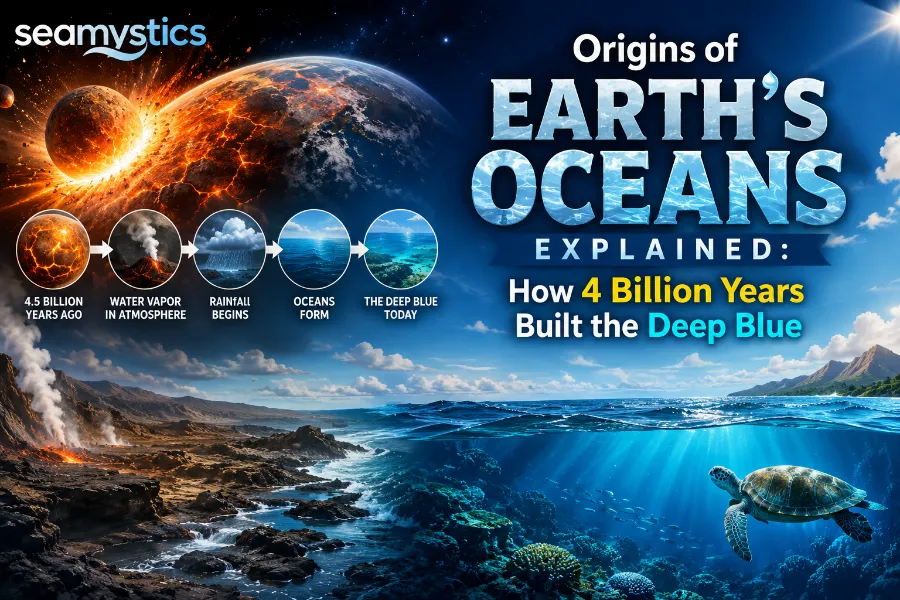

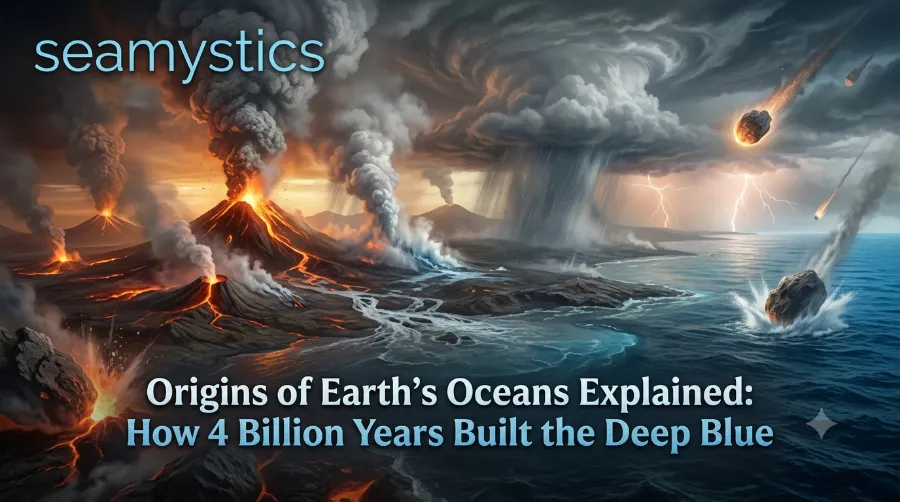
Picture a young Earth. It is glowing red, covered in molten rock, and completely dry. Now picture the same planet today, where water covers over 70 percent of the surface. That change did not happen overnight. The origins of Earth’s oceans explained through science actually stretch across almost 4 billion years, and the story involves comets, asteroids, volcanic gas, and even water hiding deep inside our planet’s mantle. As a marine biologist, I get asked this question often, so let us walk through it step by step, in plain language.Before we go further, here is a quick snapshot of the whole story so you can scan it fast.
If you want to learn more about Write what percentage of ocean still unexplored out our detailed guide for practical tips and expert advice.
Key Takeaways at a Glance
| Time Period | What Happened | Approximate Date |
|---|---|---|
| Earth forms | Molten rock, no oceans yet | 4.6 billion years ago |
| First liquid water evidence | Ancient zircon crystals found in Australia | 4.4 billion years ago |
| Heavy bombardment | Comets and asteroids deliver ice and gas | 4.1 to 3.8 billion years ago |
| Oceans stabilize | Crust cools, rain fills basins | 3.8 billion years ago |
| Deep mantle ocean discovered | Water found 700 km below crust | April 2024 |
| New comet data | D/H ratio matches Earth’s oceans | 2025 |
Now, let us dig into how each of these pieces fits together.
Why Earth Started Out Completely Dry
When our solar system formed, Earth was little more than a ball of molten rock. Temperatures near the surface were far too hot for liquid water to exist. Instead, any water that arrived early on either boiled away or stayed locked inside minerals.
To get a better understanding of tides explained ocean science, our guide breaks down exactly what to expect.
As a result, the planet needed two things before oceans could form. First, it needed a steady water supply. Second, it needed to cool down enough for that water to settle as liquid rather than vapor. This process took hundreds of millions of years, and scientists are still refining the exact timeline.
To get a better understanding of how ocean depth affects temperature our guide breaks down exactly what to expect.
Origins of Earth’s Oceans Explained Through Two Leading Theories
For decades, researchers leaned toward one main idea: water arrived from space. However, newer research from 2024 and 2025 has added an exciting twist. It turns out Earth may have made much of its own water internally, through chemistry happening deep in its molten interior.
If you want to learn more about Write what how the ocean shapes global weather out our detailed guide for practical tips and expert advice.
Theory One: Water Delivered From Space
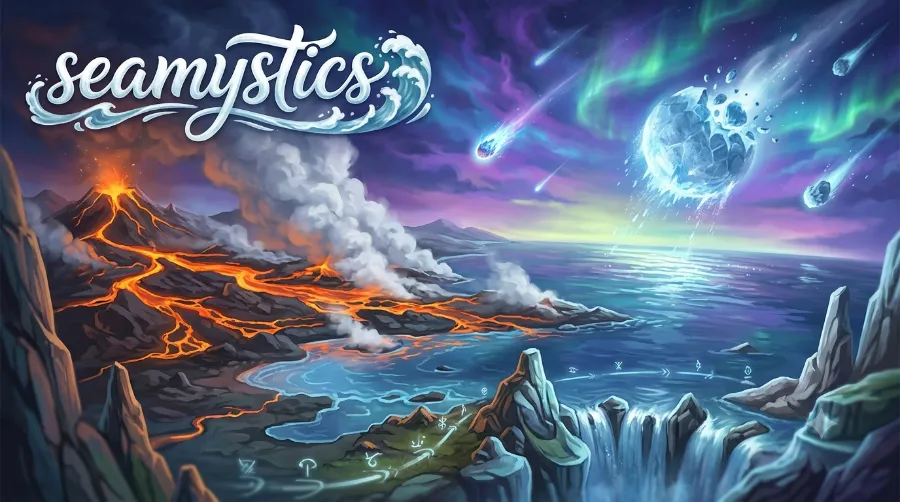
Comets and asteroids from the outer solar system likely carried ice toward the young Earth. During a chaotic period called the Late Heavy Bombardment, roughly 4.1 to 3.8 billion years ago, countless icy objects slammed into our planet. Each impact added a small amount of water to the surface.
For example, in a 2019 mission update, NASA’s Jet Propulsion Laboratory noted that scientists compare heavy water ratios in comets to those in Earth’s oceans to trace a shared origin. Meanwhile, a 2025 observation of comet 12P/Pons-Brooks detected a hydrogen ratio strikingly similar to our own seawater, giving this theory fresh support.
Theory Two: Earth Made Its Own Water
On the other hand, a growing body of research suggests Earth’s molten interior generated water through a chemical reaction. Hydrogen gas from the early atmosphere combined with oxygen-rich minerals in the magma ocean, and this reaction slowly produced water molecules deep inside the planet.
In April 2024, Northwestern University scientists identified a massive water reservoir sitting roughly 700 kilometers below Earth’s crust, trapped inside a mineral called ringwoodite. Additionally, a 2025 study published in Science found that Earth’s deep mantle retained substantial water from its earliest days, rather than losing it all to space. Therefore, many marine scientists now believe the truth combines both theories rather than favoring just one.
You can read more background on this shift in thinking through the Smithsonian’s origin of Earth’s oceans event page, which covers the planetary science side of this debate in detail.
A Simple Timeline of Ocean Formation
To make this easier to follow, here is a numbered breakdown of the major stages:
- 4.6 billion years ago: Earth forms from colliding space debris and is completely molten.
- 4.4 billion years ago: The surface cools enough that liquid water may exist briefly, based on ancient zircon crystal evidence found in Western Australia.
- 4.1 to 3.8 billion years ago: Comets and asteroids deliver additional water during intense bombardment.
- 3.8 billion years ago: Rain begins falling steadily, filling low basins and forming the first stable oceans.
- Present day: Oceans cover about 71 percent of Earth’s surface, according to NOAA estimates.
Interestingly, a 2025 report from the science journal Science.org highlighted just how much of this early water may have stayed inside Earth rather than escaping, which challenges the older assumption that most ocean water came purely from outer space. You can explore that full research summary through this detailed report on homegrown ocean origins.
From Rainfall to Salty Seas
Once liquid water started collecting on the surface, it was not yet the salty ocean we know today. Rainwater slowly dissolved minerals from volcanic rock and carried them into the growing seas. Over millions of years, this process built up the salt content we associate with ocean water now.
If you are curious about exactly why the sea tastes the way it does, our detailed guide on why the ocean tastes salty breaks down the full chemistry behind it. It pairs well with everything discussed here, since salt buildup is a direct result of the same early planetary processes.
How Deep Did These Early Oceans Get
As water kept arriving from both space and Earth’s interior, ocean basins slowly deepened. Today, the average ocean depth sits at roughly 3,682 meters, based on NOAA’s bathymetric data, though certain trenches plunge far deeper.
This depth did not happen instantly either. Instead, it built up gradually as tectonic plates shifted and ocean basins widened over hundreds of millions of years. For a full breakdown of how deep the ocean actually goes today, check out our guide on the true depth of the ocean explained.
Why This Ocean Facts Story Still Matters Today
Understanding these ocean facts is not just a history lesson. It shapes how scientists search for life on other planets. If water can form both through space delivery and internal chemistry here on Earth, then similar processes could be happening on distant rocky planets too.
Consequently, missions studying exoplanet atmospheres, including recent work using the James Webb Space Telescope, are now looking for these same hydrogen and water signatures elsewhere in the galaxy. This connects Earth’s ancient past directly to modern space exploration.
What Gave the Ocean Its Blue Color
Once oceans formed, sunlight interacting with water molecules created the blue appearance we recognize today. This is a separate process from salt content, and it depends heavily on how water absorbs and scatters light.
If you want the full science behind this, our article on the real reason the ocean is blue explains it clearly, using simple comparisons anyone can follow.
How Currents Began Moving Ocean Water Around
As oceans deepened and stabilized, temperature differences and Earth’s rotation began driving water movement. These early currents likely helped distribute heat and nutrients across the planet, setting the stage for the first forms of ocean life to survive and spread.
Modern currents work on very similar principles, just refined over billions of years. Our guide on what actually drives ocean currents walks through exactly how this works in today’s oceans.
A Quick Data Snapshot
Below is a simple visual breakdown showing roughly how much each source likely contributed to Earth’s total ocean water, based on current scientific estimates.
| Water Source | Estimated Contribution | Supporting Evidence |
|---|---|---|
| Comets and icy asteroids | 40 to 50 percent | D/H ratio matches in comet studies (2025) |
| Internal mantle chemistry | 30 to 40 percent | Deep mantle water discovery (2024, 2025) |
| Volcanic outgassing | 10 to 20 percent | Geochemical modeling of early lava flows |
Chart-style breakdown (approximate share of total ocean water):
Comets and asteroids: ▇▇▇▇▇▇▇▇▇▇ 45%
Internal mantle chemistry: ▇▇▇▇▇▇▇▇ 35%
Volcanic outgassing: ▇▇▇▇ 20%
These numbers are estimates, since scientists continue refining them as new mantle and comet data comes in. Still, they give a helpful picture of how many different processes worked together.
If you want to explore even more surprising ocean facts beyond formation, our full ocean facts hub collects the most interesting discoveries in one place. You can also browse the Sea Mystics homepage for our full collection of marine science coverage.
Frequently Asked Questions
How old are Earth’s oceans?
Most evidence points to stable oceans forming around 3.8 billion years ago, though some liquid water may have existed briefly as early as 4.4 billion years ago.
Did all ocean water come from comets?
No. Recent 2024 and 2025 research shows a large portion likely came from chemical reactions inside Earth’s own molten interior, not just from space.
Is new research still changing this theory?
Yes. Studies published as recently as 2025 in Science continue to reveal new details about how much water Earth’s mantle held onto from its earliest days.
Why does this matter for finding life elsewhere?
If Earth can form oceans through internal chemistry, similar processes could occur on other rocky planets, which helps guide the search for life beyond our solar system.
Conclusion
Earth’s oceans did not arrive in one dramatic moment. Instead, they formed slowly, through a mix of cosmic delivery and internal planetary chemistry, unfolding over nearly 4 billion years. Today’s research keeps refining this story, and every new mantle discovery or comet observation adds another piece to the puzzle. Understanding these origins helps us appreciate just how rare and precious our oceans really are, and it also gives scientists valuable clues as they search for water and life on other worlds.
References
- Smithsonian National Air and Space Museum. Origins of Earth’s Oceans. https://airandspace.si.edu/whats-on/events/origin-earths-oceans
- Science.org. Earth’s Oceans Were Homegrown. https://www.science.org/content/article/earth-oceans-were-homegrown
- NASA Jet Propulsion Laboratory. Comet Provides New Clues to Origins of Earth’s Oceans.
- National Oceanic and Atmospheric Administration. Why Do We Have an Ocean.
- Wikipedia. Origin of Water on Earth.