
Picture standing on a beach at sunset, watching the waves roll in, and realizing that everything you can see is just the surface of a world we barely understand. That feeling is not just poetic. It is backed by hard numbers. The percentage of ocean still unexplored today is far higher than most people expect, even with satellites, submarines, and robots working around the clock.
If you want to learn more about Write what percentage of ocean still unexplored out our detailed guide for practical tips and expert advice.
To get a better understanding of how ocean depth affects temperature our guide breaks down exactly what to expect.
For a publication built on real science, this question deserves a real answer. So let us walk through what scientists actually know in 2026, what remains a mystery, and why this gap matters more than ever for people living along the coasts of the United States and Europe.
To get a better understanding of tides explained ocean science, our guide breaks down exactly what to expect.
Key Takeaways
| Quick Fact | What It Means |
|---|---|
| 28.7% of the seafloor is mapped in high resolution | As of April 2026, according to NOAA and Seabed 2030 |
| Less than 5 to 10% has been explored in real detail | Mapping and exploring are two very different things |
| Over 80% of the ocean remains unmapped or unobserved | This is the widely cited NOAA estimate |
| 700,000 to 1 million marine species may exist | Roughly two thirds have not been formally described yet |
| Only 0.001% of the deep seafloor has been visually surveyed | Based on data from thousands of deep dives worldwide |
The Percentage of Ocean Still Unexplored in 2026
Let us start with the number everyone wants first. As of April 2026, 28.7% of the global seafloor had been mapped with modern high-resolution technology such as multibeam sonar systems mounted on ships. That is real progress compared to previous years. However, mapping is only the first step toward true exploration. NOAA Ocean Exploration
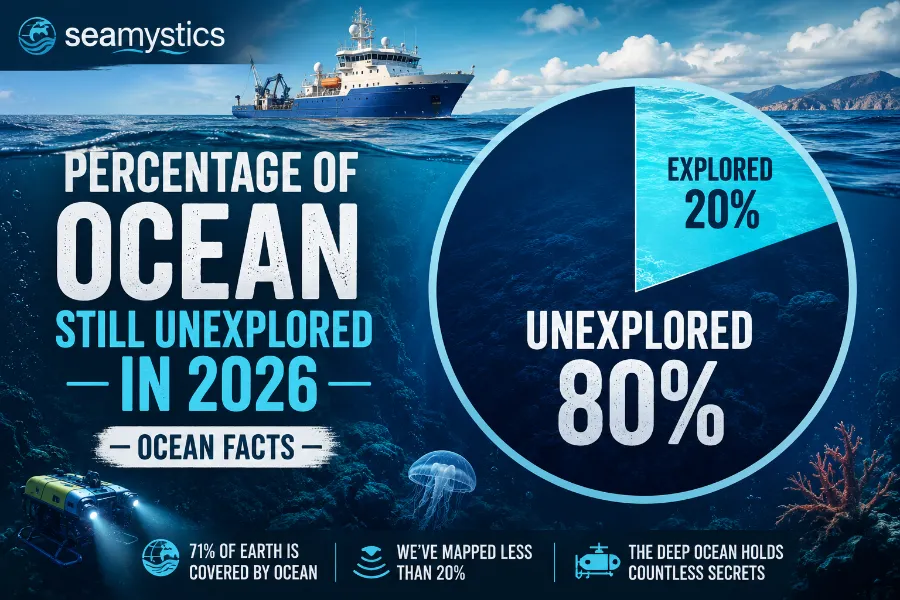
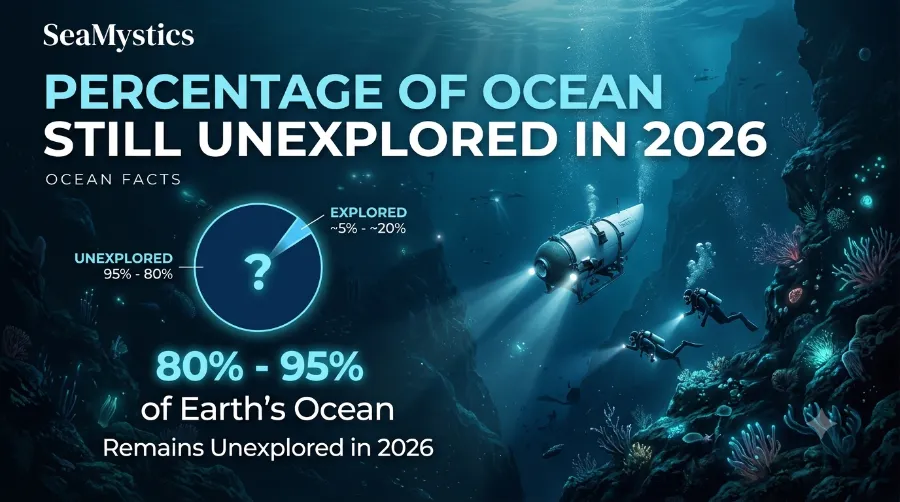
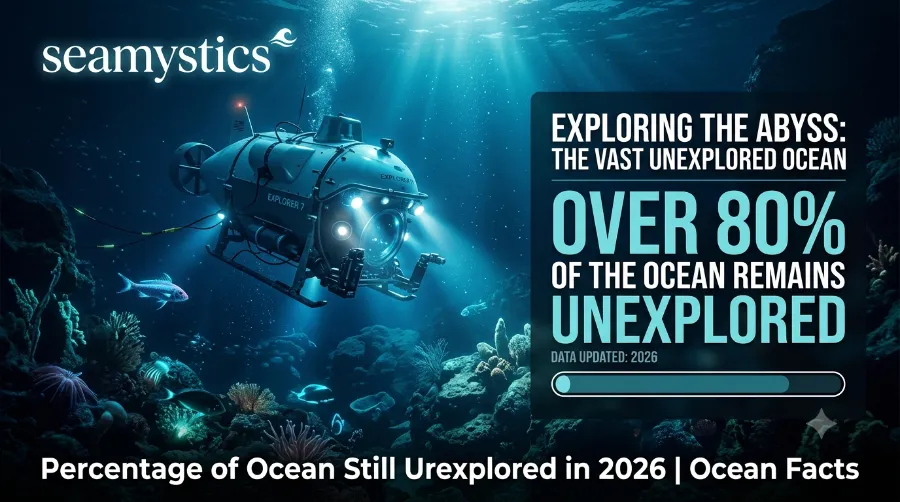
According to NOAA, more than 80% of the ocean remains unmapped, unobserved, and unexplored. This is one reason marine biologists like myself keep pushing for more funding and public interest in ocean science. Without better data, we cannot protect what we do not fully understand. National Oceanic and Atmospheric Administration
What “Mapped” Actually Means
Many readers assume mapped and explored mean the same thing. They do not. A satellite can give a rough outline of the seafloor, but it cannot show you a shipwreck, a hydrothermal vent, or a new species hiding in a trench.
Modern mapping uses sonar pulses from ships to build a detailed picture of underwater terrain. This tells scientists where mountains, valleys, and canyons exist below the surface. Still, a map is just a shape. It does not tell you what lives there.
What “Explored” Actually Means
Exploration means someone or something physically visited a location, observed it, and studied it. This could be a submersible, a remotely operated vehicle, or a diver. Because of this stricter definition, the real explored percentage drops sharply.
If you want to learn more about Write what how the ocean shapes global weather out our detailed guide for practical tips and expert advice.
Research published by BBC Science Focus in 2026 found something startling. Human-made deep submergence vehicles have filmed and photographed an area equal to less than 0.001 percent of the deep seafloor. That is roughly the size of Rhode Island compared to the entire ocean floor. BBC Science Focus Magazine
Ocean Facts That Explain Why So Much Remains Hidden
Understanding basic ocean facts helps explain why exploration moves so slowly. The ocean is not a shallow pond. It is an enormous, dark, high-pressure environment that resists easy access.
Consider these points:
- The average ocean depth is close to 3.9 kilometers, or almost 13,000 feet.
- Deep water pressure can crush unprotected equipment within minutes.
- Sunlight disappears completely below roughly 1,000 meters, which is called the midnight zone.
- Most of the deep ocean has never had a single camera pass through it.
If you want a deeper dive into how ocean depth actually works, our guide on the true depth of the ocean explained breaks this down layer by layer. It also connects nicely with why the water column changes so dramatically the deeper you go.
Exploration Is Also Uneven Across the Globe
One overlooked ocean fact is that exploration effort is not evenly spread. According to the same BBC Science Focus research, sixty-five percent of exploratory dives have taken place within 200 nautical miles of the United States, Japan, or New Zealand. This means huge stretches of ocean near Africa, South America, and parts of Asia remain almost completely untouched. BBC Science Focus Magazine
This uneven coverage matters for both science and policy. It means our current understanding of ocean life may be biased toward a small, wealthy slice of the planet. Meanwhile, entire ecosystems elsewhere could hold species or resources nobody has ever documented.
Why the Ocean Is So Hard to Reach
Marine biologists often get asked why we have explored space in more detail than our own ocean floor. The answer comes down to a mix of physics, cost, and sheer scale.
Here are the main barriers researchers face:
- Water blocks radio waves, which limits how satellites and GPS can help below the surface.
- Extreme pressure at depth requires expensive, specialized equipment that can take years to build.
- Total ocean coverage spans more than 335 million square kilometers, making full coverage a massive logistical task.
- Funding for ocean research is historically much smaller than funding for space exploration.
As a result, we often know less about our own seafloor than we do about the surface of Mars. This comparison sounds surprising, yet it is repeated often in scientific literature because it is simply true.
Real Missions Changing the Percentage of Ocean Still Unexplored
Progress is happening, and it deserves credit. The organization behind global seafloor mapping, Seabed 2030, has made steady gains over the past several years. Their milestones show how international cooperation can move the needle.
| Year | Percentage of Seafloor Mapped (High Resolution) |
|---|---|
| 2020 | Roughly 19% |
| 2022 | Roughly 23% |
| 2024 | 26.1% |
| 2025 | 27.3% |
| 2026 | 28.7% |
In June 2025, the project reported that four million square kilometres of new seafloor data had been added, an area roughly equal to the entire Indian subcontinent. Then in April 2026, another almost five million square kilometres were added, bringing the total to 28.7 percent of the global seafloor mapped. That single year of progress represents an area larger than most European countries combined. UNESCOSeabed 2030
This kind of steady improvement is exactly why organizations like Oceana continue to push for stronger protections even in areas we have not fully studied yet. You can read more about why so much ocean remains unprotected in their detailed piece on why so much ocean remains unexplored and unprotected.
Government agencies are also stepping up. The Bureau of Ocean Energy Management has highlighted new missions aimed at reaching areas that have never been surveyed before. Their overview of current efforts to boldly explore where no one has explored shows how public agencies are investing in deep sea research alongside private partners.
What Scientists Still Have Left to Discover
The biological side of this story is just as important as the mapping side. Scientists currently estimate there could be between 700,000 and 1 million species living in the ocean, and roughly two thirds of these have not yet been discovered or officially described. Nearly 2,000 new species are still added to the scientific record every year. NOAA Ocean Exploration
This is one reason marine biology remains such an exciting field to work in. Every expedition carries the possibility of finding something completely new to science. For readers curious about how ocean life relates to other basic questions, our explainer on the real reason the ocean is blue covers another commonly misunderstood ocean fact.
Coastal Waters Are Not Fully Mapped Either
Even close to shore, gaps remain surprisingly large. Reporting from Green Matters noted that only about 35 percent of United States ocean and coastal waters have been mapped using modern sonar methods. This means even familiar coastlines hold pockets of mystery. Green Matters
For readers in the United States and Europe, this local gap is worth paying attention to. Coastal ecosystems support fishing industries, tourism, and climate regulation. Yet we still lack a complete picture of what lies just offshore.
Why This Gap Actually Matters
The ocean absorbs heat and carbon dioxide, which directly affects weather patterns across the United States and Europe. It also supports fisheries that feed billions of people worldwide. Because of this, unexplored areas are not just a curiosity for scientists, they represent real risk and real opportunity.
Unmapped zones could hide new medicines, unknown ecosystems, or early warning signs of climate change. On the other hand, they could also hide risks we have not yet identified, including instability that affects coastal communities. Continued mapping helps researchers plan conservation efforts before damage occurs rather than after.
If you want to understand the bigger picture of how oceans first formed and why they behave the way they do, our guide on the origins of Earth’s oceans explained offers useful background. It pairs well with understanding why current patterns move the way they do, which you can explore further in our piece on what actually drives ocean currents.
Frequently Asked Questions
What percentage of the ocean is actually unexplored in 2026?
Roughly 80 percent remains unmapped or unobserved in detail, even though 28.7 percent of the seafloor has now been mapped at high resolution.
Is mapping the same as exploring?
No. Mapping shows the shape of the seafloor, while exploring means scientists physically observed and studied a location using submersibles, robots, or divers.
Why has so little of the ocean been explored compared to space?
Water blocks satellite signals, pressure increases rapidly with depth, and ocean coverage spans a massive area, all of which make exploration slower and more expensive than space missions.
Will the ocean ever be fully explored?
Most scientists agree it may never be completely explored, though continued technology improvements are steadily closing the gap each year.
Where can I learn more general ocean facts?
Our amazing ocean facts hub collects several beginner-friendly guides, including topics like why the ocean tastes salty.
Conclusion
So how much of the ocean is actually unexplored in 2026? The honest answer is still most of it. While mapping technology has pushed coverage to nearly 29 percent, true scientific exploration remains far behind, leaving the majority of marine life and seafloor features undiscovered. As funding, technology, and global cooperation continue to grow, that percentage should keep shrinking year after year, but for now, the deep ocean remains one of the last great mysteries on our planet.
References
- NOAA Ocean Exploration, “How much of the ocean has been explored?” oceanexplorer.noaa.gov, updated April 2026
- NOAA, “Ocean and Coasts,” noaa.gov
- Seabed 2030 and GEBCO, seabed2030.org, April 2026 announcement
- BBC Science Focus Magazine, sciencefocus.com, March 2026
- Oceana, “Why does so much ocean remain unexplored and unprotected,” oceana.org
- Bureau of Ocean Energy Management, boem.gov
- Green Matters, greenmatters.com, updated 2026