
Before diving into the science, it helps to picture the ocean as one giant, moving machine with several engines working at once. Some of those engines sit at the surface, and others work in complete darkness thousands of feet below. Together, they create a system so powerful that it can carry a message in a bottle across an entire ocean basin in just a few months.
To get a better understanding of how ocean depth affects temperature our guide breaks down exactly what to expect.
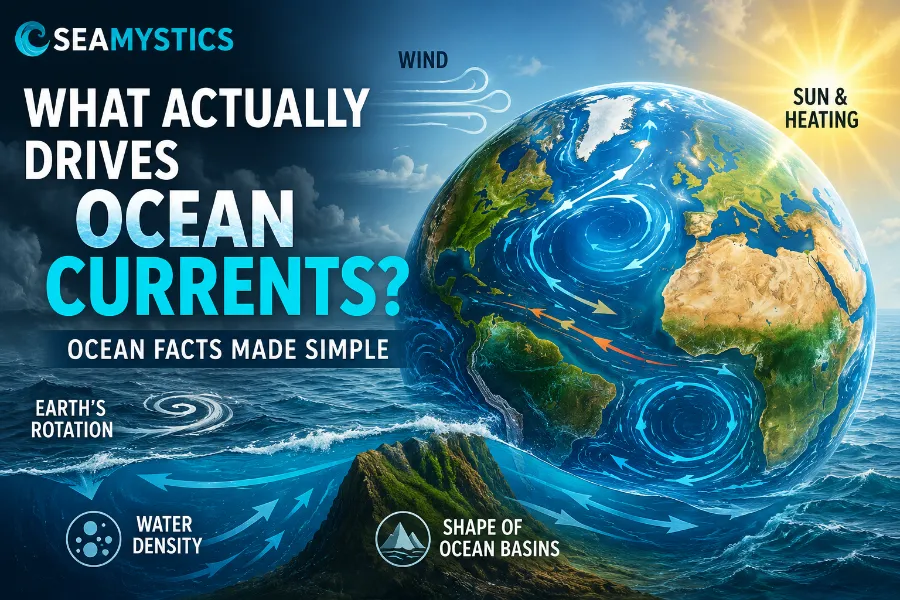
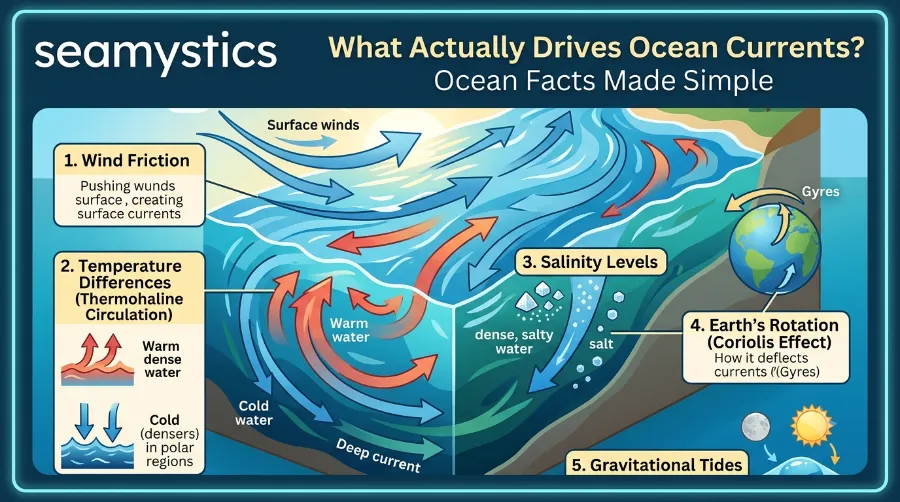
So what actually drives ocean currents? The short answer is a combination of wind, water density, gravity, and the rotation of the Earth. None of these forces work alone. Instead, they blend together to create the currents that circle our planet like invisible rivers.
To get a better understanding of tides explained ocean science, our guide breaks down exactly what to expect.
Wind: The Ocean’s First Push
Wind is the most obvious driver, and it is responsible for most of what happens at the surface. As air moves across the water, friction drags the top layer along with it. Because this happens constantly across huge stretches of ocean, the water eventually forms a steady, moving stream.
Trade winds near the equator, for example, push warm surface water westward, creating currents like the North Equatorial Current. Meanwhile, the westerlies further north and south push water in the opposite direction. This constant tug of war between wind belts is one reason currents form large, circular loops instead of straight lines.
The Coriolis Effect: Earth’s Hidden Twist
Here is where things get interesting. Because the Earth rotates, moving water does not travel in a straight line, it curves. This bending, known as the Coriolis effect, pushes currents clockwise in the Northern Hemisphere and counterclockwise in the Southern Hemisphere.
As a result, wind driven currents twist into massive rotating loops called gyres. The North Atlantic Gyre, for instance, is the reason a plastic bottle dropped off the coast of Florida can eventually wash up near the Azores. Consequently, the Coriolis effect is not just a classroom concept, it physically shapes where ocean debris, heat, and nutrients travel.
Density Driven Currents: The Ocean’s Deep Conveyor Belt
While wind controls the surface, something entirely different controls the deep ocean. This is where density steps in, and it works quietly, far below where sunlight ever reaches.
If you want to learn more about Write what how the ocean shapes global weather out our detailed guide for practical tips and expert advice.
Cold water is denser than warm water, and salty water is denser than fresh water. When these two factors combine, usually near the poles, the water becomes heavy enough to sink. As it sinks, it pulls more water behind it, creating a slow moving current that can take over a thousand years to complete one full loop around the globe.
Scientists call this system thermohaline circulation, though most people simply call it the global conveyor belt. It links every major ocean basin together, moving heat, oxygen, and nutrients from one side of the planet to the other.
For a closer look at how salt levels affect the sea, our guide on why the ocean tastes salty breaks down exactly how salinity builds up in the first place.
The Atlantic’s Famous Conveyor: AMOC
One part of this deep system has been making headlines lately, and for good reason. The Atlantic Meridional Overturning Circulation, known as AMOC, works like a massive underwater conveyor belt that carries warm water north and cold water south.
A 2026 study led by the University of Miami’s Rosenstiel School analyzed two decades of data from four monitoring arrays along the western Atlantic. The research team found direct observational evidence that the Atlantic Meridional Overturning Circulation is weakening, and the slowdown was consistent across all four locations they studied. Physical oceanographer Shane Elipot, a senior author on the study, noted that a weaker AMOC could shift weather patterns toward more extreme storms, changing rainfall, and colder winters in some regions, while also raising sea levels along coastlines. University of MiamiUniversity of Miami
Even more striking, a January 2026 preprint using high resolution modeling suggested that an AMOC collapse may be significantly more likely than earlier simulations indicated, largely because the system appears far more sensitive to Greenland meltwater than previously thought. Meanwhile, oceanographers have also linked a persistent cold patch in the North Atlantic, nicknamed the cold blob, to this same weakening trend rather than to normal seasonal cooling. Researchers now believe this cooling reflects a declining AMOC, driven by warming seas, melting ice, and a disrupted balance of temperature and salt in the North Atlantic. WikipediaThe Boston Globe
This does not mean the current is about to shut down overnight. Still, it shows how sensitive our climate system really is, and why tracking ocean currents has become one of the most closely watched areas in marine science today.
Real World Examples of Powerful Ocean Currents
Numbers and models are useful, but real examples make the science stick. Here are a few currents that show these forces in action.
- The Gulf Stream: This warm water current moves at speeds up to 5.6 miles per hour and carries roughly 30 million cubic meters of water per second past Florida, more water than all the world’s rivers combined.
- The Humboldt Current: Running along the coast of Chile and Peru, this cold water current supports one of the richest fishing grounds on Earth, feeding millions of people every year.
- The Kuroshio Current: Often called the Pacific’s version of the Gulf Stream, it carries warm water from the Philippines up toward Japan, shaping the region’s mild coastal climate.
- The 1997 to 1998 El Niño event: A dramatic weakening of the trade winds disrupted normal current patterns across the Pacific, contributing to floods, droughts, and billions of dollars in global damage.
These examples show that currents are not abstract science experiments. They influence fishing industries, coastal weather, and even how warm your beach vacation will feel.
Why Ocean Currents Matter for Climate and Daily Life
Currents do far more than move water from one place to another. They act as the planet’s thermostat, moving heat away from the tropics and toward the poles. Without this constant redistribution, the equator would grow unbearably hot while the poles would freeze even harder than they already do.
According to the Smithsonian’s Ocean portal, currents also transport nutrients, oxygen, and even tiny organisms across entire ocean basins, supporting marine food webs that stretch from plankton to whales. Similarly, National Geographic’s education resource on ocean currents and climate explains how these same currents interact with the atmosphere to influence rainfall patterns on land, sometimes thousands of miles from the coast.
Because of this connection, even small shifts in current strength can ripple outward into farming, fishing, and weather forecasting. In short, the ocean and the atmosphere are constantly talking to each other, and currents are the messengers.
A Simple Look at Current Speeds
| Current | Type | Average Speed | Region |
|---|---|---|---|
| Gulf Stream | Warm surface | Up to 5.6 mph | North Atlantic |
| Kuroshio | Warm surface | Up to 4 mph | North Pacific |
| Humboldt | Cold surface | 0.5 to 1 mph | South Pacific |
| AMOC deep branch | Cold deep | Less than 0.1 mph | Global Atlantic |
Notice how surface currents move far faster than deep ones. This difference exists because wind delivers constant, direct energy, while density driven flow depends on slow, gradual sinking that can take centuries to complete.
How Scientists Track Ocean Currents Today
Modern ocean science relies on far more than a compass and a notebook. Researchers now combine satellite data, underwater floats, and long term monitoring arrays to build a clearer picture of how currents behave over time.
- Satellite altimetry measures tiny changes in sea surface height, which reveal how currents shift from month to month.
- Argo floats drift through the ocean at different depths, recording temperature and salinity as they go.
- Monitoring arrays, like the ones used in the 2026 Rosenstiel School study, sit anchored across ocean basins to track current strength continuously for decades.
- Climate models combine all of this data to project how currents might behave decades into the future.
Because of these tools, our understanding of what actually drives ocean currents has become far more precise than it was even ten years ago.
For readers curious about other hidden forces shaping the sea, our related guides on the true depth of the ocean and why the ocean looks blue dig into two more mysteries that tie directly back to how water moves and behaves.
Frequently Asked Questions
What actually drives ocean currents the most, wind or temperature?
Wind drives surface currents, while temperature and salinity drive deep currents. Both work together, but wind has the biggest influence on the water we see and swim in.
Are ocean currents getting weaker because of climate change?
Some are. Recent research shows the AMOC has weakened measurably over the past two decades, and scientists are watching it closely for further changes.
Why do ocean currents matter for everyday weather?
Currents move heat around the planet, which influences rainfall, storm patterns, and regional temperatures far beyond the coastline.
Can ocean currents change direction?
Yes, seasonal winds and long term climate shifts can alter current strength and, in rare cases, direction, though major currents tend to stay fairly stable over short periods.
Conclusion
Ocean currents may look like random waves from the shore, but they are anything but random. Wind pushes the surface, density pulls the depths, and the Earth’s rotation bends everything into the sweeping patterns we see on a map. Once you understand what actually drives ocean currents, ocean facts like the Gulf Stream’s speed or the AMOC’s slow weakening start to make a lot more sense. As research continues into 2026 and beyond, one thing is clear, the sea’s engine room deserves far more attention than it usually gets. To keep exploring these hidden mechanics, visit our full ocean facts hub for more deep dives into how our planet’s biggest feature actually works.
References
- Ocean.si.edu, Smithsonian National Museum of Natural History, Currents, Waves, and Tides
- National Geographic Education, Ocean Currents and Climate
- University of Miami Rosenstiel School, A Critical Atlantic Ocean Current Shows Two Decade Slowdown, Study Finds, 2026
- CNN, A Vital System of Atlantic Ocean Currents is Weakening and Closer to Collapse than Thought, 2026
- Carbon Brief, AMOC: Is Global Warming Tipping Key Atlantic Currents Toward Collapse, 2026