
Have you ever swallowed a mouthful of seawater at the beach and instantly regretted it? That sharp, bitter taste is not an accident. It is the result of a process that has been running quietly for billions of years, long before any of us were around to spit it back out. Understanding why the ocean tastes salty actually tells us a lot about how our planet works, from mountain rock to deep sea vents. As a marine biologist, I get this question more than almost any other, and the answer is simpler than most people expect once you break it down.
To get a better understanding of the real reason the ocean is blue our guide breaks down exactly what to expect.
In this guide, we will walk through the real science in plain, simple language. No jargon, no fluff, just the facts, backed by research from NOAA and other trusted ocean science sources.
To get a better understanding of how ocean depth affects temperature our guide breaks down exactly what to expect.
Key Takeaways
| Quick Fact | What It Means |
|---|---|
| Average ocean salinity | About 35 grams of salt per liter of seawater (35 ppt) |
| Main source of salt | Rocks and soil on land, carried by rivers |
| Second source | Hydrothermal vents on the seafloor |
| Saltiest sea | Red Sea and Persian Gulf, around 40 ppt |
| Least salty sea | Baltic Sea, around 10 ppt |
| Saltiest large body of water | Dead Sea, roughly 330 to 337 ppt |
| Why it stays balanced | Salt is removed by minerals, marine life, and seafloor rock formation |
Why the Ocean Tastes Salty: The Short Answer
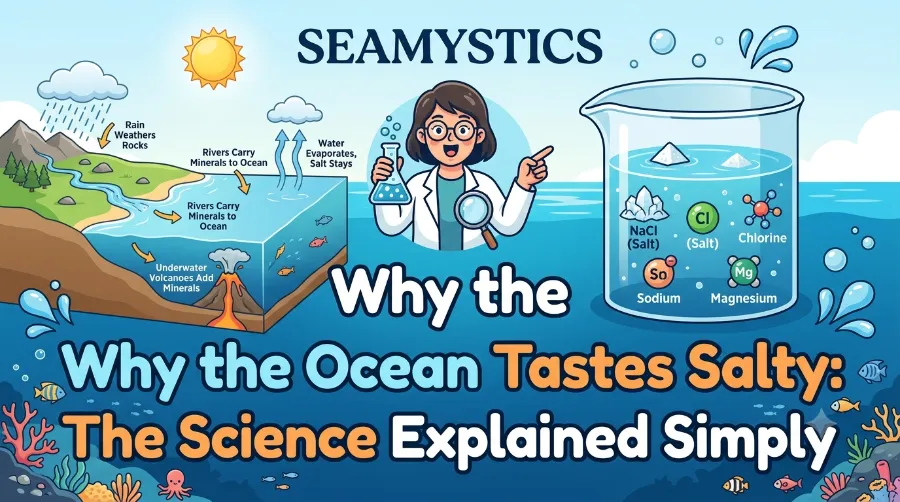
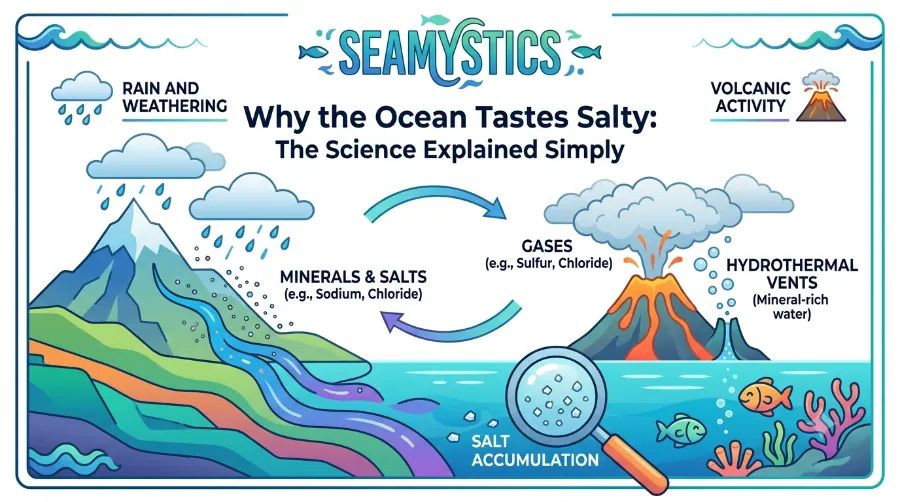
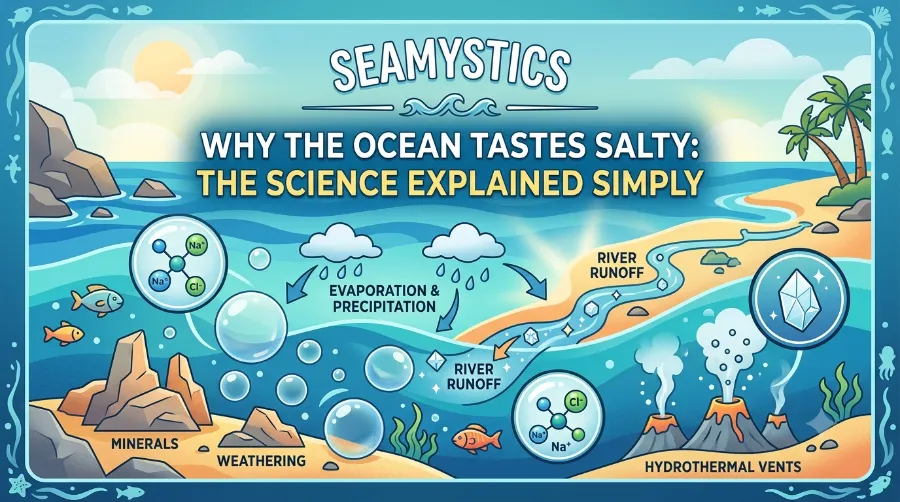
So, why the ocean tastes salty comes down to two main processes working together over an enormous stretch of time. First, rain falls on land and slowly breaks down rocks. Second, that broken down mineral matter travels through rivers and streams until it eventually reaches the sea. Once it arrives, the water evaporates back into the sky, but the salt stays behind.
If you want to learn more about Write whatOrigins of Earth’s oceans explainedout our detailed guide for practical tips and expert advice.
To get a better understanding of tides explained ocean science, our guide breaks down exactly what to expect.
This cycle has been repeating for roughly four billion years, according to geological records. Consequently, the ocean has had plenty of time to build up its salty character. It is not that someone dumped table salt into the sea. Instead, it is a slow, steady accumulation driven by weather, chemistry, and time.
Here is a simple way to picture it. Imagine leaving a glass of salty water out in the sun. As the water evaporates, the salt left behind gets more concentrated. Now imagine that happening across every ocean basin on Earth, every single day, for millions of years. That is essentially what has been happening to our seas.
If you want to learn more about Write what how the ocean shapes global weather out our detailed guide for practical tips and expert advice.
Ocean Salt
When people ask about ocean facts, this is usually where the conversation gets interesting. Seawater is not just salty because of one single cause. Instead, there are two major contributors, and both matter for different reasons.
Rocks, Rivers, and Rain
Rainwater is naturally a little acidic because it absorbs carbon dioxide from the air as it falls. As a result, when that rain lands on rocks and soil, it slowly wears them down through a process called chemical weathering. Minerals such as sodium and chloride get released and washed into streams, then rivers, then finally the sea.
If you want to learn more about Write what actually drives ocean currentscheck out our detailed guide for practical tips and expert advice
If you want to learn more about Write what percentage of ocean still unexplored out our detailed guide for practical tips and expert advice.
This might sound like it should make rivers salty too, yet river water tastes fresh. Why? Because rivers constantly refresh themselves through new rainfall and runoff, so minerals never get the chance to build up. The ocean, on the other hand, has no easy way out. Water leaves through evaporation, but the salt stays put, so it slowly accumulates over time.
Hydrothermal Vents on the Seafloor
The second major source is less familiar to most people, but it is just as important. Deep beneath the surface, seawater seeps into cracks along mid-ocean ridges, where it gets heated by magma to extreme temperatures. This superheated water reacts chemically with the surrounding basalt rock, picking up minerals like iron, copper, and sulfur before shooting back out through vents.
These hydrothermal systems have been adding minerals to seawater for a very long time. In fact, researchers studying vent chemistry have found that these underwater volcanic systems play a major role in shaping ocean chemistry, not just salinity. So while rivers get most of the credit in casual conversation, the seafloor deserves recognition too.
How Salty Is the Ocean, Really?
On average, the ocean holds about 35 grams of dissolved salt for every liter of seawater, which scientists refer to as 35 parts per thousand, or ppt for short. That said, salinity is not the same everywhere. Some regions are noticeably saltier than others, and the differences come down to local rainfall, evaporation rates, and how enclosed a body of water happens to be.
Take a look at how salinity varies around the globe.
| Location | Average Salinity (ppt) | Why |
|---|---|---|
| Red Sea and Persian Gulf | Around 40 ppt | Extremely high evaporation, little rainfall |
| Mediterranean Sea | Up to 38 ppt | High evaporation, limited freshwater inflow |
| Global ocean average | 33 to 37 ppt | Standard mix of evaporation and rainfall |
| Baltic Sea | Around 10 ppt | Heavy river inflow, low evaporation |
| Arctic Ocean regions | As low as 30 ppt | Melting ice adds freshwater |
| Dead Sea | Roughly 330 to 337 ppt | No river outflow since the 1950s, extreme evaporation |
As you can see, location changes everything. Near the equator, frequent rainfall dilutes surface salinity, while at the poles, melting ice does the same job. Meanwhile, in the dry, hot mid latitudes, high evaporation concentrates the salt further, which explains why places like the Red Sea rank among the saltiest bodies of water on the planet, according to NOAA’s ocean data.
Real Life Examples That Show Salinity in Action
Numbers on a page only tell part of the story, so let us look at a few real examples that make this science easier to picture.
- The Dead Sea, located between Israel and Jordan, has become dramatically saltier since the 1950s. Once its connection to the Jordan River was diverted, fresh water stopped flowing in. Since then, the water level has dropped by close to one meter every year, and today its salinity sits near ten times the ocean average.
- The Baltic Sea, surrounded by northern Europe, tells the opposite story. Because hundreds of rivers pour freshwater into this mostly enclosed sea, salinity there measures around 10 ppt, far below the open ocean average of 35 ppt.
- The Bay of Bengal stays less salty than nearby seas because the Ganges and Brahmaputra rivers dump enormous volumes of freshwater into it year round.
These examples show that ocean facts are rarely one size fits all. Local geography and climate shape salinity just as much as the global averages do.
Why Doesn’t the Ocean Just Keep Getting Saltier?
This is a fair question, and honestly, one of my favorites to answer. Rivers deliver roughly three billion tons of salt to the ocean every single year, yet salinity has stayed fairly stable for hundreds of millions of years. So where does all that extra salt go?
It turns out the ocean has its own natural balancing system. Several processes remove salt at roughly the same rate that rivers and vents add it.
- Marine organisms such as corals and shellfish absorb calcium and other minerals to build their shells and skeletons.
- Evaporite minerals, including halite, settle out of shallow, salty basins and become buried rock over time.
- Sediment absorption pulls dissolved ions out of the water and locks them into clay on the seafloor.
- Tectonic activity recycles ocean crust back into the mantle, taking trapped salts along with it.
Because these removal processes roughly match the rate of new salt entering the ocean, salinity has remained close to today’s levels for most of the last 541 million years, based on evidence from ancient salt beds and marine fossils. In short, the ocean is not filling up with salt forever. It has simply found a long term equilibrium.
For readers who want to go deeper into related topics, our amazing ocean facts hub covers everything from tides to deep sea creatures, and it is a great next stop after this article.
Does Climate Change Affect Ocean Salinity?
Yes, and this is becoming a bigger talking point in marine science circles. Warmer temperatures are speeding up ice melt in the Arctic, which is freshening surface waters in that region. At the same time, other areas are experiencing higher evaporation rates, which is nudging salinity upward. While the global average has not shifted dramatically yet, regional imbalances are worth watching, since they can influence ocean currents and marine ecosystems over the coming decades.
Frequently Asked Questions
Why does the ocean taste salty but rivers do not?
Rivers constantly refresh with new rainwater, so salt never has a chance to build up. The ocean has no similar outlet, so minerals accumulate there instead.
What is the average salinity of the ocean?
Most of the ocean sits between 33 and 37 parts per thousand, with a global average close to 35 ppt.
Is the Dead Sea part of the ocean?
No, the Dead Sea is a landlocked lake, not part of the ocean. However, it is one of the saltiest bodies of water on Earth because it has no river outlet and extremely high evaporation.
Could the ocean ever run out of salt or become too salty to sustain life?
Not likely anytime soon. Natural processes remove roughly as much salt as rivers and vents add, which keeps the system in balance over long stretches of time.
Is seawater safe to drink?
No, drinking seawater actually dehydrates the body faster because your kidneys need freshwater to flush out the excess salt.
Conclusion
At the end of the day, understanding why the ocean tastes salty comes down to a simple partnership between rock, rain, rivers, and time. Salt has been washing off the land and rising from the seafloor for billions of years, and a set of natural removal processes has kept everything roughly in balance ever since. So the next time a wave catches you off guard at the beach, you will know exactly what is happening beneath the surface, and why that salty taste has quite an incredible story behind it. If you enjoyed this breakdown, explore more marine science explainers on Sea Mystics,
References
- NOAA Ocean Service, “Why is the ocean salty?” https://oceanservice.noaa.gov/facts/whysalty.html
- NOAA JetStream, “Sea Water” https://www.noaa.gov/jetstream/ocean/sea-water
- BBC Future, “Why is the sea so salty?” https://www.bbc.com/future/article/20140411-why-is-the-sea-so-salty
- National Marine Sanctuary Foundation, “Why Is the Ocean So Salty?” https://marinesanctuary.org/blog/why-is-the-ocean-so-salty/