
Stand on a beach and look out at the water. It looks calm, flat, and almost polite. Yet just a few miles offshore, that same water plunges down farther than any mountain on Earth rises up.
To get a better understanding of how ocean depth affects temperature our guide breaks down exactly what to expect.
The true depth of the ocean explained in simple terms is this: our planet hides a canyon system so vast that scientists have explored less of it than the surface of Mars. As a marine biologist who has spent two decades studying deep water ecosystems, I still find that fact humbling every single time I think about it.Before we dive into the zones, here is a quick snapshot of what you are about to learn.
If you want to learn more about Write whatOrigins of Earth’s oceans explainedout our detailed guide for practical tips and expert advice.
Key Takeaway Table
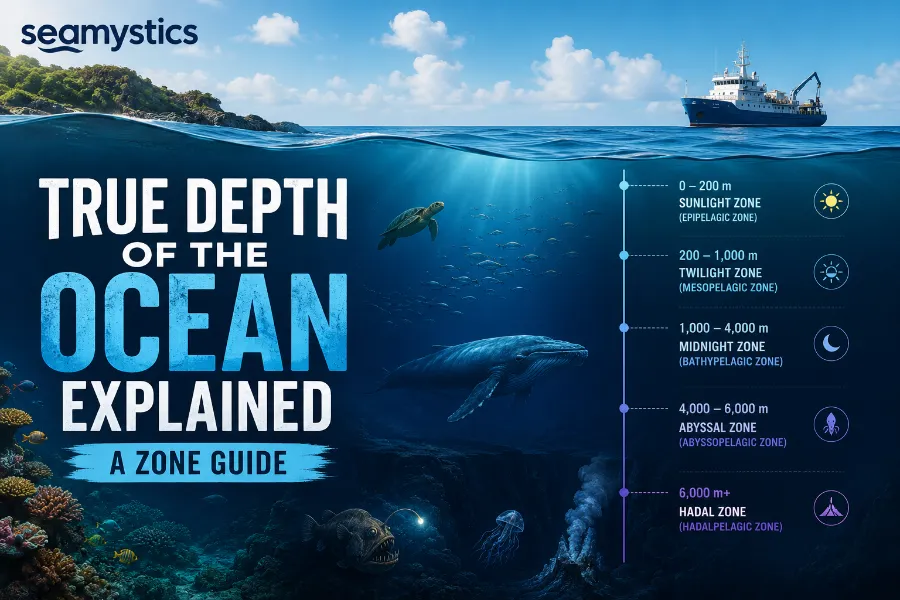
| Ocean Zone | Depth Range | Sunlight | Known For |
|---|---|---|---|
| Sunlight Zone | 0 to 200 meters | Full light | Coral reefs, most fish |
| Twilight Zone | 200 to 1,000 meters | Dim, fading | Bioluminescence begins |
| Midnight Zone | 1,000 to 4,000 meters | None | Anglerfish, giant squid |
| Abyssal Zone | 4,000 to 6,000 meters | None | Near freezing, crushing pressure |
| Hadal Zone | 6,000 to 11,000+ meters | None | Ocean trenches, Challenger Deep |
Ocean Zones 101: The True Depth of the Ocean Explained
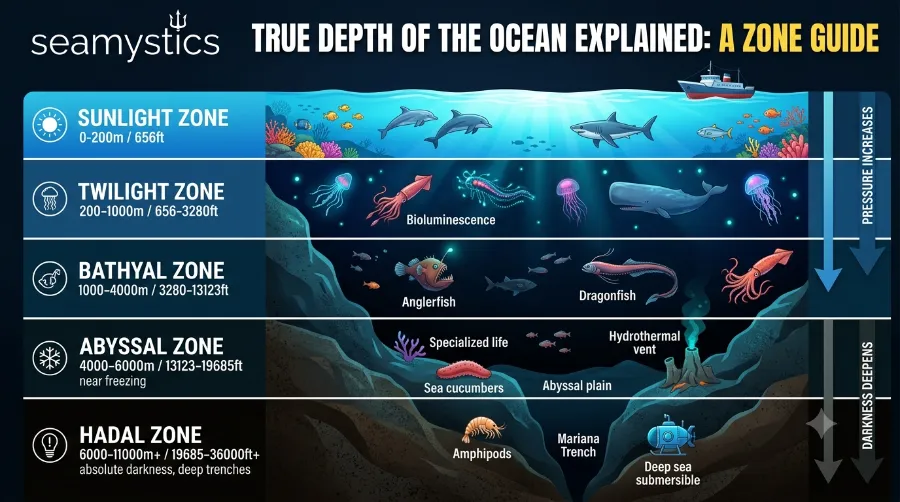
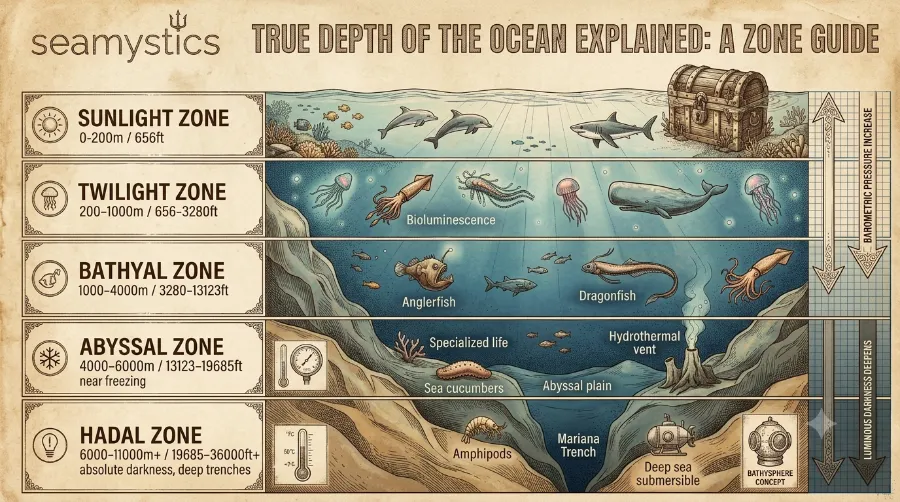
Oceanographers do not measure the sea in one simple number. Instead, they split it into five layers based on how far sunlight can travel. This layering matters because light, temperature, and pressure change so much from top to bottom that each zone supports a completely different kind of life. Once you see the ocean this way, the phrase “average depth” starts to feel almost meaningless.
If you want to learn more about Write what actually drives ocean currentscheck out our detailed guide for practical tips and expert advice
The Sunlight Zone: Where Life Begins
The sunlight zone, also called the epipelagic zone, stretches from the surface down to about 200 meters. This is where roughly 90 percent of all known marine species live, according to widely cited estimates from NOAA researchers. Warm currents, visible coral reefs, and schools of tuna all call this zone home. However, this bright and busy layer is only a thin skin compared to what lies beneath it.
If you want to learn more about Write what percentage of ocean still unexplored out our detailed guide for practical tips and expert advice.
The Twilight Zone: A World of Shrinking Light
Between 200 and 1,000 meters sits the mesopelagic, or twilight, zone. Sunlight fades quickly here, and by 1,000 meters it disappears completely. As a result, many creatures in this zone create their own light through a process called bioluminescence. Lanternfish, for example, use glowing organs along their bodies to confuse predators and find mates in near total darkness.
To get a better understanding of tides explained ocean science, our guide breaks down exactly what to expect.
The Midnight Zone: Pressure Starts to Bite
The bathypelagic zone runs from 1,000 to 4,000 meters, and this is where things get strange. No sunlight reaches this depth at all, so animals rely on smell, vibration, and touch instead of sight. The water pressure here can exceed 5,850 pounds per square inch, which is roughly 400 times the pressure at sea level. Giant squid and anglerfish, famous for their glowing lures, thrive in this crushing, silent world.
If you want to learn more about Write what how the ocean shapes global weather out our detailed guide for practical tips and expert advice.
The Abyssal Zone: Cold, Dark, and Nearly Empty
From 4,000 to 6,000 meters lies the abyssopelagic zone, often simply called the abyss. Temperatures here hover just above freezing, usually between 0 and 3 degrees Celsius, and food is scarce. Despite these harsh conditions, sea cucumbers, tripod fish, and certain species of octopus manage to survive by feeding on organic debris that drifts down from above.
The Hadal Zone: The True Depth of the Ocean Explained at Its Extreme
Finally, we reach the hadopelagic zone, which begins around 6,000 meters and includes the deepest ocean trenches on the planet. This is where the true depth of the ocean explained becomes almost unbelievable, because it stretches all the way to nearly 11,000 meters. The Mariana Trench, located in the western Pacific, holds the record for the deepest known point on Earth. That single trench is deeper below sea level than Mount Everest is tall above it.
How Deep Is the Ocean on Average? Ocean Facts You Should Know
So how deep is the ocean overall, once you average out every shallow shelf and every deep trench together. According to NOAA’s National Ocean Service, the average depth of the world’s ocean is about 3,682 meters, or roughly 12,080 feet. That number alone places the average seafloor deeper than most commercial aircraft fly above the ground. Meanwhile, the deepest confirmed point, Challenger Deep, plunges to an estimated 10,935 meters, based on a peer reviewed 2021 measurement with an error margin of only 6 meters.
Here is a quick chart comparing that record depth to familiar landmarks, since numbers like this are easier to understand side by side.
| Landmark or Location | Height or Depth |
|---|---|
| Mount Everest | 8,849 meters tall |
| Average ocean depth | 3,682 meters deep |
| Grand Canyon | About 1,800 meters deep |
| Challenger Deep | 10,935 meters deep |
If you flipped Mount Everest upside down and dropped it into Challenger Deep, its peak would still sit more than 2,000 meters below the surface. That comparison alone shows why marine scientists describe the deep ocean as one of the last true frontiers on Earth. For a broader look at fascinating figures like this, our team has gathered even more surprising numbers in the amazing ocean facts hub.
Real Expeditions That Revealed the Ocean’s True Depth
Numbers on a page only tell part of the story. The real drama comes from the handful of people who have actually traveled to these crushing depths, often at real personal risk.
- January 23, 1960: Jacques Piccard and Don Walsh became the first humans to reach Challenger Deep aboard the bathyscaphe Trieste, descending roughly 10,916 meters during a dive that lasted about five hours.
- March 26, 2012: Filmmaker James Cameron completed a solo dive to about 10,898 meters in the Deepsea Challenger, spending nearly three hours exploring the trench floor alone.
- 2019 to 2022: Explorer Victor Vescovo, through the Five Deeps Expedition, dove to Challenger Deep a record 15 separate times using the submersible Limiting Factor, gathering the most precise pressure based depth data ever recorded.
These missions did more than break records. They also confirmed that even at nearly 11,000 meters, life still exists, including strange amphipods and microbial mats that scientists are still studying today. As explained in this detailed breakdown from Reef Support on ocean depth exploration, each expedition added a new layer of precision to measurements that were once based on rough guesswork.
How Scientists Actually Measure the Deepest Points
You might wonder how anyone measures a spot nearly seven miles underwater with any accuracy. The process has changed drastically since the 1800s, and it now relies on layered technology rather than a single tool.
- Ships use multibeam sonar to send sound waves down and time how long echoes take to return.
- Pressure sensors mounted on submersibles or landers measure water pressure directly at the seafloor.
- Researchers correct these raw readings for gravity, temperature, and salinity, since all three affect how sound and pressure behave underwater.
- Satellite navigation pinpoints the ship’s exact surface position, which is then matched to the seafloor reading below.
Because of this careful process, the accepted depth of Challenger Deep has been refined several times over the decades, moving from an early 1875 estimate of just 8,184 meters to today’s far more accurate figure. You can review the official government data behind these measurements directly through NOAA’s ocean depth facts page.
Why the Ocean’s Depth Shapes Everything We Know About It
The true depth of the ocean explained through these zones is not just a fun trivia fact. It directly shapes ocean chemistry, weather patterns, and even why the sea tastes the way it does. Deep water circulation moves minerals, salts, and nutrients across the entire globe over centuries. If you have ever wondered about the chemistry behind seawater itself, our related piece on why the ocean tastes salty explains that connection in more detail.
In addition, pressure and temperature differences between zones drive massive currents that regulate the planet’s climate. Without this constant movement between shallow and deep water, coastal regions across the United States and Europe would experience far more extreme temperature swings. Therefore, understanding depth is not simply academic. It affects fisheries, shipping routes, and even long term climate forecasting.
Frequently Asked Questions
What is the true depth of the ocean, on average?
The global average depth of the ocean is about 3,682 meters, based on NOAA data, though this varies widely depending on location.
What is the deepest part of the ocean called?
The deepest known point is Challenger Deep, located within the Mariana Trench in the western Pacific Ocean, at approximately 10,935 meters.
Can any animals survive at the very bottom of the ocean?
Yes. Scientists have found amphipods, certain bacteria, and other small organisms living even at hadal zone depths near 10,000 meters.
How many people have reached the bottom of Challenger Deep?
As of 2022, roughly 27 people had descended to Challenger Deep, starting with Piccard and Walsh in 1960 and including 15 dives by Victor Vescovo alone.
Is the ocean floor completely mapped yet?
Not fully. As of recent Seabed 2030 project updates, a significant portion of the global seafloor still lacks high resolution mapping, though international efforts are closing that gap steadily.
Conclusion
The ocean is far more layered, complicated, and surprising than its calm surface suggests. From the sunlit shallows where coral reefs bloom, down through the twilight and midnight zones, and finally into the crushing silence of the hadal trenches, each layer tells its own story about survival and pressure. Once you understand the true depth of the ocean explained zone by zone, simple beach views never look quite the same again. Whether you are a student, a diver, or just someone who loves ocean facts, this layered view of the sea offers a genuine sense of how much of our planet remains unexplored. For more deep dives into ocean science, feel free to explore the rest of our library at Sea Mystics.
References
- National Oceanic and Atmospheric Administration, “How Deep Is the Ocean,” oceanservice.noaa.gov
- Reef Support, “Exploring the Depths: How Deep Is the Ocean,” reef.support
- Britannica, “Challenger Deep: Depth, Expeditions, and Facts”
- Stewart and Jamieson, “Revised Depth of the Challenger Deep,” Deep Sea Research Part I, 2021