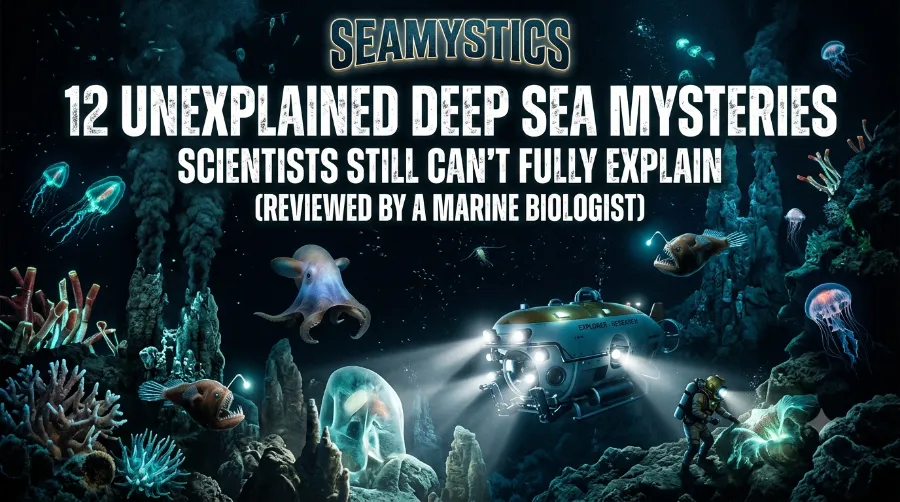

The ocean covers most of our planet, yet we know less about its floor than we know about the surface of Mars. That single fact should stop you in your tracks. Every year, new expeditions turn up creatures, sounds, and structures that break the rules we thought we understood about life on Earth. As a marine biologist who has spent two decades studying life below the surface, I still get goosebumps writing about unexplained deep sea mysteries because, frankly, the list keeps growing instead of shrinking.
To get a better understanding of how mysterious sounds deep ocean breaks down exactly what to expect.
In this guide, we will walk through twelve of the strangest and most puzzling deep sea mysteries that continue to stump researchers today. Along the way, we will also look at whale facts marine mammals lovers will appreciate, since some of the biggest creatures in the sea are tied directly to these mysteries. So grab a cup of tea, because this is going to be a fascinating ride into the dark.
To get a better understanding of how Mariana Trench unexplained mysteries exactly what to expect.
Key Takeaways
| Mystery | Location or Source | Status in 2026 |
|---|---|---|
| Ocean floor mapping | Global seafloor | Only 19% mapped in high resolution |
| Denmark Strait cataract | North Atlantic | Largest waterfall on Earth, mostly unexplored |
| Colossal squid | Southern Ocean | First video ever recorded in 2025, adult still unseen |
| The Bloop | Southern Pacific | Solved in 2005, but sparked decades of theories |
| Golden orb | Gulf of Alaska | Solved in 2026 after a two year investigation |
| Whale falls | Deep ocean basins | New species still being found on carcasses |
| Bermuda Triangle | Western Atlantic | No confirmed scientific cause |
| Yonaguni Monument | Japan | Natural rock or ancient structure, still debated |
Why the Deep Sea Still Hides So Many Secrets
Before we get into the list, it helps to understand why these mysteries have not been solved already. The deep ocean is pitch dark below about 1,000 meters, so light based tools do not work well down there. Pressure at these depths can crush a submarine like a soda can, which limits how often we can send equipment. Because of this, scientists rely on sonar, robotic submersibles, and rare manned dives to gather even small pieces of data.
To get a better understanding of how famous ghost ship mysteries exactly what to expect.
Consequently, most of what happens in the deep sea stays hidden from us for years, sometimes decades. Even so, researchers keep pushing forward, and new discoveries pop up almost every month. That is exactly what makes unexplained deep sea mysteries such an exciting corner of marine science to follow.
If you want to learn more about deep sea creatures unphotographed tips and expert advice.
12 Deep-Sea Mysteries That Still Baffle Scientists
1. The Uncharted Ocean Floor
Here is a fact that surprises most people. We actually don’t know what most of the ocean floor looks like, even though we have detailed maps of the moon and Mars. According to a review from Deep Sea World, scientists have been able to fully map the surface of the moon, yet they still haven’t completed the same task for the ocean floor. Deep Sea World
The good news is that things are improving. Thanks to the global Seabed 2030 project, roughly 19% of the ocean floor is now mapped in high resolution, up from almost nothing a decade ago. Still, that leaves the vast majority of the seabed as a total blank spot on our maps. If you want a deeper breakdown of ocean floor mapping efforts, our team has covered the topic in more detail on our ocean exploration guide. Deep Sea World
2. The World’s Largest Waterfall Is Underwater
Most people picture Niagara Falls or Victoria Falls when they think of waterfalls. However, the largest waterfall on the planet actually sits underwater in the Denmark Strait, between Greenland and Iceland. Cold, dense water tumbles over a massive underwater cliff there, falling roughly 11,500 feet, which dwarfs any waterfall found on land. Reader’s Digest
Because this cataract sits so far below the surface, direct observation is extremely difficult. Researchers mostly study it through temperature and current data rather than actual footage. This underwater giant is a perfect example of how much drama is happening beneath waves we casually glance at from a beach chair.
If you want to learn more about The real science of bioluminescence tips and expert advice.
3. Underwater Brine Pools That Mimic Lakes
Picture an actual lake sitting on the ocean floor, complete with a shoreline and shimmering surface. That is essentially what a brine pool looks like. These pools form when saltwater becomes so concentrated that it becomes denser than the surrounding seawater, so it pools together instead of mixing in.
If you want to learn more about mysterious lights deep ocean tips and expert advice.
Divers and submersibles have filmed these pools looking almost exactly like small lakes, waves and all. Few animals can survive near them because the salt concentration is so extreme, yet strange microbial life still manages to cling on at the edges. Scientists are still working out exactly how many of these pools exist and what unique organisms depend on them.
If you want to learn more about lost shipwrecks ocean floor tips and expert advice.
4. The Colossal Squid Enigma
For nearly a century, the colossal squid was known mostly through dead specimens pulled up in fishing nets. That changed in 2025, when researchers filmed a living colossal squid for the very first time, though it turned out to be just a one foot long baby, leaving the adult form still completely undocumented on camera. Reader’s Digest
Adults are believed to grow up to 45 feet long, based on specimens recovered from whale stomachs and fishing lines. We still do not know how they hunt, how long they live, or how they reproduce in the wild. This gap in knowledge shows just how little we actually understand about even the largest invertebrates on Earth. Reader’s Digest
5. The Elusive Giant Squid
The giant squid is the colossal squid’s slightly better documented cousin, yet it remains just as mysterious in many ways. Some estimates suggest giant squid can grow up to 66 feet long, though scientists admit they have not confirmed the true upper limit of their size. Reader’s Digest
Despite decades of searching, footage of giant squid in their natural deep sea habitat remains extremely rare. Most of what we know comes from carcasses that wash ashore or turn up in fishing gear. If you enjoy stories like this one, our internal deep sea creatures library covers several more species that remain largely unfilmed in the wild.
Now let’s look at how these deep sea giants actually compare in size, since the numbers alone are hard to picture without some context.
If you want to learn more about living fossils found alive tips and expert advice.
If you want to learn more about creatures thought extinct found tips and expert advice.
6. The Bloop Sound Mystery
Back in 1997, hydrophones in the Pacific Ocean picked up an extremely loud, low frequency sound that researchers nicknamed the Bloop. The sound was so powerful that it was detected by sensors thousands of miles apart, and for years people speculated it came from some undiscovered sea monster.
In 2005, after nearly a decade of acoustic analysis, scientists finally identified the source. The Bloop turned out to be the sound of a massive iceberg cracking apart in Antarctica, not a creature at all. Even though this case is technically solved, it remains one of the best examples of how strange and startling ocean sounds can be before scientists figure them out.
7. The Golden Orb of the Gulf of Alaska
In 2023, researchers exploring more than two miles deep in the Gulf of Alaska stumbled upon a strange golden orb sitting on the seafloor. Nobody could immediately explain what it was, and speculation ranged from an unknown egg to something far stranger.
It took over two years of investigation, including DNA sequencing and microscopic analysis, before scientists finally solved the mystery in 2026. The orb turned out to be tissue from a giant deep sea anemone, not an alien object or unknown species. This case shows how even something sitting in plain view on the ocean floor can take years of careful science to properly identify.
Whale Facts, Marine Mammals, and Mysteries Beneath the Surface
8. Whale Falls: Life After Death in the Deep
When a whale dies and sinks to the ocean floor, something remarkable happens. The carcass, known as a whale fall, becomes a food source for an entire community of deep sea creatures that can last for decades. Scavengers strip the flesh first, then specialized worms and bacteria slowly break down the bones themselves.
Researchers keep discovering new species living exclusively on these whale fall sites, and nowhere else on Earth. Because whale falls are so rare and scattered across the ocean floor, we still do not know how many undiscovered species depend on them. It is a strange, quiet reminder that even death in the ocean creates entirely new ecosystems.
9. Whale Song and Marine Mammal Communication
Among the most compelling whale facts marine mammal researchers have documented is the mystery of a single blue whale, sometimes called the loneliest whale, whose calls were recorded at a frequency of 52 hertz, far higher than the typical 15 to 20 hertz range of other blue whales. For years, nobody could confirm why this individual’s calls sounded so different from every other whale ever recorded.
Beyond that famous case, scientists still do not fully understand how whales coordinate migration across thousands of miles, or how calves learn regional song dialects passed down through pods. These communication patterns hint at complex social learning that we are only beginning to study properly. Understanding whale communication could also help researchers protect migration routes, a topic we explore further on our marine mammal conservation guide.
10. The Bermuda Triangle
Few ocean mysteries have captured public imagination quite like the Bermuda Triangle, a stretch of the western Atlantic where numerous ships and planes have reportedly vanished without explanation since the early twentieth century. Popular theories have ranged from magnetic anomalies to sea monsters, though most of these ideas have been debunked over time.
Scientists have proposed more grounded explanations, including especially rough waves, sudden storms, and simple human error during navigation. Even so, there is still no single confirmed cause that explains every disappearance linked to the region. This gap between popular myth and hard evidence is exactly why the Bermuda Triangle remains one of the most talked about unexplained deep sea mysteries today.
11. Mysterious Underwater Structures
Off the coast of Yonaguni Island in Japan sits a rock formation with strikingly straight edges and stepped, terrace like features. Some researchers argue the structure was carved by ancient humans roughly 10,000 years ago, while others insist natural erosion alone can explain the sharp angles.
A similar debate surrounds the Bimini Road near the Bahamas, a line of flat stones resembling a paved road beneath shallow water. Despite multiple dives and geological studies, nobody has confirmed whether either structure is natural or man made. Until clearer evidence emerges, both sites will likely stay firmly in the unexplained column.
12. Ancient Deep-Sea Ecosystems Frozen in Stone
In 2026, a paleoecologist hiking through Morocco’s Central High Atlas Mountains noticed unusual wrinkle patterns preserved in ancient rock, patterns that should not exist in that location according to standard geological models. Further study suggested these wrinkles were formed by microbial mats that once lived on a deep sea floor, long before that seabed was pushed up into mountains.
This discovery hints at a hidden ecosystem that thrived in total darkness millions of years ago, similar in some ways to the chemosynthetic communities found near modern hydrothermal vents. Researchers are still working out how widespread these ancient ecosystems once were. Findings like this remind us that deep sea mysteries are not limited to the modern ocean, they are written into the rocks beneath our feet as well.
How Researchers Study Unexplained Deep Sea Mysteries
Understanding these mysteries takes more than a single tool or method. Scientists typically combine several approaches to build a clearer picture over time.
- Sonar mapping to build rough images of the seafloor from surface ships
- Remotely operated vehicles (ROVs) to film and sample areas too deep for human divers
- DNA sequencing to identify tissue or organisms that cannot be recognized visually
- Hydrophone networks to track unusual sounds across vast distances
- Deep sea submersibles for rare, direct human observation of extreme depths
Each of these tools has limitations, which is exactly why mysteries can take years, or even decades, to solve. Progress often depends on new technology becoming available rather than simply trying harder with old equipment.
That stdy climb is encouraging, but it also shows how far the Seabed 2030 project still has to go before the ocean floor is fully mapped.
What This Means for the Future of Ocean Science
These twelve cases are only a small sample of what remains unknown beneath the waves. As mapping technology improves and expeditions become more frequent, some of these unexplained deep sea mysteries will likely be solved within the next decade. Others, however, may stay puzzling for much longer simply because the deep ocean is so difficult to reach.
For readers who want to explore more marine topics, our team regularly publishes updates on new expeditions and discoveries at Sea Mystics. We also maintain a growing archive covering whale facts marine mammals and deep sea biology for anyone who wants to go further down this rabbit hole.
Frequently Asked Questions
What is the biggest unsolved mystery of the deep sea?
Most marine biologists would point to the unmapped ocean floor itself, since roughly 81% of it has still not been surveyed in high resolution as of the most recent Seabed 2030 reporting.
Has the giant squid ever been filmed alive?
Yes, footage of a giant squid in its natural habitat has been captured before, though sightings remain extremely rare, and the colossal squid was only filmed alive for the first time in 2025.
Are whale falls dangerous to divers?
Whale falls are not inherently dangerous, but they are usually located far too deep for recreational divers to safely reach, so most observation happens through submersibles instead.
Is the Bermuda Triangle scientifically real?
The region itself is real, but there is no confirmed scientific evidence that it causes more disappearances than any other heavily trafficked stretch of ocean.
Why haven’t we mapped the entire ocean floor yet?
Mapping the seafloor requires specialized sonar equipment and significant ship time, both of which are expensive and slow compared to satellite based mapping used on land.
Conclusion
The deep sea remains one of the last true frontiers on our planet, and that is exactly what makes it so captivating. From uncharted seafloor terrain to whales with mysterious calls, each of these twelve cases proves that we still have an enormous amount to learn about the water covering most of Earth. As new technology continues to develop, I expect several of these mysteries to finally get answers within our lifetime, while a few will likely keep scientists guessing for generations to come.
References
- Deep Sea World, “Mysteries of the Ocean We Still Don’t Know,” https://www.deepseaworld.com/blog/mysteries-of-the-ocean-we-still-dont-know/
- PADI Blog, “Ocean Mysteries Scientists Are Still Trying to Solve,” https://blog.padi.com/ocean-mysteries-scientists-are-still-trying-to-solve/
- Reader’s Digest, “14 Mysteries of the Ocean Scientists Still Can’t Explain,” https://www.rd.com/list/ocean-mysteries/
- NOAA Ocean Exploration, via ScienceDaily, “Scientists Finally Solve Mystery of Strange Golden Orb Found 2 Miles Deep,” 2026
- Seabed 2030 Project, global ocean floor mapping initiative
- University of Texas at Austin research on ancient chemosynthetic ecosystems, Central High Atlas Mountains, Morocco, 2026