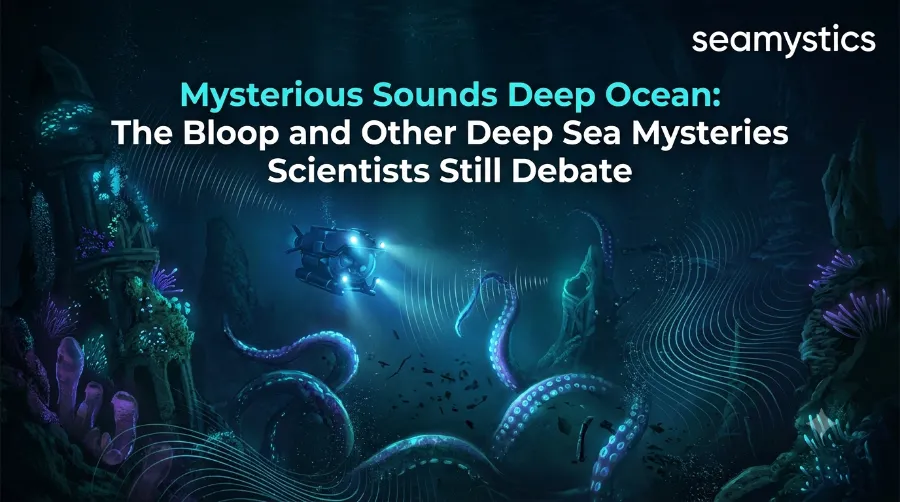

Picture a hydrophone sitting on the seafloor. Without warning, it picks up a boom so loud it crosses thousands of miles of open water. That is exactly what happened in the summer of 1997. It is why people still talk about the mysterious sounds deep ocean researchers have picked up over the decades. Some of these noises turned out to be whales. Others turned out to be cracking ice. A few are still open questions. This piece walks through the most famous cases, what scientists now believe caused them, and why these Deep Sea Mysteries keep drawing new research today.
To get a better understanding of how famous ghost ship mysteries exactly what to expect.
To get a better understanding of how Mariana Trench unexplained mysteries exactly what to expect.
Key Takeaways
| Topic | Quick Fact |
|---|---|
| The Bloop | Recorded in 1997, explained in 2005 as an Antarctic icequake |
| Biotwang | First heard in 2014, traced to Bryde’s whales in 2024 with help from AI |
| Bio-duck | Heard since the 1960s, linked to Antarctic minke whales in 2014 |
| 52-Hertz whale | Detected since 1989, species still not confirmed as of 2026 |
| Upsweep | First recorded in 1991, likely linked to underwater volcanic activity |
| Ocean coverage | Roughly 80 to 95 percent of the seafloor remains unmapped |
What Makes The Deep Ocean So Noisy In The First Place
Sound behaves differently underwater than it does in air. Water is denser than air, so sound waves travel farther and faster through it. This is one reason mysterious sounds deep ocean listening stations record can travel thousands of miles before anyone hears them.
If you want to learn more about deep sea creatures unphotographed tips and expert advice.
Scale plays a role too. Humans have never directly observed roughly 80 percent of the ocean floor. Some researchers put the truly mapped fraction even lower. That leaves enormous room for strange noises to appear without an obvious nearby source.
If you want to learn more about The real science of bioluminescence tips and expert advice.
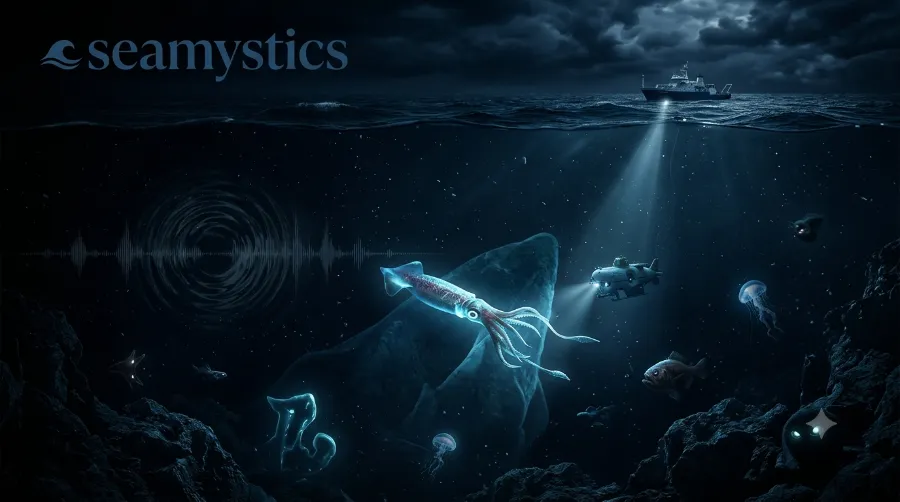
A mix of causes drives most of these sounds. Marine animals like whales create some of them. Geology creates others, including volcanoes, earthquakes, and cracking glaciers. Human activity, like shipping and sonar, causes a smaller share. Sorting one cause from another still takes years of patient listening.
If you want to learn more about mysterious lights deep ocean tips and expert advice.
The Bloop: The Sound That Started It All
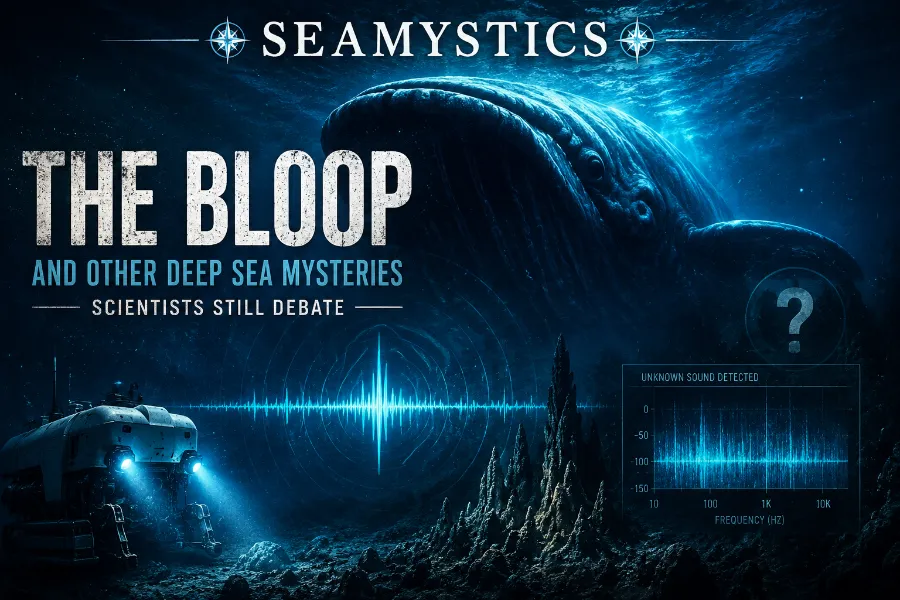
In the summer of 1997, NOAA researchers were monitoring hydrophones for volcanic tremors in the South Pacific. Their equipment sat more than 3,000 miles apart. It picked up a strange, ultra low frequency signal. The sound rose and fell over about a minute. When researchers sped it up, it resembled a bubbling noise, so the team nicknamed it “the Bloop.”
If you want to learn more about lost shipwrecks ocean floor tips and expert advice.
How NOAA Hydrophones Caught The Bloop
NOAA originally built these hydrophones for a different purpose. The network was meant to track undersea earthquakes and volcanic activity, not to hunt for sea creatures. Nothing in the historical record matched this new sound’s signature.
If you want to learn more about living fossils found alive tips and expert advice.
The sound’s reach stood out most. Robert Dziak, a NOAA acoustics researcher, has noted that sensors thousands of miles apart picked up the same signal. Almost no known animal call could travel that far. Speculation quickly took over.
If you want to learn more about creatures thought extinct found tips and expert advice.
Why People Thought It Was A Sea Monster
Word of the Bloop spread beyond scientific circles, and public imagination ran wild. Theories ranged from secret military testing to fishing equipment. Eventually, the idea of an undiscovered giant sea creature took hold. Humans had explored only about 5 percent of the ocean at the time, so the idea did not seem far fetched to many people.
The sea monster comparison stuck around for years. It even shaped references in horror and fantasy fiction. Meanwhile, scientists kept working the problem quietly in the background.
The Real Answer: Icequakes And Climate Change
NOAA researchers moved hydrophones closer to Antarctica. There, they began recording low frequency, high amplitude events that closely matched the original Bloop signal. In 2005, the team concluded the sound matched an icequake. An icequake happens when large icebergs crack and break away from Antarctic glaciers. Later analysis around 2012 confirmed this explanation with even more data.
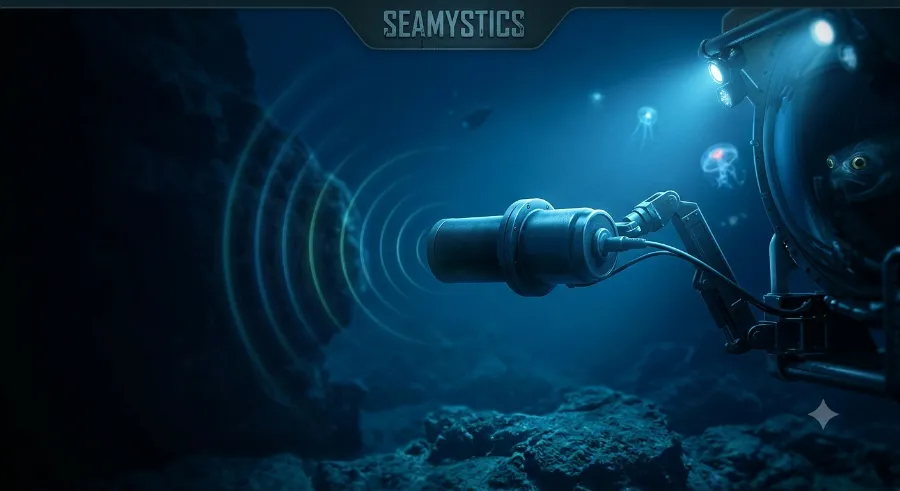
Between 2007 and 2008, NOAA hydrophones in the Scotia Sea picked up numerous glacial earthquakes. Their spectrograms nearly matched the Bloop. Researchers even used these signals to track a massive iceberg, A53a, as it broke apart near South Georgia Island in early 2008. NOAA reports that tens of thousands of icequakes now happen every year, and that number keeps rising as global temperatures increase.
So the Bloop was never a monster. Instead, it turned out to be an early acoustic signal of a changing climate. In some ways, that explanation feels more unsettling than any imagined creature. NOAA breaks down the full technical story on their acoustics monitoring program page.
Beyond The Bloop: Other Deep Sea Mysteries Scientists Have Tracked
The Bloop is famous, but it is far from the only strange noise NOAA and other research teams have recorded. Several other sounds carry their own nicknames, timelines, and eventual explanations. Together, they show just how much sound activity happens beneath the waves at any given moment.
The Biotwang: A Frog Burping In Space
In October 2014, autonomous underwater gliders picked up an odd sound near the Mariana Trench. Researchers heard a low moan followed by a squeaky, metallic echo. Some compared it to a frog burping in space. The sound spanned an unusually wide range, starting around 38 hertz and finishing near 8,000 hertz.
The source remained unclear for years. Then, during a 2018 survey near the Mariana Islands, NOAA researchers spotted Bryde’s whales ten separate times. Nine of those ten sightings included the biotwang sound. NOAA researcher Ann Allen summed it up simply: once is a coincidence, twice is happenstance, but nine times points strongly to a Bryde’s whale.
To confirm the pattern, the team partnered with Google and built an AI model. That model scanned more than 200,000 hours of underwater recordings. Frontiers in Marine Science published the results in September 2024, confirming that biotwangs occurred seasonally and matched known Bryde’s whale migration routes. Scientific American’s coverage of the discovery walks through how the AI analysis sealed the case.
Julia, Upsweep, And The Bio-Duck
Not every strange sound gets a fast answer. Some take on a life of their own before scientists catch up. Here are three more entries that regularly show up on lists of Deep Sea Mysteries.
- Julia: NOAA’s equatorial hydrophone array recorded this sound on March 1, 1999. It got its nickname because it resembled a muffled woman’s voice. Scientists now generally attribute it to a large iceberg scraping the seafloor near Antarctica.
- Upsweep: Researchers first recorded this sound in August 1991. It is loud enough to reach across the entire Pacific Ocean. Scientists believe the source sits somewhere between New Zealand and the southern tip of South America, likely tied to volcanic or seismic activity. Its intensity has slowly declined since 1991.
- Bio-duck: Australian surveyors first noticed this quacking noise in the 1960s. It puzzled scientists for decades. Researcher Denise Risch led a 2014 study in Biology Letters that finally confirmed Antarctic minke whales made the sound.
Discover Wildlife’s guide to weird ocean sounds offers a broader roundup if you want to keep exploring after this article.
The 52-Hertz Whale: The Loneliest Voice In The Ocean
The 52-hertz whale might be the most emotionally resonant case on this list. A U.S. Navy hydrophone system first detected it in 1989. The Navy had originally built that system to track Soviet submarines. This particular whale calls at a frequency far higher than typical blue or fin whale calls, which usually sit between 10 and 39 hertz.
William Watkins of the Woods Hole Oceanographic Institution tracked this whale’s calls for years. The Navy partly declassified the underlying data in 1992, which gave civilian researchers access. Between 2002 and 2003 alone, the whale’s recorded seasonal travel distance ranged from 708 kilometers to more than 11,000 kilometers. No other whale ever seemed to answer its calls, so it earned the nickname “the world’s loneliest whale.” NBC News covered the story in detail.
More recent research complicates that lonely narrative somewhat. In 2010, a separate hydrophone array picked up a possible second source calling at a similar frequency. This suggests more than one such whale may exist. As of 2026, scientists still have not confirmed the exact species behind the call, so this mystery remains open.
Comparing The Cases At A Glance
Here is a quick side by side look at how these cases compare, drawn from the sources above.
| Sound | First Detected | Solved | Likely Source |
|---|---|---|---|
| The Bloop | 1997 | 2005 | Antarctic icequake |
| Bio-duck | 1960s | 2014 | Antarctic minke whale |
| Biotwang | 2014 | 2024 | Bryde’s whale |
| Upsweep | 1991 | Not fully confirmed | Volcanic or seismic activity |
| 52-Hertz whale | 1989 | Not confirmed | Unknown, possibly a hybrid whale |
Some of these cases took years to close. One has stretched on for over three decades without a firm answer. The chart above lays out how long each mystery took, from first detection to explanation, and the gap between cases is striking.
How Scientists Track Down Mysterious Sounds Deep Ocean Waters Hide
Solving one of these cases rarely happens fast. It almost never involves a single breakthrough moment. Instead, researchers usually follow a repeatable process, refined over decades of ocean acoustics work.
- Detect and record. A hydrophone array picks up an unusual signal, often by accident while monitoring for something else, such as seismic activity.
- Compare spectrograms. Scientists convert the sound into a visual frequency pattern and compare it against a growing library of known signals.
- Deploy closer sensors. Teams move equipment nearer to the suspected source region to gather cleaner, more detailed recordings.
- Cross reference with sightings. If an animal is suspected, researchers try to match sound recordings with direct visual observations in the same place and time.
- Apply modern tools. Machine learning models can now scan hundreds of thousands of hours of audio in a fraction of the time it once took humans, as the biotwang case showed.
This process explains why the Bloop took about eight years to solve, while the bio-duck took over fifty. Every extra piece of data narrows the possibilities, even when the final answer takes a long time to arrive.
Why These Deep Sea Mysteries Still Matter Today
It would be easy to treat these sounds as trivia. That would be a mistake, though, because several of these cases connect directly to bigger issues facing the ocean right now.
Take the Bloop as an example. Scientists ultimately traced it to glacial ice breaking apart. NOAA has noted that these icequakes are becoming more frequent as global temperatures rise. In that sense, the sound now functions almost like an early acoustic warning sign of climate change, even though nobody recognized it that way back in 1997.
Cases like the biotwang and bio-duck reveal how little we still know about whale populations, especially elusive species such as the Bryde’s whale. Visual surveys alone struggle to track migration and behavior for these animals. Acoustic monitoring gives researchers a second, often more reliable, window into their lives. Understanding where and when whales travel also helps conservation efforts respond to shifting ocean conditions.
Unresolved cases such as the 52-hertz whale remind us how much of the ocean remains genuinely unexplored. If you want to go deeper into other unexplained phenomena beneath the waves, our full guide to unexplained deep sea mysteries covers several cases not included here, and we update it regularly as new research comes out.
Frequently Asked Questions
Is the Bloop sound still a mystery?
No. NOAA concluded in 2005, with further confirmation around 2012, that the Bloop came from a large Antarctic icequake, not a marine animal.
What is the loudest sound ever recorded in the ocean?
Researchers often cite the Bloop as one of the loudest natural sounds ocean hydrophones have ever picked up, detectable across thousands of miles of water.
Has the 52-hertz whale ever been seen?
No. As of 2026, nobody has visually confirmed the whale behind the 52-hertz call, though hydrophones have tracked its calls since 1989.
Why do deep ocean sounds travel so far?
Water carries sound much more efficiently than air does, especially at low frequencies, so certain signals can travel thousands of miles before fading out.
Are there still unexplained ocean sounds today?
Yes. Sounds such as Upsweep and the exact species behind the 52-hertz call still lack full explanations, and researchers continue investigating them using newer acoustic and AI tools.
Conclusion
The story of the Bloop and its stranger relatives shows just how much detective work goes into understanding what happens beneath the ocean’s surface. Patient hydrophone monitoring, and more recently artificial intelligence, eventually cracked cases like the Bloop and the biotwang. The 52-hertz whale remains an open question even after decades of listening. Either way, each solved or unsolved case adds another piece to our understanding of a part of the planet that stays less explored than the surface of the Moon, by most estimates. For more deep dives like this one, explore the full collection of ocean stories at Sea Mystics.
References
- NOAA Pacific Marine Environmental Laboratory, Acoustics Monitoring Program, Icequakes (Bloop)
- NOAA Ocean Service, What is the Bloop?
- Scientific American, Mystery of Deep Ocean Biotwang Sound Has Finally Been Solved
- Discover Wildlife, Weirdest Ocean Noises
- NBC News, coverage of the 52-hertz whale
- Biology Letters (2014), Mysterious bio-duck sound attributed to the Antarctic minke whale
- Frontiers in Marine Science (September 2024), biotwang and Bryde’s whale study