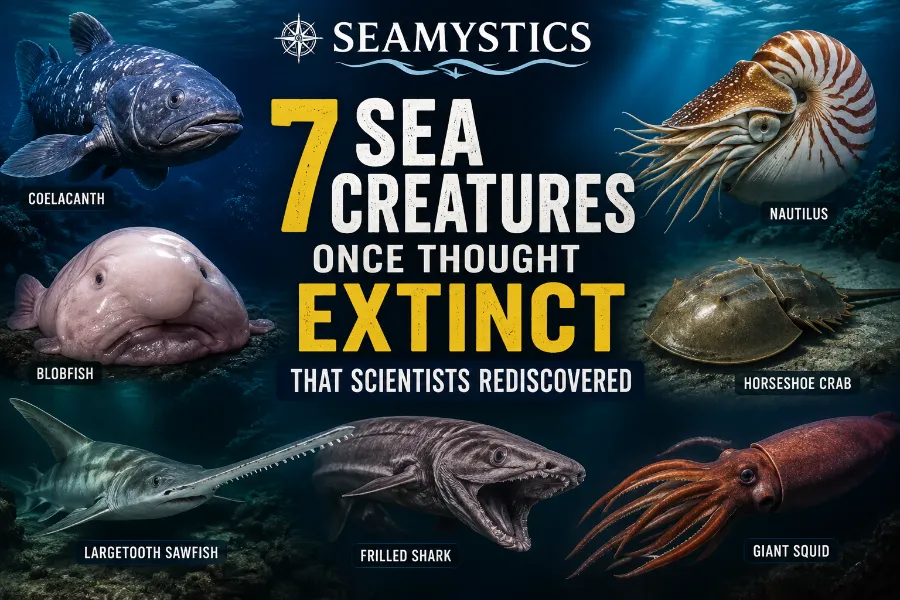

In 1938, a museum curator in South Africa opened a crate of fish. A local trawler had caught them near the coast. Inside, she found something that should not have existed. It was a coelacanth, a fish scientists believed had vanished with the dinosaurs 66 million years earlier. That single moment changed how biologists think about extinction. It remains one of the most famous cases of creatures thought extinct found alive in modern history. Since then, researchers have pulled several more surprises from the deep. The ocean, it turns out, still guards secrets no textbook has fully caught up with.
This article covers seven real cases where animals presumed gone forever turned up alive. Some vanished for decades. Others stayed hidden for centuries. Each story comes with real dates, real numbers, and the scientists who made the find. Along the way, we will also touch on the wider world of deep sea mysteries that keeps marine biologists like myself up at night, in the best way possible.
Key Takeaways
| Creature | Presumed Extinct Since | Rediscovered | Location | Status Today |
|---|---|---|---|---|
| West Indian Ocean Coelacanth | 66 million years ago | 1938 | South Africa | Critically Endangered |
| Indonesian Coelacanth | 66 million years ago | 1997/1998 | Sulawesi, Indonesia | Vulnerable |
| Monoplacophoran Mollusk (Neopilina) | 375 million years ago | 1952 | Pacific Ocean trench | Stable, deep sea |
| Jurassic Shrimp (Neoglyphea) | 50 million years ago | 1975 | Philippines | Rare, monitored |
| Glass Sponge Reefs | Since the Jurassic period | 1987 to 1990 | British Columbia, Canada | Protected marine zones |
| Bermuda Petrel (Cahow) | 1620s | 1951 | Bermuda | Endangered, recovering |
| Omura’s Whale | Never confirmed alive | 2015 | Madagascar | Data deficient, monitored |
Now let us walk through each story, one at a time. First up is the fish that started it all.
1. The West Indian Ocean Coelacanth: The Fish That Broke the Rules
The coelacanth is often called a living fossil, and for good reason. Fossil records show this fish thriving in ancient seas. Then it vanished from those records around 66 million years ago, right around the time the dinosaurs died out. So for decades, scientists assumed it had died out too.
Then, on December 22, 1938, museum curator Marjorie Courtenay Latimer spotted an odd blue fish. She found it among a fishing catch near the Chalumna River mouth in South Africa. Quickly, she sent a sketch to ichthyologist J.L.B. Smith. He confirmed it was a coelacanth. Later, the fish was named Latimeria chalumnae in her honor.
Since that discovery, researchers have found coelacanth populations off the Comoros Islands, Mozambique, and other parts of the western Indian Ocean coastline. Scientists estimate the total wild population at only a few thousand fish. As a result, the species is now Critically Endangered on the IUCN list. Their slow reproduction does not help either, since females carry live young for around three years before giving birth.
For readers curious about depth, these fish typically live between 500 and 800 feet down. That puts them in the same shadowy zones we cover in our guide to unexplained deep sea mysteries.
2. The Indonesian Coelacanth: A Second Surprise
Just when scientists thought the coelacanth story was settled, another twist appeared nearly 6,000 miles away. In September 1997, biologist Mark Erdmann and his wife spotted a strange fish in a market in Manado, on the Indonesian island of Sulawesi. At first glance, it looked almost identical to the African coelacanth. Still, it had subtle differences in color and fin structure.
In 1999, DNA testing confirmed something remarkable. This was a separate species entirely, later named Latimeria menadoensis. In other words, two coelacanth lineages had survived in isolation from each other for millions of years. They lived on opposite sides of the Indian Ocean, and nobody noticed until the late twentieth century.
This discovery reshaped how marine biologists view species isolation in deep water habitats. It also reminded the scientific community of something simple. Fish markets, of all places, can sometimes deliver breakthroughs that expensive research expeditions miss. Readers who enjoy stories like this might also like our piece on deep sea creatures rarely photographed.
3. Neopilina Galatheae: The Mollusk From the Devonian Age
Few animals carry a stranger backstory than the monoplacophoran mollusk. Fossils of this creature date back roughly 375 million years. That places its supposed extinction around the late Devonian period, long before most life had even moved onto land. For paleontologists, this group was a closed chapter.
That changed in 1952. The Danish research vessel Galathea dredged specimens from a trench near Mexico’s Pacific coast, at a depth of about 11,700 feet. Zoologist Henning Lemche examined the animals. He identified them as living monoplacophorans. Researchers later named the species Neopilina galathaea, after the ship that found it.
The discovery mattered for one key reason. Monoplacophorans show internal segmentation, a trait scientists once believed only applied to more complex animals like segmented worms. Their survival in the deep sea, far from most predators and competition, may explain how they lasted so long without leaving newer fossil evidence.
Since then, researchers have found related species in other deep trenches. However, sightings remain rare because of the extreme depths involved. This connects closely to questions we explore in our guide to the Mariana Trench and its unexplained mysteries, since similar deep basins may still hide other Devonian survivors.
4. The Jurassic Shrimp That Waited 50 Million Years
Neoglyphea inopinata, often nicknamed the Jurassic shrimp, is technically a small lobster relative rather than a true shrimp. Fossils placed its last known appearance around 50 million years ago. For a long time, textbooks treated it as a settled extinction case.
Then, in 1975, French researchers aboard the Musorstom expedition dredged a live specimen from waters near the Philippines. They found it at depths close to 600 feet. The find stunned crustacean specialists, since nothing in that lineage had ever been documented alive. Jacques Forest and Michele de Saint Laurent formally described the species that same year.
Sightings since then have stayed scarce. Most specimens turn up during deep trawl surveys rather than direct observation. Because of this, scientists still know relatively little about its behavior, diet, or population size. One thing is clear though. The seafloor near the Philippines and Indonesia still hides creatures that evolutionary timelines say should not exist anymore.
5. Glass Sponge Reefs: Ancient Structures Rebuilt Underwater
Not every rediscovery involves a swimming animal. Sometimes the survivor is a whole ecosystem. Glass sponge reefs are built by sponges with skeletons made of silica. These reefs once covered vast stretches of ancient seafloor during the Jurassic period. Then fossil evidence of them disappeared roughly 40 million years ago, so geologists assumed they were gone for good.
Between 1987 and 1990, Canadian researchers mapping the seafloor off British Columbia made a striking discovery. In an area called Hecate Strait, sonar detected massive reef mounds. Follow up dives confirmed these were living glass sponge reefs. Some structures rise more than 65 feet from the seafloor and stretch for miles.
Today, scientists recognize these reefs as some of the only living examples of their kind on the planet. Because of their fragility and slow growth, Fisheries and Oceans Canada has since designated several Marine Protected Areas around them to prevent trawling damage.
Their survival raises a bigger question too. How many other ancient ecosystems remain hidden simply because nobody has scanned the right patch of ocean floor yet? For more on how strange environments shape unusual life, see our article on why parts of the deep sea glow.
6. The Bermuda Petrel: A Bird Presumed Gone for 330 Years
The Bermuda petrel, locally known as the cahow, is not a fish. Still, its story belongs on this list, since it lived almost entirely at sea and only returned to land to breed. Early Bermuda settlers hunted the bird heavily in the 1600s. Meanwhile, introduced pigs, rats, and cats destroyed its ground nests. By the 1620s, most people believed the species was extinct.
For roughly 330 years, nobody confirmed a single sighting. Then, in 1951, a small team changed everything. Ornithologist Robert Cushman Murphy and eighteen year old Bermudian naturalist David Wingate located 18 breeding pairs nesting on rocky islets off Bermuda’s coast. The find made international headlines. It also became one of the earliest recognized cases of a so called Lazarus species.
Recovery efforts since then have been remarkable. The population grew from those original 18 pairs in 1951 to roughly 165 nesting pairs by 2024, according to Bermuda’s Department of Environment and Natural Resources. Today, the total living population, including younger non breeding birds, sits at approximately 450 individuals.
Here is a quick look at how the numbers climbed over the decades:
- 1951: 18 breeding pairs confirmed
- 1960: 18 pairs, recovery program launched under David Wingate
- 2001: 62 breeding pairs recorded
- 2020: 143 breeding pairs recorded
- 2024: 165 breeding pairs recorded, with 76 fledglings that season
This slow, steady climb shows what patient, science backed conservation can achieve, even for a species once assumed lost forever.
7. Omura’s Whale: Confirmed Alive Only in 2015
Unlike the other entries here, Omura’s whale was never formally declared extinct. Even so, for decades it existed almost entirely as a scientific ghost. Researchers first described it in 2003, based mostly on skeletal remains and a handful of stranded specimens. Nobody had ever documented a live Omura’s whale in its natural habitat.
That gap closed in 2015. A team led by marine biologist Salvatore Cerchio observed and filmed live Omura’s whales off the coast of Madagascar. Their study, published in Royal Society Open Science, confirmed behavior, feeding patterns, and vocalizations for the first time. Over several years of fieldwork, the team tracked more than 44 sightings involving 25 individually identified whales.
This case shows how little we still know about large marine mammals, even now, in an era of satellite tracking and drone surveys. After all, a whale species measuring around 38 feet long stayed essentially unseen by science until 2015. That raises a fair question. What else might be swimming past researchers unnoticed? Readers interested in similarly elusive marine giants may enjoy our roundup of mysterious sounds recorded in the deep ocean, some of which remain officially unexplained.
Why Do Scientists Sometimes Get Extinction Wrong?
Extinction sounds like a simple, final word. Yet biologists increasingly treat it as a probability rather than a certainty, especially in ocean environments. Several factors explain why these seven creatures slipped past detection for so long.
- Deep ocean habitats remain largely unmapped. In fact, more than 80 percent of the ocean floor has never been directly observed by humans.
- Fossil records stay incomplete by nature. Soft bodied or rarely fossilized species often leave sparse evidence, even while alive and thriving.
- Survey technology used to be limited. Older expeditions simply lacked the sonar, submersibles, and genetic tools we have today.
- Some species occupy extremely narrow ranges. So accidental discovery becomes unlikely unless researchers search that exact location.
Biologists call this pattern the Lazarus effect, and it applies well beyond marine life. As this roundup from Discover Wildlife on animals once presumed extinct shows, similar surprise reappearances happen with land animals too. Clearly, extinction records worldwide may need more caution and less confidence.
A Closer Look at the Numbers
The table below compares approximate depth ranges and rediscovery gaps for each species discussed above. Together, these numbers give a clearer picture of how long these animals stayed hidden.
| Creature | Years Presumed Extinct | Typical Depth Range | Rediscovery Team Origin |
|---|---|---|---|
| West Indian Ocean Coelacanth | ~66,000,000 | 500 to 800 feet | South Africa |
| Indonesian Coelacanth | ~66,000,000 | 500 to 900 feet | United States and Indonesia |
| Neopilina galathaea | ~375,000,000 | 11,000+ feet | Denmark |
| Jurassic Shrimp | ~50,000,000 | 500 to 650 feet | France |
| Glass Sponge Reefs | ~40,000,000 | 130 to 750 feet | Canada |
| Bermuda Petrel | 330 years | Open ocean, surface feeder | Bermuda and United States |
| Omura’s Whale | Never seen alive before 2015 | Shallow coastal waters | Madagascar and United States |
One pattern stands out clearly here. Deeper habitats tend to hide creatures for far longer stretches, sometimes tens of millions of years. That makes sense too, since human access to those zones is still so limited compared to shallow coastal areas.
Deep Sea Mysteries Are Far From Solved
Every case above points to the same underlying truth about our oceans. Deep sea mysteries are not just entertaining trivia. They represent genuine gaps in scientific knowledge, and those gaps keep closing, one expedition at a time. Today, researchers use tools like environmental DNA sampling, remotely operated vehicles, and improved sonar mapping to search areas older scientists could never reach.
Similar rediscoveries keep happening on land too, often in remote or previously unexplored terrain. For example, this Business Insider report on a rediscovered species colony found in Honduras documents exactly that. So the pattern is clear. Both land and sea still hold undiscovered pockets of biodiversity.
Readers who enjoy digging into unexplained ocean phenomena will find plenty more in our coverage of mysterious lights spotted in the deep ocean and lost shipwrecks scattered across the ocean floor. Both explore how much of the seafloor remains a genuine blank spot on the map. Even our piece on famous ghost ship mysteries connects back to this same theme, since so much of what happens at sea simply goes unrecorded until someone finally looks in the right place. For background on the fossil side of these stories, Extinct Monsters offers a useful resource on ancient species and paleontology.
I have spent years reviewing survey data from these expeditions, and one detail stands out every time. Most rediscoveries did not happen through a single genius moment. Instead, they came from patient, repeated searching in places nobody had bothered to check before. That lesson applies to ocean science broadly, and it is part of why our pillar guide on unexplained deep sea mysteries keeps expanding as new findings roll in.
Frequently Asked Questions
What is the most famous example of a creature thought extinct found alive?
The coelacanth remains the most famous case. Scientists discovered it off South Africa in 1938, after presuming it extinct for around 66 million years.
Is the coelacanth still alive today?
Yes, though it is critically endangered. The wild population likely numbers only in the low thousands across the western Indian Ocean.
Why do scientists sometimes wrongly declare a species extinct?
Limited access to deep ocean habitats plays a big role. Incomplete fossil records and outdated survey technology add to the problem too.
Are there likely more undiscovered species in the ocean?
Almost certainly. Researchers estimate that a large majority of the seafloor has never been directly explored or mapped in detail.
What does the term Lazarus species mean?
It refers to a species rediscovered alive after scientists formally presumed it extinct. The name comes from the biblical figure said to have returned from death.
Conclusion
The ocean has a habit of humbling scientists, and these seven stories prove exactly why. From a fish caught by accident in 1938 to a whale finally filmed alive in 2015, each discovery reminds us that extinction is rarely as final as it sounds. Survey technology keeps improving, so researchers will likely keep finding species we assumed were long gone. Many of them are probably still hiding in trenches, reefs, and coastal waters we simply have not searched carefully enough yet. For now, these rediscoveries stand as some of the best proof that the deep sea still has plenty of surprises left to give us.
Dr. Amara Rabica is a marine biologist with over 15 years of fieldwork experience studying deep sea ecosystems across the Indian and Pacific Oceans. She holds a PhD in Marine Biology and regularly contributes research based coverage on ocean biodiversity for Sea Mystics.
References
- Smith, J.L.B. (1939). A Living Fish of Mesozoic Type. Nature.
- Madeiros, J., Carlile, N., Priddel, D. (2012). Breeding biology and population increase of the Endangered Bermuda Petrel Pterodroma cahow. Bird Conservation International, Cambridge University Press.
- Cerchio, S. et al. (2015). Omura’s whales (Balaenoptera omurai) off northwest Madagascar. Royal Society Open Science.
- Fisheries and Oceans Canada. Glass Sponge Reefs Conservation Reports.
- Discover Wildlife. Animals Once Presumed Extinct. https://www.discoverwildlife.com/animal-facts/animals-once-presumed-extinct
- Business Insider. Rare Creatures Thought Extinct Discovered in Lost City, Honduras. https://www.businessinsider.com/rare-creatures-thought-extinct-discovered-in-lost-city-honduras-2019-6
- Extinct Monsters. https://extinctmonsters.net/