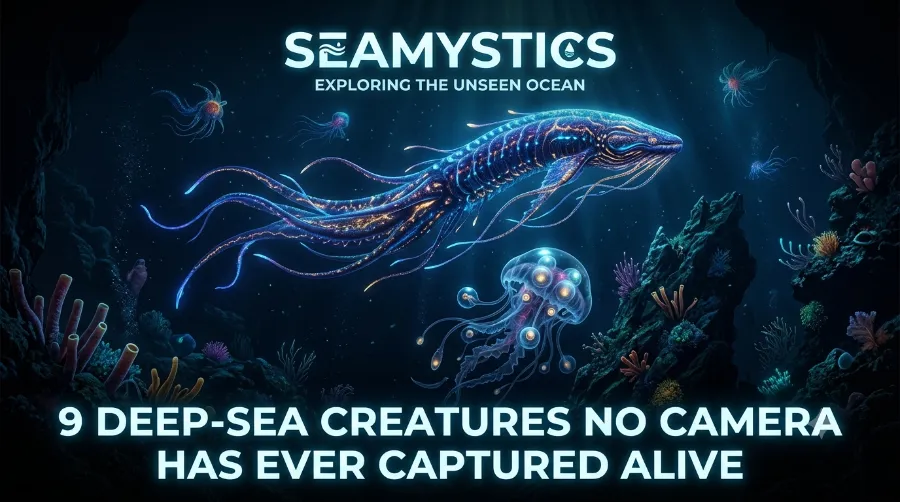

The ocean floor holds more secrets than outer space, and that is not an exaggeration. Humans have mapped the surface of Mars in sharper detail than the bottom of our own seas. Somewhere below 3,000 meters, in total darkness and crushing pressure, there are still deep sea creatures unphotographed by any lens, human or robotic. Scientists know these animals exist because of torn nets, sonar echoes, and bite marks on submarine cables, yet not one camera has ever caught them living and breathing in their natural world.
To get a better understanding of how famous ghost ship mysteries exactly what to expect.
This gap between knowing and seeing is what makes deep sea mysteries so gripping. Every year, research vessels push a little deeper, and every year, a few more shadows step into the light. But as you will see below, several giants of the abyss still refuse to show their faces, and that stubborn silence is part of what keeps ocean science moving forward.
To get a better understanding of how Mariana Trench unexplained mysteries exactly what to expect.
Key Takeaways
| Creature | Depth Range | Status as of 2026 | Fascinating Fact |
|---|---|---|---|
| Adult Colossal Squid | 1,000 to 2,200 meters | Only a juvenile filmed in 2025 | Eyes as large as dinner plates |
| Giant Squid Hunting | 300 to 1,000 meters | Filmed near bait, never hunting | Longest recorded specimen was 13 meters |
| Adult Bigfin Squid | 2,000 to 4,800 meters | Only young forms recorded since 1998 | Arms up to 8 meters long |
| Giant Oarfish in Habitat | 200 to 1,000 meters | Only dying or stranded fish seen | Can grow past 11 meters |
| Megamouth Shark Feeding | 15 to 500 meters | Fewer than 100 confirmed sightings | First discovered by accident in 1976 |
| Giant Isopod Mating | Up to 2,140 meters | Never observed in the wild | Can survive without food for years |
| Frilled Shark Hunting | 500 to 1,500 meters | One live clip exists from 2007 | Called a living fossil |
| Unidentified Hadal Organism | 9,100 meters | Found in 2026, still unclassified | Recorded off the coast of Japan |
| The Kraken Legend | Folklore only | Never confirmed to exist | Believed inspired by real giant squid |
Why So Many Deep Sea Creatures Remain Unphotographed
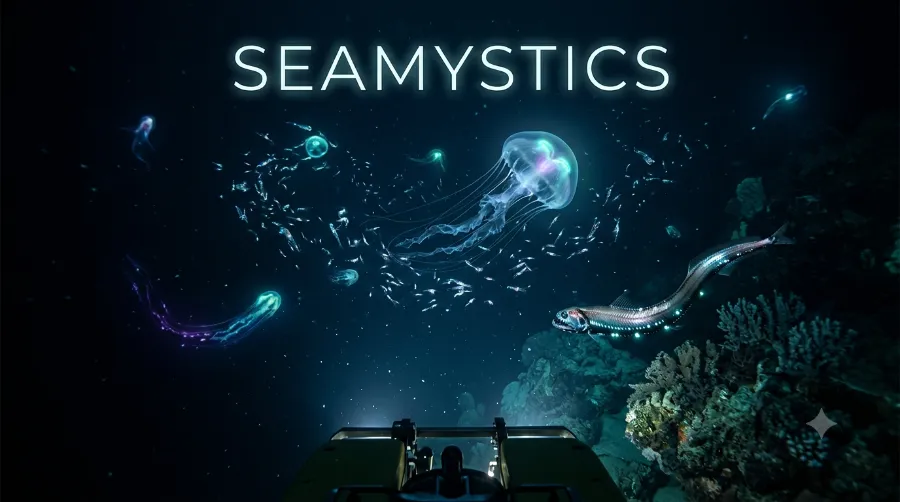
Before diving into the list, it helps to understand why this problem is so stubborn. The deep ocean is not simply dark, it is a place where light has physically never touched the seafloor. Consequently, most animals down there either produce their own glow or have no need for eyes at all.
If you want to learn more about deep sea creatures unphotographed tips and expert advice.
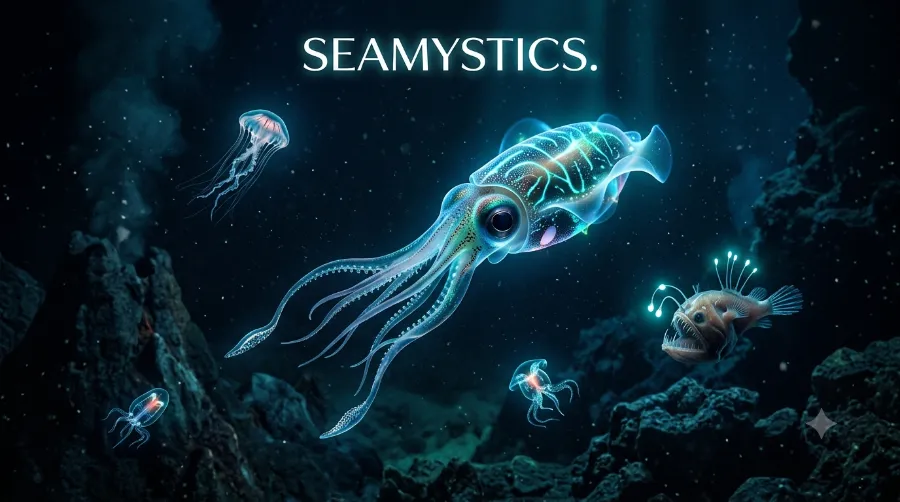
Pressure is another massive barrier. At 4,000 meters, the water pushes down with a force strong enough to crush a submarine that is not built for it. Because of this, only a handful of vehicles on Earth, such as those used by Monterey Bay Aquarium’s deep sea research team, can safely explore that zone with working cameras.
Finally, many of these animals are simply shy or scarce. A creature that lives across thousands of square kilometers of open water, with only a few hundred individuals total, is basically a needle in the largest haystack on the planet. That combination of darkness, pressure, and rarity is exactly why unexplored deep sea mysteries continue to outnumber solved ones. If you want a broader look at this puzzle, our guide on unexplained deep sea mysteries covers the bigger picture.
If you want to learn more about The real science of bioluminescence tips and expert advice.
Finally, many of these animals are simply shy or scarce. A creature that lives across thousands of square kilometers of open water, with only a few hundred individuals total, is basically a needle in the largest haystack on the planet. That combination of darkness, pressure, and rarity is exactly why unexplored deep sea mysteries continue to outnumber solved ones. If you want a broader look at this puzzle, our guide on unexplained deep sea mysteries covers the bigger picture.
If you want to learn more about creatures thought extinct found tips and expert advice.
1. The Adult Colossal Squid
The colossal squid, known scientifically as Mesonychoteuthis hamiltoni, is heavier than the more famous giant squid, though it tends to be shorter overall. It lives in the freezing waters around Antarctica, often more than 1,000 meters down. Its eyes are the largest in the animal kingdom, roughly the size of a soccer ball, built to catch every scrap of bioluminescent light.
If you want to learn more about living fossils found alive tips and expert advice.
In March 2025, a research team aboard the Schmidt Ocean Institute’s vessel filmed a young colossal squid for the very first time in its natural habitat. That footage was a landmark moment for marine science. However, the squid caught on camera was only about 30 centimeters long, a baby compared to the estimated 7 meter length of a full-grown adult.
If you want to learn more about mysterious lights deep ocean tips and expert advice.
Therefore, even after that breakthrough, the true giant of this species remains one of the most sought-after deep sea creatures unphotographed to date. Researchers still rely on beaks and tentacle fragments pulled from the stomachs of sperm whales to estimate its true size.
2. The Giant Squid, Caught but Never Truly Seen Hunting
Unlike the colossal squid, the giant squid, Architeuthis dux, has technically been filmed alive. A Japanese and American team achieved this first in 2004, and a clearer video followed in 2012 in the Gulf of Mexico. Both sightings, though, involved the squid approaching a lure or bait rig set by researchers.
As a result, nobody has ever filmed a giant squid doing what it naturally does: actively hunting fish or fending off a sperm whale in open water. The suction cup scars often found on whale skin suggest these battles happen regularly, yet not a single frame of footage exists.
This distinction matters a great deal to biologists. Behavior filmed near an artificial bait rig cannot tell scientists how the animal truly moves, feeds, or defends itself in its own environment. So while the giant squid is no longer a total mystery, its everyday life still is.
3. The Adult Bigfin Squid
The bigfin squid, part of the genus Magnapinna, might be one of the strangest looking animals in the ocean. It has long, spindly arms that trail below it like tangled string, sometimes stretching past 8 meters from an body barely 30 centimeters long. Its first confirmed sighting came from Gulf of Mexico oil rig footage back in 1998.
Since then, ROVs have filmed young and mid-sized individuals dozens of times, mostly between 2,000 and 4,800 meters down. Even so, no camera has ever recorded a fully mature adult specimen, and scientists are not entirely sure how large this species can grow.
Because bigfin squid have never been caught in nets either, almost everything known about them comes from video alone. That leaves a strange gap in the data: researchers can describe the animal’s shape in detail, yet cannot say how big, how old, or how it actually reproduces.
4. The Giant Oarfish in Its True Habitat
Regalecus glesne, commonly called the giant oarfish, is the longest bony fish on Earth, with confirmed lengths beyond 11 meters. For centuries, sailors likely mistook this silvery, ribbon-shaped fish for sea serpents, which fits neatly into the folklore covered in our piece on famous ghost ship mysteries, where sea monster tales often overlap with real maritime history.
Almost every recorded sighting of a giant oarfish involves a dying or already dead individual that has drifted, or been washed, toward the surface. A widely reported case from Baja California in August 2020 involved kayakers filming a live but clearly distressed oarfish near the shoreline. Cases like this happen a few times per decade worldwide.
What remains completely absent is footage of a healthy giant oarfish swimming naturally at depth, undisturbed and behaving normally in the vertical orientation it is believed to prefer. Until that happens, this animal stays firmly on the list of deep sea creatures unphotographed in its true home.
5. The Megamouth Shark While Feeding
Megachasma pelagios, or the megamouth shark, was not discovered until 1976, making it one of the most recently identified large sharks on record. It can grow past 5 meters and filters plankton through a massive, glowing mouth, somewhat like a small whale shark.
Since its discovery, researchers have documented fewer than 100 confirmed encounters worldwide, according to marine tracking databases. A small number of those encounters include brief video, yet none show the shark performing its full natural feeding behavior in deep water, away from boats or nets.
This scarcity is not for lack of trying either. Because megamouth sharks migrate vertically, feeding near the surface at night and retreating below 150 meters during the day, catching the right moment on camera is a matter of extreme luck as much as skill.
6. The Giant Isopod While Mating
Bathynomus giganteus looks like a supersized pill bug, and in some ways, that is exactly what it is. This crustacean can reach over 30 centimeters long and survives on the seafloor by scavenging whale falls and other carcasses that sink from above.
Aquariums such as the Smithsonian’s ocean exhibits have kept giant isopods in captivity for years, and you can read more about how these animals are studied through the <a href=”https://ocean.si.edu/ocean-life/invertebrates/look-life-deep-sea”>Smithsonian’s deep sea invertebrate research</a>. Interestingly, even in captivity, mating has almost never been documented, and no footage exists of this behavior happening naturally on the ocean floor.
This gap frustrates biologists because reproduction data is critical for understanding how deep sea populations survive and recover. Without it, scientists are left estimating isopod life cycles from indirect clues rather than direct observation.
7. The Frilled Shark While Hunting
The frilled shark, Chlamydoselachus anguineus, looks like something pulled straight out of the Jurassic period, and in a sense, it practically is. Fossil-like features, an eel shaped body, and rows of needle-thin teeth have earned it the nickname living fossil among marine biologists.
A single, brief clip from 2007 near Japan remains the only widely cited footage of a live frilled shark, and even that clip shows the animal after it had already been caught and was struggling near the surface, not hunting naturally in its deep water home. Since then, sightings have stayed almost nonexistent.
Given how rarely this species appears, it fits comfortably alongside other deep sea mysteries tied to the Mariana Trench’s unexplained mysteries, where extreme depth continues to shield animals from modern technology.
8. The Unidentified Hadal Organism of 2026
In early 2026, researchers exploring trenches roughly 9,100 meters deep off the coast of Japan filmed a pale, symmetrical organism that scientists could not classify. It was tentatively labeled Animalia incerta sedis, a placeholder Latin term essentially meaning of uncertain classification.
According to the research team from the Minderoo-UWA Deep-Sea Research Centre, the creature initially resembled a nudibranch, a type of sea slug, due to its antenna-like projections. However, its ghostly, near-translucent body did not match any known species in existing databases.
This case is a fresh, real-time example of how active this mystery still is. Even with modern baited cameras and submersibles, brand new deep sea creatures unphotographed and unclassified continue turning up almost every year, proving the ocean’s inventory is far from complete.
9. The Kraken, Where Legend Meets Biology
No list about deep sea mysteries would be complete without the Kraken, the legendary sea monster said to drag entire ships beneath the waves. Norse sailors described it as early as the 12th century, long before anyone had scientific proof that giant squid were real.
Most marine historians now agree the Kraken myth likely grew from genuine encounters with giant or colossal squid, animals that were terrifying enough on their own without embellishment. Strange sounds recorded in deep trenches, some of which are explored in our feature on mysterious sounds from the deep ocean, have only added fuel to these old stories over time.
Naturally, the Kraken itself has never been filmed, because as far as science can confirm, it never truly existed as described. Still, its legend serves as a reminder that unphotographed, mysterious deep sea creatures have haunted human imagination for centuries, long before ROVs and submersibles entered the picture.
What the Data Tells Us About Deep Sea Exploration
To put these gaps into perspective, it helps to look at how much of the ocean remains unexplored compared to how much has actually been mapped and filmed.
| Ocean Zone | Depth | Percentage Explored (2026 estimate) |
|---|---|---|
| Sunlight Zone | 0 to 200m | Over 90 percent |
| Twilight Zone | 200 to 1,000m | Around 35 percent |
| Midnight Zone | 1,000 to 4,000m | Less than 10 percent |
| Abyssal Zone | 4,000 to 6,000m | Less than 5 percent |
| Hadal Zone | Below 6,000m | Less than 1 percent |
These figures, drawn from ongoing oceanographic survey data, explain a lot. As depth increases, exploration drops sharply, and that steep decline is exactly why unphotographed deep sea life becomes more common the deeper researchers go. In other words, the seafloor is not lacking mysteries, it is lacking visitors.
What the Data Tells Us About Deep Sea Exploration (corrected paragraph)
Meanwhile, tools are improving fast. Systems such as MBARI’s DeepPIV laser imaging, covered in Time’s report on bizarre deep sea creatures, allow scientists to study fragile animals without touching or disturbing them at all. That single shift in technology has already helped identify more than two dozen new species in a single 2026 expedition off Brazil.
How Scientists Are Closing the Gap
Even though several creatures remain unseen, researchers are not standing still. A few methods are actively narrowing the list of deep sea creatures unphotographed each year.
- Baited remote cameras, which sit quietly on the seafloor for days at a time, attracting animals without a noisy submersible scaring them off.
- Environmental DNA sampling, which detects genetic traces left in seawater, confirming a species is present even before it is ever filmed.
- Laser-based imaging systems, which capture extremely fragile, gelatinous creatures without physical contact.
- Deep-diving autonomous vehicles, which can stay submerged far longer than any crewed submarine, quietly waiting for rare encounters.
Because of these tools, the rate of new discoveries has actually sped up rather than slowed down. Ironically, the more we learn, the longer the list of confirmed mysteries seems to grow, since each expedition tends to reveal new questions alongside its answers.
Frequently Asked Questions
Why haven’t these deep sea creatures been photographed yet?
Extreme depth, total darkness, and crushing pressure make most of the deep ocean physically inaccessible to standard cameras and divers, so only specialized submersibles can even attempt it.
Has any deep sea creature ever been filmed for the first time recently?
Yes, a juvenile colossal squid was filmed alive for the first time in March 2025, and an unidentified hadal organism was recorded off Japan in 2026.
Is the Kraken a real animal?
No, most researchers believe the Kraken legend was inspired by real encounters with giant squid, not an actual separate species.
What is the deepest part of the ocean that remains unexplored?
The hadal zone, below 6,000 meters, remains less than one percent explored, based on current oceanographic survey estimates.
Which organization is leading deep sea camera research today?
Groups such as Monterey Bay Aquarium Research Institute and the Schmidt Ocean Institute currently lead most cutting-edge deep sea imaging expeditions.
Final Thoughts
The deep ocean is not empty, it is simply patient. Every animal on this list, from a shy bigfin squid to a legend as old as the Kraken, proves that mystery still has a home on this planet, even in an age of satellites and underwater drones. As camera technology keeps improving, a few more of these deep sea creatures unphotographed today will eventually step into the light, though history suggests the ocean will always keep a few secrets in reserve.
For readers who want to keep exploring this world, our full unexplained deep sea mysteries hub is the best place to dive deeper into everything the ocean has yet to reveal.
References
- Monterey Bay Aquarium, Deep Sea Creatures Stories, montereybayaquarium.org
- Time Magazine, Meet 10 Bizarre and Beautiful Creatures from the Deep, time.com
- Smithsonian Ocean Portal, A Look at Life in the Deep Sea, ocean.si.edu
- Schmidt Ocean Institute, 2025 to 2026 Expedition Reports
- Minderoo-UWA Deep-Sea Research Centre, Biodiversity Data Journal, 2026
- Discover Wildlife, Deep-Sea Trench Japan Coverage, 2026
- Ocean Conservancy, Deep-Sea Animals That Look Like Aliens, 2026