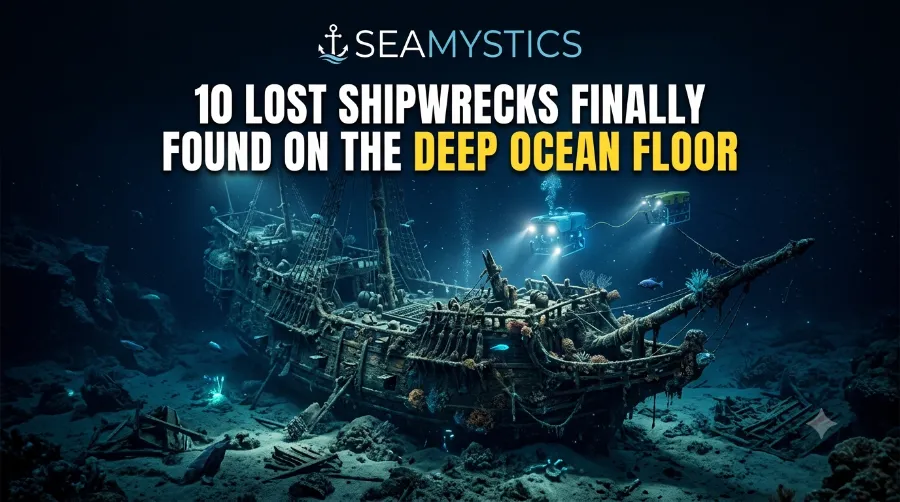

Somewhere below the waves, right now, a robot submarine is sliding a beam of sonar across an empty stretch of seabed. Most of the time it finds nothing but mud, rock, and the odd curious fish. Then, every so often, a shape appears that should not be there. A hull. A mast. A gun turret sitting upright as if the crew just stepped away. These are lost shipwrecks ocean floor discoveries, and in the past few years they have arrived faster than at any point in history.
If you want to learn more about living fossils found alive tips and expert advice.
This is not luck. Better sonar, cheaper robotic submersibles, and a new generation of ocean explorers have turned old mysteries into solved cases. Below, you will meet ten ships that vanished for decades or even centuries, and the teams who finally found them resting on the seafloor. Each story comes with real dates, real depths, and a few surprises that even seasoned marine researchers did not expect.
If you want to learn more about mysterious lights deep ocean tips and expert advice.
Key Takeaways
| Ship | Sank | Found | Depth | Location |
|---|---|---|---|---|
| Endurance | 1915 | 2022 | 3,008 m | Weddell Sea, Antarctica |
| USS Samuel B. Roberts | 1944 | 2022 | 6,895 m | Philippine Sea |
| USS Johnston | 1944 | 2021 | 6,456 m | Philippine Trench |
| San José | 1708 | 2015 | 600 m | Cartagena, Colombia |
| HMS Erebus & HMS Terror | 1845 | 2014/2016 | 11 to 24 m | Canadian Arctic |
| Gloucester | 1682 | 2007 | Shallow, Norfolk coast | North Sea, England |
| SS Pacific | 1875 | 2022 | 2,800 m | Off Washington State |
| USS Stewart | 1946 | 2024 | 1,067 m | Pacific Ocean |
| Quest | 1962 | 2024 | 390 m | Labrador Sea, Canada |
| Porcelain Wreck | 1700s | 2025 | 600 m | Skagerrak Strait |
Why So Many Lost Shipwrecks Are Surfacing Now
For most of history, a sunken ship simply disappeared. The ocean is huge, dark, and crushingly deep, so searchers had almost no way to look below a few hundred feet. That changed once navies and universities began sharing sonar technology once reserved for military use.
If you want to learn more about creatures thought extinct found tips and expert advice.
Today, a handful of tools drive nearly every major shipwreck find:
- Side-scan sonar that maps miles of seabed in a single pass
- Autonomous underwater vehicles, or AUVs, that can dive for days without a crew
- Remotely operated vehicles, or ROVs, that send back live video from crushing depths
- Digitized naval records that narrow a search area from thousands of square miles to just a few
- Climate-driven changes, such as lower river and lake levels, that expose wrecks once buried in silt
- If you want to learn more about lost shipwrecks ocean floor tips and expert advice.
Because of this, deep sea mysteries that puzzled historians for a century are now being solved in a matter of weeks. Teams that once needed a decade of funding can now scan a search grid in a single expedition season. If you enjoy this kind of underwater detective work, our Mariana Trench mysteries guide covers similar detection methods used in the deepest part of the planet.
10 Lost Shipwrecks Finally Found on the Ocean Floor
Each of these wrecks disappeared for years, sometimes for over a century. Then, thanks to patient searchers and modern tools, each one turned up again on the seabed.
1. Endurance: Shackleton’s Ship, Found After 107 Years
Ernest Shackleton’s ship Endurance was crushed by Antarctic pack ice in 1915, and the crew watched it sink from the surrounding floe. For over a hundred years, nobody knew exactly where it settled.
In March 2022, the Endurance22 expedition, led by geographer Dr. John Shears and archaeologist Mensun Bound, located the wreck 3,008 meters down in the Weddell Sea. It sat almost four miles from Captain Frank Worsley’s original recorded position. The cold, oxygen-poor water had kept wood-eating organisms away, so the ship appeared remarkably whole, with its name still readable on the stern.
2. USS Samuel B. Roberts: The Deepest Wreck Ever Found
Nicknamed “Sammy B,” this World War Two destroyer escort fought far larger Japanese warships during the Battle off Samar in October 1944. Sailors on board earned lasting praise for taking on a battleship fleet while badly outgunned.
On 22 June 2022, an expedition led by undersea explorer Victor Vescovo found the wreck broken into two pieces at 6,895 meters off the Philippines. Guinness World Records later confirmed that depth as the deepest shipwreck ever located, a record you can read about directly on their site. For scale, that is nearly double the depth of the Titanic.
3. USS Johnston: A Ghost Fleet Reunited
The USS Johnston sank during the same brutal battle as the Samuel B. Roberts, fighting alongside it against overwhelming odds. Its wreck sat undiscovered until a research team located it in 2019, and a follow-up dive in 2021 confirmed its exact depth at 6,456 meters in the Philippine Trench.
At the time, this made Johnston the deepest wreck ever surveyed, a title it held until the Roberts was found the following year. Together, the two ships form one of the most complete underwater records of a single WWII naval battle anywhere on the planet.
4. San José: The $17 Billion Treasure Galleon
The Spanish galleon San José sank off the coast of Cartagena, Colombia in 1708 while carrying gold, silver, and emeralds meant to fund a war back in Europe. Historians spent three centuries guessing at its resting place.
Colombian authorities announced its discovery in 2015, at a depth of roughly 600 meters. Experts have valued the cargo near 17 billion dollars, making it possibly the richest shipwreck ever located. Ownership disputes between Colombia, Spain, and private salvage companies continue today, which shows how a single wreck can still stir modern legal battles centuries later.
5. HMS Erebus and HMS Terror: The Franklin Expedition Solved
In 1845, Sir John Franklin led two ships, HMS Erebus and HMS Terror, into the Canadian Arctic to find the Northwest Passage. Both ships vanished, and all 129 crew members were lost, sparking one of history’s most famous nautical mysteries.
HMS Erebus was found in 2014 near King William Island, and HMS Terror followed in 2016 in Terror Bay, roughly 45 miles away. Inuit oral histories, passed down for generations, helped searchers pinpoint both locations. Stories like these overlap closely with our guide to famous ghost ship mysteries, which covers several similar vanishing-crew cases in more depth.
6. Gloucester: The Warship That Carried a Future King
HMS Gloucester struck a sandbank off the Norfolk coast in 1682 while carrying James Stuart, then Duke of York and future King James II of England. James survived, though dozens of crew members did not, and the wreck slipped into obscurity.
Brothers Julian and Lincoln Barnwell first located the site in 2007, but the discovery stayed confidential for 15 years while researchers confirmed its identity. Norfolk Museums Service and the University of East Anglia publicly announced the find in 2022. Historians have called it the most significant maritime discovery in England since the Mary Rose.
7. SS Pacific: A Forgotten Tragedy Off Washington State
The sidewheel steamship SS Pacific sank in 1875 after a collision, killing more than 300 people in one of the deadliest maritime disasters on the West Coast of the United States. For nearly 150 years, treasure hunters searched without success.
In 2022, a search team announced they had located the wreck roughly 23 miles off the coast of Washington State, at a depth of about 2,800 meters. The find finally gave historians a physical site to match the newspaper accounts written at the time of the sinking.
8. USS Stewart: The Only US Navy Ship Captured by Japan
USS Stewart earned the nickname “Ghost Ship” after Japanese forces captured it in 1942, becoming the only American vessel taken during the Pacific War. Allied sailors reported spotting it deep behind enemy lines for years afterward, which only added to its eerie reputation.
The US Navy eventually recovered and scuttled the ship. In 2024, a team of autonomous submersible drones operated by Ocean Infinity relocated it in just a few hours, sitting roughly 1,067 meters down in the Pacific after 78 years on the seabed. Discoveries like this one show why deep sea mysteries rarely stay hidden forever once modern tools get involved.
9. Quest: Shackleton’s Final Ship
Quest carried Ernest Shackleton on his last expedition, and he died aboard it in 1922 near South Georgia. The ship kept working for decades afterward as a minesweeper and sealing vessel before ice finally crushed its hull in the Labrador Sea in 1962.
The Royal Canadian Geographical Society, working with the Woods Hole Oceanographic Institution, located the wreck on 9 June 2024 at a depth of 390 meters. A follow-up expedition in July 2026 sent the crewed submersible Alvin, the same vessel that first photographed the Titanic, down for a close look. Researchers found the wreck largely intact, though tangled in abandoned fishing nets and covered in soft coral.
10. The Porcelain Wreck: An 18th-Century Trader Rediscovered
In 2025, researchers exploring the Skagerrak strait between Norway and Denmark found an 18th-century trading vessel nearly 600 meters down. Its cargo told a striking story on its own, including Chinese porcelain and ornate chandeliers destined for wealthy European buyers.
Marine archaeologists nicknamed it the Porcelain Wreck for that reason. The find adds to a growing list of merchant ships now surfacing in European waters, and it hints that many more trading vessels from the same era remain waiting to be found nearby.
What These Discoveries Have in Common
Looking across all ten wrecks, a few patterns repeat again and again. Understanding them helps explain why the pace of discovery keeps accelerating.
- Oral history and eyewitness records often narrow a search area long before sonar confirms anything.
- Cold, low-oxygen, or low-light water tends to preserve wood and metal far better than warm shallow seas.
- Government and university funding usually pairs with private expedition teams to share both cost and expertise.
- Anniversaries, such as a 100th or 150th anniversary of a sinking, frequently trigger renewed search efforts.
- Once one wreck from a battle or expedition is found, the sister ship or companion vessel often follows within a few years.
If you have ever wondered what else might be hiding in the dark, our piece on deep sea creatures that have never been photographed shows that shipwrecks are far from the only secrets the ocean floor is still keeping.
Depth and Discovery Timeline
The chart below lays out how deep each ship rested and how long it stayed lost before researchers found it.
| Ship | Years Lost | Depth (meters) |
|---|---|---|
| Endurance | 107 | 3,008 |
| USS Samuel B. Roberts | 78 | 6,895 |
| USS Johnston | 75 | 6,456 |
| San José | 307 | 600 |
| HMS Erebus | 169 | 11 |
| HMS Terror | 171 | 24 |
| Gloucester | 325 | Shallow |
| SS Pacific | 147 | 2,800 |
| USS Stewart | 78 | 1,067 |
| Quest | 62 | 390 |
| Porcelain Wreck | Roughly 250 | 600 |
The trend is clear once you scan the numbers. Wrecks that once seemed impossible to find, sitting three or four miles down, are now within reach of modern robotic tools. Meanwhile, shallow wrecks close to shore, like the Gloucester, sometimes stay hidden for centuries simply because nobody looked at the right patch of sand.
For readers based in the United States, coastal wrecks off Florida offer an easier way to see this history firsthand. The Florida Keys National Marine Sanctuary documents dozens of accessible wrecks that divers can visit without needing a deep-sea submersible at all, and their Sunken Secrets blog is a good place to start.
How Researchers Actually Find a Lost Wreck
Locating a shipwreck sounds dramatic, and it often is, but the process itself follows a fairly consistent path.
- Historians gather ship logs, survivor accounts, and old newspaper reports to estimate a last known position.
- A survey ship tows a sonar array across a defined search grid, sometimes for weeks at a time.
- Any promising sonar return gets flagged and marked for a closer pass.
- An ROV or crewed submersible then dives to the target to capture video and confirm identity.
- Archaeologists compare structural details, such as portholes or hull markings, against historical photographs to prove the match.
This same process has helped researchers document unusual acoustic signals from the deep, which our article on mysterious sounds recorded in the deep ocean explores in far more detail. Sonar built to find shipwrecks often picks up strange noises along the way that scientists still cannot fully explain.
Not every strange find at sea turns out to be a shipwreck, however. Maritime history site Shipwreck World, which you can browse at shipwreckworld.com, notes that sonar operators regularly chase false leads, including natural rock formations and old debris fields that mimic a hull shape on screen. Confirming a wreck usually takes several dives, not just one lucky sonar image.
Why These Discoveries Matter Beyond History
A shipwreck is more than a rusting hull sitting in the dark. Each one is a time capsule that preserves details historians cannot get anywhere else, from cargo manifests to personal belongings left untouched for decades.
Marine biologists also gain something valuable from every find. Wrecks quickly become artificial reefs, drawing coral, sponges, and fish species that would otherwise have nowhere to settle on a flat, sandy seabed. The Quest wreck, for example, is now home to Atlantic cod, redfish, and even a spotted wolffish, all living among soft corals that grew directly on the hull.
There is also a quieter, more troubling lesson buried in these stories. Researchers surveying the Quest noted that abandoned fishing nets, or ghost gear, still drape much of the ship decades after bottom trawling was banned nearby. That kind of long-term damage rarely gets attention until a wreck brings it back into view.
Author John Christopher Fine has spent decades documenting stories like these firsthand. His book, Lost on the Ocean Floor, walks through dozens of similar cases where patience and modern technology finally solved decades-old mysteries. It pairs well with our broader guide to unexplained deep sea mysteries if you want to keep exploring after finishing this list.
The Ocean Still Hides Millions of Wrecks
Despite all these breakthroughs, researchers estimate that more than three million shipwrecks remain scattered across the seafloor worldwide. Most will likely never be found, either because they hold little historical value or because they simply sit too deep for current technology to reach easily.
That said, the tools keep improving every year. AUVs can now map larger areas at lower cost than a decade ago, and satellite data helps narrow search zones before a single boat even leaves the dock. Bioluminescent creatures near these wreck sites sometimes complicate underwater filming too, a phenomenon covered in our piece on why parts of the deep sea glow in the dark.
Given the pace of the last five years alone, from Endurance in 2022 to the Porcelain Wreck in 2025, it seems safe to expect several more headline discoveries before the decade ends. You can browse more finds like these on the Sea Mystics homepage as new expeditions report back.
Frequently Asked Questions
What is the deepest shipwreck ever found?
The USS Samuel B. Roberts holds that record, resting 6,895 meters down in the Philippine Sea. Explorer Victor Vescovo’s team confirmed the depth in June 2022.
Why do so many shipwrecks stay hidden for over a century?
Ocean water is dark, cold, and often several miles deep, which made searching nearly impossible before modern sonar existed. Historical navigation records from centuries ago were also frequently inaccurate, so search areas used to span hundreds of square miles.
Are shipwrecks bad for the ocean environment?
Not usually. Most wrecks become artificial reefs that support coral, fish, and other marine life within just a few years of sinking.
Can regular divers visit any of these wrecks?
Some, like wrecks in the Florida Keys sanctuary, sit in shallow enough water for recreational diving. Deep-sea wrecks like the Samuel B. Roberts or Quest require specialized submersibles and are generally off limits to the public.
How is a wreck’s identity actually confirmed?
Archaeologists compare visible features such as portholes, hull shape, or serial markings against historical photographs and blueprints. In the case of Quest, two distinctive portholes below the bridge matched old photos closely enough to confirm the ship’s identity.
Final Thoughts
Ten wrecks, ten very different stories, yet each one shares the same quiet ending. Something the ocean swallowed decades or centuries ago finally came back into view, thanks to patient researchers and steadily improving technology. As sonar and submersibles keep advancing, more lost shipwrecks ocean floor stories like these seem almost certain to surface in the years ahead, and each one will likely teach us something new about the sea, about history, and about the people who sailed into it and never returned.
References
- Guinness World Records, “World’s deepest shipwreck found almost 7 km beneath the waves,” 2022
- Woods Hole Oceanographic Institution, Underwater Archaeology Program
- Royal Canadian Geographical Society and Canadian Geographic, Quest and Terra Nova expedition reports, 2024 to 2026
- History Hit, “The Most Famous Shipwrecks Ever Found”
- 24/7 Wall St., “16 Shipwrecks Discovered in 2022”
- Popular Science, “Ghost ships to ghost sharks: 10 wildest underwater discoveries of 2024”
- CBC News and PBS News, Shackleton Quest Expedition coverage, June 2024