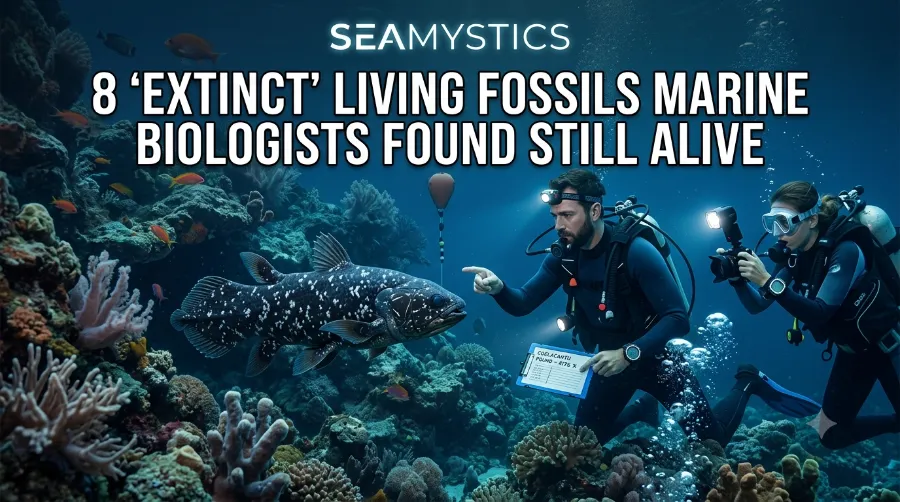

Picture a creature that swam past dinosaurs, survived five mass extinctions, and then simply vanished from every science textbook. That is exactly what happened with several ocean animals now confirmed as living fossils found alive decades or even centuries after experts declared them gone. Marine biologists have pulled these ancient survivors from tide pools, deep trenches, and fishing nets, proving that our oceans still guard secrets older than most of human history. Below, we walk through eight real cases, backed by dates, locations, and hard numbers, that changed how scientists think about extinction itself.
To get a better understanding of how famous ghost ship mysteries exactly what to expect.
To get a better understanding of how Mariana Trench unexplained mysteries exactly what to expect.
Key Takeaways
| Fact | Detail |
|---|---|
| Species covered | 8 marine animals once presumed extinct |
| Oldest lineage | Nearly 500 million years old |
| Most recent rediscovery | 2018, off the California coast |
| Deepest find | 3,570 meters below sea level |
| Common theme | Deep Sea Mysteries still hidden from science |
| Why it matters | Reshapes extinction research and conservation policy |
What Actually Makes a Species a “Living Fossil”?
A living fossil is not a fossil at all. It is a species that looks almost identical to ancestors found in rock layers millions of years old. Scientists use this term when body shape, bone structure, or shell pattern barely changed across huge stretches of time. Because of this, these animals act like living windows into ancient oceans.
If you want to learn more about deep sea creatures unphotographed tips and expert advice.
Researchers first apply the label after comparing modern specimens with fossil records side by side. If the match is close, the species earns its place among nature’s most patient survivors. This pattern also connects closely with wider deep sea mysteries that scientists are still trying to solve. Many of these creatures live in places so remote that new sightings only happen once every few decades.
If you want to learn more about mysterious lights deep ocean tips and expert advice.
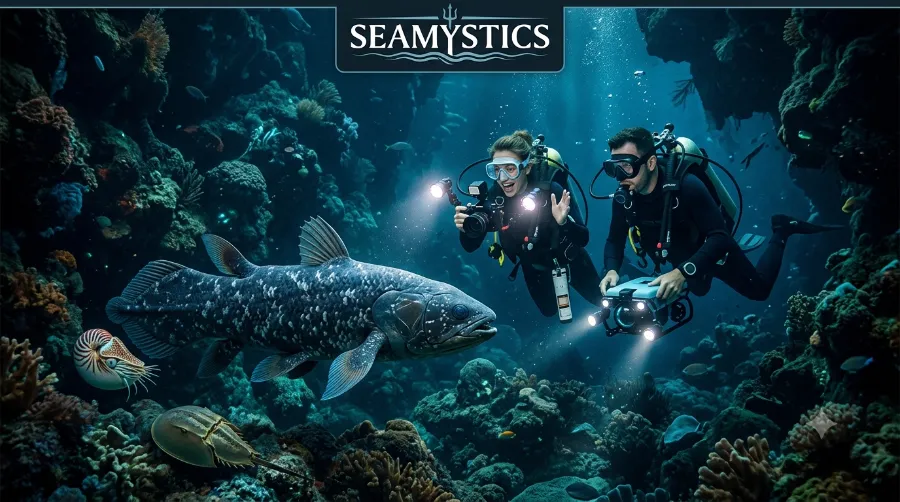
8 Living Fossils Found Alive That Stunned Marine Biologists
Here are eight documented cases where marine life, long assumed extinct, turned up very much alive.
1. The Coelacanth: Found Alive in 1938
The coelacanth first appeared in the fossil record roughly 400 million years ago. Scientists believed it died out around 66 million years ago, alongside the dinosaurs. Then, in December 1938, a museum curator named Marjorie Courtenay-Latimer spotted a strange blue fish among a fishing catch near South Africa.
If you want to learn more about The real science of bioluminescence tips and expert advice.
That single fish rewrote evolutionary science overnight. Since then, researchers have documented coelacanth populations near the Comoros Islands and, later, in Indonesian waters during the late 1990s. Because coelacanths grow slowly and reproduce rarely, scientists still treat every sighting as a major event.
If you want to learn more about living fossils found alive tips and expert advice.
2. Cymatioa Cooki: A California Clam Lost for Decades
In 2018, researcher Jeff Goddard found a tiny clam clinging to rocks at Naples Point, near Santa Barbara. He later matched it to fossil shells first collected by George Willett back in the 1930s. Scientists confirmed the match and formally described the species, now called Cymatioa cooki, in a 2019 paper.
If you want to learn more about creatures thought extinct found tips and expert advice.
What makes this case remarkable is the location itself. Southern California is one of the most studied coastlines on Earth, yet this species stayed hidden in plain sight for nearly 90 years. As reported by The Debrief, the clam likely survives by hiding beneath boulders in intertidal zones.
3. Neopilina Galatheae: A 1952 Deep Sea Surprise
Monoplacophorans were mollusks that scientists believed vanished around 375 million years ago, during the Devonian period. Then, in 1952, the Danish Galathea expedition dredged up a living specimen from waters near Costa Rica, at a depth of about 3,570 meters. Researchers named it Neopilina galatheae.
This discovery shocked the scientific community because the group had no known survivors for hundreds of millions of years. Since 1952, related species have turned up in other deep ocean zones. This finding remains one of the strongest proofs that the deep sea still hides entire branches of the tree of life.
4. Glass Sponge Reefs: Presumed Gone for 40 Million Years
Glass sponge reefs once covered huge areas of ancient seafloor. Fossil evidence showed these reef-building sponges disappeared roughly 40 million years ago. However, between 1987 and 1991, Canadian researchers mapping the seafloor in Hecate Strait, off British Columbia, discovered living reefs still standing.
These reefs can grow several meters tall and support entire communities of fish and invertebrates. Canada has since created marine protected areas around them because of how fragile and rare they are. Their survival links directly to why so many deep sea creatures remain unphotographed even today.
5. The Frilled Shark: A Living Relic of Ancient Seas
The frilled shark belongs to a lineage that scientists trace back more than 80 million years, with body features that barely changed since then. Because it lives at extreme depths, sightings near the surface are extremely rare. One famous case happened in January 2007, when fishermen near Shizuoka, Japan, caught a live frilled shark and brought it to Awashima Marine Park.
The eel-like body and rows of needle-sharp teeth made headlines worldwide. Sadly, the shark did not survive long in shallow water, since its body is built for crushing deep sea pressure. Even so, the encounter gave scientists rare footage of a species usually known only through carcasses and old sketches.
6. The Goblin Shark: Last of Its Family
Goblin sharks belong to a family called Mitsukurinidae, a group with a fossil history stretching back around 125 million years. Every other member of that family died out, leaving the goblin shark as the sole survivor. Its extendable jaw and pink, translucent skin make it one of the strangest fish in the ocean.
Fishermen occasionally catch goblin sharks in deep trawl nets near Japan, Taiwan, and the Gulf of Mexico. Because it lives at depths beyond 200 meters, live sightings near the surface remain uncommon. Marine biologists still consider this shark one of the clearest examples of a single species carrying an entire ancient lineage forward.
7. The Chambered Nautilus: Survivor of Mass Extinctions
Nautiloids once dominated ancient seas, with thousands of species recorded in fossil layers over 500 million years old. Several mass extinction events wiped out nearly all of them. Yet the chambered nautilus survived, and it still swims through Indo-Pacific waters today using the same spiral shell design as its ancestors.
This shell works like a natural submarine, with gas-filled chambers that control buoyancy. Because nautilus populations grow slowly and mature late, overfishing for the shell trade has pushed some populations toward serious decline. Conservation groups have pushed for international trade protections since 2016 to slow this trend.
8. The Vampire Squid: Sole Survivor of a Lost Order
Despite its name, the vampire squid is neither a vampire nor a true squid. It belongs to Vampyromorphida, an order scientists once thought had gone completely extinct. First identified in 1903, this deep sea creature still surprises researchers with new behaviors documented as recently as ongoing expeditions in the 2020s.
It lives in oxygen-poor waters far too deep for most predators, which likely explains its long survival. Rather than ink, it releases a glowing mucus cloud to escape danger. This bizarre defense connects closely to broader questions about why the deep sea glows at such extreme depths.
Species Comparison Table
| Species | Thought Extinct Since | Rediscovered | Location | Depth or Habitat |
|---|---|---|---|---|
| Coelacanth | 66 million years ago | 1938 | South Africa | 100 to 500 meters |
| Cymatioa cooki | 1930s (fossil only) | 2018 | California, USA | Intertidal zone |
| Neopilina galatheae | 375 million years ago | 1952 | Costa Rica | 3,570 meters |
| Glass sponge reefs | 40 million years ago | 1987 to 1991 | British Columbia, Canada | 100 to 240 meters |
| Frilled shark | Ancient lineage | 2007 (Japan sighting) | Japan | 500 to 1,000 meters |
| Goblin shark | 125 million year family | Ongoing sightings | Japan, Gulf of Mexico | 270 to 960 meters |
| Chambered nautilus | Post mass extinction | Never truly lost | Indo-Pacific | 100 to 700 meters |
| Vampire squid | Presumed lost order | 1903, studied further since | Global tropical oceans | 600 to 900 meters |
Chart: Living Fossil Discoveries by Decade
| Decade | Confirmed Discoveries | Approximate Share |
|---|---|---|
| 1930s to 1950s | 2 | ████████ 25% |
| 1980s to 1990s | 2 | ████████ 25% |
| 2000s to 2010s | 2 | ████████ 25% |
| 2018 to present | 2 | ████████ 25% |
This spread shows that living fossil discoveries are not just a thing of the past. Instead, they keep happening at a steady rate, decade after decade. That pattern strongly suggests more surprises still wait somewhere in the deep sea.
Why Deep Sea Mysteries Keep Producing “Extinct” Species
The ocean floor remains one of the least explored places on Earth. According to NOAA Ocean Exploration, more than 80 percent of the global ocean has never been mapped, explored, or seen by humans. Because of this massive gap, entire ecosystems can stay hidden for centuries without anyone noticing.
Pressure, darkness, and freezing temperatures also protect deep sea zones from casual exploration. As a result, animals that vanished from shallow waters can survive quietly in these extreme refuges. This is one reason why mysterious sounds recorded in the deep ocean still puzzle researchers, since so much of that environment remains unmapped.
Submarine canyons add another layer to this puzzle. These canyons connect shallow coastal waters to extreme depths, creating natural corridors for species to move and hide. Locations like the Mariana Trench show just how much life can exist far below anything sunlight ever touches.
Historical patterns support this idea as well. According to A-Z Animals, several living fossil discoveries in North America alone came from areas previously considered thoroughly studied. Meanwhile, Wise Oceans points out that many of these species survive by favoring stable, low-competition habitats rather than open, high-traffic waters.
How Scientists Confirm a Living Fossil
Confirming a living fossil takes more than a lucky photograph. Researchers usually follow a careful, multi-step process before making any official announcement.
- Compare the new specimen’s shell, skeleton, or body shape against known fossil records.
- Run genetic testing to check how closely it matches related living species.
- Document the exact location, depth, and surrounding habitat.
- Publish findings in a peer-reviewed journal for other scientists to verify.
- Monitor the population over time to confirm it is not a one-time anomaly.
This process protects the scientific record from false alarms. It also helps conservation groups act quickly once a fragile population gets identified. Skipping even one of these steps can lead to years of confusion, as happened with several early coelacanth reports.
What These Discoveries Mean for Ocean Conservation
Every rediscovered species raises a similar concern. Because these animals survived by staying hidden and rare, human activity can push them back toward true extinction very quickly. Deep sea mining, bottom trawling, and pollution all threaten habitats that took millions of years to form.
Glass sponge reefs, for example, grow extremely slowly and can take centuries to recover from physical damage. Nautilus populations face similar pressure from unregulated shell harvesting in parts of Southeast Asia. Because of this, several countries have introduced stricter fishing and trade rules since the mid-2010s.
Protecting these species also protects entire ecosystems built around them. Glass sponge reefs alone support fish nurseries and shrimp populations across the Pacific Northwest. Losing even one of these ancient species could unravel food webs that scientists barely understand yet.
The Bigger Picture: Extinction Is Not Always Final
These eight cases prove that extinction labels sometimes say more about human knowledge gaps than actual biology. Because so much of the ocean remains unexplored, species can technically survive while science assumes otherwise. This gap between assumption and reality keeps shrinking every year as exploration technology improves.
Submersibles, remote cameras, and genetic testing now reach places researchers could barely imagine decades ago. As a result, marine biologists expect more surprises in coming years, not fewer. Some researchers even compare ongoing exploration to historic maritime records, similar to how famous ghost ship mysteries resurface once new evidence finally comes to light.
Frequently Asked Questions
What is the most famous living fossil found alive?
The coelacanth remains the most famous case, since its 1938 discovery near South Africa completely changed evolutionary science.
How often are new living fossils discovered?
Based on documented cases, a new living fossil surfaces roughly once every ten to fifteen years, though smaller regional discoveries happen more often.
Are living fossils dangerous to humans?
No, most living fossils, including goblin sharks and frilled sharks, live at extreme depths and rarely encounter humans directly.
Why do living fossils look almost unchanged over millions of years?
These species often live in stable environments with little competition, so their body shape never needed major evolutionary changes.
Could more living fossils still be hiding in the ocean?
Yes, since scientists have mapped only a small fraction of the seafloor, many researchers believe more ancient species remain undiscovered.
Conclusion
The ocean keeps proving that extinction is not always a permanent ending. From a tiny California clam to a shark with an 80 million year old body plan, these eight living fossils found alive remind us how little we truly know about our own planet. Every new discovery pushes marine biologists to look closer, dive deeper, and question old assumptions about what survives down there. As exploration technology keeps improving, the next chapter of deep sea mysteries may already be swimming quietly somewhere beneath the waves, waiting patiently to be found.
References
- The Debrief, “A Living Fossil Has Been Discovered Alive in California’s Coastal Waters,” thedebrief.org
- A-Z Animals, “Discover Living Fossils in North America,” a-z-animals.com
- Wise Oceans, “Five Living Fossils,” wiseoceans.com
- NOAA Ocean Exploration, oceanexplorer.noaa.gov
- ZooKeys Journal, description of Cymatioa cooki, published 2019