
Picture a single drop of seawater under a microscope. Inside that tiny drop swim thousands of plankton, and those plankton feed nearly every living thing in the sea, from tiny shrimp to giant blue whales. That is how marine ecosystems work: a chain of eating and being eaten that links the smallest cell to the largest animal on Earth. Ocean food webs are not random. They follow clear rules, and once you understand those rules, the whole ocean starts to make sense. In this guide, we will walk through how marine ecosystems work, why every layer of the ocean food web matters, and what deep sea mysteries scientists are still uncovering in 2026.
If you want to learn more about coral reef ecosystem explained found tips and expert advice.
Along the way, we will look at real expeditions, real numbers, and real species that were found only months ago. This is not a dry textbook lesson. It is a living, breathing story about the planet’s largest habitat, and honestly, it never gets old.
If you want to learn more about hydrothermal vent ecosystem facts tips and expert advice.
Key Takeaways
| Point | What It Means |
|---|---|
| Marine ecosystems run on energy transfer | Sunlight feeds phytoplankton, which feeds nearly everything else |
| Trophic levels connect all ocean life | Producers, consumers, and decomposers keep the system balanced |
| Deep sea mysteries are still being solved | Over 800 new species found through recent Ocean Census expeditions |
| Coral reefs hold huge biodiversity | Reefs may host a quarter of all ocean species despite covering a tiny area |
| Climate stress is reshaping food webs | Marine heatwaves and warming seas are altering energy flow between species |
| Small changes affect the whole chain | A drop in one species, like krill, can ripple through the entire web |
What Is a Marine Ecosystem, Really
A marine ecosystem is any community of living things that depends on saltwater to survive. This includes coral reefs, open oceans, estuaries, mangrove forests, and the deep sea floor. Each of these habitats has its own mix of plants, animals, and microbes, yet they are all tied together by water, nutrients, and energy. According to the National Geographic Education Hub, marine ecosystems are shaped by both living and nonliving factors, including sunlight, oxygen levels, depth, and temperature.
If you want to learn more about kelp forest ecosystem facts tips and expert advice.
Because sunlight cannot travel far underwater, scientists split the ocean into light zones. The euphotic zone reaches about 200 meters down and gets enough light for regular photosynthesis. Below that sits the dysphotic zone, where only a little light seeps through. Past 1,000 meters lies the aphotic zone, a place of total darkness that covers most of the planet’s living space. This layered structure is the foundation for understanding how marine ecosystems work.
If you want to learn more about deep sea food web tips and expert advice.
Why the Ocean Matters to Everyone, Not Just Marine Biologists
The ocean is not some distant, separate system. It regulates our climate, produces much of the oxygen we breathe, and feeds billions of people. As the National Wildlife Federation has noted, the ocean acts almost like a heartbeat for the entire planet, driving weather patterns and absorbing heat that would otherwise make land temperatures far more extreme. When ocean food webs weaken, the effects reach far past the coastline.
learn more about Seagrass meadows and ocean health tips and expert advice.
Healthy marine ecosystems also protect coastal communities. Coral reefs and mangroves act as natural storm barriers, reducing flooding and erosion during hurricanes, as highlighted in research shared at the University of Florida’s Florida Keys Marine Science Conference. In short, when the ocean struggles, so do we.
The Building Blocks: How Marine Ecosystems Work Through Trophic Levels
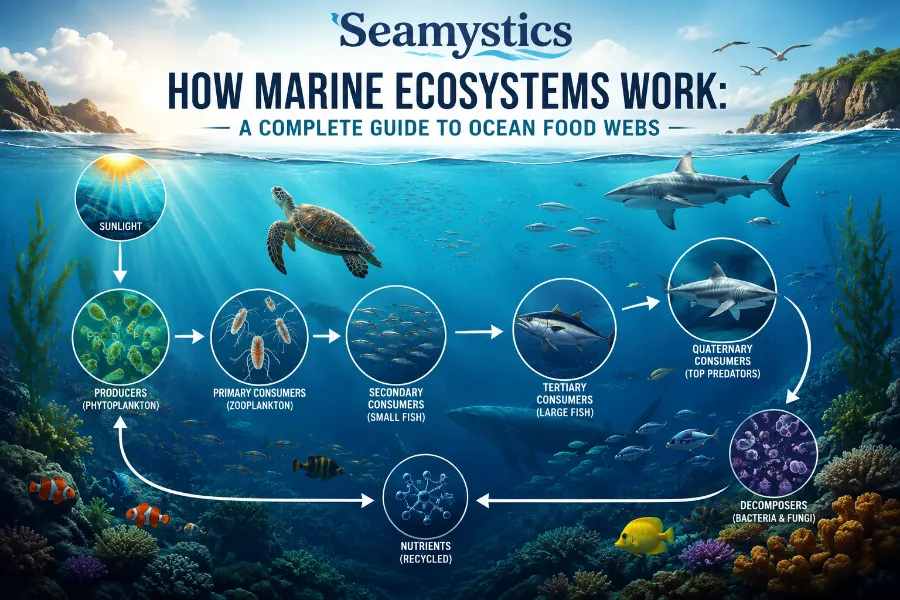
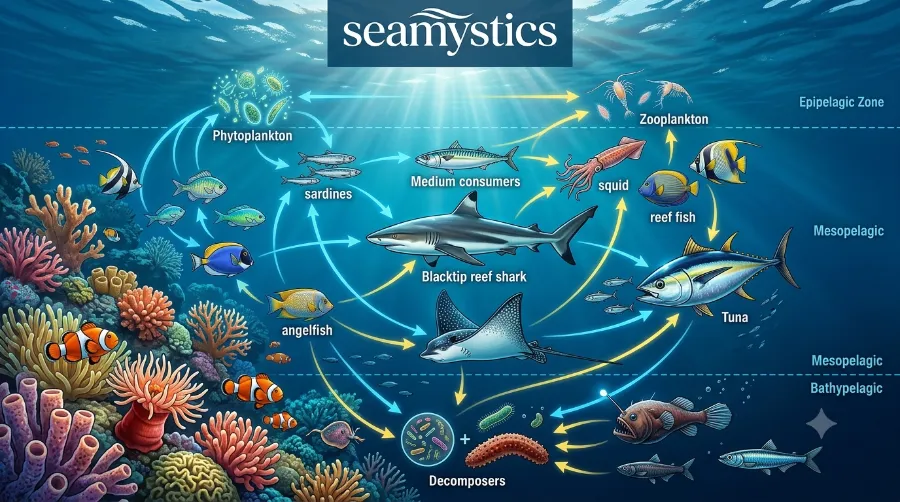
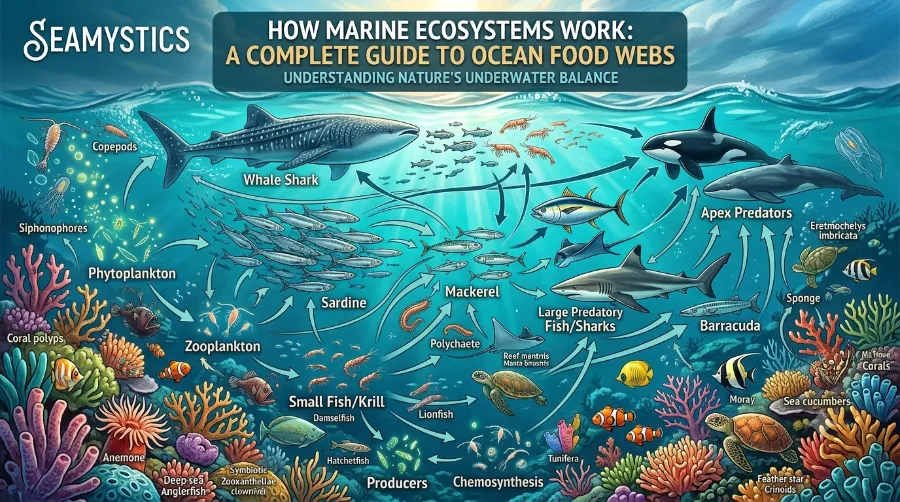
To understand how marine ecosystems work, you need to understand trophic levels. A trophic level is simply a rank in the food chain, based on how an organism gets its energy. There are usually four or five levels in a marine food web, and each one depends on the level below it.
Here is a simple breakdown:
want to learn more aboutwhale fall ecosystem explained health tips and expert advice.
- Producers – phytoplankton and algae that make their own food using sunlight through photosynthesis.
- Primary consumers – zooplankton, small fish, and krill that eat producers directly.
- Secondary consumers – larger fish, squid, and seabirds that eat primary consumers.
- Tertiary consumers – apex predators like sharks, tuna, and orcas that sit near the top.
- Decomposers – bacteria and fungi that break down dead matter and recycle nutrients back into the water.
Only about ten percent of energy passes from one trophic level to the next. This is why there are always far more plankton than there are sharks in the ocean. Energy simply gets used up as it moves up the chain, and this single rule explains a huge amount about ocean population sizes.
Producers: The Quiet Engine Room
Phytoplankton are microscopic, yet they produce roughly half of the oxygen on Earth through photosynthesis. They float near the ocean surface, soaking up sunlight and carbon dioxide, and in return they release oxygen and sugars. Without this tiny engine room, the rest of the food web simply could not exist.
Interestingly, research published by fisheries ecologists at Texas A&M found that in some coastal habitats, phytoplankton fatty acids showed up in the tissue of fish and shrimp far more than expected, even when floating Sargassum algae seemed like the bigger food source. This challenged the old assumption that biomass always predicts importance. Sometimes the smaller, less visible producer matters more than the obvious one.
Consumers: Small Steps and Giant Leaps
Zooplankton graze on phytoplankton the same way cows graze on grass. Krill, copepods, and small larval fish fall into this group, and they form the primary food source for herring, sardines, and baleen whales. From there, secondary and tertiary consumers take over, creating longer and more complex chains.
A great real world example comes from a 2024 study on canned Alaskan salmon. Researchers examined salmon samples collected over four decades and tracked levels of anisakid worms, a parasite that moves through the food web from krill to small fish to salmon and finally to marine mammals. Rising parasite levels actually suggested a healthier, more connected food web, not a sicker one, because the parasite needs many different host species to complete its life cycle.
Decomposers: The Ocean’s Cleanup Crew
Bacteria and fungi break down dead plants, animals, and waste, releasing nutrients like nitrogen and phosphorus back into the water. These nutrients then fuel new phytoplankton growth, completing the cycle. Without decomposers, dead material would simply pile up and nutrients would become locked away, starving the entire system.
Ocean Food Webs vs Food Chains: What’s the Difference
Many people use these two terms interchangeably, but they are not quite the same thing. A food chain is a straight line, phytoplankton to krill to fish to shark. A food web is the full, tangled network of many overlapping food chains happening at once in the same habitat.
Real ocean systems almost always work as webs rather than single chains, because most animals eat more than one type of food and get eaten by more than one type of predator. This overlapping structure actually makes ecosystems more stable. Research published in Science Advances in 2026 found that marine food web structure, particularly how tightly species are interconnected, directly affects an ecosystem’s resistance and resilience to disturbance. Simply put, webs with more connections tend to bounce back faster after a shock like a heatwave or pollution event.
A Quick Comparison Table
| Feature | Food Chain | Food Web |
|---|---|---|
| Structure | Single, straight line | Multiple, overlapping lines |
| Realism | Simplified model | Closer to actual nature |
| Stability | Fragile, one break affects all | More stable due to backup paths |
| Example | Phytoplankton to krill to whale | Phytoplankton to krill to herring to salmon to orca, plus dozens of side paths |
Where the Action Happens: Key Marine Habitats
Different habitats support ocean food webs in different ways, and each one plays a specific role in how marine ecosystems work as a whole.
- Estuaries, where rivers meet the sea, are some of the most productive nurseries on the planet. According to NOAA, estuarine habitats support about 68 percent of the United States commercial fish catch and 80 percent of the recreational catch, making them essential to coastal economies.
- Coral reefs cover less than one percent of the ocean floor, yet by some estimates they host around a quarter of all marine species, based on figures shared by National Geographic.
- Mangrove forests filter salt and trap sediment while sheltering juvenile fish, crabs, and shrimp among their tangled roots.
- The open ocean supports wide ranging animals like tuna, dolphins, and whales, all of which travel enormous distances chasing shifting food sources.
- The deep sea floor, the largest habitat on Earth by volume, remains mostly unexplored and is where some of the strangest food webs exist.
If you want a deeper breakdown of coastal habitat types, our /related-guide on coastal ecosystem conservation covers each one step by step.
Deep Sea Mysteries: The Last Great Frontier of Ocean Food Webs
No conversation about how marine ecosystems work is complete without diving into deep sea mysteries. Below 1,000 meters, sunlight disappears entirely, yet life still thrives in astonishing ways. Instead of relying on photosynthesis, many deep sea food webs run on chemosynthesis, a process where bacteria convert chemicals from hydrothermal vents into usable energy.
This alternate energy source supports entire communities of tube worms, blind shrimp, and giant clams clustered around vent openings on the seafloor. It is one of the most unusual food webs found anywhere on the planet, because it does not depend on the sun at all.
Recent Discoveries That Are Rewriting the Textbooks
The pace of deep sea discovery has picked up dramatically in the past two years, and these expeditions keep proving how little we still understand about ocean food webs.
- In July 2026, an Ocean Census expedition to the remote South Sandwich Islands discovered new hydrothermal vents, coral gardens, and several suspected new species, including a vent chimney standing four meters tall and covered in snails and barnacles.
- In October 2025, the Nippon Foundation Nekton Ocean Census confirmed 30 new deep sea species from the Southern Ocean, including a carnivorous “death ball” sponge covered in tiny hooks that trap prey, a sharp contrast to the passive filter feeding most sponges rely on.
- That same Southern Ocean mission collected nearly 2,000 specimens across 14 animal groups and captured the first confirmed footage of a juvenile colossal squid.
- In February 2026, researchers exploring cold seeps off Argentina uncovered 28 new deep sea species, along with a wide range of tube worms and clams that feed on chemical rich seepage rather than sunlight driven food sources.
- Scientists estimate roughly 700 hydrothermal vents have been identified globally so far, though more than 250 remain active, meaning entire chemosynthetic food webs are still waiting to be mapped.
Each of these finds shows that ocean food webs are far more complex, and far more fragile, than older models suggested. Every new species adds another link to a chain scientists are only beginning to trace.
For readers who enjoy this kind of ocean exploration content, check out our /related-guide on deep sea creatures for a closer look at some of these bizarre animals.
How Climate Change Is Rewiring Ocean Food Webs
Ocean food webs are not fixed. They shift constantly in response to temperature, currents, and human activity. In recent years, marine heatwaves have become one of the biggest disruptors of how marine ecosystems work.
A study using long term monitoring data from the Northeast Pacific Ocean, covering 361 marine species, found that gelatinous animals like jellyfish experienced the largest shifts in the food web following recent heatwaves. As waters warmed, energy flow between predators and prey changed significantly, forcing entire ecosystem models to be rebuilt from scratch.
Similarly, a June 2026 study analyzing fossil coral reef records found that roughly 76 percent of reefs face a risk of submergence by the year 2100 if sea level rise continues at current rates. Because reefs support such a large share of ocean biodiversity, this kind of stress does not just threaten coral. It threatens every species that depends on the reef for food or shelter.
A Snapshot of Climate Pressure on Ocean Food Webs
| Stressor | Observed Impact | Source Year |
|---|---|---|
| Marine heatwaves | Major shifts in predator prey energy flow, especially gelatinous species | 2024 |
| Rising sea levels | 76 percent of reefs at risk of submergence by 2100 | 2026 |
| Ocean warming and acidification | Weakened energy flow to higher trophic levels, more detritus based systems | Ongoing |
| Plastic pollution | Growing but still poorly understood effects on marine biodiversity | 2026 |
Why Every Link in the Chain Matters
It is tempting to think that losing one small species will not matter much. In reality, ocean food webs are built on tight dependencies, and removing even a modest link can trigger what scientists call a trophic cascade. This happens when a change at one trophic level ripples outward and reshapes population sizes at several other levels.
A well documented example involves sea otters in Monterey Bay. When otter numbers drop, sea urchin populations explode because otters are a key urchin predator. Those extra urchins then devour kelp forests at a much faster rate, which removes shelter and food for dozens of other species. One missing predator can quietly unravel an entire underwater forest.
This is exactly why marine biologists pay such close attention to keystone species, animals whose presence or absence has an outsized effect on the rest of the ecosystem. Protecting these species often protects everything connected to them as well.
Simple Ways Ocean Food Webs Stay Balanced
Despite constant pressure, ocean ecosystems do have natural mechanisms that help them stay balanced over time. Understanding these mechanisms helps explain how marine ecosystems work even under stress.
- Species diversity spreads risk across many food sources, so losing one prey species does not collapse the whole system.
- Migration patterns allow predators to follow shifting food supplies rather than starving in one fixed location.
- Nutrient cycling through decomposers constantly refuels the base of the food web with fresh nutrients.
- Reproductive timing, such as spawning events, is often synced with seasonal plankton blooms to maximize survival of offspring.
- Predator prey feedback loops naturally control population booms before they become unsustainable.
When these mechanisms are disrupted by pollution, overfishing, or warming water, ocean food webs become noticeably less stable, which is exactly what several of the 2026 studies referenced above are now tracking in real time.
Frequently Asked Questions
What is the base of most ocean food webs?
Phytoplankton form the base of most marine food webs. These microscopic organisms use sunlight to produce energy through photosynthesis, and nearly every other marine animal depends on them either directly or indirectly.
How many trophic levels are in a typical marine ecosystem?
Most marine ecosystems have four to five trophic levels, starting with producers like phytoplankton and ending with apex predators such as sharks or orcas, plus a decomposer layer that recycles nutrients.
Why is the deep sea considered full of mysteries?
Because sunlight cannot reach most of the deep ocean, scientists rely on submersibles and remotely operated vehicles to explore it. Even in 2026, expeditions continue finding new species and hydrothermal vent systems, showing how much remains unmapped.
Can one species really affect an entire ocean food web?
Yes. Keystone species like sea otters or certain predatory fish can trigger trophic cascades if their populations drop, reshaping population sizes several levels away in the food chain.
How does climate change affect ocean food webs?
Warming waters and marine heatwaves shift energy flow between predators and prey, often favoring gelatinous species over fish. Rising sea levels and acidification also stress coral reefs, which support a large share of marine biodiversity.
Do ocean food webs recover after disturbances like storms or heatwaves?
Many can recover, especially when biodiversity and habitat quality remain high, because more connected food webs tend to be more resilient. However, repeated or prolonged stress, such as consecutive heatwaves, makes recovery slower and less certain.
Conclusion
Marine ecosystems are not simple, but they are understandable once you break them into layers. Energy starts with sunlight, moves through producers and consumers, and eventually returns to the water through decomposers. Every layer depends on the one before it, and the whole system depends on balance. Deep sea mysteries remind us that we have only explored a small fraction of the ocean floor, and every new expedition adds fresh pieces to this enormous puzzle. Protecting ocean food webs is not just about saving individual species. It is about keeping an entire planetary support system intact for generations to come. To keep exploring this topic, visit /related-guide for more ocean science guides, or head back to our homepage at https://seamystics.com/ to browse the full library of marine research content.
References
- National Wildlife Federation. Oceans Are the Heart of the Planet. https://blog.nwf.org/2026/05/oceans-are-the-heart-of-the-planet/
- National Geographic Education. Marine Ecosystems. https://education.nationalgeographic.org/resource/marine-ecosystems/
- University of Florida IFAS. Importance of Healthy Marine Ecosystems, Florida Keys Marine Science Conference. https://conference.ifas.ufl.edu/floridakeys/importance-healthy-marine-ecosystems.php
- NOAA. Aquatic Food Webs. https://www.noaa.gov/education/resource-collections/marine-life/aquatic-food-webs
- Ocean Census / Nippon Foundation Nekton, Schmidt Ocean Institute. Southern Ocean deep sea species discoveries, 2025 to 2026.
- Nature Communications. Marine heatwaves disrupt ecosystem structure and function via altered food webs and energy flux, 2024.
- Science Advances. Mediating role of food web structure in linking diversity to multidimensional stability, 2026.