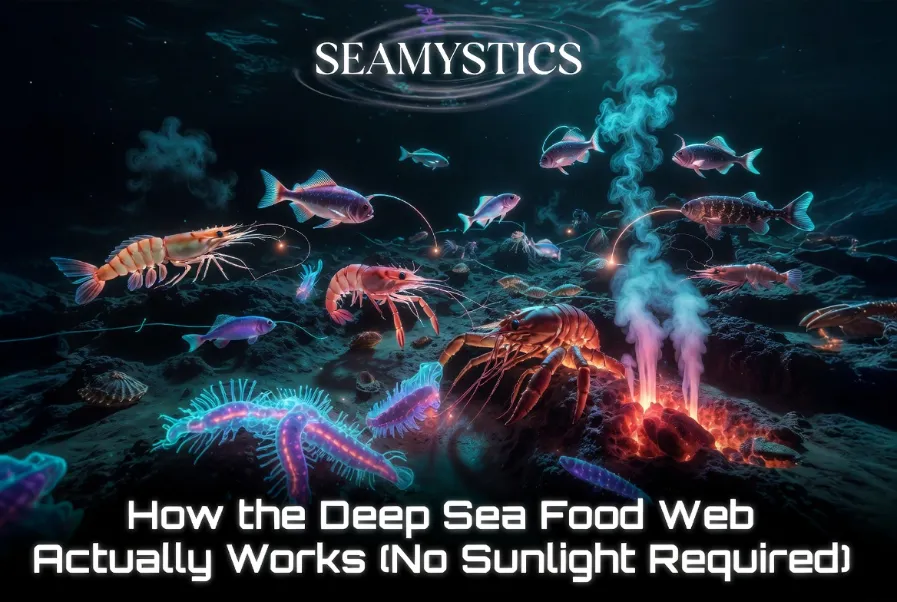

Picture a world with no sun, crushing pressure, and near freezing water, yet packed with life that feeds, hunts, and grows in total darkness. That is the daily reality below 1,000 meters, where the deep sea food web keeps entire communities alive without a single ray of light. Scientists once believed nothing could survive down there, but decades of ocean expeditions have proven the opposite. Today, the deep sea food web stands as one of the most fascinating examples of marine ecosystems on the planet, and once you understand how it runs, you will never look at the ocean the same way again.
If you want to learn more about hydrothermal vent ecosystem facts tips and expert advice.
Most people assume every food chain starts with sunlight and plants, yet the deep ocean flips that rule on its head. Instead of photosynthesis, this hidden world runs on falling debris, bacteria that eat chemicals, and the occasional feast of a sunken whale. Below is a quick summary before we go deeper into the science.
If you want to learn more about kelp forest ecosystem facts tips and expert advice.
Key Takeaways
| Aspect | Detail |
|---|---|
| Main energy sources | Marine snow and chemosynthesis |
| Depth where sunlight disappears | Around 200 meters, called the twilight zone edge |
| Carbon lost during marine snow descent | Up to 50% carbon and 58 to 63% nitrogen, per 2025 research in Science Advances |
| Chemosynthesis discovery | First confirmed at Galapagos hydrothermal vents in 1977 |
| Annual carbon fixed by phytoplankton | 55 to 60 billion metric tons |
| Whale fall lifespan as food source | Can sustain scavenger communities for several decades |
| Primary producers in vent zones | Chemosynthetic bacteria using hydrogen sulfide or methane |
What Makes the Deep Sea Food Web So Different
The surface ocean gets its energy from the sun. Plants and algae absorb light and turn it into food through photosynthesis. This process powers nearly every marine ecosystem near the coastline, including the ones covered in our pillar guide on how marine ecosystems work.
But sunlight fades quickly underwater. By around 200 meters, most usable light is already gone. Below that point, the deep sea food web has to rely on other tricks to keep organisms fed. There is no grass, no coral, and no algae bloom to snack on.
If you want to learn more about deep sea food web tips and expert advice.
Instead, life down there depends on two main systems. The first is marine snow, a slow and steady rain of organic material sinking from above. The second is chemosynthesis, a chemical process used by bacteria near hydrothermal vents. Together, these two sources form the base of nearly every deep ocean food chain.
If you want to learn more about symbiosis in coral reefs tips and expert advice.
Why Sunlight Cannot Reach the Ocean Floor
Water absorbs and scatters light quickly, and by the time it reaches a few hundred meters down, almost nothing is left. As a result, temperatures also drop, often falling close to freezing. Pressure increases dramatically too, reaching levels that would crush an unprotected human body within seconds.
If you want to learn more about mangrove ecosystem ocean role tips and expert advice.
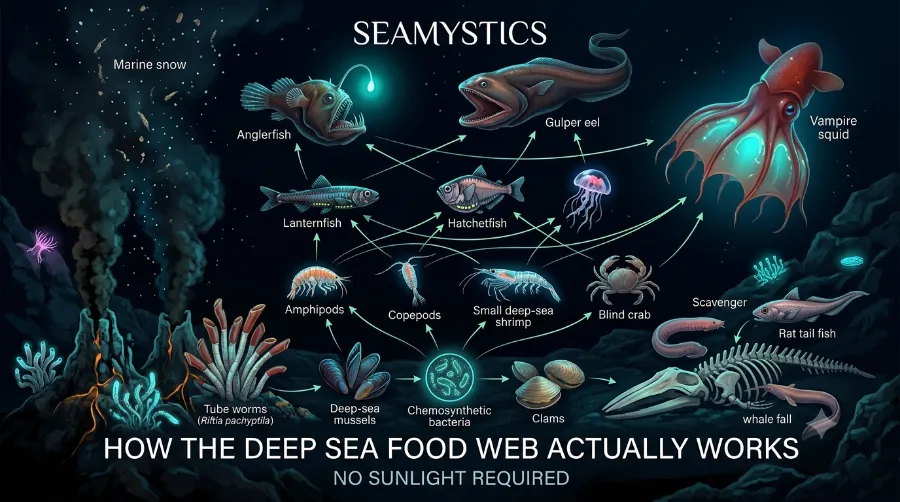
Because of these extreme conditions, ordinary plant life simply cannot survive. Yet somehow, thousands of species still find enough to eat. That is the real puzzle behind the deep sea food web, and it is one marine biologists have been solving piece by piece since the late 1970s.
If you want to learn more about open ocean ecosystem zones tips and expert advice.
Marine Snow: The Slow Blizzard That Feeds the Ocean Floor
Marine snow sounds poetic, but it is really just organic debris. It includes dead plankton, fish scales, fecal matter, and bits of decaying tissue drifting down from sunlit waters above. This steady drizzle can take days or even weeks to reach the seafloor.
want to learn more aboutwhale fall ecosystem explained health tips and expert advice.
Although it looks light and unimportant, marine snow plays a massive role in ocean chemistry. According to a 2025 study published in Science Advances, sinking marine snow particles can lose as much as 50 percent of their original carbon and between 58 and 63 percent of their nitrogen before ever reaching the bottom. This leakage happens because deep water pressure forces dissolved material out of the particles as they sink.
That discovery matters for more than just biology. Scientists had long assumed most of this carbon settled permanently into ocean sediment. Now researchers know a large portion stays suspended in deep water instead, sometimes for centuries, quietly reshaping how we understand the planet’s carbon cycle.
learn more about Seagrass meadows and ocean health tips and expert advice.
How Marine Snow Supports Deep Ocean Life
Many bottom dwelling creatures rely almost entirely on marine snow for survival. Filter feeders such as sponges and sea fans catch drifting particles directly from the water column. Sea cucumbers, brittle stars, and various worms crawl along the seabed, feeding on whatever settles nearby.
This slow but constant food supply keeps entire marine ecosystems functioning, even in places far from any hydrothermal activity. Without marine snow, most of the open deep ocean would be nearly empty of life.
A few examples show just how far reaching this process is:
- Sea lilies use feathery arms to catch falling particles as they drift past
- Polychaete worms burrow into sediment enriched by settled marine snow
- Deep sea sponges filter thousands of liters of water daily to trap tiny food particles
- Rockfish and halibut often prey on smaller organisms that feed directly on marine snow
Researchers from NASA’s EXPORTS mission, detailed in a December 2025 report, tracked how storms in the North Atlantic disrupted marine snow particles, temporarily slowing carbon transport before renewed storm activity helped particles reaggregate and continue sinking. This kind of fieldwork shows how weather patterns thousands of miles from the seafloor still influence what deep sea creatures eat.
Chemosynthesis: Life Powered By Chemistry, Not Light
While marine snow feeds most of the deep ocean, certain hotspots run on a completely different fuel source. Around hydrothermal vents and cold seeps, bacteria use a process called chemosynthesis to build organic matter from chemicals rather than sunlight.
These bacteria absorb hydrogen sulfide or methane released from the seafloor and combine it with carbon dioxide to produce energy. This process was first confirmed scientifically in 1977, when researchers exploring the Galapagos Rift discovered thriving communities clustered around underwater vents. It was a discovery that reshaped biology textbooks almost overnight.
Since then, similar chemosynthetic communities have been found at cold seeps, sunken wood, and even old shipwrecks. Our detailed breakdown of hydrothermal vent ecosystems explores exactly how these chemical powerhouses form and thrive.
How Chemosynthetic Bacteria Build a Food Web
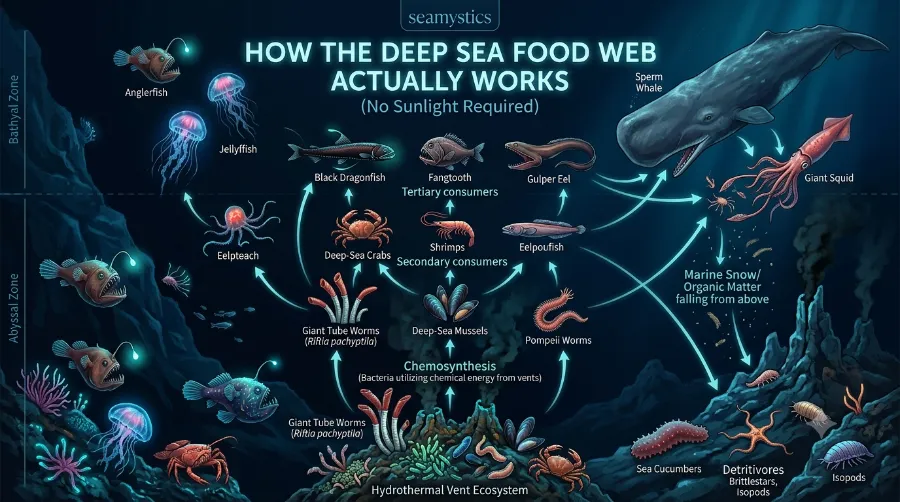
Once bacteria convert chemicals into usable energy, other organisms step in to take advantage. Some animals, like tubeworms, host these bacteria directly inside their bodies, forming a partnership where both sides benefit.
Others simply graze on bacterial mats that coat nearby rocks. Yeti crabs, for instance, farm bacteria on their own hairy claws and then eat the bacteria they grow. This unusual behavior highlights how creative marine ecosystems can get when sunlight is not an option.
A typical vent food chain often looks like this:
- Chemosynthetic bacteria convert hydrogen sulfide into energy
- Grazers such as limpets and shrimp feed directly on bacterial mats
- Small predators like crabs and eels hunt the grazers
- Larger predators, including octopuses and certain deep sea fish, feed on the smaller predators
This layered structure mirrors surface ecosystems in some ways, but it runs entirely on chemistry instead of sunlight. It also tends to support far denser populations than the surrounding seafloor, since vent zones offer a much richer and steadier energy supply.
Whale Falls: Nature’s Deep Sea Buffet
Every so often, a whale dies and sinks to the ocean floor, creating what scientists call a whale fall. These events might sound rare, yet they play a surprisingly large role in the deep sea food web. A single whale carcass can weigh over 30 tons and can feed an entire community of scavengers for decades.
The process usually unfolds in stages. First, mobile scavengers such as hagfish, sleeper sharks, and amphipods strip away soft tissue within months. Next, smaller organisms move in to consume leftover scraps and organic sediment around the carcass. Finally, bacteria break down the remaining bones, releasing sulfur compounds that support chemosynthetic life similar to what happens at hydrothermal vents.
Some whale fall communities have been documented supporting life for more than 50 years at a single site. That makes a whale carcass one of the longest lasting food sources anywhere in the deep sea food web, rivaling even the output of some smaller hydrothermal vent fields.
How Energy Moves Through the Deep Sea Food Web
Once energy enters the system, whether through marine snow, chemosynthesis, or a whale fall, it moves upward through several trophic levels. Each level represents a different feeding role within the broader marine ecosystems found in deep water.
Primary Producers
These are the bacteria that create energy from chemicals, along with the sinking organic material from surface waters above. They form the true foundation of the entire deep sea food web.
Primary Consumers
Creatures like limpets, shrimp, and filter feeding sponges eat bacteria or marine snow directly. They convert that raw energy into a form other predators can use.
Secondary and Tertiary Consumers
Crabs, eels, and octopuses hunt the smaller grazers. At the very top, larger predators such as certain deep sea sharks and giant squid feed on almost everything below them, closing the loop of this dark water system.
Real World Research Shaping Our Understanding
Marine biologists continue to uncover new details about how this hidden world functions. NOAA’s ongoing fieldwork, documented through its Teacher at Sea program, has repeatedly highlighted how food web dynamics shift across different ocean zones, giving researchers fresh data every expedition season.
Separately, a detailed 2025 exploration from WFSU’s Coastal Health series examined why studying deep sea food webs remains so difficult, pointing out that pressure, darkness, and remoteness still limit how much of the seafloor scientists can physically observe.
Long term monitoring projects, including the M139 expedition documented on Ocean Blogs, continue tracking how deep sea communities respond to changing ocean conditions over multiple years. This kind of sustained observation is exactly what allows scientists to spot slow moving shifts that a single visit could never reveal.
For readers who want authoritative background on ocean food chains more broadly, the National Oceanic and Atmospheric Administration offers detailed public resources through noaa.gov, while peer reviewed findings on chemosynthetic ecosystems are archived through the National Center for Biotechnology Information.
Comparing Deep Sea Energy Sources
| Energy Source | Location | Main Organisms Supported | Energy Reliability |
|---|---|---|---|
| Marine snow | Entire deep ocean floor | Sea cucumbers, sponges, worms, filter feeders | Steady but low density |
| Chemosynthesis | Hydrothermal vents, cold seeps | Tubeworms, yeti crabs, vent shrimp | High density, localized |
| Whale falls | Scattered seafloor locations | Hagfish, amphipods, sleeper sharks, bone eating worms | Temporary but very rich |
Why This Matters for Marine Ecosystems Everywhere
Understanding the deep sea food web is not just an academic exercise. These systems influence global carbon storage, fisheries health, and even climate regulation. Since roughly 15 percent of the carbon fixed by phytoplankton each year gets exported into deeper ocean layers, disruptions to marine snow or chemosynthetic activity could ripple upward into surface marine ecosystems too.
Coastal habitats are not isolated from these deep processes either. Our guide on coral reef ecosystems shows how nutrient cycling connects shallow reefs to much deeper water systems, while our piece on kelp forest ecosystems explains how organic material from these habitats eventually contributes to the same marine snow that feeds the deep sea.
As ocean temperatures shift and storm patterns change, researchers worry these connections could weaken. A warming surface layer may alter how efficiently carbon and nutrients travel downward, which would directly affect the deep sea food web and the countless species depending on it.
Threats Facing the Deep Sea Food Web
Even in one of the most remote places on Earth, human activity is starting to leave a mark. Several pressures now threaten the balance that has existed for millions of years.
- Deep sea mining disturbs hydrothermal vent fields and destroys chemosynthetic habitats
- Bottom trawling damages seafloor sediment that supports marine snow feeders
- Climate change alters ocean currents, which can shift where marine snow settles
- Plastic pollution has been found even in trenches deeper than 10,000 meters
These threats develop slowly, which makes them easy to overlook. Yet because deep sea ecosystems recover so slowly, damage in these environments can take decades or even centuries to reverse.
Frequently Asked Questions
What is the deep sea food web?
It is the network of feeding relationships among organisms living below the sunlit zone of the ocean, powered mainly by marine snow and chemosynthesis instead of sunlight.
How do deep sea creatures get energy without sunlight?
Most rely on sinking organic debris called marine snow, while others near hydrothermal vents depend on bacteria that convert chemicals like hydrogen sulfide into usable energy.
What is chemosynthesis in simple terms?
Chemosynthesis is a process where bacteria create food using chemical energy instead of light, often near hydrothermal vents or cold seeps.
How long can a whale fall feed deep sea life?
Some whale fall communities have supported scavengers and bacteria for more than 50 years at a single location.
Why is marine snow important to marine ecosystems?
It transports carbon and nutrients from surface waters down to the deep ocean, supporting countless species while also playing a role in global carbon storage.
Conclusion
The deep sea food web proves that life finds a way, even in total darkness and crushing pressure. Between drifting marine snow, chemical powered bacteria, and the occasional whale fall feast, this hidden system supports far more life than most people ever imagine. As research expeditions continue mapping this dark frontier, our picture of how these marine ecosystems function keeps growing sharper. Protecting these fragile depths starts with understanding them, and that understanding begins right here on the surface, one discovery at a time.
References
- Science Advances (2025). Hydrostatic pressure induces strong leakage of dissolved organic matter from marine snow particles.
- NASA EXPORTS Mission Report (2025). Storms reveal how marine snow shapes carbon flow in the deep ocean.
- National Center for Biotechnology Information. Deep-Water Chemosynthetic Ecosystem Research.
- NOAA Teacher at Sea Program. Food Web Field Notes.
- WFSU Coastal Health Series (2025). Deep Sea Food Webs: Life on the Ocean Floor.
- Ocean Blogs, M139 Expedition Field Reports.