
Picture a forest so tall it touches sunlight from below the waves, yet so quiet that most people never learn it exists. That is the world of kelp forest ecosystems, a hidden underwater rainforest that stretches along cold coastlines from California to Norway. These towering seaweed forests feed millions of fish, shelter sea otters, and pull carbon out of the air faster than many land forests. Still, hardly anyone talks about them.
If you want to learn more about hydrothermal vent ecosystem facts tips and expert advice.
In this guide, we will walk through real kelp forest ecosystem facts, backed by recent marine research, so you can understand why these underwater giants deserve as much attention as coral reefs. You will also see how they connect to other marine ecosystems and why their slow disappearance should worry all of us.
If you want to learn more about kelp forest ecosystem facts tips and expert advice.
Key Takeaways
| Fact | Detail |
|---|---|
| Global coverage | Kelp forests line more than one third of the world’s coastlines across a biome that covers more than a third of the world’s coastline Frontiers |
| Decline rate | Roughly 1.8% of global kelp cover is lost every year Mongabay |
| Historic loss | Between 40 to 60% of the world’s kelp forests have declined over the past fifty years Frontiers |
| Economic value | Kelp forests generate close to $500 billion annually in ecosystem services worldwide World Resources Institute |
| Protection gap | Only 1.6% of kelp forests sit inside highly protected marine areas Mongabay |
| Growth speed | Some kelp species can grow up to 2 feet in a single day under ideal conditions |
What Is a Kelp Forest Ecosystem, Exactly?
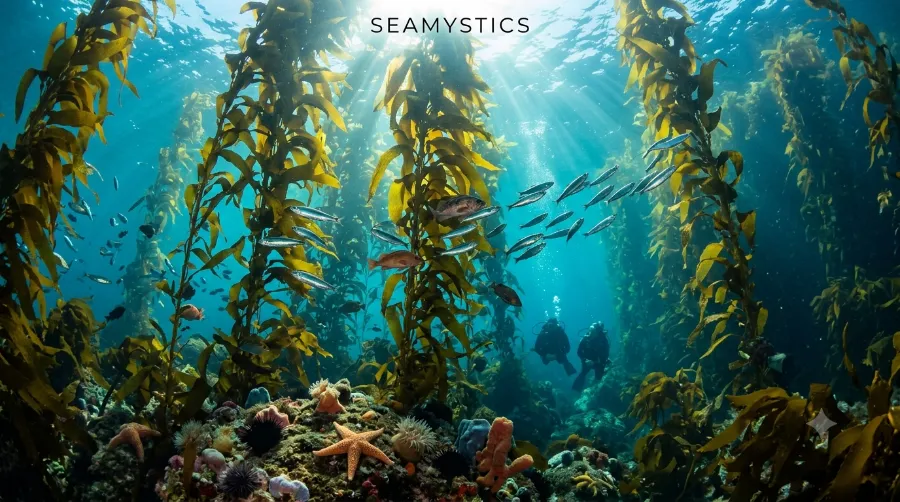
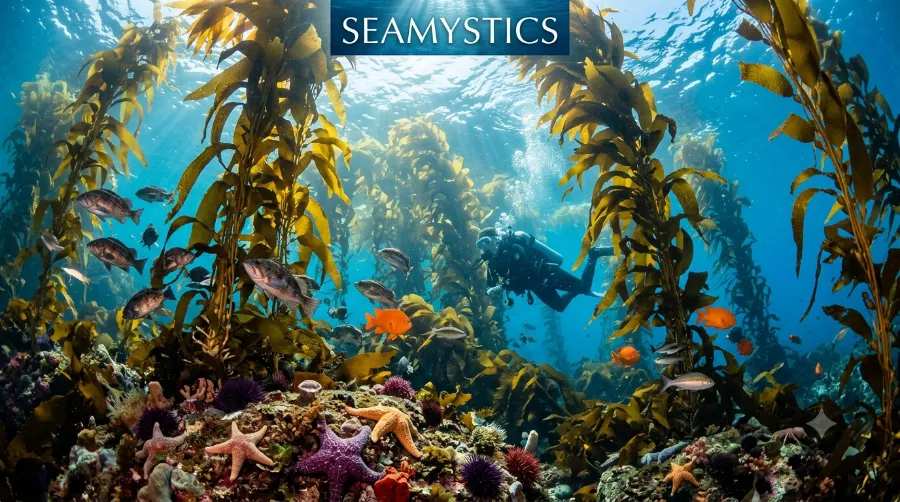
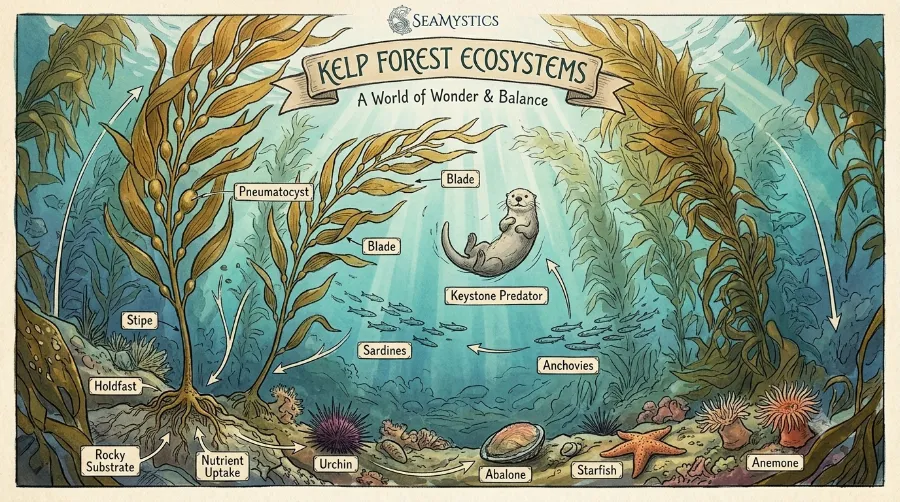
A kelp forest is a dense underwater stand of large brown algae that grows in cold, nutrient rich coastal waters. Unlike trees, kelp has no roots. Instead, it clings to rocky seafloors using a structure called a holdfast, then floats upward using gas filled bladders that keep its blades near the surface.
If you want to learn more about deep sea food web tips and expert advice.
Because kelp grows so fast and so tall, it builds the same kind of layered habitat that a rainforest builds on land. There is a canopy near the surface, a mid water zone, and a shaded floor below. Each layer hosts different creatures, which is exactly why marine biologists often compare kelp forests to tropical rainforests.
If you want to learn more about mangrove ecosystem ocean role tips and expert advice.
This layered structure is one of the clearest kelp forest ecosystem facts that surprises people. Most assume the ocean floor is flat and empty, yet a healthy kelp bed can be as busy and vertical as a jungle canopy. If you want a deeper look at how these zones interact across different ocean habitats, our guide on how marine ecosystems work breaks down the layers in more detail.
If you want to learn more about symbiosis in coral reefs tips and expert advice.
Where Kelp Forests Grow Around the World
Kelp forests need cold, clear, nutrient rich water, so they are found mostly in temperate and polar coastal regions rather than the tropics. Major kelp forests exist along the Pacific coast of North America, the coastlines of Chile and Argentina, South Africa, Australia, New Zealand, and much of Northern Europe including Norway and the United Kingdom.
If you want to learn more about open ocean ecosystem zones tips and expert advice.
Some of the healthiest remaining forests grow near Tasmania, Alaska, and the Falkland Islands, where water temperatures stay consistently cool. In Baja California, researchers tracking kelp canopy from 2004 to 2023 found that southern regions maintained historical coverage levels while northern regions saw a 95% decline in 2023 following marine heatwaves. This regional gap shows how sensitive kelp is to even small shifts in ocean temperature.
learn more about Seagrass meadows and ocean health tips and expert advice.
Why Kelp Forests Matter to Marine Ecosystems
Kelp forests are not just pretty scenery. They act as the backbone of coastal marine ecosystems, and their loss ripples through the entire food chain. Because kelp grows so quickly, it produces huge amounts of organic material that feeds everything from tiny grazers to large predators.
Here is what kelp forests do for the wider ocean and, indirectly, for us:
- They absorb carbon dioxide and store it as biomass, helping offset climate change
- They buffer coastlines from strong waves and storm surges
- They filter excess nutrients out of coastal waters, improving water quality
- They provide nursery habitat for commercially important fish species
- They support tourism, diving, and recreational fishing industries worth billions
Because of these roles, kelp forests function similarly to other keystone marine ecosystems, such as coral reefs and hydrothermal vent communities, even though they look nothing alike. If you are curious how a completely different ocean habitat builds its own food web, our piece on the coral reef ecosystem shows a warm water version of the same story, while our breakdown of the hydrothermal vent ecosystem covers one of the strangest habitats on Earth.
The Animals That Call Kelp Forests Home
A single kelp forest can support hundreds of species, which is why scientists often rank it among the most biodiverse marine ecosystems on the planet. Sea otters are perhaps the most famous residents, since they wrap themselves in kelp fronds while sleeping so ocean currents do not carry them away.
Sea otters also play a direct role in keeping kelp forests alive. They eat sea urchins, and without that predation, urchins can multiply out of control and chew through entire kelp beds, turning a lush forest into what scientists call an urchin barren. This otter and kelp relationship is one of the best documented examples of a keystone species protecting an entire habitat.
want to learn more aboutwhale fall ecosystem explained health tips and expert advice.
Beyond otters, kelp forests host:
- Rockfish, lingcod, and other commercially valuable fish species
- Harbor seals and sea lions that hunt within the kelp canopy
- Sea stars, snails, and crabs that live along the holdfast
- Kelp bass and garibaldi that shelter among the blades
- Migrating gray whales that sometimes rest in kelp beds during long journeys
This dense web of life is one of the strongest kelp forest ecosystem facts for anyone wondering why conservation groups fight so hard to protect these habitats. Remove one species, such as the otter, and the entire structure can collapse within a few years.
Kelp Forest Ecosystem Facts: The Numbers Behind the Decline
Kelp forests are disappearing faster than most people realize, and the data paints a clear picture. Long term monitoring across multiple continents shows a consistent downward trend, even though the pace differs by region.
The table below summarizes some of the most recent findings from marine research teams studying kelp decline.
| Region | Time Period | Finding |
|---|---|---|
| Global average | 1970s to present | 40 to 60% of kelp forests have declined over the past half century Frontiers |
| Northern Baja California | 2014 to 2023 | 95% decline following marine heatwaves in the northern region nih |
| Northern California | Since 2014 | Over 90% loss of bull kelp since 2014 due to predator loss and heatwaves Wiley Online Library |
| Northwest Spain | 1998 to 2023 | Kelp disappeared or nearly vanished at two thirds of the 50 resurveyed sites ScienceDirect |
| Global protection | As of 2025 | Only 15.9% of kelp forests sit inside any protected area and just 1.6% receive the highest protection level Mongabay |
These numbers matter because kelp forests do not recover quickly once they collapse. A forest that took decades to establish can vanish within a single warm summer, and it may never return if urchins or invasive species move in first.
What Is Causing the Kelp Forest Decline
Several overlapping pressures are driving this loss, and most of them connect back to climate change. Marine heatwaves are perhaps the biggest single threat, since kelp cannot survive prolonged exposure to warm water the way many tropical species can.
Other major threats include:
- Overgrazing by sea urchins after predator populations collapse
- Coastal pollution and nutrient runoff from farms and cities
- Overharvesting for food, cosmetics, and fertilizer products
- Sedimentation from coastal development that blocks sunlight
- Invasive species that outcompete native kelp for space and light
Researchers reviewing the broader picture note that kelp forests worldwide face threats from climate change, marine heat waves, storms, coastal development, and overgrazing by sea urchins, and this combination is reducing the biodiversity and productivity these forests once supported. Because so many factors work together, no single fix will solve the problem on its own. Annual Reviews
Kelp Forests as Carbon Storage Powerhouses
One of the more surprising kelp forest ecosystem facts involves climate change mitigation. Kelp grows so fast that it absorbs large amounts of carbon dioxide, and much of that carbon eventually settles on the deep seafloor where it can stay locked away for centuries.
In the Canadian Arctic, researchers found that the total carbon stored in large kelp forests equals the annual greenhouse gas emissions of more than 5 million Canadians. That is a staggering amount of carbon capture happening quietly beneath the waves, largely unnoticed by climate policy discussions.
Despite this climate value, kelp forests receive far less attention in global conservation planning than mangroves or seagrass meadows. A 2023 review of environmental governance found that kelp forests consistently receive the least attention compared to other major marine habitats, even though their scale and carbon storage rival better known ecosystems. Frontiers
Restoration Efforts Bringing Kelp Forests Back
The good news is that restoration is possible, and several projects around the world are showing real progress. In places like Tasmania, California, and Norway, scientists and local communities are experimenting with urchin removal, kelp transplanting, and selective breeding of heat tolerant kelp strains.
Community led marine reserves have shown particularly strong results. In Baja California, areas managed directly by local fishing communities maintained significantly higher densities of predator species such as spiny lobster and horn shark compared to federally managed marine protected areas. Because predators like lobsters and sheephead eat urchins, these community reserves indirectly protected kelp forests from urchin overgrazing. nih
If you want to support this work directly, groups such as the Kelp Forest Alliance track restoration projects and provide ways to get involved through their ongoing kelp restoration initiatives. Their work connects scientists, divers, and coastal communities who are trying to reverse decades of loss one reef at a time.
Comparing Kelp Forests to Other Marine Ecosystems
Kelp forests often get overshadowed by coral reefs in public conversation, yet the two habitats play very different roles. Coral reefs thrive in warm, clear tropical waters and build their structure from calcium carbonate. Kelp forests, on the other hand, thrive in cold water and rebuild their entire structure from scratch every year or two.
| Feature | Kelp Forests | Coral Reefs |
|---|---|---|
| Water temperature | Cold, temperate | Warm, tropical |
| Growth rate | Extremely fast, up to 2 feet per day | Very slow, millimeters per year |
| Structure | Soft algae, rebuilds seasonally | Hard calcium carbonate, builds over centuries |
| Main threat | Marine heatwaves, urchin overgrazing | Ocean acidification, bleaching |
| Carbon role | Strong carbon sequestration | Limited carbon storage |
Both marine ecosystems support enormous biodiversity, and both are under serious pressure from a warming ocean. Understanding how they differ helps explain why conservation strategies cannot be one size fits all. A deeper comparison of these coastal habitats is available on our marine ecosystems overview, which walks through how temperature and geography shape ocean life.
How Sea Otters Protect Kelp Forests
Because the otter and kelp relationship comes up so often in kelp research, it deserves its own closer look. Sea otters were hunted to near extinction for their fur during the 18th and 19th centuries, and kelp forests along the Pacific coast suffered as urchin populations exploded in their absence.
Conservation efforts since the mid 20th century have helped otter populations recover in parts of California and Alaska, and kelp forests in those areas have shown signs of rebounding as a result. Marine biologists studying this relationship point out that predator loss remains one of the clearest drivers of kelp collapse, since urchins left unchecked can strip a healthy forest bare within months.
For a closer look at how this predator prey balance shapes coastal food webs, the Natural Habitat Adventures team has documented the connection in detail through their field reporting on kelp, sea otters, and coastal recovery. Their observations from Patagonia and California offer a firsthand look at how fragile this balance really is.
Why This Matters for the United States and Europe
Kelp forests along the California coast support a fishing and tourism industry worth hundreds of millions of dollars annually, while similar forests off Norway and the United Kingdom anchor local fishing economies and coastal protection systems. In both regions, warming waters and shifting storm patterns are testing how resilient these forests can be.
European researchers working in Spain documented dramatic kelp loss even in a region once considered a potential climate refuge, finding that kelp had disappeared or nearly vanished at 58% of resurveyed sites after 25 years. Meanwhile, American researchers along the Pacific coast are racing to understand why some patches of bull kelp survive extreme heat while neighboring patches do not. ScienceDirect
For coastal communities on both sides of the Atlantic, kelp forest health is directly tied to fishing yields, storm protection, and tourism revenue. Losing these forests is not just an ecological problem, it is an economic one too.
Frequently Asked Questions
What are kelp forests and why are they called underwater rainforests?
Kelp forests are dense stands of fast growing brown algae that create layered habitat similar to a rainforest canopy, supporting hundreds of marine species in a small area.
How fast does kelp grow?
Some kelp species can grow up to 2 feet in a single day under ideal light and nutrient conditions, making it one of the fastest growing organisms on Earth.
Why are kelp forests disappearing?
Marine heatwaves, sea urchin overgrazing, pollution, and coastal development are the main drivers, with global kelp cover declining by roughly 1.8% each year.
Do kelp forests help fight climate change?
Yes, kelp forests absorb large amounts of carbon dioxide and store carbon in ocean sediments, sometimes for centuries, making them valuable natural carbon sinks.
Can kelp forests recover once they are lost?
Recovery is possible but difficult, and it usually requires restoring predator populations, removing excess urchins, and reducing local pollution sources.
Conclusion
Kelp forests may not get the same headlines as coral reefs, yet they quietly support coastal economies, absorb carbon, and shelter an extraordinary range of marine life across two continents and beyond. The kelp forest ecosystem facts covered here show a habitat under real pressure, but also one that can bounce back when communities, scientists, and policy makers work together. Protecting these underwater rainforests is not just about saving seaweed, it is about protecting the fish, otters, whales, and coastal towns that depend on them every single day.
References
- Frontiers in Marine Science, “Unseen and unheard: the invisibility of kelp forests in international environmental governance,” 2023
- World Resources Institute, “What Is Kelp and How Can We Protect It?,” 2023
- Mongabay, “The world’s kelp needs help, less than 2% is highly protected,” 2025
- ScienceDirect, “Twenty-five years on: Widespread kelp forest decline revealed in a potential climatic refugium,” 2024
- PMC, “Community-led management maintains higher predator biomass supporting kelp forests persistence in Baja California,” 2025
- Annual Reviews, “Kelp Forests Under Threat and the Loss of Ecosystem Services They Provide,” 2025