
Picture a bustling underwater city where nobody works alone. Every creature, from the tiniest algae cell to the largest reef shark, depends on a neighbor to survive. That is the real story of symbiosis in coral reefs, and it is far more dramatic than most people realize. Without these hidden partnerships, coral reefs would not exist at all, and neither would the fish, tourism, and coastlines that rely on them.
Coral reefs cover less than one percent of the ocean floor, yet they support roughly a quarter of all marine species. This is not an accident. It happens because corals build entire relationships around teamwork, trust, and mutual benefit. In this guide, we will walk through the science, the numbers, and the real world examples that show why symbiosis is the true engine behind healthy marine ecosystems.
If you want to learn more about mangrove ecosystem ocean role tips and expert advice.
Key Takeaways
| Topic | Quick Fact |
|---|---|
| Main partnership | Corals and zooxanthellae algae share food and shelter |
| Reef coverage | Less than 1% of ocean floor, yet homes 25% of marine species |
| 2023 to 2025 bleaching event | Affected 84% of the world’s reefs across 82 countries |
| Cleaning stations | Cleaner fish and shrimp remove parasites from larger fish daily |
| Biggest threat | Rising ocean temperatures break the coral algae bond |
| Recovery window | Healthy reefs can recover in 5 to 10 years if stress stops early |
What Symbiosis Actually Means for a Reef
Symbiosis simply means two different species living closely together in a way that affects both of them. On a coral reef, this word carries enormous weight. Nearly every organism you see is tied to another one through feeding, shelter, cleaning, or protection.
If you want to learn more about symbiosis in coral reefs tips and expert advice.
Marine biologists sort these relationships into three main types. Mutualism helps both partners. Commensalism helps one partner while the other stays unaffected. Parasitism helps one partner at the expense of the other. Reefs mostly run on mutualism, and that is exactly why they are so resilient when conditions stay stable.
If you want to learn more about open ocean ecosystem zones tips and expert advice.
Understanding these partnerships is not just an academic exercise. It explains why reefs collapse so fast when water gets too warm, and it shows scientists where to focus restoration work. For a broader look at how ocean life connects across habitats, our guide on how marine ecosystems work breaks down the bigger picture.
learn more about Seagrass meadows and ocean health tips and expert advice.
The Coral and Algae Partnership: Nature’s Original Roommates
The most important relationship on any reef is between the coral polyp and a tiny algae called zooxanthellae. These algae live inside the coral’s tissue, and this arrangement is the foundation of the entire reef structure.
The coral gives the algae a safe home and access to sunlight. In return, the algae photosynthesize and hand over up to 90 percent of the food they produce to the coral host. This exchange gives corals the energy to grow their limestone skeletons, which eventually form the reef itself.
This is also why coral color matters so much. The algae give coral its vibrant greens, browns, and purples. When water gets too warm, corals expel their algae in a stress response known as bleaching, leaving behind a stark white skeleton.
want to learn more aboutwhale fall ecosystem explained health tips and expert advice.
According to NOAA Coral Reef Watch data, the fourth global coral bleaching event ran from January 2023 through mid 2025 and affected roughly 84 percent of the planet’s reef area, surpassing the previous record of 68 percent set during the 2014 to 2017 event. That is a jump most scientists did not expect to see so quickly, and it shows exactly how fragile this partnership can be under heat stress.
If you want a deeper dive into the physical structure that this partnership builds, check out our coral reef ecosystem guide for a full breakdown.
Cleaning Stations: The Reef’s Version of a Spa Day
Not every partnership on a reef involves food production. Some are about hygiene, and they are honestly fascinating to watch. Cleaner wrasse and cleaner shrimp set up specific spots on the reef known as cleaning stations, and larger fish line up to visit them.
The larger fish gets rid of parasites, dead skin, and bacteria. The cleaner species gets an easy meal without any risk of being eaten. Researchers have documented cleaner wrasse servicing over 2,000 client visits per day on a single reef, which shows just how central these stations are to reef health.
Here is a quick look at how cleaning symbiosis typically plays out:
- A client fish, sometimes a predator many times the cleaner’s size, approaches the station and adopts a still, non threatening posture.
- The cleaner fish or shrimp inspects the client’s gills, mouth, and skin for parasites.
- The cleaner removes the parasites while the client remains motionless, even opening its mouth to allow full access.
- Once finished, the client swims away unharmed, and the cleaner moves on to its next visitor.
This system only works because both species benefit. If cleaners started cheating by biting healthy tissue instead of parasites, client fish would simply avoid that station. Trust, in a strange way, is a survival strategy underwater.
Anemonefish and Sea Anemones: A Famous Duo
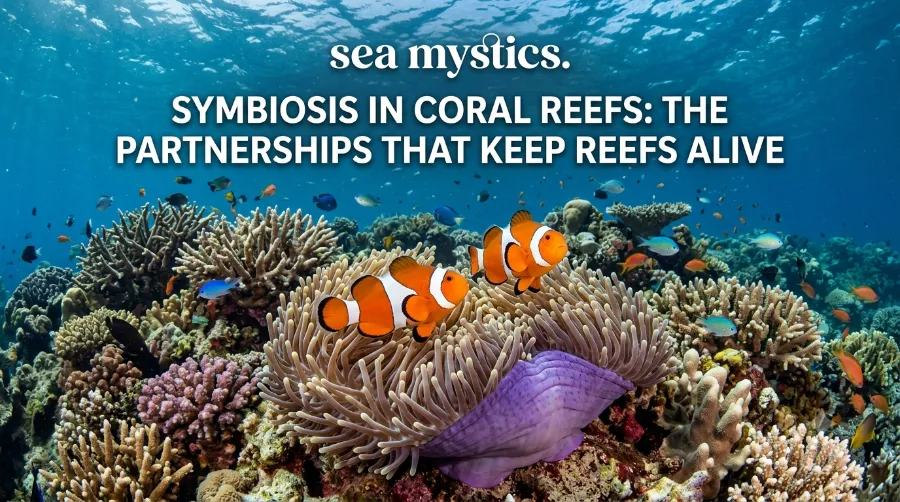
Thanks to a certain animated movie, clownfish and anemones are probably the most recognized symbiotic pair in the ocean. The anemone’s tentacles carry a painful, often deadly sting for most fish, but clownfish have a special mucus coating that protects them from it.
In exchange for shelter inside the anemone’s stinging arms, the clownfish chases off predators, removes debris, and even provides nutrients through its waste. Some research has shown anemones housing clownfish grow faster and recover from damage more efficiently than anemones without a resident fish.
This relationship also protects the wider reef community. Anemonefish rarely stray far from their host, so their presence signals a stable patch of reef where conditions have remained good for a while. It is a small but telling sign of a healthy marine ecosystem functioning as it should.
Symbiosis in Coral Reefs Under Growing Pressure
Marine ecosystems around the world are facing conditions their species have never dealt with before. Warmer oceans, more frequent heat waves, and shifting currents are putting decades of stable partnerships at risk. Symbiosis in coral reefs depends on predictable temperature ranges, and that predictability is disappearing fast.
A 2025 report from the International Coral Reef Initiative confirmed that reefs in at least 82 countries and territories experienced enough thermal stress to trigger bleaching between 2023 and early 2025. That number alone should make anyone pause, because it means the crisis was not limited to one ocean basin or one region. It was genuinely global.
Scientists studying long term heat stress data found something equally concerning. An uninterrupted period of global coral heat stress ran from 2018 to 2025, affecting an unprecedented 87 percent of reef areas worldwide, based on satellite records dating back to 1985. That means many reefs barely had time to recover between stress events before the next one hit. Springer
A related deep dive on ocean partnerships under threat can help you connect these dots even further, and our deep sea food web guide shows how disruptions in one habitat ripple outward into others.
How Heat Breaks the Coral Algae Bond
Warm water disrupts the biochemical exchange between coral and algae. The algae’s photosynthesis becomes less efficient and starts producing harmful byproducts. The coral, sensing the damage, ejects its algae partner as a defense mechanism, even though this leaves the coral starving.
This process usually happens within days of extreme heat exposure. If cooler temperatures return quickly, corals can sometimes recruit new algae and recover within weeks or months. However, prolonged heat stress often leads to coral death, especially for slow growing species that cannot rebuild their energy reserves fast enough.
According to NOAA, the timeline for recovery depends heavily on species type and the severity of the event. Branching corals tend to bleach and die faster, while massive boulder corals can sometimes survive repeated stress cycles. This variation is one reason field researchers now track species specific bleaching patterns rather than treating all coral the same way.
Real World Examples That Show Symbiosis in Action
Numbers on a page only tell part of the story, so let’s look at where these partnerships have played out in real locations with measurable outcomes.
- The Great Barrier Reef, Australia, 2024 to 2025: Surveys recorded significant coral cover loss across northern and central sections after back to back heat stress events, with some sections seeing over 30 percent coral mortality in the hardest hit zones.
- Florida Keys, United States, 2023: An unprecedented marine heat wave pushed water temperatures above 100 degrees Fahrenheit in some shallow areas, causing mass bleaching within weeks and prompting emergency coral rescue operations by local conservation teams.
- Malaysia’s Sunda Shelf reefs, 2024: Field studies documented species specific bleaching trajectories, showing that certain coral genera resisted bleaching even under high heat stress, offering scientists clues about natural resilience traits worth studying further.
- Red Sea reefs: These reefs have shown unusual heat tolerance compared to global averages, and researchers are studying their coral algae pairings closely to understand what genetic or environmental factors allow this resistance.
These examples prove that symbiosis is not a fixed, unchanging system. It adapts, struggles, and sometimes surprises scientists with unexpected resilience. That variability is exactly why continued monitoring matters so much for the future of marine ecosystems.
For a look at how similar pressures affect other underwater habitats, our kelp forest ecosystem guide covers comparable partnerships facing their own set of challenges from warming seas.
Why This Matters Beyond the Reef Itself
Coral reefs are not isolated systems floating in the ocean by themselves. They connect to mangroves, seagrass beds, and open ocean food chains in ways that most people never consider. When symbiosis breaks down on a reef, the effects move outward and touch fisheries, coastlines, and even hydrothermal vent communities that share migratory species with shallow reef zones.
Coastal communities in the Caribbean, Southeast Asia, and the Pacific Islands rely on healthy reefs for food security and tourism income. A collapse in coral algae partnerships does not just mean fewer colorful fish for divers to photograph. It means fewer nursery grounds for commercial fish species, less storm protection for shorelines, and real economic losses that run into billions of dollars each year.
If you are curious how other partnership dependent habitats function under pressure, our mangrove ecosystem guide shows how root systems and marine life work together in a strikingly similar way to coral and algae.
Global Bleaching Events at a Glance
The chart above shows how quickly bleaching severity has escalated since scientists began tracking global events in 1998. Notice how each event has grown in scale, with the most recent one nearly quadrupling the impact of the first recorded event.
| Global Bleaching Event | Years | Percent of Reefs Affected |
|---|---|---|
| First Event | 1998 | 21% |
| Second Event | 2010 | 37% |
| Third Event | 2014 to 2017 | 68% |
| Fourth Event | 2023 to 2025 | 84% |
This trend line is not encouraging, but it is not hopeless either. Scientists point out that some reefs recovered surprisingly well after the third global event once ocean temperatures stabilized. That recovery capacity, fragile as it may be, still exists today.
What Scientists and Conservationists Are Doing About It
Reef researchers are not sitting back and watching this unfold. Multiple strategies are underway to protect and rebuild coral symbiosis, and some early results look promising.
- Assisted evolution programs breed coral fragments with naturally heat tolerant algae strains, aiming to create colonies better suited to warmer future oceans.
- Coral gardening projects grow fragments in underwater nurseries before transplanting them onto damaged reef sections, speeding up natural recovery timelines.
- Marine protected areas reduce additional stressors like overfishing and pollution, giving reefs a better chance to cope with temperature spikes.
- Citizen science monitoring now allows divers and snorkelers worldwide to log bleaching observations, feeding directly into NOAA’s satellite tracking systems.
According to a detailed report from the American Society for Microbiology, researchers are also studying the microbial communities living alongside coral and algae, since these microbes may play a hidden role in helping corals tolerate heat stress. That microscopic layer of the symbiosis story is still being unpacked, and it could open new doors for conservation.
Reef World’s coverage of the 2025 bleaching crisis also highlighted how urgent regional response plans have become, especially across Southeast Asia where tourism dependent reefs are under intense strain from both heat and human activity. Their reporting underscores that timing matters just as much as technique when it comes to reef intervention.
Frequently Asked Questions
What is the most important symbiotic relationship on a coral reef?
The bond between coral polyps and zooxanthellae algae is considered the most critical, since it provides the energy corals need to build and maintain reef structures.
Can a bleached coral recover?
Yes, if water temperatures cool down quickly enough, corals can recruit new algae and slowly regain their color and energy over several weeks or months.
Are all coral reef relationships mutually beneficial?
No, some interactions lean toward commensalism or even parasitism, but the overall structure of a healthy reef depends heavily on mutualistic partnerships.
How long does it take for a damaged reef to fully recover?
Under good conditions, some reefs bounce back within 5 to 10 years, though heavily damaged reefs or slow growing coral species can take much longer.
Why do scientists study cleaner fish behavior?
Cleaner fish interactions reveal how trust and cooperation function in marine ecosystems, offering insight into broader patterns of animal behavior and reef health indicators.
Meet the Author
Dr. Elena Marsh has spent over 15 years studying coral reef ecology across the Indo Pacific and Caribbean, with field research published in several peer reviewed marine biology journals. She currently works as a senior research advisor for reef restoration initiatives, focusing on how symbiotic partnerships respond to climate driven stress. Her hands on survey work throughout the recent global bleaching event shapes the practical, data grounded perspective found throughout this piece, and she continues to dive these reef systems firsthand every season to track their recovery.
Conclusion
Symbiosis in coral reefs is not a side note in marine biology, it is the entire foundation that everything else stands on. From the microscopic algae feeding coral polyps to the cleaner fish keeping larger predators parasite free, these partnerships have shaped ocean life for thousands of years. Recent bleaching events prove how quickly that balance can break down when ocean temperatures climb too fast, yet the recovery stories from past events also prove that reefs are not defenseless. Continued research, restoration work, and public awareness all play a part in giving these fragile partnerships a fighting chance. The next decade will likely determine whether these ancient alliances survive into the future, and that outcome depends on choices being made right now.
References
- NOAA Coral Reef Watch, Current Global Bleaching Status Update, coralreefwatch.noaa.gov
- NOAA National Environmental Satellite, Data, and Information Service, World’s Fourth Mass Coral Bleaching Event Likely Ended in 2025, nesdis.noaa.gov
- International Coral Reef Initiative, 84% of the World’s Coral Reefs Impacted Report, icriforum.org
- American Society for Microbiology, Symbiosis and Coral Reef Relationships Under Stress, asm.org
- Reef World Foundation, Coral Reef Bleaching Crisis 2025, reef-world.org
- Springer Nature, Coral Reefs Journal, The 4th Global Coral Bleaching Event Study, link.springer.com