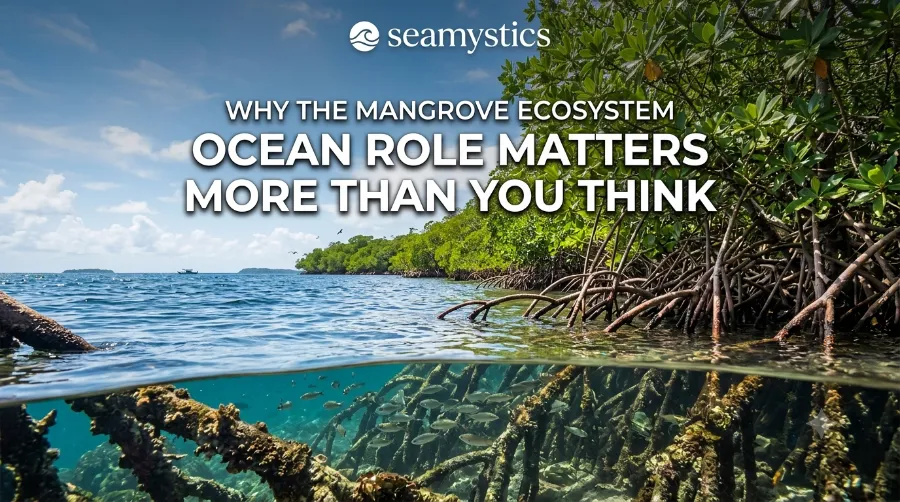

Picture a forest that grows with its roots underwater, feeds a nursery of a trillion baby fish, and holds back a hurricane at the same time. That is not fiction. It is a normal day for a mangrove forest. Most people walk past these tangled, muddy trees and see nothing special, but scientists who study coastlines know better. The mangrove ecosystem ocean role is one of the biggest quiet forces keeping our seas alive, our shores standing, and our climate a little more stable. In this guide, we will unpack why these salty, twisted trees deserve far more credit than they usually get.
learn more about Seagrass meadows and ocean health tips and expert advice.
If you want to learn more about symbiosis in coral reefs tips and expert advice.
Key Takeaways
| Topic | What the Research Shows |
|---|---|
| Global coverage | Mangroves now cover about 15.53 million hectares worldwide as of 2025, following decades of decline, according to the FAO Global Forest Resources Assessment |
| Carbon storage | Mangrove soils and roots hold between 4.4 and 11.7 petagrams of carbon worldwide, burying roughly 26.1 teragrams of carbon each year |
| Fish and food security | Around 4 million fishers depend on mangrove-linked waters for their livelihoods, and mangroves support close to 20,000 extra fish per hectare each year compared to bare coastlines |
| Storm defense | During Hurricanes Charley and Wilma, mangrove belts in South Florida cut storm surge height by as much as 9.4 centimeters for every kilometer of forest crossed |
| Risk level | Nearly half of the world’s remaining mangrove area faces a risk of ecosystem collapse by the year 2050 |
Understanding the Mangrove Ecosystem Ocean Role
Mangroves grow where rivers meet the sea, in a salty, muddy strip that most plants cannot tolerate. Because of this, they act as a living bridge between land and ocean. This bridge position gives mangroves a job that no other coastal habitat fully replicates, and it is why marine biologists keep circling back to them in climate and fisheries research.
If you want to learn more about open ocean ecosystem zones tips and expert advice.
The mangrove ecosystem ocean role stretches across several jobs at once. Filtering runoff before it reaches coral reefs and seagrass beds is one of them. Trapping sediment that would otherwise smother marine life is another. On top of that, mangroves pump oxygen and organic matter into the water, feeding everything from tiny shrimp to reef fish. If you want a wider picture of how these pieces link together across the ocean, our guide on how marine ecosystems work breaks down the full chain from coastline to open water.
want to learn more aboutwhale fall ecosystem explained health tips and expert advice.
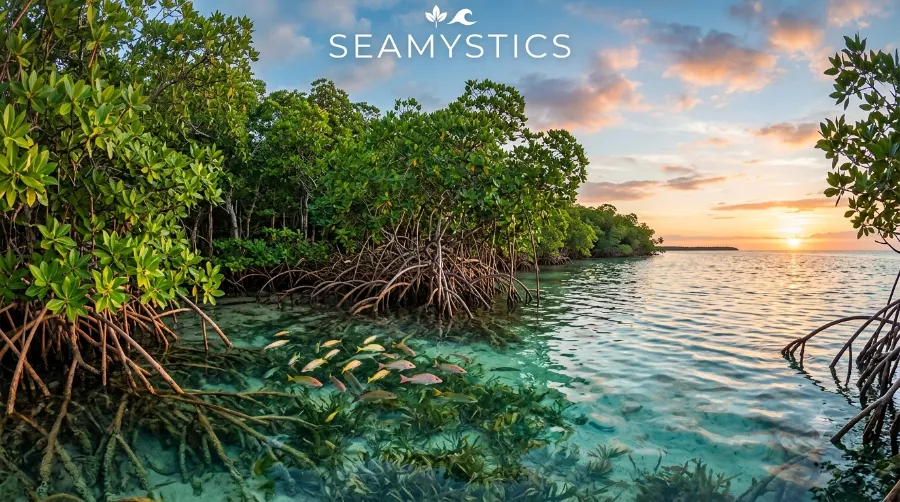
What makes mangroves stand apart from other coastal habitats is their ability to do several jobs in one location. A single stretch of mangrove forest can protect a coastline, store carbon, and raise juvenile fish, all within the same root system. Few habitats on Earth multitask this well.
A Coastal Habitat Built for Survival
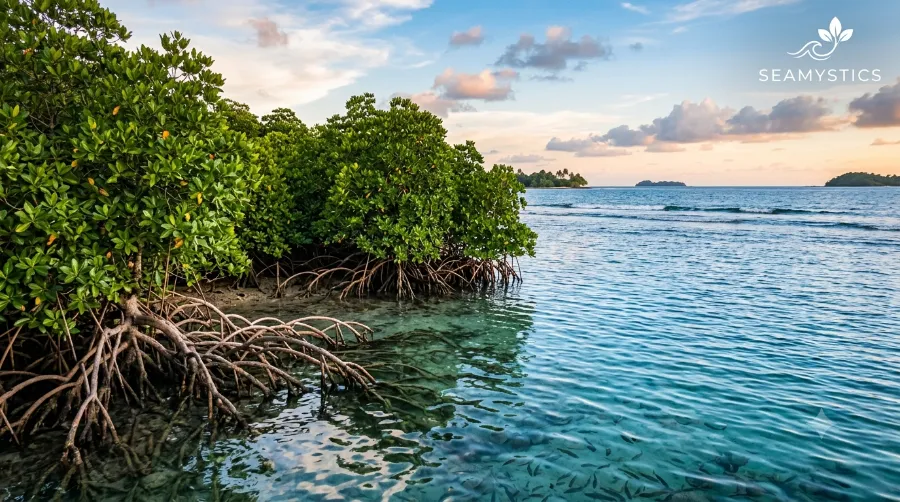
Mangrove trees have adapted in strange and useful ways. Some species push out salt through their leaves. Others send roots straight up out of the mud to breathe air. These adaptations let mangroves survive in a zone that floods twice a day with every tide.
This toughness is part of why mangroves matter so much to nearby Marine Ecosystems. Coral reefs and kelp forests cannot survive where mangroves thrive, yet all three habitats depend on each other in a shared coastal system. If you want to see how a nearby habitat handles a completely different set of challenges, our breakdown of the coral reef ecosystem shows a similar teamwork story playing out just offshore.
How Marine Ecosystems Depend on Mangrove Forests
Fish do not appear in the ocean fully grown. Most start life small, weak, and easy prey. Mangrove roots create a maze of hiding spots that shelter these young fish until they are strong enough to head into open water.
Research published in 2025 estimated that mangroves support an annual abundance of more than 700 billion juvenile fish and invertebrates across the globe. That number alone shows why fisheries scientists treat mangroves as a nursery, not just a forest. Nearly all commercially valuable fish species rely on coastal habitats like this, with about 95 percent of commercially important fish species depending on habitats such as mangroves at some stage of their life.
The Smithsonian’s ocean research team has documented this nursery function for decades, and their overview of mangrove ecosystems offers a clear look at the species that rely on these roots. Meanwhile, marine researchers at the University of Miami have studied how mangrove loss ripples through entire food chains, and their analysis of mangroves and ocean health explains why sharks, rays, and other predators also lean on these coastal nurseries.
Why the Nursery Function Matters So Much
Here are a few reasons Marine Ecosystems stay healthier where mangroves survive:
- Juvenile fish and shrimp gain shelter from larger predators among the tangled roots.
- Sediment trapped by mangrove roots keeps nearby coral reefs and seagrass meadows clearer and healthier.
- Nutrient-rich leaf litter feeds crabs, mollusks, and smaller organisms at the base of the food web.
- Fishing communities gain steady catches, since about 4 million fishers worldwide rely on mangrove-linked waters for their income.
This is also why mangroves link so closely to habitats further offshore. For a look at what happens once young fish leave the mangroves and head into deeper water, our guide to the deep sea food web picks up the story from there.
A Real Example: Fisheries Value in Numbers
Coastal fisheries tied to mangroves are not a small side benefit. Mapping Ocean Wealth researchers found that mangrove-linked fishing grounds can generate between 100 and 1,000 kilograms of fish per hectare each year, and in some high-value locations, from Fiji to Hong Kong, fishing grounds bring in more than 2,000 US dollars per hectare annually. These figures explain why coastal towns from Louisiana to the Philippines treat mangrove protection as an economic decision, not only an environmental one.
Mangroves as Nature’s Carbon Vaults
Trees store carbon. Everyone learns that in school. However, mangroves store carbon at a scale that puts most land forests to shame. Their waterlogged soil traps organic material for centuries because there is not enough oxygen underground to let it fully decompose.
Studies show that carbon burial rates in mangrove soil run two to four times higher than in tropical forests, with total carbon stocks that can be three to five times greater because so much of it sits belowground. Other researchers have found mangroves can store up to five times more carbon per unit area than tropical rainforests. Despite occupying a tiny sliver of forested land worldwide, mangroves cover just 0.36 percent of the global forest area yet sequester carbon at nearly four times the rate of land-based forests, contributing an estimated 10 to 15 percent of all coastal marine carbon stocks.
Carbon Storage Snapshot
| Measurement | Figure |
|---|---|
| Global carbon stored | 4.4 to 11.7 petagrams (mostly belowground) |
| Annual long-term carbon burial | Around 26.1 teragrams per year |
| Comparison to tropical forests | 2 to 4 times higher sequestration rate |
| Share of coastal marine carbon stocks | 10 to 15 percent worldwide |
| Land area occupied globally | Only 0.36 percent of forested land |
A real-world case makes this less abstract. In the United Arab Emirates, satellite monitoring tracked mangrove area growing from 7,080.88 hectares in 2017 to 9,142.21 hectares in 2024, a rise of 29.11 percent over seven years. That expansion alone added an estimated 194,383 tons of stored carbon, equal to roughly 713,367 tons of carbon dioxide fixed from the atmosphere. A single restoration program, run over less than a decade, pulled that much carbon out of circulation.
For readers who want to compare this to another blue carbon powerhouse, our piece on the kelp forest ecosystem covers a different plant-based carbon sink that works in colder waters far from any mangrove root.
Coastal Protection and Climate Resilience
Ask anyone who has lived through a coastal storm what stood between their home and the sea, and in many tropical regions, the answer includes a wall of mangroves. These trees absorb wave energy before it reaches the shoreline, slowing storm surge and reducing flood damage.
During Hurricanes Charley in 2004 and Wilma in 2005, researchers tracking water levels through mangrove zones along the Gulf Coast of South Florida found that surge heights dropped by up to 9.4 centimeters for every kilometer of mangrove forest the storm crossed. That reduction sounds small until you multiply it across miles of coastline protecting entire towns.
The pattern repeats in tsunami research. Following the devastating 2004 Indian Ocean tsunami, multiple studies reported that villages sitting behind mangrove belts suffered less damage than villages directly exposed to the open coast. That event, which claimed an estimated 2.3 million lives across the region according to later disaster reviews, pushed governments and conservation groups to treat mangrove restoration as a frontline defense strategy, not just an ecological nicety.
The United Nations has highlighted similar resilience work in island nations. In Mauritius, coastal and ocean resilience projects have leaned on mangrove restoration as a defense against erosion and storm damage, a case study detailed in the UN’s partnership report on mangrove ecosystems. This kind of small-island case shows how the same coastal defense principle scales down to a single nation’s shoreline.
Why Storm Protection Still Gets Overlooked
Despite this evidence, storm protection remains one of the least appreciated services mangroves provide. A few reasons explain the gap:
- Damage from storms is visible immediately, but the damage prevented by mangroves is invisible, since it never happens.
- Coastal development often clears mangroves first, before communities realize what protection they are losing.
- Engineered seawalls get more funding attention, even though they cost more to build and maintain over time than restoring a natural mangrove buffer.
- Insurance and disaster planning models are only recently starting to factor mangrove cover into risk calculations.
Threats Facing Mangrove Forests Today
Mangroves are resilient, but they are not invincible. Coastal development, aquaculture expansion, and pollution have all chipped away at mangrove forests for decades.
Historical and Ongoing Losses
Between 1980 and the early 2000s, global mangrove area shrank sharply, with roughly 20 percent, or 3.6 million hectares, lost since 1980 according to long-term FAO tracking. The picture has improved somewhat in recent years. Global mangrove area actually grew at an average rate of about 65,900 hectares per year over the 2015 to 2025 period, largely thanks to restoration and natural regrowth in Asia, where the region added roughly 44,100 hectares per year, driven mostly by reported increases in Indonesia.
That said, recovery has not been even everywhere. Africa and South America have continued to see losses even as Asia and North America gained ground.
Where the Risk Remains Highest
Conservation groups estimate that half of all mangroves worldwide could face collapse by 2050 if current pressures continue unchecked. The main threats include:
- Coastal urban development that clears mangroves for housing, ports, and tourism infrastructure.
- Shrimp farming and aquaculture ponds that replace natural mangrove root systems.
- Upstream pollution and altered freshwater flow that stress mangrove roots.
- Rising sea levels that outpace some mangrove species’ ability to adapt in place.
To understand a completely different kind of marine habitat facing its own set of extreme pressures, our article on hydrothermal vent ecosystem facts shows how even the deepest, darkest corners of the ocean carry their own fragile balance.
Restoration Efforts and What You Can Do
The good news is that mangrove restoration works, and it works reasonably fast compared to many other habitat recovery efforts. Restored mangroves can begin supporting fish communities similar to natural forests within five to eleven years, according to recent field research in Guyana.
Global Restoration Targets
Large-scale restoration goals are already in motion. The Bonn Challenge, launched in 2011, set a global target to restore 350 million hectares of degraded land worldwide by 2030. Building on that, the Global Mangrove Alliance has set its own specific goal to restore half of the world’s restorable mangrove area, roughly 4,092 square kilometers out of 8,183 square kilometers identified as recoverable, by 2030.
Simple Actions That Help
If you want to support this effort personally, here is a simple set of steps:
- Choose seafood certified as sustainably sourced, since responsible fishing practices reduce pressure on mangrove-linked fisheries.
- Support or donate to verified mangrove restoration organizations working in tropical coastal regions.
- Reduce plastic and chemical runoff at home, since pollution travels downstream into mangrove estuaries.
- Spread accurate information about mangrove value, since public support often drives local protection policy.
- If you travel to a coastal tropical destination, choose tour operators that respect mangrove boundaries instead of clearing them for beach access.
Frequently Asked Questions
What is the main ocean role of mangrove ecosystems?
Mangroves protect coastlines from storms, store large amounts of carbon in their soil, and act as nurseries for young fish and invertebrates that later populate reefs and open ocean waters.
How much carbon do mangroves store compared to other forests?
Mangroves can store between three and five times more carbon than tropical rainforests per unit area, largely because so much carbon builds up belowground in oxygen-poor soil.
Are mangrove forests increasing or decreasing worldwide?
Both trends exist at once. Long-term losses since 1980 remain significant, but global mangrove area has grown by roughly 65,900 hectares a year over the past decade, with strong gains reported in parts of Asia and North America.
Do mangroves actually protect against hurricanes?
Yes. Field data from Hurricanes Charley and Wilma showed mangrove belts reduced storm surge height by as much as 9.4 centimeters for every kilometer of forest crossed, a measurable buffer that grows with forest width.
Why are mangroves important to fish populations?
Mangrove roots shelter juvenile fish from predators, giving them a safer place to grow. Recent modeling suggests mangroves support more than 700 billion juvenile fish and invertebrates globally each year.
Conclusion
Mangroves rarely get the spotlight that coral reefs or open ocean wildlife receive, yet their quiet, tangled roots hold up far more of the ocean’s health than most people realize. From nursing young fish to locking away carbon for centuries, the mangrove ecosystem ocean role touches nearly every part of coastal life, human and marine alike. Protecting these forests is not a side project for conservationists alone. It is a direct investment in food security, storm safety, and a more stable climate for coastal communities everywhere. The next time you walk past a muddy, root-tangled shoreline, it is worth remembering just how much quiet work is happening beneath the surface.
References
- Breithaupt, J.L. et al. (2025). Carbon sequestration in mangrove ecosystems: Sources, transportation pathways, influencing factors, and its role in the carbon budget. ScienceDirect.
- Wang, M. et al. (2025). Mapping accumulated carbon storage of global mangroves from 2000 to 2020 at a 1 km resolution. Scientific Data, Nature.
- Lee, H. et al. (2025). Beyond carbon: a systematic review of multiple ecosystem services of mangroves. Journal of Coastal Conservation.
- FAO Global Forest Resources Assessment (2025). Global mangrove area trends 1990 to 2025.
- Zu Ermgassen, P. et al. (2020). Fishers who rely on mangroves: Modelling and mapping the global intensity of mangrove-associated fisheries.
- Nature Communications Earth & Environment (2025). Mangroves support an estimated annual abundance of over 700 billion juvenile fish and invertebrates.
- Krauss, K.W. et al. NOAA. The role of mangroves in attenuating storm surges, South Florida Gulf Coast.
- PNAS (2009). Mangroves protected villages and reduced death toll during Indian super cyclone.
- Global Mangrove Alliance (2025). The State of the World’s Mangroves.
- Arxiv (2024). Artificial Intelligence Mangrove Monitoring System Based on Deep Learning and Sentinel-2 Satellite Data in the UAE.