
Picture yourself floating above open water with no land in sight. A deep column of water sits below your feet. It drops for miles. Each layer holds its own light, its own pressure, and its own strange residents. That column makes up the zones of the open ocean ecosystem, and once you understand them, you see the sea differently.
If you want to learn more about open ocean ecosystem zones tips and expert advice.
If you want to learn more about mangrove ecosystem ocean role tips and expert advice.
Most people picture the ocean as one big blue space. In reality, it works more like a tall building with separate floors. Each floor follows its own rules for survival. Sunlight fades. Pressure builds. Temperature drops. Life adapts at every level, so this guide breaks down each zone in plain language, backed by real numbers and current research.
If you want to learn more about symbiosis in coral reefs tips and expert advice.
Dr. Rabica has spent years studying pelagic habitats and open water food webs. This piece pulls together field data, recent expedition findings, and simple explanations anyone can follow. If you want the full picture of how ocean ecosystems connect from the surface to the seafloor, check our guide on how marine ecosystems work.
Key Takeaways
| Zone | Depth Range | Light Level | Known For |
|---|---|---|---|
| Epipelagic (sunlight zone) | 0 to 200 meters | Full sunlight | Phytoplankton, tuna, sharks |
| Mesopelagic (twilight zone) | 200 to 1,000 meters | Dim, fading light | Lanternfish, daily migration |
| Bathypelagic (midnight zone) | 1,000 to 4,000 meters | No sunlight | Bioluminescence, anglerfish |
| Abyssopelagic (abyssal zone) | 4,000 to 6,000 meters | Total darkness | Sea cucumbers, low oxygen |
| Hadalpelagic (hadal zone) | Below 6,000 meters | Total darkness | Ocean trenches, extreme pressure |
Now let’s walk through each layer and see what actually lives there.
What Are The Zones Of The Open Ocean Ecosystem?
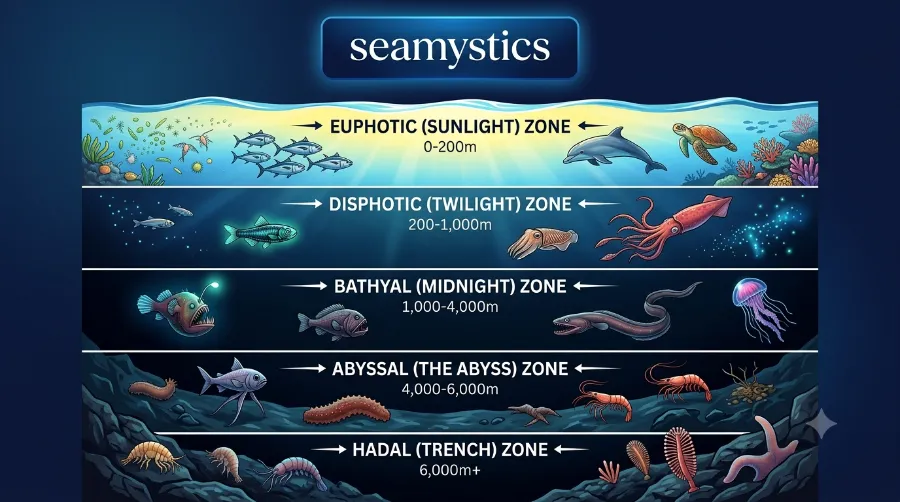
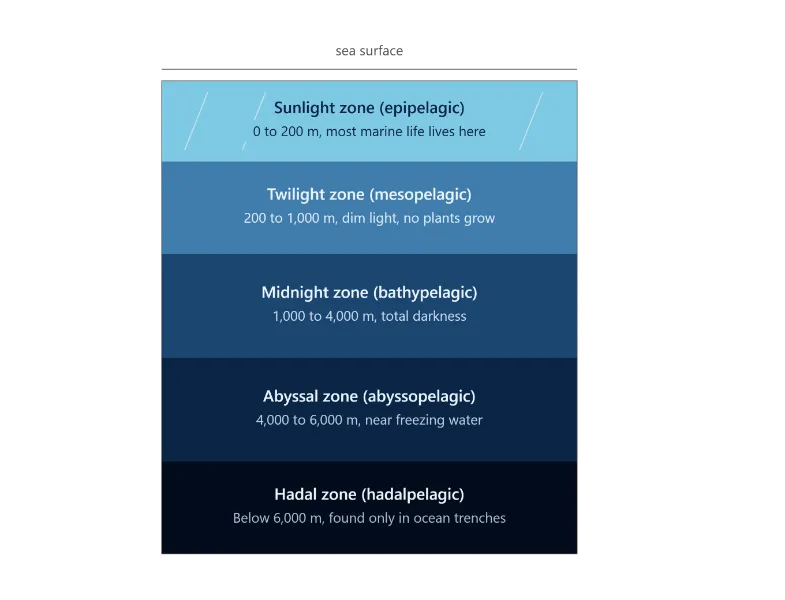
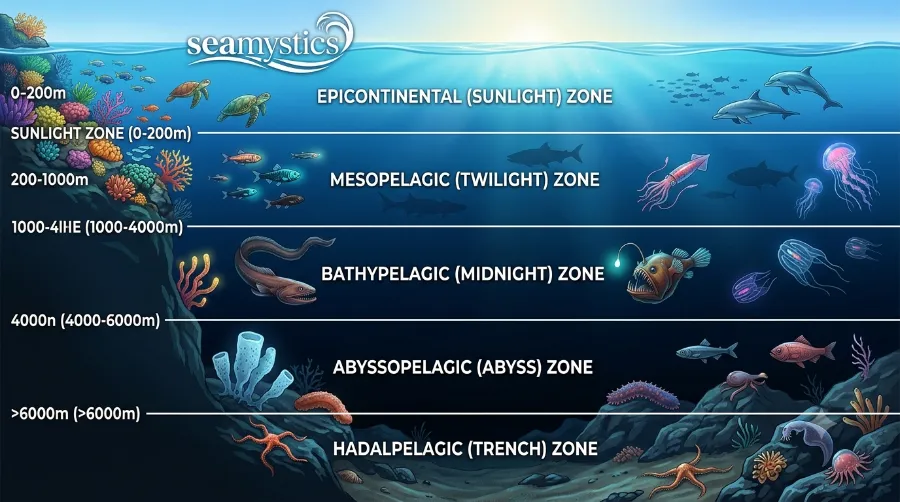
The open ocean, also called the pelagic zone, covers everything beyond the coast and above the seafloor. Scientists split this space into five main depth zones. They base the split on how much light reaches each level. This system helps researchers predict what kind of life can survive at a given depth, since light, temperature, and pressure shift together as you go down.
learn more about Seagrass meadows and ocean health tips and expert advice.
Woods Hole Oceanographic Institution breaks the water column into five parts. The ocean water column is made up of five zones: the sunlight zone (epipelagic), the twilight zone (mesopelagic), the midnight zone (bathypelagic), the abyssal zone (abyssopelagic) and the hadal zone (trenches). This layered structure forms the backbone of nearly every open water food chain on Earth. Woods Hole Oceanographic Institution
Before we go deeper, compare these zones to coastal habitats you may already know, such as the coral reef ecosystem or the kelp forest ecosystem. Those systems sit close to shore and get constant sunlight. The open ocean zones stretch far offshore and lose light fast with depth.
want to learn more aboutwhale fall ecosystem explained health tips and expert advice.
Why These Zones Matter For Marine Ecosystems
Marine ecosystems depend on this layered structure because energy has to move from the surface downward. Sunlight only reaches the top layer, so nearly every deeper ecosystem survives on leftovers. Sinking food particles, dead organisms, and waste drift down constantly. Scientists call this slow, steady drift marine snow, and it acts like a food delivery system for the deep sea.
Without this vertical transfer, the deep sea would sit empty. Instead, it hosts surprising biodiversity, and researchers are still mapping much of it. A global research effort called the Ocean Census identified more than a thousand new marine species between 2023 and 2026. That number alone shows how much of this hidden world still waits to be discovered.
Zone 1: The Epipelagic Zone, The Sunlight Layer
The epipelagic zone, often called the sunlight zone, runs from the surface down to about 200 meters. This is the only zone with enough light for photosynthesis, so it supports the base of the entire ocean food web. Manoa’s ocean science program notes this region as the one where enough light penetrates the water to support photosynthesis, so it is also called the euphotic or photic zone. Manoa Hawaii
Sunlight drives plant like growth here, so this layer holds the highest concentration of life in the open ocean. Phytoplankton bloom across huge stretches of surface water. These tiny organisms feed nearly everything else, directly or indirectly. Tuna, sharks, dolphins, sea turtles, and countless seabirds all rely on this productive top layer.
Temperature in this zone shifts a lot by location. Waters near the equator can reach the mid 80s Fahrenheit. Polar surface waters can drop close to freezing. This range shapes which species thrive where, and it explains why tropical open ocean life looks so different from what you find near the poles.
Real Examples From The Sunlight Zone
A few real examples show how rich this zone can be:
- Bluefin tuna migrate thousands of miles through epipelagic waters each year. They often cross entire ocean basins between feeding and spawning grounds.
- Whale sharks, the largest fish alive, filter feed on plankton blooms near the surface. Groups of more than a hundred individuals gather off Mexico’s Yucatan coast during summer months.
- Flying fish use this zone’s wave energy to launch above the water. They glide for over 150 feet to escape predators below.
If shallow, sunlit systems interest you, explore how symbiotic relationships form in bright, warm water in our piece on symbiosis in coral reefs. Many of the same survival pressures apply near the surface.
Zone 2: The Mesopelagic Zone, The Twilight World
Once you pass 200 meters, sunlight fades fast. By 1,000 meters, it disappears almost entirely. This stretch is called the mesopelagic zone, or twilight zone, and it sits right at the edge of what human eyes could register as light. Wikipedia defines the boundary clearly: it is defined by light, and begins at the depth where only 1% of incident light reaches and ends where there is no light. Wikipedia
This zone is far from empty. Researchers believe it may hold more biomass than any other ocean layer. Small fish like lanternfish gather here in massive schools. Some estimates place the total biomass of mesopelagic fish above one billion tonnes, which makes this dim layer one of the most important, yet least understood, parts of global marine ecosystems.
The Nightly Migration And A Real Discovery
Many mesopelagic animals take part in what scientists call the largest migration on Earth. They move up toward the surface each night to feed. They drop back down at dawn to avoid predators. This daily journey moves huge amounts of carbon and nutrients through the water column, and that matters for ocean health and climate regulation alike.
A striking discovery highlights how alive this zone really is. In November 2025, a team from the California Academy of Sciences retrieved monitoring devices that had spent eight years attached to reefs near Guam. The scientists gathered 2,000 specimens. They identified 100 species never before recorded in the region, and at least 20 appeared to be completely new to science. That single expedition proved how much twilight zone biodiversity still waits to be documented.
If you want to see how food travels between these ocean layers, our detailed breakdown of the deep sea food web walks through exactly how energy moves from sunlit waters down into darkness.
Zone 3: The Bathypelagic Zone, The Midnight Zone
Past 1,000 meters, you enter complete darkness. This is the bathypelagic zone, often nicknamed the midnight zone, and it stretches down to roughly 4,000 meters. Conditions barely shift once you reach this depth. As Wikipedia explains, the bathypelagic zone is characterized by a nearly constant temperature of approximately 4 °C (39 °F) and a salinity range of 33-35 g/kg. Wikipedia
No natural light reaches this layer. The only glow comes from bioluminescent creatures that generate their own light through chemical reactions. This adaptation helps animals attract mates, lure prey, or confuse predators in a world where eyesight alone barely works.
Creatures That Call The Midnight Zone Home
The famous anglerfish lives here. It uses a glowing lure to draw in curious prey before snapping them up in the darkness. Giant squid, some reaching over 40 feet long, also patrol these depths. Much of what scientists know about them comes from stranded specimens rather than direct observation, since live sightings remain extremely rare.
Pressure at this depth stays intense. As Wikipedia notes, the hydrostatic pressure in this zone ranges from 100-400 atmospheres (atm) due to the increase of 1 atm for every 10 m depth. Animals here have evolved flexible bodies and reduced skeletal structures to handle this crushing force without harm. Wikipedia
Zone 4: The Abyssopelagic Zone, The Abyss
Below 4,000 meters lies the abyssopelagic zone, commonly shortened to the abyssal zone. It reaches down to about 6,000 meters and covers a huge portion of the deep ocean floor. Water temperature here hovers just above freezing, and oxygen levels drop compared to shallower zones.
Life still exists here, though it moves slowly and survives on very little food. Sea cucumbers, brittle stars, and deep sea worms crawl across the muddy floor. They feed almost entirely on marine snow drifting down from above. Food stays scarce, so many species in this zone run on extremely slow metabolisms, and some deep sea organisms may live for well over a century.
One fascinating abyssal ecosystem forms around hydrothermal vents. Mineral rich water erupts from the seafloor here and supports entire communities that skip sunlight completely. Instead, these communities run on chemosynthesis, a process where bacteria convert chemicals into energy. Our guide on hydrothermal vent ecosystem facts explains exactly how life thrives without a single ray of sunlight.
Zone 5: The Hadalpelagic Zone, The Deepest Trenches
The hadalpelagic zone, or hadal zone, marks the deepest and least explored part of the open ocean. It exists only within ocean trenches, where the seafloor drops below 6,000 meters. In places like the Mariana Trench, it plunges past 10,000 meters. Study.com confirms this range in its overview of ocean depth zones, noting this zone extends from the bottom of the abyssopelagic zone to over 10,000 meters in certain deep sea trenches. Study.com
Pressure here reaches over a thousand times what we feel at sea level. Yet life persists. Amphipods, a type of small crustacean, scavenge at the very bottom of the Mariana Trench. Specialized fish called snailfish have been recorded swimming at depths beyond 8,000 meters.
New Species Still Turning Up In The Trenches
Recent expeditions keep expanding what scientists know about this extreme environment. A 2025 to 2026 wave of deep sea research, including work from the Ocean Census expedition to Australia’s Coral Sea Marine Park, uncovered new species even in these punishing conditions. One team documented a previously unknown catshark species at depths between 748 and 982 meters. This shows discoveries are not limited to the very deepest trenches alone, but continue across the whole open ocean system.
Ocean Zones At A Glance
The table below pulls together current figures from oceanographic institutions so you can compare zones side by side.
| Zone | Depth | Temperature | Pressure | Light |
|---|---|---|---|---|
| Epipelagic | 0 to 200 m | Warm, variable | 1 to 20 atm | Full sunlight |
| Mesopelagic | 200 to 1,000 m | Cooling steadily | 20 to 100 atm | Faint, blue only |
| Bathypelagic | 1,000 to 4,000 m | About 4°C constant | 100 to 400 atm | None, bioluminescence only |
| Abyssopelagic | 4,000 to 6,000 m | Near freezing | 400 to 600 atm | None |
| Hadalpelagic | Below 6,000 m | Near freezing | Over 600 atm | None |
Pressure climbs steadily with depth. Temperature drops fast, then levels off. This pattern explains why the deepest zones of the open ocean ecosystem host fewer species than the sunlit surface, yet still surprise researchers with new finds almost every year.
How Life Adapts Across These Marine Ecosystems
Every zone forces its residents to solve different survival problems. Marine life across the open ocean uses several key strategies to cope with depth:
- Bioluminescence, which fish, squid, and even bacteria use to communicate, hunt, or hide in total darkness.
- Slow metabolism, which lets deep sea animals survive on scarce food for long stretches of time.
- Vertical migration, where animals travel hundreds of meters daily to feed near the surface at night and retreat to safer depths by day.
- Pressure resistant bodies, often built with soft tissue and reduced bone density instead of rigid skeletons.
- Large eyes or sensitive lateral lines, which help animals detect faint light or vibrations when vision alone falls short.
These strategies did not appear overnight. They developed over millions of years as species pushed into deeper, darker, colder water in search of food or safety from predators. Similar pressures shape shallower marine ecosystems too. Coastal habitats like mangrove ecosystems show their own version of adaptation, where roots handle shifting tides instead of crushing pressure.
Why The Open Ocean Ecosystem Faces Growing Pressure
Even though the open ocean feels remote, human activity reaches deeper than most people realize. Overfishing, plastic pollution, and warming surface waters all affect the zones described above, and scientists are only beginning to measure some of these effects.
The Monterey Bay Aquarium reports that open ocean habitats support a huge share of the planet’s biodiversity, yet remain among the least protected marine spaces on Earth. Oceana continues to push for stronger fishing rules and marine protected areas to safeguard these fragile systems before the damage becomes irreversible.
Threats Building Beneath The Surface
Warming surface temperatures already shift where species live. Fish that once stayed within a specific latitude now move toward cooler waters, disrupting fishing communities and food webs alike. Meanwhile, plastic waste turns up at nearly every depth tested, including samples pulled from hadal trenches more than 10,000 meters down.
Here are some of the biggest pressures facing open ocean zones today:
- Overfishing has cut some large predator populations, including tuna and sharks, by more than half since the mid twentieth century, according to multiple stock assessments.
- Warming waters push species toward the poles and disrupt long standing migration patterns.
- Plastic pollution now reaches even the deepest trenches, threatening filter feeders and deep sea scavengers alike.
- Companies have begun exploring commercial harvesting of twilight zone fish stocks, and this raises concern among marine scientists about unknown ecological consequences.
Recent Discoveries Reshaping What We Know
Ocean science moves fast, and the last two years delivered exciting findings. Between 2025 and 2026, researchers reported more than a thousand newly identified ocean species through the global Ocean Census initiative. That scale of discovery would have seemed impossible just a decade ago.
Fresh Finds From Recent Expeditions
One standout example comes from the Mar del Plata Canyon off South America. A 2025 expedition there suspected around 40 potential new species, including red soft corals and star shaped marine organisms living far below the reach of sunlight. Around the same period, the research vessel Falkor II documented over two dozen new deep sea species in the mesopelagic zone off Brazil within just a few days.
These findings matter. They remind us the zones of the open ocean ecosystem are still not fully mapped, even in 2026. Every expedition adds new species, new behaviors, and new questions about how deep sea life actually functions.
Frequently Asked Questions
What are the five zones of the open ocean ecosystem?
The five zones are the epipelagic, mesopelagic, bathypelagic, abyssopelagic, and hadalpelagic zones. Depth, light, and temperature define each one, and each supports a different set of marine life suited to those exact conditions.
Which zone has the most marine life?
The epipelagic zone, or sunlight zone, holds the greatest density of marine life because it is the only layer with enough light for photosynthesis. The mesopelagic zone may still hold the largest total biomass on the planet, thanks to the sheer number of small fish living there.
How deep is the deepest part of the ocean?
The Mariana Trench, located in the hadal zone, reaches a depth of roughly 10,935 meters at its deepest known point, called Challenger Deep. This makes it the deepest known location in any ocean on Earth.
Do animals live in every zone of the open ocean?
Yes. Even the coldest, darkest, and most pressurized zones host life, including amphipods, snailfish, and specialized bacteria near hydrothermal vents. Life has adapted to nearly every condition the open ocean presents.
Why is the mesopelagic zone important for climate change?
The mesopelagic zone moves carbon from the surface to deeper water through the daily vertical migration of fish and plankton. Scientists call this process the biological pump, and it helps keep more carbon trapped in the deep ocean rather than the atmosphere.
Conclusion
The zones of the open ocean ecosystem tell a story of adaptation, pressure, and hidden biodiversity that most people never get to see. Tuna and sharks thrive at the sunlit surface. Shadowy twilight gives way to total darkness. Crushing trenches sit at the very bottom. Every layer plays a role in keeping the wider ocean healthy. New expeditions keep uncovering species we never knew existed, and that proves this vast blue world still holds far more mysteries than answers. Protecting it starts with understanding exactly how it works.
References
Woods Hole Oceanographic Institution, Ocean Zones overview
Wikipedia, Bathypelagic Zone entry
Wikipedia, Mesopelagic Zone entry
Study.com, Ocean Depth Zones lesson overview
Manoa Exploring Our Fluid Earth, Depth Zones overview
Monterey Bay Aquarium, Open Ocean Ecosystem overview
Oceana, Open Ocean marine life overview
Mongabay, Deep sea twilight zone species report, December 2025
CNN, Ocean twilight zone dive report, December 2025
Forbes, Ocean Census new species report, May 2026