
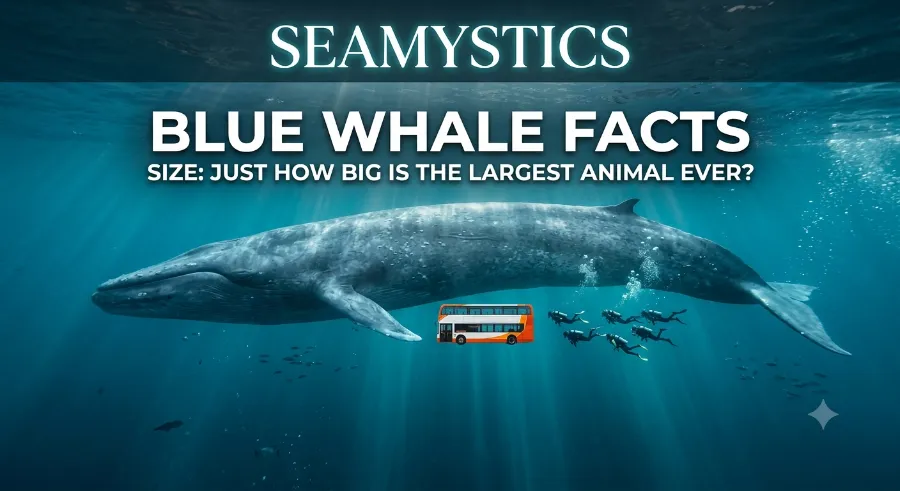

Picture a creature longer than three school buses parked end to end, with a heart the size of a small car and a tongue that outweighs an elephant. That is not a myth from an old sailor’s tale. It is simply another day in the life of a blue whale, the undisputed record holder when it comes to blue whale facts size. Scientists agree that nothing in Earth’s 4.5 billion year history, not even the largest dinosaurs, has ever come close to matching this animal’s mass. In this guide, we break down the real numbers behind its size, weight, and daily life, using the latest research from marine biologists and conservation groups around the world.
To get a better understanding of how whale facts marine mammals breaks down exactly what to expect.
Before we go further, here is a quick snapshot of what you are about to learn.
If you want to learn more about seal vs sea lion tips and expert advice.
Key Takeaways
| Fact | Detail |
|---|---|
| Maximum length | Up to 110 feet (33.5 meters), based on a 1909 whaling record |
| Average length | 70 to 90 feet (24 to 27 meters) |
| Maximum weight | Up to 200 tons in Antarctic populations |
| Heart size | Roughly 400 pounds, about the size of a small car |
| Tongue weight | Up to 4 tons, heavier than an African elephant |
| Newborn calf | About 3 tons and 23 to 25 feet at birth |
| Daily milk intake for calves | Up to 100 gallons |
| Daily krill intake for adults | Up to 8,000 pounds, roughly 40 million krill |
| Lifespan | 80 to 90 years, with some individuals reaching past 100 |
| Conservation status | Endangered, with an estimated 10,000 to 25,000 remaining worldwide |
Why Blue Whale Facts Size Numbers Are So Hard to Believe
Numbers on a page rarely capture what it feels like to stand next to something this large. However, once you compare a blue whale to familiar objects, the scale starts to sink in. A full grown adult can stretch beyond 90 feet, and some documented individuals have reached even further.
If you want to learn more about whale song communication explained tips and expert advice.
For context, that is longer than a basketball court and roughly the length of three school buses lined up bumper to bumper. Meanwhile, its weight can climb past 300,000 pounds, which is heavier than 30 African elephants combined. These are not rough guesses either. Marine biologists at institutions such as the Monterey Bay Aquarium have measured and documented these animals for decades using stranding data, whaling records, and modern tagging technology.If you want to learn more about sperm whale deep divetips and expert advice.
The Longest Blue Whale Ever Recorded
The largest confirmed blue whale was a female caught in the South Atlantic back in 1909. She measured an incredible 110 feet from nose to tail. Although commercial whaling ended decades ago, this record still stands today because no living whale has been measured at that scale since.
If you want to learn more about manatee facts marine mammal tips and expert advice.
Most blue whales swimming in today’s oceans fall between 70 and 90 feet long. Antarctic blue whales tend to run larger than their North Pacific or North Atlantic relatives, likely because colder, krill rich waters allow for more growth. If you want to explore how blue whales stack up against other ocean giants, our guide on whale facts and marine mammals breaks down size comparisons across several species.
How Much Does a Blue Whale Weigh
Weight estimates for blue whales vary depending on the region and the season, but the numbers are staggering across the board. Females typically outweigh males, sometimes by a wide margin. Antarctic females have been recorded at around 130 tons, while males in the same population average closer to 112 tons.
To put this in perspective, a single blue whale can weigh as much as 33 African elephants standing together. Its heart alone weighs close to 400 pounds and pumps roughly 60 gallons of blood with every single beat. Meanwhile, its tongue can weigh up to 4 tons, which is heavier than most adult elephants.
Whale Facts Marine Mammals: How Blue Whales Compare to Other Giants
Blue whales are not the only massive creatures in the ocean, but they are in a league of their own. The table below compares blue whales to other well known marine mammals and prehistoric giants so you can see exactly where they stand.
| Animal | Maximum Length | Maximum Weight |
|---|---|---|
| Blue whale | 110 feet | 200+ tons |
| Fin whale | 85 feet | 80 tons |
| Sperm whale | 67 feet | 57 tons |
| Humpback whale | 60 feet | 40 tons |
| Orca (killer whale) | 32 feet | 6 tons |
| Whale shark (largest fish) | 62 feet | 20 tons |
| Tyrannosaurus rex | 40 feet | 9 tons |
As the table shows, even a massive predator like the orca looks small next to a blue whale. Interestingly, orcas make up for their smaller size with speed, coordination, and hunting intelligence rather than sheer bulk. If you want to see how a much smaller marine mammal still dominates the ocean food chain, check out our breakdown of orca whale hunting behavior, which explains how these animals work together in pods.
How Blue Whales Get So Big on Such a Tiny Diet
Here is where things get genuinely surprising. Despite their colossal size, blue whales survive almost entirely on krill, which are tiny shrimp like creatures barely bigger than a paperclip. So how does an animal reach 200 tons by eating something so small?
The answer lies in sheer volume and an efficient feeding system. Blue whales are baleen whales, meaning they filter feed instead of chewing prey. Their mouths contain hundreds of comb like plates made of keratin, the same material found in human fingernails.
Here is a simple breakdown of how the feeding process works:
- The whale opens its mouth wide and lunges through a dense patch of krill, taking in a massive gulp of water.
- Pleats along its throat expand like an accordion, allowing the mouth to hold a volume of water greater than the whale’s own body.
- The tongue then pushes the water back out through the baleen plates, which act like a sieve.
- Thousands of krill get trapped inside the mouth and are swallowed in one motion.
During peak feeding season, a single blue whale can consume close to 8,000 pounds of krill in a day. That works out to roughly 40 million individual krill, according to data compiled by the World Wildlife Fund. This massive intake fuels a body that needs enormous amounts of energy simply to move through the water.
Life Cycle of the Biggest Baby on the Planet
Even at birth, blue whale calves are already record breakers. After a pregnancy lasting roughly 10 to 12 months, a newborn calf enters the world weighing close to 3 tons and stretching about 25 feet long. That is longer than most adult killer whales.
From there, growth happens at a speed that seems almost impossible. Calves gain around 200 pounds every single day during their first year of life, fueled by nursing on their mother’s extremely rich milk. Some researchers have documented calves gaining up to 9 pounds per hour during peak nursing periods.
A few quick facts about early blue whale development:
- Newborn calves drink up to 100 gallons of milk daily.
- Calves can grow more than an inch in length per day.
- By seven months old, a calf can already measure 50 feet and weigh over 46,000 pounds.
- Blue whales typically reach sexual maturity between 6 and 10 years of age.
This rapid early growth explains why blue whales are able to reach such extraordinary sizes within a single lifetime. Once mature, individuals can live for 80 to 90 years, and researchers studying earwax layers have identified at least one individual believed to be over 100 years old.
Where Blue Whales Live and Travel
Blue whales are found in every ocean on Earth except the Arctic. They tend to migrate seasonally, following krill populations and water temperatures across thousands of miles each year. North Pacific blue whales, for example, often spend winters near Mexico and Central America before heading north toward the U.S. West Coast during summer feeding season.
Antarctic blue whales follow a similar pattern in the Southern Hemisphere, staying close to the ice edge during summer and moving toward warmer, low latitude waters in winter. Because they are usually solitary or found in small groups, tracking their exact movements has taken decades of tagging research and acoustic monitoring.
Speaking of sound, blue whales are also among the loudest animals on the planet. Their calls can reach up to 188 decibels, louder than a jet engine at close range. These low frequency calls travel enormous distances underwater, and in ideal ocean conditions, blue whales may be able to hear each other from as far as 1,000 miles away, according to the National Geographic Society.
Threats Facing the World’s Largest Animal
Despite their massive size, blue whales are surprisingly vulnerable. Commercial whaling throughout the 1900s pushed populations to the brink of extinction, wiping out an estimated 99% of the global population before international protections were introduced. Although whaling has largely stopped, blue whales still have not fully recovered.
Today, the biggest threats come from human activity in different forms. Ship strikes remain a leading cause of death, especially in busy shipping lanes along the U.S. and European coastlines. Entanglement in fishing gear, ocean noise pollution, and the effects of climate change on krill populations all continue to put pressure on these animals.
According to NOAA Fisheries, blue whales remain listed as endangered under the Endangered Species Act. Conservation groups such as Whale and Dolphin Conservation continue to push for safer shipping practices and stronger protections in key migration corridors. If you would like to learn more about how different whale species are being protected worldwide, our main resource on seamystics.com covers conservation efforts across multiple species.
For travelers hoping to witness these giants firsthand, several operators offer responsible whale watching tours. Guides like the one from Original Diving outline the best seasons and locations for spotting blue whales in the wild, which can be a powerful way to understand their true scale in person rather than through numbers alone.
Frequently Asked Questions
How big is a blue whale compared to a human?
An adult blue whale can be more than 15 times longer than the average adult human and thousands of times heavier. Standing next to one, a person would look roughly the size of a single fingernail on the whale’s body.
What is the biggest blue whale ever recorded?
The largest confirmed blue whale measured 110 feet long and was documented in the South Atlantic in 1909 during commercial whaling operations.
Do blue whales have any natural predators?
Adult blue whales have very few natural predators due to their size, though orcas have occasionally been observed attacking young or weakened individuals in coordinated group hunts.
How many blue whales are left in the world today?
Current estimates suggest there are between 10,000 and 25,000 blue whales remaining globally, a small fraction of the population that existed before commercial whaling began.
Why are blue whales bigger than any dinosaur that ever lived?
Ocean water supports a body’s weight far better than land does, which allowed blue whales to grow past the physical limits that restricted even the largest land dwelling dinosaurs.
Final Thoughts
Blue whales remind us that size alone does not always mean danger or aggression. Instead, this gentle giant survives on some of the smallest creatures in the ocean while carrying a body that dwarfs anything else that has ever lived on Earth. From a heart the size of a car to a calf that gains 200 pounds a day, every blue whale fact seems to top the last. As conservation efforts continue, protecting this species means protecting a living piece of natural history that took millions of years to evolve into the record holder it is today.
References
- National Geographic, Blue whale facts and photos, nationalgeographic.com
- Monterey Bay Aquarium, Blue whale species profile, montereybayaquarium.org
- NOAA Fisheries, Blue whale species overview, fisheries.noaa.gov
- World Wildlife Fund, What’s the biggest animal that has ever lived, worldwildlife.org
- Whale and Dolphin Conservation, Facts about blue whales, us.whales.org
- Original Diving, Blue whale facts guide, originaldiving.com