
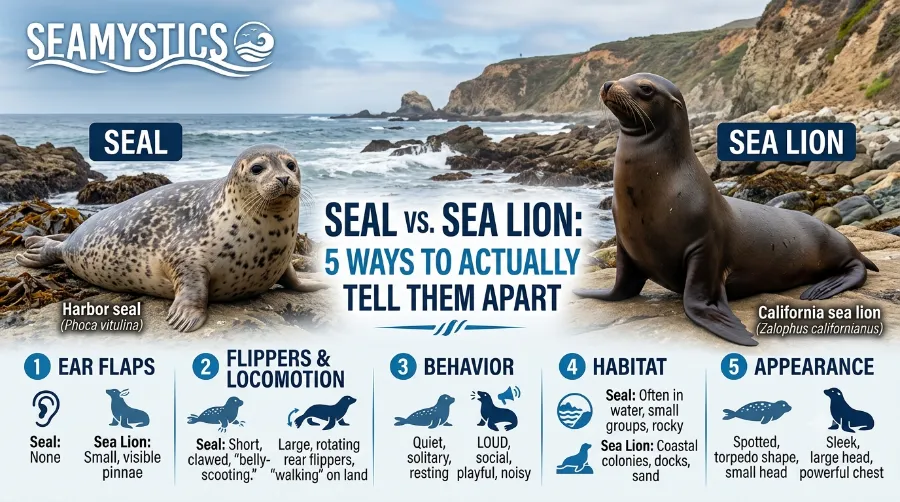

Picture this. You are standing on a rocky shoreline in California, and a sleek, whiskered creature slides off a rock and slips into the surf. Was that a seal or a sea lion? Most beachgoers guess wrong, and honestly, so do a lot of tour guides. The seal vs sea lion mix up is one of the most common mistakes in ocean wildlife spotting, and once you know the five real differences, you will never confuse them again.
If you want to learn more about whale song communication explained tips and expert advice.
I have spent years studying pinnipeds along the Pacific coast and in colder Atlantic waters, and I still meet visitors who insist every whiskered animal on a beach is “just a seal.” That is simply not true. Seals and sea lions belong to different biological families, they move differently, they sound different, and they even swim in different ways.
If you want to learn more about manatee facts marine mammal tips and expert advice.
Key Takeaways
| Feature | Seal | Sea Lion |
|---|---|---|
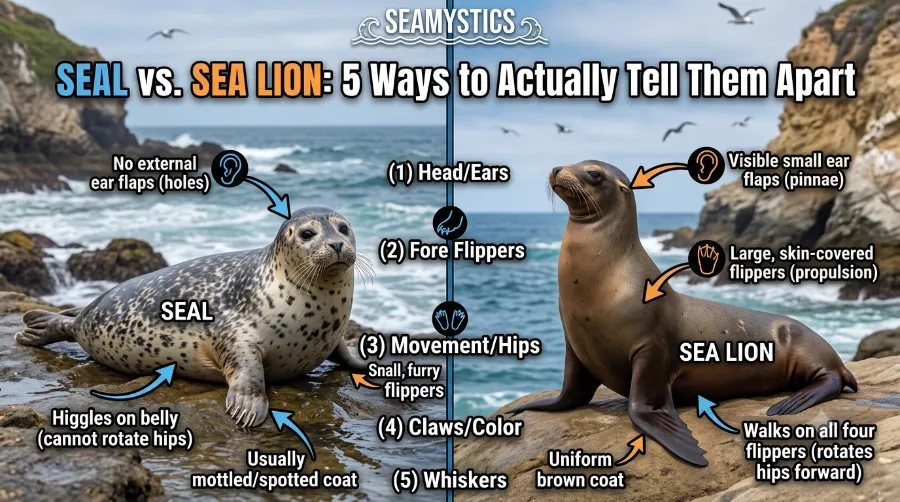
| Ears | No visible ear flap, just a small hole | Small visible external ear flap |
| Front flippers | Short, furry, clawed | Long, mostly hairless, paddle-like |
| Movement on land | Wriggles on belly like a caterpillar | Walks and gallops on all four flippers |
| Sound | Quiet grunts, hisses, and growls | Loud barking, roaring, and growling |
| Swim speed | Roughly 14 to 23 mph | Roughly 25 to 30 mph |
| Social style | Mostly solitary, gathers to breed | Highly social, lives in herds of hundreds |
Before we go further, if you enjoy learning how ocean animals are built for survival, our guide on whale facts and marine mammals covers the wider family tree that seals and sea lions belong to.
Seals and Sea Lions Are Cousins, Not Twins
Both seals and sea lions are pinnipeds, a word that means “fin footed” in Latin. So are walruses. All three groups share a common ancestor, yet they split into separate families a long time ago, and that split shows up clearly in their bodies today.
Seals belong to the family Phocidae, often called true seals or earless seals. Sea lions belong to Otariidae, alongside fur seals, and this family is nicknamed the eared seals. There are roughly 33 known pinniped species living around the world today, and that number includes true seals, eared seals, and the walrus. Smithsonian Ocean
Because these animals share so much in size, color, and habitat, most people rely on guesswork rather than real features. That guesswork is exactly why the seal vs sea lion question keeps popping up in comment sections, nature forums, and family road trips to the coast. Below are the five features that actually work, every single time.
1. Check the Ears First
This is the fastest test, and it works from a fair distance if you have binoculars. Sea lions have small external flaps on the outer part of their ears, similar to a tiny fold of skin. True seals lack that flap entirely. NOAA National Ocean Service
Instead, a seal only has small ear holes with no visible flap at all. You often need to get close, or zoom in with a camera, to even notice the holes on a seal’s smooth, rounded head. Because of this, scientists sometimes call sea lions “eared seals” and true seals “earless seals,” which sounds odd until you have seen both side by side. Britannica
A fun fact for road trips or aquarium visits: harp seals look like they have no ears whatsoever from a distance, according to marine educators at Sea Smart. That single detail, ears or no ears, solves most identification arguments on the spot.
2. Look at the Front Flippers
Flippers tell an equally clear story, and they matter for more than just looks. A seal’s front flippers are short, stubby, and covered in fur, with small claws on each toe. A sea lion’s front flippers are long, mostly bare skin, and shaped more like paddles built for power.
This difference exists because each animal swims in its own unique way. Sea lions rely mainly on their large front flippers to push through water, almost like rowing with oars, while their back flippers help with steering. Seals, on the other hand, generate speed by sweeping their rear flippers side to side, more like a fish tail, while their front flippers barely help at all in the water.
Claw placement is another small but telling clue. According to IFAW researchers, seals have long claws on every toe of both front and back flippers, while sea lions only carry claws on their hind flippers, which they use mainly for scratching and grooming rather than swimming. If you ever get a close photo of a resting pinniped, checking the claws can settle the debate quickly. IFAW
3. Watch How They Move on Land
This is where the difference becomes almost comical. Sea lions can rotate their rear flippers forward, tucking them underneath their body, which lets them stand up and actually walk, and even gallop, across sand or rocks. That rotating hip joint is a genuine anatomical advantage that true seals simply do not have.
Seals cannot do this because their pelvic structure is fused and rigid. As a result, a seal on land has to hitch itself forward on its belly, shifting its weight and rolling slightly, in a motion that researchers often compare to a caterpillar or an inchworm. It looks slow and a little awkward, though seals are still surprisingly quick over short bursts when startled.
This mobility gap also explains why sea lions are the ones you usually see performing at marine parks and aquarium shows. Their ability to balance and move on all four flippers makes them far easier to train for land-based tricks, while seals remain almost entirely water bound performers. If it helps to picture another highly mobile marine hunter for comparison, check out how differently an orca hunts using coordinated pod strategy, since orcas rely on teamwork rather than land mobility at all.
4. Compare Size, Shape, and Color
Size varies a lot across both families, so this clue works best alongside the others rather than alone. Sea lions generally have a leaner, more streamlined body with a longer neck and a face that many people describe as dog-like. Their coats usually run from tan to a deep chestnut brown, and they often look sleek and muscular when wet.
True seals tend to look rounder, plumper, and shorter-necked, almost torpedo-shaped when resting. Coat color ranges widely by species, from silvery gray to spotted brown to near black, and many seals show unique spot patterns that researchers use to identify individuals over many years.
Size records are genuinely wild once you dig into the numbers. The largest seal on record is the Southern elephant seal, which can stretch over 20 feet in length and weigh more than 8,800 pounds, according to WWF data. Compare that to the smallest seal, the Baikal seal of Siberia, which barely reaches three feet and lives its entire life in freshwater rather than the ocean, a genuine rarity among pinnipeds. World Wildlife Fund
5. Listen for the Sound
Sound might be the single most reliable clue if you cannot get a clear visual. Sea lions are loud, social, and honestly a little chaotic when gathered in numbers. They bark repeatedly, and larger males will roar and growl to defend territory or attract mates, a scene familiar to anyone who has walked past Pier 39 in San Francisco.
Seals communicate very differently. Most species stick to soft grunts, low growls, and occasional hisses, and they rarely raise their voices the way sea lions do. Elephant seals are the notable exception, since bull elephant seals produce a deep, drum-like vocal threat during mating season that can carry a surprising distance across a beach.
This vocal gap connects directly to lifestyle. Sea lions are highly social animals that gather in groups called herds or rafts, and these groups can include upwards of 1,500 individuals in a single haul-out area. Seals, by contrast, tend to be quieter loners that only gather in large numbers once a year, mainly for breeding season. NOAA National Ocean Service
Quick Speed Comparison Chart
Swimming speed is one of the clearest ways to see how differently these two families are built. The chart below uses simple bar visuals to compare typical top speeds, based on published wildlife data.
| Animal | Typical Top Speed | Visual |
|---|---|---|
| California Sea Lion | 25 to 30 mph | ████████████████████████████ |
| Gray Seal | 14 to 23 mph | █████████████████████ |
| Steller Sea Lion | up to 25 mph | █████████████████████████ |
| Harbor Seal | up to 15 mph | ███████████████ |
As the chart shows, sea lions generally win the speed contest. According to the Smithsonian’s National Zoo, sea lions can reach speeds of 25 to 30 miles per hour, while gray seals typically clock in around 14 to 23 miles per hour. IFAW researchers report similar figures, noting sea lions can hit up to 40 kilometres per hour, or about 25 miles per hour, making them among the fastest swimming pinnipeds on the planet. Smithsonian’s National Zoo + 2
Where You Are Most Likely to Spot Each One
Geography actually solves a lot of confusion before you even need to check ears or flippers. Sea lions live along the Pacific coasts of North and South America, around New Zealand, and near southern Africa, but there is a detail most people miss.
There are no sea lions in the North Atlantic Ocean at all, according to aquarium researchers at the National Aquarium. So if you spot a whiskered pinniped lounging on a beach in Maine, New Jersey, or anywhere along the eastern seaboard, it is a seal, guaranteed, not a sea lion. Meanwhile, seals are found much more broadly, ranging from Arctic ice floes to a handful of surprisingly warm coastlines, and even one freshwater lake in Siberia.
Habitat range also connects to migration behavior, something seals share with much larger ocean giants. If migration patterns fascinate you, our breakdown of humpback whale migration facts shows just how far marine mammals will travel to find food and safe breeding grounds each year.
A Real World Case: The Sea Lion Cancer Study
Here is a fact that surprises most people, including some marine biology students. Veterinarians at The Marine Mammal Center found that nearly 25 percent of adult California sea lions they treat develop cancer, a rate strongly linked to a herpesvirus and pollutant exposure in coastal waters. That single statistic reshaped how rescue teams screen and treat stranded sea lions along the California coast. The Marine Mammal Center
This detail matters beyond trivia. It shows why correctly identifying seal vs sea lion species is not just a fun beach game, it is genuinely important for wildlife rescue teams who need to apply the right medical protocol the moment an animal is found stranded. Misidentifying the species at intake can delay proper treatment and put the animal at greater risk.
Conservation Status in 2025
Not every pinniped species is thriving, and the picture has shifted in recent years. Based on the latest IUCN assessments reported by IFAW, several species now sit in worrying categories.
- The Galapagos fur seal, Hawaiian monk seal, and Caspian seal are all currently classed as endangered as of 2025. IFAW
- The Mediterranean monk seal remains listed as vulnerable.
- The Australian, Galapagos, and New Zealand sea lions are also classed as endangered, while the Steller sea lion sits at near threatened. IFAW
- The South American sea lion and California sea lion remain at least concern, the most stable category available.
Two pinniped species have already vanished entirely. The Japanese sea lion and the Caribbean monk seal have not been sighted in the past 50 years, and researchers now consider both extinct. That loss is a sobering reminder of how quickly hunting pressure and habitat change can erase an entire species. IFAW
Thankfully, some protections have helped. The European Union introduced a seal product trade ban back in 2009, and while that regulation is currently under review, it remains one of the more effective conservation tools pinnipeds have benefited from over the past decade and a half.
Why This Identification Skill Actually Matters
Learning to separate seal vs sea lion traits is not just a party trick for beach trips. Wildlife rescue hotlines, citizen science apps, and coastal researchers all rely on accurate public reporting to track population health and respond quickly to strandings.
Correct identification also helps everyday beachgoers stay safe. Sea lions, especially large males during breeding season, can become aggressive if approached too closely, while seals may abandon a resting pup if humans crowd too near. Both NOAA Fisheries and WWF strongly recommend viewing these animals from a respectful distance, ideally at least 50 yards, for the safety of both the animal and the observer.
If you want to go deeper into how ocean mammals evolved these different survival strategies, our guide to dolphin intelligence and problem solving explores another marine mammal family that took a very different evolutionary path from pinnipeds.
Fur Seals: The Confusing Third Category
No discussion of seal vs sea lion differences is complete without mentioning fur seals, since they trip up almost everyone. Fur seals actually belong to the same family as sea lions, Otariidae, which means they also have visible external ear flaps and can walk on all four flippers.
The giveaway with fur seals is their coat. They carry a dense, plush undercoat beneath longer guard hairs, a trait that made them heavily hunted for the fur trade in past centuries. Sea lions lack that thick undercoat, and their faces also tend to be broader and more bear-like, while fur seals typically have a narrower, pointier snout.
Common Mistakes People Make
Even experienced beachgoers fall into a few predictable traps when trying to tell these animals apart. Here is a quick list to keep in mind next time you are near the coast.
- Assuming size alone tells you the species, when in fact some seals grow far larger than sea lions.
- Judging color as a reliable clue, since both families range widely from tan to gray to near black.
- Confusing fur seals with true seals, when fur seals are actually much closer to sea lions biologically.
- Forgetting the geography rule, especially along the Atlantic coast where sea lions simply do not exist naturally.
- Ignoring sound entirely, even though a loud bark almost always signals a sea lion rather than a seal.
Marine mammals as a whole share deep evolutionary roots, and pinnipeds are just one branch of that story. For a broader sense of how differently marine giants like the blue whale grew to record breaking sizes, it helps to see how varied ocean adaptation really is across species.
Frequently Asked Questions
Is a sea lion a type of seal?
Not technically. Sea lions belong to a separate family called Otariidae, while true seals belong to Phocidae, and the two groups split apart on the evolutionary tree a long time ago.
Which is bigger, a seal or a sea lion?
It depends entirely on the species. The Southern elephant seal, a true seal, is actually the largest pinniped on the planet, easily outsizing every sea lion species that exists today.
Can seals and sea lions breed together?
No, they cannot produce offspring together. They are different families with different chromosome structures, similar to how a dog and a fox cannot interbreed despite looking somewhat alike.
Do seals or sea lions live longer?
Lifespans overlap quite a bit, with many species in both families living between 20 and 30 years in the wild, though this varies by species, sex, and environmental pressures like pollution or predation.
Why are sea lions used in shows but not seals?
Sea lions can rotate their rear flippers to walk and balance on land, which makes training for tricks far easier, while true seals remain mostly limited to water based movement.
Conclusion
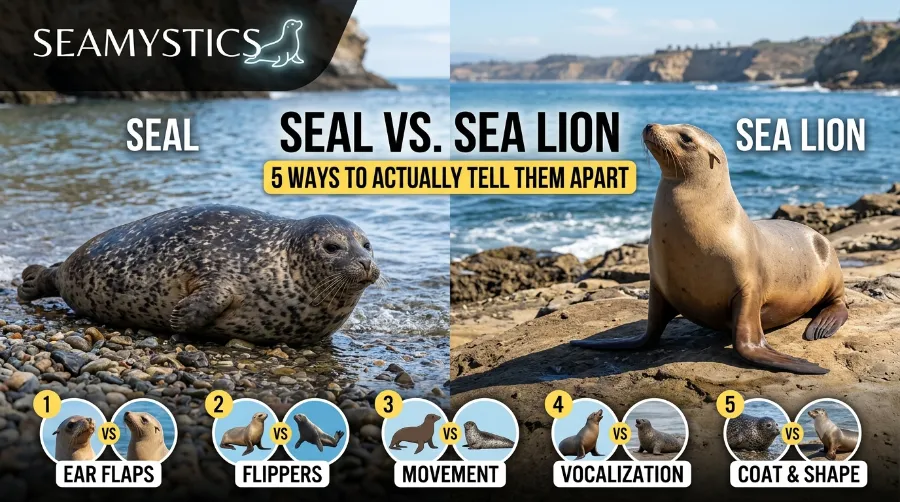
Telling a seal from a sea lion really comes down to five practical checks, and once you know them, you will never second guess yourself on a beach again. Look at the ears first, then the flippers, then how the animal moves on land, then its size and color, and finally listen for that unmistakable bark. Together, these five clues turn a confusing guessing game into a confident, quick identification, whether you are watching from a boardwalk in California or a rocky shoreline in New England. The next time someone near you asks whether that whiskered creature is a seal or a sea lion, you will actually know the answer, and you will know exactly why.
References
- NOAA Fisheries, “Is It a Seal or a Sea Lion?” https://www.fisheries.noaa.gov/feature-story/it-seal-or-sea-lion
- World Wildlife Fund, “What’s the Difference Between a Seal and a Sea Lion?” https://www.worldwildlife.org/resources/facts/whats-the-difference-between-a-seal-and-a-sea-lion/
- Nature Galapagos, “Difference Between Sea Lions and Seals” https://naturegalapagos.com/blog/difference-between-sea-lions-and-seals/
- Smithsonian Ocean, “Pinnipeds: Seals, Sea Lions, and Walruses” https://ocean.si.edu/ocean-life/marine-mammals/seals-sea-lions-and-walruses
- The Marine Mammal Center, “Seal vs. Sea Lion: Your Guide to Knowing the Difference” https://www.marinemammalcenter.org/news/seal-vs-sea-lion-your-guide-to-knowing-the-difference
- IFAW, “Seals vs. Sea Lions: What’s the Difference?” https://www.ifaw.org/international/journal/difference-seals-sea-lions