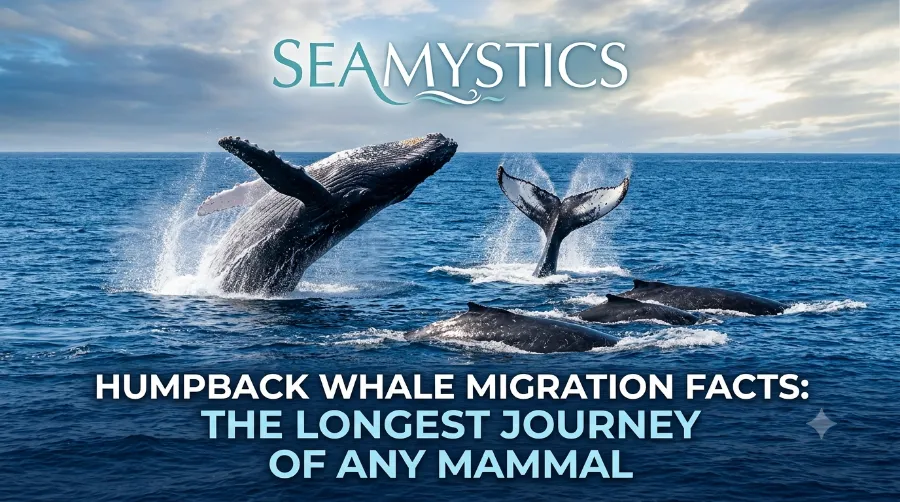

Picture a single animal swimming farther than the distance from New York to London, twice, without a map, a compass, or a single rest stop on land. That is not fiction. It is the real life of a humpback whale, and it is one of the most astonishing humpback whale migration facts scientists have ever confirmed. Every year, these giants leave icy feeding grounds and head toward warm tropical waters, covering thousands of miles in a journey that puts almost every other creature on Earth to shame.
If you want to learn more about Humpback whale’s annual migration route guide for practical tips and expert advice.
If you want to learn more about sperm whale deep divetips and expert advice.
This blog breaks down the true numbers, the latest research, and the record-setting whales that have rewritten what marine biologists thought they knew. You will also see how this connects to broader whale facts marine mammals lovers should know, plus real examples with dates so you can see the scale for yourself.
If you want to learn more about narwhal facts arctic whale guide for practical tips and expert advice.
Key Takeaways
| Fact | Detail |
|---|---|
| Typical migration distance | Around 5,000 miles (8,046 km) one way between feeding and breeding grounds |
| Fastest recorded Pacific crossing | Alaska to Hawaii in as few as 28 days, roughly 3,000 miles |
| Longest confirmed single journey (2022) | 8,106 miles, Colombia to Zanzibar, documented over 2013 to 2022 |
| Longest confirmed journey (2025) | 15,100 km between Brazil and Australia, tracked from 2003 to September 2025 |
| Lifespan | 80 to 90 years, according to NOAA Fisheries |
| Population segments worldwide | 14 distinct groups tracked by NOAA |
| Main identification tool | Fluke photo matching through the Happywhale database |
What Drives Humpback Whale Migration Facts Worth Knowing
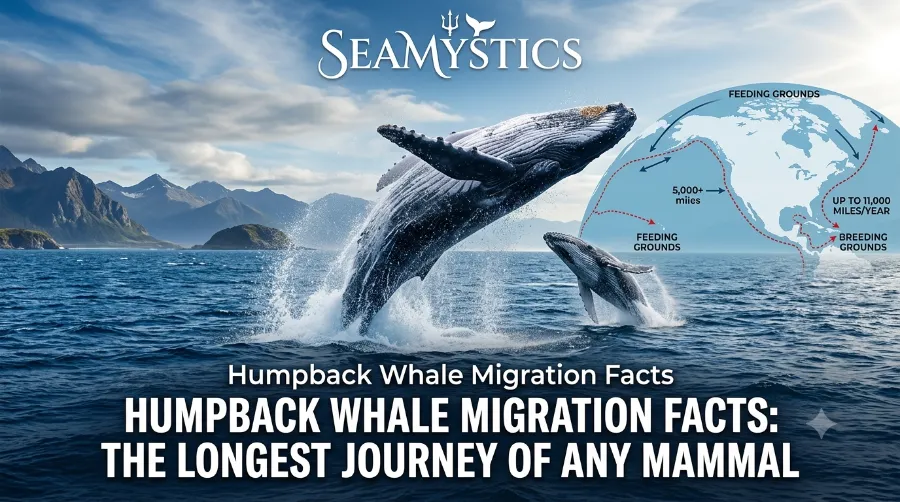
Humpback whales do not wander aimlessly. Their travel pattern follows a strict seasonal rhythm tied to food and reproduction. In summer, they gather in cold, nutrient-rich waters near places like Alaska, Antarctica, and Norway to feed heavily on krill and small fish. Then, as winter approaches, they swim toward warm, calm waters near the equator to mate and give birth.
If you want to learn more about seal vs sea lion tips and expert advice.
This back and forth pattern happens because tropical waters, while ideal for newborn calves, contain almost no food. Therefore, adult whales must fast for months, living entirely off blubber reserves built up during the feeding season. Consequently, timing the migration correctly can mean the difference between a healthy calf and a starving one.
How Far Do Humpback Whales Travel Each Year
According to NOAA Fisheries, some humpback populations swim as far as 5,000 miles from their feeding grounds to their breeding areas. One especially fast route runs between Alaska and Hawaii, and NOAA notes that whales have completed that roughly 3,000 mile trip in as few as 28 days. That pace works out to well over 100 miles a day, sustained for nearly a month straight, through open ocean, with no stops.
If you want to learn more about whale song communication explained tips and expert advice.
For context, that is faster than most sailboats cover the same distance. Meanwhile, other populations in the Southern Hemisphere travel similar distances from Antarctic feeding zones to breeding grounds off Central America, eastern Australia, or Mozambique. If you want a deeper dive into how other giant mammals compare on distance and endurance, our guide on whale facts and marine mammals covers the full picture across species.
The Discovery That Redefined Migration Records
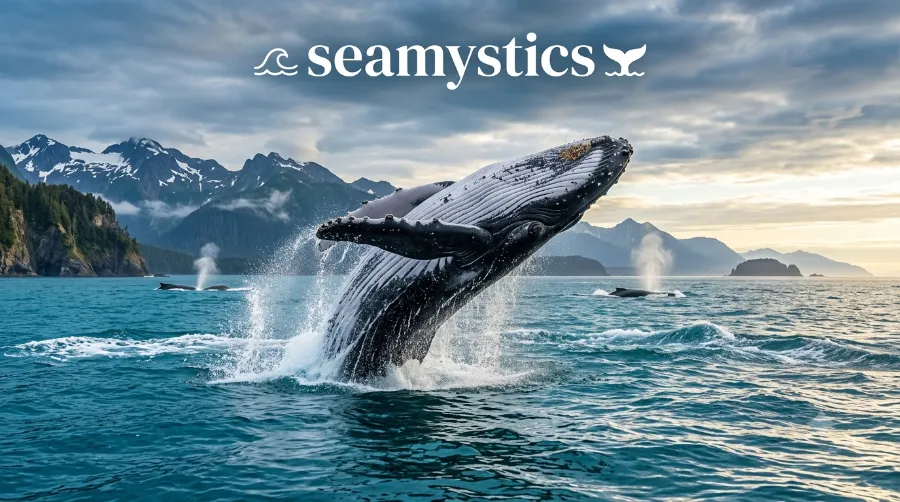
For years, biologists believed humpback populations mostly stayed within their own ocean basin, moving north and south but rarely crossing between oceans. That assumption fell apart in December 2024, when researchers published a study in the journal Royal Society Open Science documenting a male humpback that swam from Colombia to Zanzibar, crossing the Pacific, Atlantic, and Indian Oceans.
If you want to learn more about manatee facts marine mammal tips and expert advice.
As BBC News reported on the discovery, the finding stunned even the scientists involved, since nothing in prior whale research had suggested this kind of interocean movement was common, or even possible, for the species. NBC News also covered the story, noting that the whale’s route amounted to a distance roughly equivalent to swimming from London to Tokyo and partway back. This single case forced marine biologists to rethink long-held ideas about how rigid humpback migration routes really are.
Why Whale Facts Marine Mammals Fans Should Pay Attention
Understanding migration is not just trivia. It shapes how conservation groups protect shipping lanes, set fishing regulations, and track population recovery after decades of commercial whaling nearly wiped humpbacks out. Before a global whaling ban took effect in 1985, most humpback populations had dropped by more than 95 percent, based on figures from NOAA Fisheries.
Since then, numbers have rebounded significantly in many regions, though some groups, including the Arabian Sea and Central America populations, remain endangered. Migration data helps scientists figure out which populations are recovering and which still need protection.
Here are a few reasons migration research matters so much for marine mammal conservation:
- It reveals which shipping routes overlap with whale travel corridors, helping reduce deadly vessel strikes
- It shows how climate change may be altering food availability and forcing whales to travel farther than usual
- It helps identify breeding grounds that need legal protection under frameworks like the Endangered Species Act
- It allows researchers to track population health across generations using photo identification
If you are curious how a close relative of the humpback stacks up in size and behavior, our detailed piece on blue whale facts and size is a natural next read.
Feeding Grounds Versus Breeding Grounds
The contrast between these two zones explains almost everything about humpback behavior. Feeding grounds are cold, oxygen-rich, and packed with krill and small schooling fish. Breeding grounds, on the other hand, are warm, shallow, and nearly empty of food, but they offer calm water where newborn calves can build strength before facing open ocean currents.
This tradeoff forces adult whales to essentially choose between eating and reproducing during any given season. As a result, pregnant females often arrive at breeding grounds already carrying months of stored energy, since they will not feed again until they return north or south to colder waters.
Record-Breaking Journeys: Real Whales, Real Numbers
Nothing illustrates humpback whale migration facts better than specific, documented cases. Below is a comparison chart showing how recent record-setting whales stack up against typical migration distances.
| Whale Case | Route | Distance | Years Tracked | Source |
|---|---|---|---|---|
| Typical humpback migration | Feeding to breeding grounds | Up to 5,000 miles (8,046 km) | Annual | NOAA Fisheries |
| Alaska to Hawaii population | North Pacific | About 3,000 miles in 28 days | Annual | NOAA Fisheries |
| Colombia to Zanzibar male | Pacific to Indian Ocean | 8,106 miles (13,046 km) | 2013 to 2022 | Royal Society Open Science, reported by BBC and NBC |
| Brazil to Australia individual | South Atlantic to South Pacific | 15,100 km (about 9,385 miles) | 2003 to 2025 | Griffith University study, Royal Society Open Science, 2026 |
The Colombia to Zanzibar Whale
Researchers first photographed this male humpback off the Pacific coast of Colombia in July 2013. Four years later, in 2017, the same whale turned up again near the Colombian coast, roughly 50 miles from where it was first seen. Then, in August 2022, photographers spotted it near Zanzibar, off the coast of East Africa, an ocean and a half away from where its journey began.
Scientists compared the whale’s unique fluke markings, essentially a natural fingerprint, to confirm it was the same animal. The study’s authors suggested the journey may have been driven by mating competition, food scarcity linked to warming seas, or simply population growth pushing individuals to explore new territory. Either way, this case remains one of the clearest examples of how flexible humpback migration can actually be.
The Brazil to Australia Discovery
An even longer case emerged more recently. Researchers first photographed a humpback whale in 2003 at Brazil’s Abrolhos Bank, a major nursery area off the coast of Bahia. At that time, it was swimming among a group of nine adult whales.
Twenty two years later, in September 2025, the same individual was spotted alone in Hervey Bay, Australia. Scientists confirmed the match using thousands of fluke photographs collected between 1984 and 2025 through the citizen science platform Happywhale. The straight-line distance between the two sightings reached roughly 15,100 kilometers, setting a new benchmark for the longest confirmed movement ever recorded for a single humpback whale.
How Scientists Track These Incredible Journeys
None of these discoveries would be possible without modern identification tools. Humpback whale flukes, which can span up to 18 feet wide, carry unique pigment patterns and scars, much like a human fingerprint. Because of this, researchers can match photos taken years or even decades apart to confirm they belong to the same animal.
Photo Identification and Citizen Science
The platform Happywhale plays a central role in this process. It hosts more than 900,000 whale tail photographs submitted by both professional researchers and everyday whale watchers around the world. According to the organization, its matching algorithm achieves a success rate between 97 and 99 percent when comparing fluke images.
This citizen science approach means a photo taken by a tourist on a whale watching boat in Australia could someday match a photo taken by a scientist in Brazil decades earlier. That kind of global crowdsourced tracking simply was not possible before digital photography and image recognition software became widely available.
Satellite Tags and Aerial Surveys
Beyond photo matching, NOAA Fisheries also uses satellite tagging and aerial surveys to monitor whale movement in real time. Small aircraft help scientists record seasonal distribution patterns, which then inform decisions about shipping lane adjustments and speed restrictions in high traffic whale corridors.
Suction cup tags, which eventually fall off without harming the animal, have also been used to measure how vessel noise affects whale behavior. Together, these tools give researchers a much fuller picture of where whales go, how fast they travel, and what risks they face along the way.
Conservation Challenges Along the Migration Route
Long migrations expose humpback whales to serious risks the entire way. Vessel strikes remain one of the leading causes of injury and death, since busy shipping lanes frequently cross traditional whale corridors. Entanglement in fishing gear is another major threat, particularly in areas with heavy crab pot or gillnet fishing activity.
Climate change adds a newer layer of pressure. Warming oceans are shifting the location and abundance of krill, which may be forcing some populations to travel farther than their ancestors did to find adequate food. Some researchers believe this could partly explain the unusually long journeys documented in 2024 and 2025.
To reduce these risks, several protective measures are already in place, including:
- Speed restrictions for vessels in known whale migration zones during peak seasons
- Federal viewing distance rules requiring boats and aircraft to stay at least 100 yards away from whales
- Marine protected areas, including sister sanctuaries linking feeding and breeding grounds thousands of miles apart
- Ongoing entanglement response networks trained to safely free whales caught in fishing gear
These efforts have helped several humpback populations recover significantly since the 1985 whaling moratorium, even though a few distinct groups remain listed as endangered or threatened.
How Humpback Migration Compares to Other Marine Mammals
Humpback whales are far from the only long distance travelers in the ocean, but their combination of distance, predictability, and now proven ocean crossing behavior sets them apart. Gray whales also complete lengthy annual migrations, and some seals and sea turtles travel thousands of miles too, yet few match the humpback’s demonstrated ability to cross entire ocean basins outside its usual range.
For a completely different style of marine mammal behavior, one built around coordinated hunting rather than long distance travel, take a look at our breakdown of orca whale hunting behavior. Comparing these two species side by side shows just how varied marine mammal survival strategies can be, even among animals that share the same ocean.
Frequently Asked Questions
How far do humpback whales migrate each year?
Most populations travel around 5,000 miles one way between cold water feeding grounds and warm water breeding grounds, based on NOAA Fisheries data.
What is the longest humpback whale migration ever recorded?
The longest confirmed case reached about 15,100 kilometers between Brazil and Australia, tracked from a 2003 sighting to a matching 2025 sighting.
Why do humpback whales migrate such long distances?
They migrate to balance two competing needs, feeding in nutrient rich cold water and breeding in safer, warmer water where calves can survive more easily.
How do scientists know it is the same whale after so many years?
Researchers match unique markings on the underside of each whale’s tail fluke, using photo databases like Happywhale to confirm individual identity across decades.
Are humpback whales still endangered?
Some distinct population segments, including the Central America, Western North Pacific, Arabian Sea, and Cape Verde Islands groups, remain listed as endangered, while several other populations have recovered enough to be delisted.
Conclusion
Humpback whale migration facts reveal something genuinely humbling about the natural world. These animals travel farther than almost any other mammal on the planet, guided by instinct, memory, and possibly even Earth’s magnetic fields, all without a single wrong turn most years. Recent discoveries, like the 2022 Colombia to Zanzibar case and the 2025 Brazil to Australia record, prove that scientists are still learning new things about a species many assumed was already well understood. As tracking technology keeps improving, expect even more surprising humpback whale migration facts to surface in the years ahead, reshaping how we protect these remarkable ocean travelers.
References
- NOAA Fisheries. Humpback Whale species profile. https://www.fisheries.noaa.gov/species/humpback-whale
- BBC News. Humpback whale breaks record for longest migration. https://www.bbc.com/news/articles/cp3zywxlqlxo
- NBC News. Humpback whale makes record migration to find new breeding grounds. https://www.nbcnews.com/id/wbna40006348
- Griffith University, via ScienceDaily. Humpback whale breaks migration record with 15,000 kilometer ocean journey, 2026.
- Royal Society Open Science. First evidence of bidirectional exchange between distant humpback whale breeding populations in eastern Australia and Brazil, 2026.