
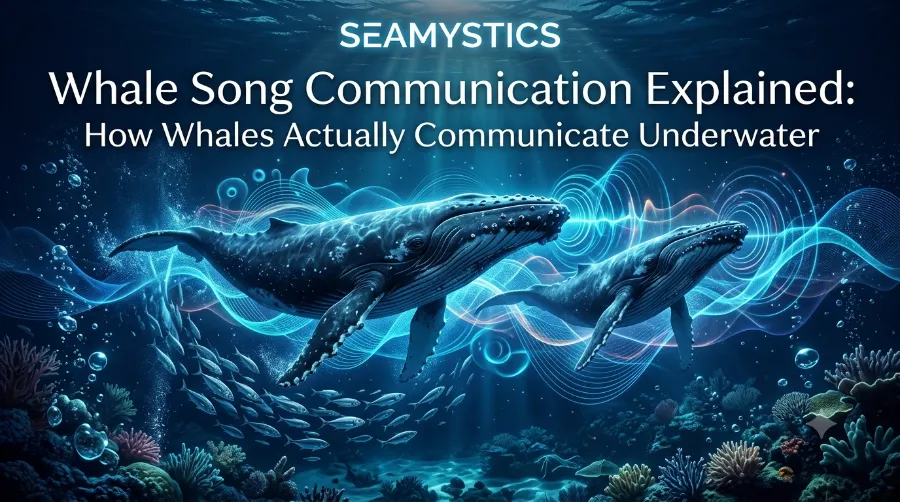

Picture a male humpback whale, alone in the dark water off Hawaii, singing the exact same song as every other male in his region that season. He did not learn it from a teacher. He picked it up from the ocean itself, the way a song spreads through a crowd at a concert. This is whale song communication explained at its most basic level, and it is far stranger and more organized than most people realize.
If you want to learn more about sperm whale deep divetips and expert advice.
Whales do not speak in words, yet they clearly share information. They warn each other of danger, find mates across hundreds of miles, and keep pods together in total darkness. Marine biologists have spent decades trying to decode this hidden language, and recent studies from 2025 have brought us closer than ever before. Before we go deeper, here is a quick snapshot of what you need to know.
If you want to learn more about manatee facts marine mammal tips and expert advice.
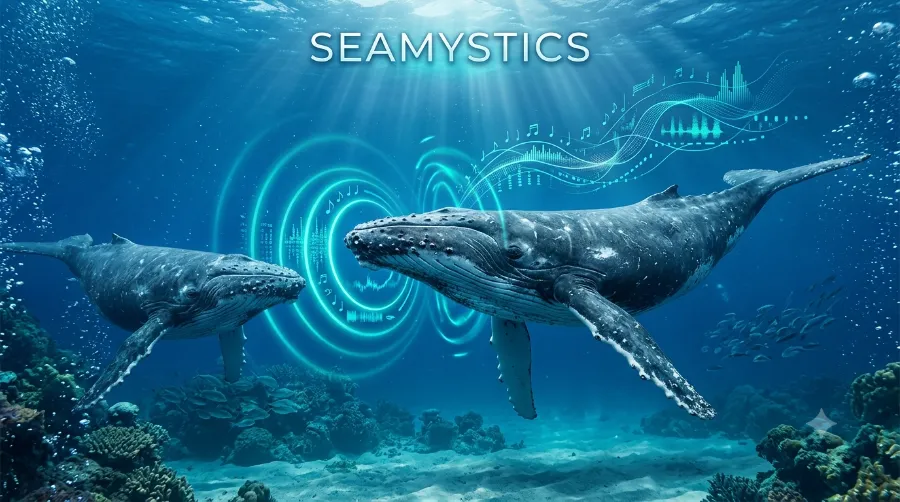
Key Takeaways
| Topic | Quick Fact |
|---|---|
| Primary method | Whales use clicks, moans, whistles and songs to communicate |
| Sound travel distance | Low frequency calls can travel over 1,000 miles underwater |
| Who sings | Mostly male humpback whales sing structured songs |
| Recent discovery | A 2025 Science study found whale song follows language-like patterns |
| Purpose | Mating, navigation, hunting, bonding and warning signals |
| Loudest species | Sperm whales can produce clicks louder than a jet engine |
Because sound moves faster and farther underwater than in air, whales rely on it the way humans rely on sight. Therefore, understanding whale song really means understanding how an entire underwater society stays connected.
What Is Whale Song, Really?
Whale song is not just random noise. It follows a repeated, patterned sequence, almost like verses in a song we would recognize on land. Male humpback whales sing the most famous songs, and these songs can last anywhere from a few minutes to over 30 minutes before repeating.
What makes this fascinating is that every male in a population sings the same song during a breeding season. However, that song slowly changes over months and years. Scientists call this cultural transmission, meaning the whales essentially learn and copy a shared trend, much like how a popular tune spreads through a community.
A landmark 2025 study in Science, led by researchers at the Hebrew University of Jerusalem and the University of St Andrews, found that humpback whale songs share a statistical structure with human language. The team revealed an unexpected similarity between human and humpback vocalizations. This does not mean whales use grammar or vocabulary like we do. Still, it suggests their communication system evolved in a way that mirrors how human babies learn to break speech into meaningful chunks.
If you want the bigger picture of these ocean giants, our whale facts and marine mammals guide covers everything from anatomy to behavior in one place.
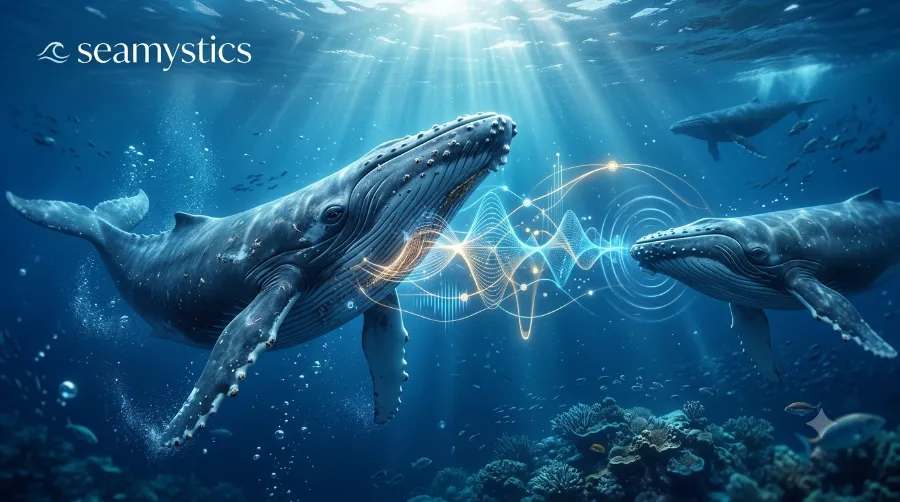
How Do Whales Actually Make Sound Underwater?
Unlike humans, whales do not have vocal cords in the traditional sense. Baleen whales, such as humpbacks and blue whales, push air through a specialized structure called the laryngeal sac to create their deep, resonant calls. This process lets them produce sound without releasing air bubbles, which matters because they need to conserve oxygen during long dives.
Toothed whales, including sperm whales and orcas, rely on a completely different system. They generate clicks and whistles through structures near their blowhole known as phonic lips, then they focus these sounds through a fatty organ in their forehead called the melon. This setup works almost like a natural loudspeaker and lens combined, so they can aim their sound with real precision.
For example, sperm whales produce rapid click patterns that scientists call codas, and a groundbreaking November 2025 study from UC Berkeley and Project CETI found something remarkable. Researchers discovered that the acoustic properties of sperm whale calls resemble vowels, a defining feature of human language. As Professor Gašper Beguš explained, scientists once assumed whale communication worked like a kind of morse code, but this paper shows their calls behave more like very, very slow vowels.
This finding marks a major shift in how we think about marine mammal communication overall. If you want to compare this to another highly vocal predator, our guide on orca whale hunting behavior breaks down how killer whales use sound while coordinating attacks.
Types of Whale Communication Explained
Whales do not rely on just one type of sound. Instead, they draw on a whole toolkit depending on the situation. Below is a simple breakdown of the main categories.
- Songs: Long, structured sequences that male humpback whales sing during breeding season, likely to attract mates and assert dominance
- Codas: Short click patterns that sperm whales produce, functioning almost like a name or identity marker between family members
- Social calls: Short, varied sounds that orcas and dolphins produce to coordinate movement, express excitement, or maintain contact within a pod
- Echolocation clicks: High frequency clicks that whales rely on mainly for hunting and navigation rather than direct communication
Songs and Their Hidden Structure
Small sound units, similar to notes, build humpback whale songs, and these units combine into phrases. These phrases then repeat to form themes, and multiple themes make up a full song. Because this structure resembles how we build sentences from words, researchers have started applying linguistic tools to study it.
Dr Ellen Garland of the University of St Andrews, a senior contributor to the 2025 study, has spent years recording these patterns in the South Pacific. Her team analyzed groans, moans, whistles, barks, shrieks and squeaks that they collected over eight years in New Caledonia to reach their conclusions. This kind of long-term fieldwork explains exactly why marine acoustics research takes so long to produce solid answers.
Codas and Family Identity
Sperm whales live in tight matrilineal family units, and their codas seem to work almost like dialects. A family in the Caribbean uses different click rhythms than a family in the Pacific, similar to how regional accents differ among humans.
Project CETI, a nonprofit research initiative combining marine biology with artificial intelligence, has been decoding these patterns using advanced recording tags. One study using bio-logger data suggests that sperm whales may use a form of alphabet, while another study reports vowel-like sounds and diphthongs that mirror elements of human speech. These bio-loggers can now also identify which specific whale made which sound, a task that felt nearly impossible just a few years ago.
Why Do Whales Sing? Breaking Down the Purpose
No single reason explains why whales produce sound. Instead, different species and different situations call for different vocal strategies. The table below summarizes the leading theories that current research supports.
| Purpose | Species Most Involved | Supporting Evidence |
|---|---|---|
| Attracting mates | Humpback whales | Only males sing during breeding season |
| Navigation | Baleen whales | Low frequency calls bounce off distant landmasses |
| Hunting coordination | Orcas, sperm whales | Group calls precede coordinated attacks |
| Family bonding | Sperm whales | Codas act as identity markers within pods |
| Warning signals | Most species | Sharp, sudden calls trigger group movement |
Interestingly, earlier research found that male humpback whales sing exclusively, likely to attract mates, fend off challengers and mark territory. So while singing looks like a peaceful activity from the surface, it can also function as a competitive display between rival males.
For a deeper look at how another baleen giant uses its massive size to survive, check out our piece on blue whale facts and size, where sound plays a role in long distance mate finding as well.
Real Life Examples That Show Whale Communication in Action
Theory is one thing, but real observations bring this topic to life. Between 2024 and 2025, researchers documented several striking examples of whale communication happening in real time.
- In February 2025, the journals Science and Science Advances jointly published findings showing that humpback whale songs, gathered over eight years, followed Zipf’s law, a pattern also found in human language frequency distribution
- In November 2025, UC Berkeley linguists working with Project CETI identified two distinct vowel-like sounds in sperm whale codas, which they labeled the a-vowel and the i-vowel
- Off the coast of Norway, researchers repeatedly observed orca pods using specific call sequences right before coordinated herring hunts, a behavior teams first documented decades ago and continue to study today
- Along the eastern coast of Australia, researchers recorded humpback whales changing their song mid-season as new song versions spread from western populations
These examples show that whale communication does not stay static. It shifts, spreads, and evolves constantly, almost like a living culture that moves between pods across entire ocean basins. If migration patterns interest you, our detailed guide on humpback whale migration facts explains how these journeys connect to breeding and singing behavior.
How Far Can Whale Song Actually Travel?
This is where things get genuinely astonishing. Sound moves about four times faster in water than in air, and low frequency whale calls can travel enormous distances because of a phenomenon scientists call the deep sound channel. This layer of ocean water traps and carries low frequency sound with very little loss of energy.
According to the National Park Service, whale calls can travel across entire ocean basins under the right conditions, particularly for large baleen whales using low frequency moans. Researchers estimate that some blue whale calls travel well beyond 1,000 miles when conditions are ideal. This means another whale thousands of miles away could theoretically hear a whale singing near Hawaii under the right circumstances.
However, ocean noise pollution from shipping, drilling, and sonar has been steadily shrinking this range over the past few decades. As a result, many researchers now worry that whales must sing louder or shift frequencies just to cut through human made noise. This concern keeps growing among conservation groups such as Whale and Dolphin Conservation, which notes that whales depend on sound for almost everything they do, from finding food to locating mates, and that noise pollution now threatens their survival.
Comparing Whale Communication to Other Marine Mammals
Whales are not the only ocean animals with complex vocal systems. Dolphins, for example, use signature whistles that work almost like individual names, letting them call specific pod members by name underwater. Our detailed breakdown of dolphin intelligence facts explained dives deeper into how these closely related toothed whales use sound for social bonding.
Meanwhile, narwhals, which people often nickname the unicorns of the sea, communicate through clicks and whistles similar to other toothed whales, though their famous tusk actually works as a sensory organ rather than a communication tool. Danish researchers at Aarhus University confirmed this through tooth analysis, and their findings show that the narwhal’s tusk reveals detailed information about the animal’s living conditions and health over time. If you want the full picture, our guide on narwhal tusk biology and arctic life explains this in more detail.
Even seals and sea lions, though not whales, rely on underwater vocalizations for mating displays and territorial disputes. Our comparison guide on seal versus sea lion behavior makes a useful next read if you want to understand the wider world of marine mammal communication beyond whales.
The Latest Research Explained Simply
Between late 2024 and late 2025, whale communication research moved forward faster than in the previous decade combined. Advanced recording technology, machine learning, and long term field studies all came together at once. Because of this, scientists now question old assumptions about how simple or complex whale vocalizations really are.
According to Britannica, whales sing for reasons that connect to both reproduction and social bonding, though scientists still only partly understand the exact meaning behind specific song patterns. This uncertainty actually signals good science. It means researchers stay careful rather than jump to overly simple conclusions about animal language.
Dr Emma Carroll from the University of Auckland, one of the researchers who worked on the 2025 humpback study, summarized the discovery well. She noted that a remarkable similarity in how humans and whales communicate emerged in this new research, adding that the noises whales make and the words humans use share a common underlying pattern. Still, she carefully clarified that this does not prove whales have language in the human sense, only that both species may have developed communication through similar learning processes.
Frequently Asked Questions
Do whales understand each other the way humans do?
Not exactly. Whales share information through patterns and repeated sounds, but scientists have not confirmed that specific sounds carry fixed meanings the way human words do.
Which whale species sings the most complex songs?
Humpback whales produce the most structured and most studied songs, though sperm whale codas are turning out to be surprisingly complex as well.
Can whale song really travel over 1,000 miles?
Yes, under ideal deep sound channel conditions, low frequency calls from large whales can travel extremely long distances, though ocean noise pollution keeps shrinking this range.
Why do only male humpback whales sing?
Researchers believe singing mostly connects to mating and territorial behavior, both of which matter more for male reproductive strategies.
Is Project CETI trying to translate whale language into English?
Not quite. The team wants to understand the structure and patterns of sperm whale communication first, before anyone makes claims about direct translation.
Conclusion
Whale song communication explained through modern science paints a picture far more intricate than the simple idea of animals making noise underwater. From humpback songs that evolve like cultural trends to sperm whale codas that may function like an alphabet, these creatures clearly exchange meaningful information. As new technology from projects like CETI keeps improving, we likely only scratch the surface of what whales truly say to each other. What remains certain is that protecting the ocean’s soundscape matters just as much as protecting the whales themselves, because without a quiet ocean, their voices simply cannot reach each other.
References
- Oceanographic Magazine, Scientists Listen In On Sperm Whale Communication With New Tech, December 2025
- Science (AAAS), Humpback Whale Songs Are Structured Like Human Language, February 2025
- UC Berkeley Letters and Science, UC Berkeley and Project CETI Study Shows Sperm Whales Communicate In Ways Similar To Humans, November 2025
- University of Auckland News, Whale Song and Human Language Share Same Structure, February 2025
- Whale and Dolphin Conservation, How Do Whales Communicate, 2025
- National Park Service, Whale Calls, nps.gov
- Britannica, Why Do Whales Sing
- Aarhus University, Biology Department, Narwhal Tusk Research Findings


What I in fact concern myself most about is wellness subject areas.
On my own, I signed up for magazines and catalogs
oriented toward this subject, and I preserve educated about the latest wellness
research. Just how is this relevant? I feel there is no more crucial concentration for
my energy. Furthermore, this site entry seems as though it’s deserving
the time to read. I dig through 1000s or more of blogs weekly.
Truth be told, my spine constantly is painful and I desire a different spare time
interest. lol Regardless, I think if everybody had written about
their unique time in life, and did it clearly, we’d have a much more cool planet.
This excellent blog website is great. Subject matter such as this are in many cases missed,
if truth of the matter be told. At times the greatest of the
World-wide-web is not the very most extensively marketed content and articles,
nonetheless rather all things other than them, the
overlooked masses with sites that are genuinely much more suitable compared to all those
of important influencers. This is this type of a web log. My spouse and I will definitely provide guidelines, especially when ever not encouraged to do
this. First is, always keep crafting. Second is, continue to keep
crafting on the regular basis. Lastly is, apply your own personal blog website to create your own personal presence.
I am not really a writer I guess; I am in fact a Perinatal Massage Practitioner.
I practice Postnatal Massage Therapy, being able to help a lot of women to
heal following having a infant. It’s pleasing activity.
That is what I invest a lot of of my free time performing, but
yet I have additionally cherished penning from the time frame I was
youthful. I am a well-read person and every calendar
year I browse a collection way higher in comparison with me
personally. rofl In the subsequent twelve months, maybe I should get serious
concerning blogs. The thing is, it can not simply
a perception; the labor of penning and creating often helps make a blog site blossom in time.