
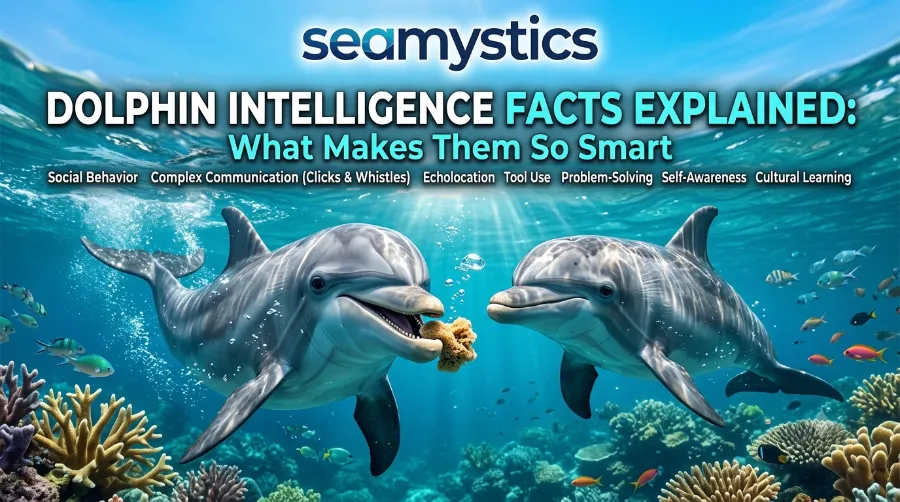

A dolphin can recognize its own reflection, remember a friend’s voice after twenty years apart, and teach its calf a hunting trick passed down for generations. These dolphin intelligence facts explained through decades of marine research show that dolphin minds work in ways scientists once thought belonged only to humans and a few great apes. Because dolphins live in a world built on sound rather than sight, their intelligence looks different from ours, yet the results speak for themselves. This guide breaks down the brain science, the behavior, and the newest 2025 and 2026 research so you can understand exactly why dolphins earn their reputation as ocean geniuses.
If you want to learn more about Humpback whale’s annual migration route guide for practical tips and expert advice.
If you want to learn more about seal vs sea lion tips and expert advice.
Key Takeaways
| Fact | What It Means | Source or Example |
|---|---|---|
| Dolphins have an encephalization quotient (EQ) around 4.14 | Second highest of any animal after humans | Marino, PNAS research |
| They passed the mirror self-recognition test in 2001 | Proof of self-awareness, rare in the animal kingdom | New York Aquarium study |
| Each dolphin uses a signature whistle as a name | They call specific pod members by “name” | Sarasota Bay, Florida research |
| Shark Bay dolphins use sea sponges as tools | Skill passed from mother to calf for generations | Shark Bay, Australia, since the 1980s |
| A 2025 WHOI study found shared “vocabulary” whistles | Suggests a structured communication system | Woods Hole Oceanographic Institution, April 2025 |
| Google’s DolphinGemma project uses AI to study dolphin sound | Modern technology is decoding wild dolphin calls | Wild Dolphin Project, 2025 to 2026 |
What Makes Dolphin Brains So Special
Dolphins carry brains that are large, dense, and packed with the type of neurons linked to social thinking and emotion. Their brain to body size ratio, known as the encephalization quotient, sits at roughly 4.14, second only to humans and well above chimpanzees. This is not just a fun statistic. It points to a brain built for complex tasks like problem solving, memory, and reading social cues within a pod.
If you want to learn more about narwhal facts arctic whale guide for practical tips and expert advice.
The Encephalization Quotient Explained
Scientists use the encephalization quotient, or EQ, to compare brain size against what would be expected for an animal’s body weight. A higher number usually points to more cognitive horsepower. Research published through the National Institutes of Health confirms that bottlenose dolphins display gaze alternation and referential communication even in tasks designed to be impossible to solve, a sign of flexible thinking rather than simple instinct. EBSCO
Because this brain structure evolved separately from the primate line, dolphins offer a rare case of convergent evolution. In other words, two very different animals arrived at similar intelligence through completely different evolutionary paths. This matters for anyone comparing whale facts marine mammals research, since toothed whales like dolphins and orcas share this same brain pattern.
If you want to learn more about whale song communication explained tips and expert advice.
Spindle Neurons and Emotional Processing
Dolphins also carry spindle neurons, a specialized cell type once believed to exist only in humans and great apes. These cells are tied to emotional processing, social awareness, and quick decision making. Their presence helps explain why dolphins show grief, play, and even what looks like joy during social interaction.
If you want to learn more about sperm whale deep divetips and expert advice.
Dolphin Intelligence Facts Explained Through Communication
Sound is the dolphin’s main tool for understanding the world, and their communication system is far more layered than most people realize. Every dolphin develops its own signature whistle early in life, functioning much like a personal name.Wild dolphins in
If you want to learn more about manatee facts marine mammal tips and expert advice.
Wild dolphins in Sarasota Bay, Florida have been recorded calling out the signature whistles of pod mates they had not heard in over twenty years, and they responded correctly almost every time. That kind of long-term social memory is rare outside of humans and elephants.
The 2025 Breakthrough in Dolphin Vocabulary
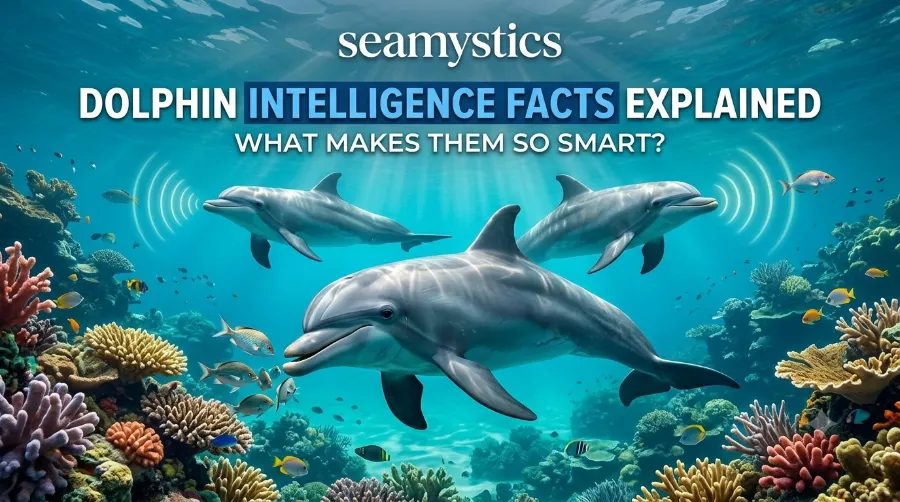
In April 2025, researchers led by Laela Sayigh at the Woods Hole Oceanographic Institution published preprint findings on non-signature whistles, the sounds that make up roughly half of all dolphin vocalizations. The team identified stereotyped whistle types shared across multiple individuals, not unique identifiers but shared signals with consistent functions such as alarm and query. That is a different class of communication compared to naming, and it looks closer to shared vocabulary than anything documented before. The study won the inaugural Coller Dolittle Challenge, a prize created specifically to reward breakthrough animal communication research. –
According to the Whale and Dolphin Conservation organization, dolphins and whales share cognitive traits that place them among the most socially complex animals in the ocean, which is why researchers studying whale facts and marine mammals often study dolphin cognition side by side with species like orcas and humpbacks.
Can Dolphins Actually Understand Language?
Between the 1980s and 1990s, researchers at the Kewalo Basin Marine Mammal Laboratory in Hawaii trained two dolphins named Phoenix and Akeakamai to understand artificial sign and sound based languages. The dolphins learned that word order changed meaning, grasped the difference between actions and objects, and recognized abstract ideas such as together or left. This showed the dolphins were not just memorizing commands. They understood grammar rules well enough to respond correctly to sentences they had never heard before. Science News Today
That research still shapes how scientists design cognition tests today, and it forms one of the strongest pieces of evidence behind every dolphin intelligence facts explained discussion in marine biology circles.
Problem Solving, Tool Use, and Culture Among Dolphins
Intelligence is not only about brain size or vocabulary. It also shows up in behavior, and dolphins offer some of the clearest examples of animal culture ever documented.
In Shark Bay, Australia, a population of bottlenose dolphins learned to break off marine sponges and wear them over their beaks while foraging along the sharp, rocky seafloor. This “sponging” behavior protects their sensitive skin while they hunt for fish hidden in the rubble. Researchers tracking this population since the late 1980s found the skill passes almost exclusively from mother to daughter, generation after generation, rather than appearing as an instinct every dolphin is simply born with.
This kind of learned tradition is exactly what anthropologists look for when defining culture in humans, and its presence in dolphins reshaped how biologists think about animal minds.
The Mirror Test and Self-Awareness
In 2001, at the New York Aquarium, researchers Diana Reiss and Lori Marino ran mirror self-recognition tests on two bottlenose dolphins named Presley and Tab. The dolphins showed evidence of self-awareness, one of the hallmarks of complex intelligence, joining a very short list of species including great apes, elephants, and magpies. Dr. Marino’s research also confirmed that having an unusually large brain relative to body size is not unique to humans and primates, since dolphins clearly share this trait too. The Whale Sanctuary Project
Everyday Signs of Dolphin Problem Solving
Wild and captive dolphins show intelligence through behaviors that anyone can observe, including:
- Working together in coordinated groups to herd fish into tight balls before feeding, a hunting method similar in structure to the cooperative strategies seen in orca whale hunting behavior
- Using mud plumes as circular nets in shallow waters to trap fish, a technique sometimes called mud ring feeding
- Passing down local hunting traditions to calves over several years of close supervision
- Recognizing and remembering human trainers and researchers across many years, even after long gaps without contact
How Dolphin Intelligence Compares Across Whale Facts and Marine Mammals
Dolphins belong to the same broad group as whales, called cetaceans, and comparing their intelligence side by side helps put the numbers into perspective. Sperm whales and orcas carry the largest brains in the animal kingdom by raw weight, yet dolphins often outperform them on tasks that require flexible, on the spot problem solving.
| Species | Average Brain Weight | Encephalization Quotient (EQ) | Known Cognitive Trait |
|---|---|---|---|
| Bottlenose Dolphin | 1.5 to 1.7 kg | 4.14 | Self-recognition, tool use, vocabulary |
| Orca (Killer Whale) | 5.4 to 6.8 kg | 2.57 | Coordinated group hunting, dialects |
| Humpback Whale | 4.8 kg | 1.8 | Complex song structure, migration memory |
| Sperm Whale | 7 to 8 kg | 1.5 to 1.8 | Loudest bio-sonar clicks, deep social bonds |
| Chimpanzee | 0.4 kg | 2.2 to 2.5 | Tool use, basic social learning |
| Human | 1.3 to 1.4 kg | 7.0 to 7.8 | Language, abstract reasoning |
Even though orcas and sperm whales carry heavier brains, dolphins hold a higher EQ because their brain size is large relative to their smaller body mass. This is a helpful distinction for anyone researching whale facts marine mammals topics, since raw brain size alone does not tell the full story.
The intelligence patterns seen in dolphins also show up in their larger cousins. Orcas, for example, hunt using coordinated strategies passed down through family pods, something explored in more depth in this guide to orca whale hunting behavior. Meanwhile, the sheer scale of a blue whale’s size and biology shows that bigger is not always smarter, since the blue whale’s EQ sits well below that of a dolphin. Migration intelligence also plays a role, and the seasonal precision documented in humpback whale migration facts reflects a different but equally impressive form of memory and navigation skill.
According to Whale and Dolphin Conservation, both whales and dolphins rely on complex social bonds and long-term memory, traits that researchers increasingly link to advanced cognitive development across the entire cetacean family.
The Newest Research: AI Is Helping Decode Dolphin Minds
Technology has recently opened a new chapter in dolphin cognition research. Between 2025 and 2026, Google collaborated with the Wild Dolphin Project and Georgia Tech researchers on a project called DolphinGemma, an AI model trained to recognize patterns in wild dolphin sound recordings. Using Pixel smartphones for the fieldwork dramatically reduces the need for custom hardware, improves system maintainability, lowers power consumption, and shrinks the device’s cost and size, all crucial advantages for field research in the open ocean. Google
Researcher Dr. Denise Herzing has led decades of fieldwork on this project among wild Atlantic spotted dolphins in the Bahamas, and the AI tools now being tested aim to identify recurring sound patterns that may function like words or short phrases. While the technology has not cracked a full dolphin language, it has already sped up the process of spotting patterns that once took human researchers years to notice by hand.
This blend of field biology and machine learning represents one of the most active frontiers in marine science today, and it continues to strengthen the evidence behind dolphin intelligence facts explained through direct observation rather than assumption.
Why Dolphin Intelligence Matters Beyond Curiosity
Understanding how dolphins think has practical value that reaches past pure fascination. Conservation groups use behavioral and cognitive research to argue for stronger protections in fishing zones, since dolphins that struggle with entanglement or habitat loss also lose access to the social learning networks that keep pods thriving. According to NOAA Fisheries, human activity including fishing gear entanglement remains one of the largest threats facing wild dolphin populations along U.S. coastlines.
Because dolphins pass knowledge across generations, the loss of older, experienced individuals in a pod can erase decades of learned survival skills, not just remove one animal from a population count. This is one more reason researchers treat dolphin cognition as a conservation priority rather than a side curiosity.
Frequently Asked Questions
Are dolphins smarter than dogs?
Dolphins generally score higher on cognitive tests involving self-recognition, abstract thinking, and vocabulary style communication. Dogs are highly trainable and socially attuned to humans, but most comparative studies place dolphins closer to great apes in overall cognitive complexity.
Do dolphins have names for each other?
Yes. Each dolphin develops a unique signature whistle early in life, and pod members use these whistles to call specific individuals, similar to how humans use names.
How long can dolphins remember another dolphin?
Research from Sarasota Bay recorded dolphins recognizing the signature whistles of former pod mates after more than twenty years apart, suggesting extremely long-term social memory.
Can dolphins actually understand human language?
Studies at the Kewalo Basin Marine Mammal Laboratory showed dolphins could understand basic grammar rules in artificial languages, including word order and object relationships, though this is different from full human language comprehension.
Are whales as intelligent as dolphins?
Whales show different but equally impressive intelligence, including complex song structures in humpbacks and coordinated hunting in orcas. Dolphins tend to score higher on EQ due to their smaller body size relative to brain mass.
Conclusion
Dolphin intelligence is not a myth built on cute documentary footage. It rests on decades of peer reviewed research covering brain structure, self-awareness, tool use, and now even AI assisted communication studies. From the sponge carrying dolphins of Shark Bay to the vocabulary style whistles identified in 2025, every new study adds another layer to what we understand about these animals. As research tools improve, our picture of dolphin minds, and the wider world of whale facts marine mammals research, will likely keep expanding in ways that challenge how we define intelligence altogether.
References
- Marino, L. et al. National Institutes of Health, PMC Article on Cetacean Brain Evolution: https://pmc.ncbi.nlm.nih.gov/articles/PMC2346519/
- Whale and Dolphin Conservation, “How Intelligent Are Whales and Dolphins”: https://us.whales.org/whales-dolphins/how-intelligent-are-whales-and-dolphins/
- Whale and Dolphin Conservation, “How Intelligent Are Dolphins”: https://us.whales.org/whales-dolphins/how-intelligent-are-dolphins/
- NOAA Fisheries, Common Bottlenose Dolphin Species Page: https://www.fisheries.noaa.gov/species/common-bottlenose-dolphin
- Reiss, D. and Marino, L. (2001). Mirror Self-Recognition in the Bottlenose Dolphin, Proceedings of the National Academy of Sciences.
- Sayigh, L. et al. (2025). Non-Signature Whistle Research, Woods Hole Oceanographic Institution, Coller Dolittle Challenge.
- Google and Wild Dolphin Project, DolphinGemma AI Research Initiative (2025 to 2026).