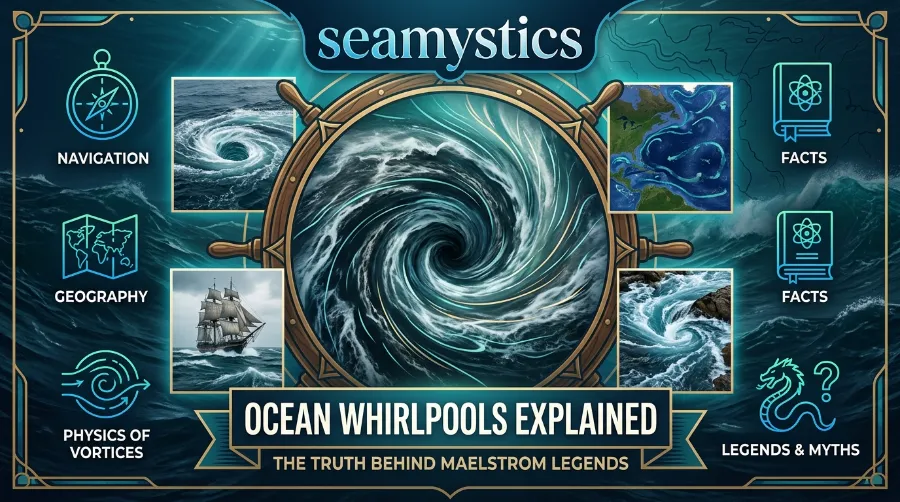

For centuries, sailors swore that certain patches of ocean could swallow a ship whole. Old maps marked these spots with sea monsters and spiraling funnels. The word maelstrom became shorthand for watery doom. Ocean whirlpool legends grew from something real, though. Once you understand the mechanics behind them, the truth turns out to be almost as astonishing as the myth. As a marine biologist who has spent two decades studying tidal systems from Norway to the Pacific, I still find these currents humbling every time I watch one form.
Key Takeaways
| Fact | Detail |
|---|---|
| Strongest tidal current | Saltstraumen, Norway, up to 22 knots (40 km/h) |
| Largest whirlpool by diameter | Old Sow, Canada, roughly 76 meters (250 feet) wide |
| Third largest whirlpool | Corryvreckan, Scotland, speeds up to 8.5 knots |
| Fastest whirlpool tied to legend | Moskstraumen, Norway, inspired Poe and Jules Verne |
| Real danger to boats | Turbulence and rocks, not deep suction |
| Deepest measured vortex depth | Around 5 meters at Saltstraumen’s core |
TL;DR: Powerful tides squeeze through narrow channels or collide with opposing currents to form ocean whirlpools, often called maelstroms. They are real, and they can endanger small boats, but they don’t pull ships down into bottomless pits the way old legends claimed. Norway’s Saltstraumen and Moskstraumen remain the benchmark for both raw power and myth.
What Is a Maelstrom, Really? Maelstrom Explained Science
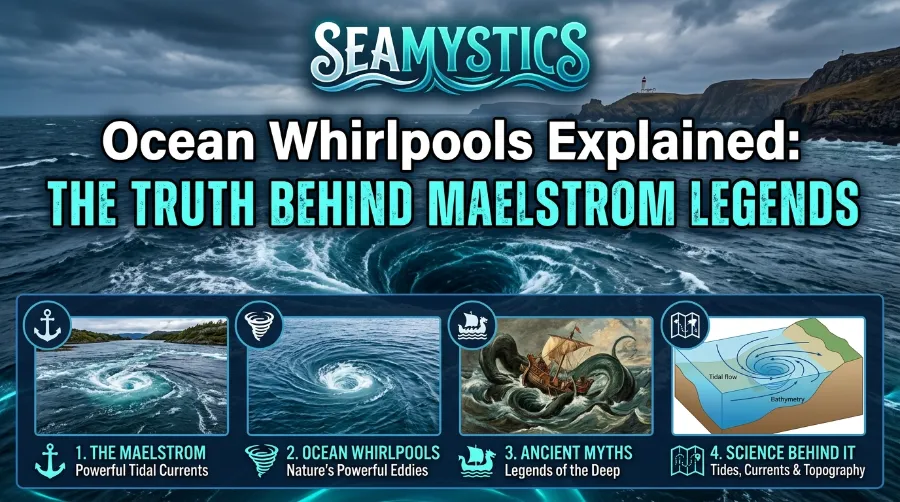
The word maelstrom comes from an old Dutch phrase meaning grinding stream. It originally described one specific place: the Moskstraumen near Norway’s Lofoten Islands. Today people use the term loosely for any large, dangerous whirlpool, but the science behind it stays fairly consistent everywhere it happens.
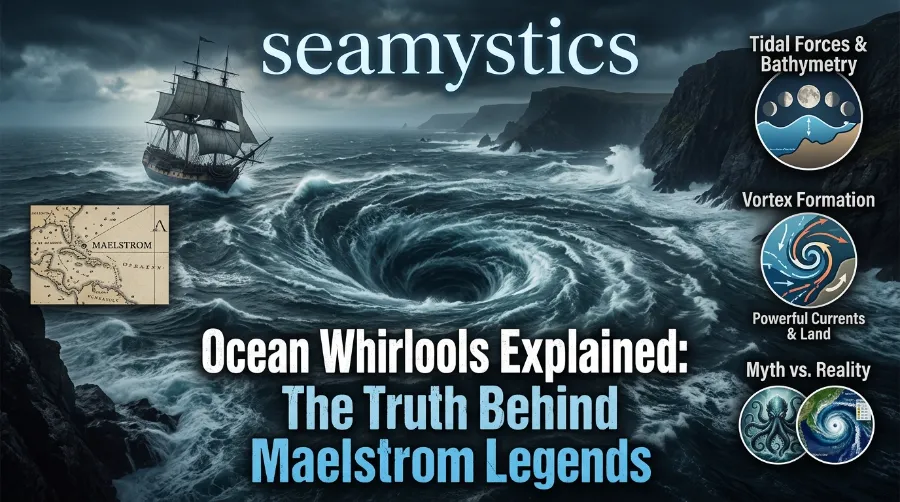
Tides push enormous volumes of seawater in and out of fjords and straits every six hours, and that water has to travel through gaps that are often far too narrow for it. When the flow gets squeezed, it speeds up. When fast-moving water meets a shallow ridge, a sudden drop-off, or a current running the opposite way, it starts to rotate. That rotation is the whirlpool.
Underwater Waterfalls The Illusion That Fools Cameras Every Time
Oceanographers separate this coastal phenomenon from the much larger mesoscale eddies that spin quietly out in the open sea. A recent study led by researchers at Plymouth Marine Laboratory found that these open-ocean eddies can stretch for hundreds of kilometers and last for months. They continually mix and transport water, nutrients, and marine organisms across entire ocean basins. In other words, the coastal maelstroms tourists photograph and the vast rotating currents that shape whole ecosystems are cousins, not the same animal, even though both fall under the umbrella of ocean whirlpool legends.
Why Whirlpools Do Not Actually Suck Ships to the Bottom
This is the part that surprises most people. Despite what Edgar Allan Poe wrote, a real tidal whirlpool rarely has the strength to drag a large vessel straight down. Turbulence, standing waves, and the risk of being thrown against rocks cause most shipwrecks near places like Corryvreckan or Saltstraumen, not a bottomless funnel.
Ghost Nets The Silent Killers Drifting Through the Deep Ocean
That said, small boats and swimmers face genuine risk. Researchers have measured the downdraft at the center of Saltstraumen’s vortex at roughly five meters deep. That’s more than enough to capsize a kayak or a dinghy caught at the wrong moment.
The Biggest Ocean Whirlpool in the World: A Global Comparison
People often ask which whirlpool actually deserves the title of biggest ocean whirlpool. The honest answer depends on whether you’re measuring speed or size. The table below pulls together the most consistently reported figures for the five whirlpools that marine researchers and coastal authorities reference most often.
| Whirlpool | Location | Max Speed | Max Diameter | Claim to Fame |
|---|---|---|---|---|
| Saltstraumen | Bodø, Norway | 22 knots (40 km/h) | About 10 meters | World’s strongest tidal current |
| Moskstraumen | Lofoten, Norway | 11 mph (18 km/h) | 3 to 6 km of eddies | Inspired Poe’s 1841 story |
| Old Sow | New Brunswick, Canada | Moderate | 76 meters (250 feet) | Largest in the Western Hemisphere |
| Corryvreckan | Jura, Scotland | 8.5 to 10 knots | Varies with tide | Third largest whirlpool in the world |
| Naruto Strait | Tokushima, Japan | 11 knots (20 km/h) | Up to 30 meters | Fourth fastest tidal current on record |
Saltstraumen wins on raw speed, while Old Sow wins on width, and that distinction matters more than it sounds. A narrow, fast vortex like Saltstraumen’s poses danger in a completely different way than a wide, slower rotation like Old Sow’s. Old Sow tends to catch drifting logs and lobster gear rather than pull swimmers under.
Norway’s Saltstraumen and Moskstraumen: Where Myth Meets Measurement
Norway’s coastline earned the reputation behind ocean whirlpool legends more than any other stretch of coast. Both Saltstraumen and Moskstraumen sit within a few hundred kilometers of each other, and both have terrified and fascinated sailors since at least the 13th century, when the Old Norse poems known as the Edda first described the Moskstraumen.
The Charybdis Whirlpool Legend and the Real Whirlpools of the Strait of Messina
Saltstraumen forms in a strait barely 150 meters wide between the Saltfjord and the Skjerstadfjord. Every six hours, roughly 400 million cubic meters of seawater force their way through it. That flow accelerates to a measured 22 knots, nearly 25 miles per hour, and creates whirlpools up to about 10 meters across with a downdraft reaching five meters deep. Local guides still time boat crossings around the brief calm window when the tide turns, because trying to cross at full flow simply isn’t an option.
Underwater Volcano Eruptions The Eruptions Happening Right Now Beneath the Waves
Moskstraumen, roughly 150 kilometers north near the Lofoten Islands, is the whirlpool that actually inspired the legend. In 1841, Edgar Allan Poe wrote “A Descent into the Maelström” after reading a description of the Moskstraumen in an early edition of the Encyclopaedia Britannica. Jules Verne later dragged Captain Nemo’s Nautilus into the same waters in Twenty Thousand Leagues Under the Sea, published in 1870. Herman Melville even gave it a nod through Captain Ahab in Moby-Dick. Modern measurements put the Moskstraumen’s currents at around 5 meters per second. That’s powerful enough to be dangerous, but nowhere near the mile-wide abyss Poe imagined.
The Mystery of Disappearing Fishing Fleets in the Bermuda Region
For readers curious about how deep-water pressure interacts with currents like these, our guide on deep sea pressure breaks down what actually happens to objects, and creatures, once they sink below the surface layer.
Whirlpool Ocean Facts That Rarely Make the Headlines
Beyond the headline numbers, several whirlpool ocean facts tend to get lost in the more sensational retellings. These details matter because they separate the folklore from what marine scientists have actually documented in the field.
- The Gulf of Corryvreckan in Scotland nearly killed writer George Orwell in 1947, when the current caught his small boat while he was drafting parts of 1984.
- These whirlpools can be heard before they’re seen; Corryvreckan’s roar has reportedly carried up to 10 miles on a stormy day.
- The word maelstrom entered common English almost entirely because of fiction, since Poe’s story pushed a regional Norwegian term into global vocabulary.
- Naruto’s whirlpools in Japan even lent their spiral shape to narutomaki, the pink-swirled fish cake found in ramen bowls worldwide.
- Old Sow, near the Canada-Maine border, produces smaller companion vortices nicknamed piglets that appear around the main whirlpool during strong tides.
- Scientists still use the Continuous Plankton Recorder, a device towed behind ships since the 1930s, as one of the primary tools to connect whirlpool activity to marine life today.
- Saltstraumen has existed in its current form for roughly 2,000 years, shaped by the retreat of glaciers that once covered Norway.
The picture that emerges, then, is less about sea monsters and more about geometry: narrow channels, shifting seabeds, and the moon’s gravitational pull working together on a predictable schedule.
Notable Whirlpool Incidents Worth Remembering
Beyond the general folklore, a handful of documented, dated incidents give ocean whirlpool legends real weight. These aren’t exaggerated sailor’s tales; they’re events with names, places, and timestamps attached.
In August 1947, the Corryvreckan’s currents nearly drowned novelist George Orwell along with his young son and two companions when their small boat flipped. Orwell was living on the nearby island of Jura at the time, working on the manuscript that became 1984. All four survived by scrambling onto a nearby rocky islet, and a passing fishing boat later rescued them.
More recently, in 2022, two brothers known as the Wild Swimming Brothers completed the first recorded open-water swim across the Moskstraumen. They covered the roughly 8-kilometer crossing in 2 hours and 31 minutes, and a support team from WWF-Norge tracked them the entire way, partly to raise awareness of Arctic marine conservation. During the same expedition season, they also swam across Saltstraumen, timing their crossing around the brief slack-tide window when the current calms.
These modern incidents matter because they show the gap between legend and reality clearly. Orwell survived a whirlpool that folklore says should have killed him instantly, and two athletes deliberately swam through waters that 19th century sailors believed no vessel could escape.
From Legend to Ecosystem: Why Whirlpools Matter to Ocean Life
It would be easy to treat these currents as nothing more than a tourist spectacle, but that undersells their role in the wider ocean. Whirlpools and their larger cousins, the mesoscale eddies, constantly mix nutrients from deep water up toward the surface, and that mixing ends up shaping entire food webs.
A 2025 study out of Plymouth Marine Laboratory, examined in detail by Oceanographic Magazine, found that cyclonic eddies in the northern and southern North Atlantic tend to pull nutrient-rich water upward, which supports larger zooplankton populations. In the middle latitudes, the opposite type of eddy created warmer, more stable conditions that favored growth instead. Zooplankton sit near the base of the marine food chain, so a shift in where they thrive can ripple all the way up to fish stocks and seabird colonies. Most maelstrom folklore articles leave out this kind of practical, evidence-based detail, yet it’s arguably more important than any shipwreck story.
I have watched this play out firsthand during fieldwork near tidal races similar to Saltstraumen, where cod, coalfish, and halibut congregate right at the edge of the strongest current, feeding on whatever the turbulence stirs up. It’s not a coincidence that Saltstraumen also holds a world record for the largest pollock ever caught on a rod. The same forces that make these waters dangerous for small boats make them extraordinarily rich fishing grounds.
How Scientists Actually Track These Currents Today
Folklore relied on shipwrecks and word of mouth, but modern researchers have far better tools, and this is where the science behind maelstrom explained content gets genuinely interesting. Researchers monitor coastal whirlpools like Saltstraumen with current meters anchored to the seabed, while they track the much larger mesoscale eddies out in open water from space.
Satellite altimetry measures tiny bumps and dips in sea surface height, and it lets agencies such as NOAA and the European Space Agency map rotating eddies across entire ocean basins without ever sending a ship out. A cyclonic eddy pulls cooler water upward and creates a slight dip in sea level, while an anticyclonic eddy does the opposite. That difference lets scientists identify and track thousands of these features at once, in near real time.
Meanwhile, older and lower-tech methods still matter close to shore. Local guides at Saltstraumen and Corryvreckan track tide tables going back decades to predict the exact hour a whirlpool will peak, and that same data now feeds directly into research databases used well beyond the tourism industry. A few research teams have even started using drone footage since around 2022 to measure vortex diameter more precisely than older shore-based estimates allowed, which has refined numbers that had barely changed since the early 20th century.
What the Continuous Plankton Recorder Reveals
One of the most useful long-running datasets for understanding eddies comes from something almost embarrassingly analog: a mechanical plankton-sampling device that ships have towed behind them since the 1930s, known as the Continuous Plankton Recorder. Researchers at Plymouth Marine Laboratory combined decades of this survey data with modern satellite eddy tracking to publish their North Atlantic findings in December 2025. Pairing old-school sampling with new-school satellite data is becoming a template for how oceanographers study whirlpool-driven ecosystems elsewhere.
Climate Change and the Future of Ocean Eddies
It’s fair to ask whether these currents are changing as the ocean warms. The honest answer is that researchers are only beginning to build the long-term records needed to know for certain. The North Atlantic plankton data does show a noticeable rise in zooplankton abundance across the mid-latitudes since around 2005, and the study’s authors linked this shift to changing climate conditions altering the balance between eddy types in that region.
A mix of wind, temperature gradients, and tidal forcing drives whirlpools and eddies, so warming oceans could plausibly shift how often certain rotation patterns form. Tidal maelstroms like Saltstraumen, though, run mainly on the moon’s schedule and are unlikely to change much regardless of climate trends. Open-ocean eddies respond more directly to shifting temperature and wind patterns, which is exactly why long-term monitoring programs matter so much going forward.
Whirlpools Versus Other Ocean Phenomena
People often lump whirlpools together with several unrelated ocean features, so a side-by-side comparison helps clear up the confusion once and for all.
| Phenomenon | Scale | Cause | Typical Duration |
|---|---|---|---|
| Tidal whirlpool (maelstrom) | Meters to tens of meters | Tidal flow through narrow straits | Hours, tied to tide cycle |
| Mesoscale eddy | Tens to hundreds of kilometers | Current instability, wind, temperature | Weeks to months |
| Ocean gyre | Entire ocean basin | Wind patterns and Earth’s rotation | Permanent, ongoing |
| Rip current | A few meters wide | Waves pushing water back out to sea | Minutes to hours |
| Tidal bore | River mouth, several km | Incoming tide against river flow | Minutes, tied to tide cycle |
This distinction matters for anyone researching ocean whirlpool legends, because sensational headlines sometimes blur a small coastal maelstrom with the massive, slow-moving Great Pacific Garbage Patch, when the two share almost nothing beyond the word rotation.
Are Ocean Whirlpools Dangerous? A Practical Breakdown
Given how dramatic the legends sound, it’s worth asking plainly whether these currents pose a real threat today. The answer depends heavily on the size of whatever gets caught in them.
- Large ships rarely face serious risk, since modern vessels have the power and draft to push through even Saltstraumen’s strongest flow, and captains simply time crossings around slack tide.
- Small boats and kayaks face genuine danger, because standing waves and sudden turbulence can capsize a light craft in seconds.
- Swimmers should never attempt these waters without expert local guidance, though a pair of endurance swimmers did successfully cross the Moskstraumen in 2 hours and 31 minutes during a supported expedition, wearing wetsuits and tracked by a support boat the entire way.
- Marine wildlife generally avoids the strongest part of the current, though orcas have occasionally shown up hunting near the edges of these tidal races.
If you enjoy stories about strange optical effects created by fast-moving water, our piece on the underwater waterfall illusion covers a related phenomenon that photographers frequently mistake for something supernatural.
How Ocean Whirlpool Legends Spread Across Cultures
Long before oceanographers had instruments to measure current speed, coastal communities built entire mythologies around these spinning waters. Norse sailors believed an underground fire fed Moskstraumen, alternately swallowing and spitting out the sea. Scottish folklore credited the Corryvreckan to Cailleach, a hag goddess of winter, who supposedly used the gulf as her washtub.
These stories weren’t simply superstition for its own sake. They served as practical warnings passed down through generations who had no other way to record danger zones. Interestingly, the same instinct that created maelstrom legends also produced other sea monster folklore, and if that topic interests you, our deep dive into the kraken myth origins traces a similar pattern of exaggerated ocean danger shaping maritime culture for centuries.
Modern science hasn’t erased the wonder either. Whirlpool tourism now draws thousands of visitors a year to Saltstraumen, Corryvreckan, and Naruto, and boat operators in all three locations report steady growth in bookings since the mid 2020s as more travelers seek out dramatic natural phenomena over standard sightseeing routes.
A Quick Look at Related Ocean Mysteries
Whirlpools are far from the only misunderstood feature of the deep. Readers chasing more unexplained ocean phenomena often move next to reports of enormous, rarely seen predators, and our coverage of megamouth shark sightings documents just how little we still know about creatures that share these same current-rich waters. Between rare sharks, optical illusions, and swirling maelstroms, the ocean keeps proving that reality rarely needs much embellishment. If any of this has sparked your curiosity, the full Sea Mystics archive covers dozens of similar ocean mysteries, each grounded in the same mix of real science and old sailor folklore.
Frequently Asked Questions
What causes an ocean whirlpool to form? Fast tidal currents get squeezed through narrow channels or collide with opposing currents and uneven seabeds, and that forces the water to rotate.
Is Saltstraumen the biggest whirlpool in the world? Saltstraumen holds the record for the strongest tidal current at 22 knots, though Old Sow in Canada is wider at roughly 76 meters in diameter. The biggest ocean whirlpool title depends on which measurement you use.
Can a whirlpool really sink a ship? Large modern ships rarely face serious risk. Smaller boats face real danger from turbulence, standing waves, and nearby rocks rather than getting pulled straight down.
Did Edgar Allan Poe base his story on a real place? Yes. Poe based his 1841 story “A Descent into the Maelström” on the Moskstraumen near Norway’s Lofoten Islands, which he researched through an early edition of the Encyclopaedia Britannica.
Are whirlpools connected to ocean gyres or garbage patches? No, they operate at a completely different scale. Gyres are massive, slow, basin-wide circulation systems, while whirlpools and maelstroms are localized, tide-driven vortices that dissipate within hours.
Conclusion
Ocean whirlpool legends survive because they sit at a rare intersection of genuine danger and genuine beauty. Once you strip away the exaggeration, what remains is still remarkable. Saltstraumen’s 22 knot current, Moskstraumen’s literary legacy, and Corryvreckan’s near miss with George Orwell all prove that reality didn’t need much help becoming legendary. The old stories got the scale wrong, not the existence, since these currents are real, measurable, and in many cases essential to the marine food webs that depend on them. The next time someone mentions a maelstrom, you’ll know it’s less about sea monsters and more about tides, geometry, and a few square kilometers of water doing exactly what physics demands.
References
- Nord Norge, “Saltstraumen is the World’s Strongest Tidal Current”
- Wikipedia, “Moskstraumen”
- Wikipedia, “Gulf of Corryvreckan”
- Wikipedia, “Old Sow whirlpool”
- WorldAtlas, “The World’s Largest Whirlpools”
- Oceanographic Magazine, “Ocean whirlpools reveal their power over North Atlantic food web”
- Wanderlust Magazine, “The World’s Most Awesome Whirlpools”
- Marine Technology News, Whirlpool coverage archive
- LiveScience, “Corryvreckan whirlpool: Scotland’s ‘raging cauldron'”
- Encyclopaedia Britannica, “Maelstrom”