

For centuries, sailors told the same story. A calm, ordinary sea suddenly lifted a wall of water as tall as a ten-story building. Scientists smiled and called it exaggeration. Then on New Year’s Day in 1995, a laser sensor on a North Sea oil platform recorded one. That single measurement turned the rogue wave phenomenon from sea myth into hard data. In this guide, I explain what these waves are, how they form, how big they get, and what they mean for anyone who works or travels on the ocean.
TL;DR: A rogue wave is a sea wave more than twice as tall as the waves around it. Science ignored sailors’ reports until 1995, when the Draupner platform measured a 25.6 meter wave. Today, satellites, buoys, and lab tests show these waves are real, rare, and still hard to predict.
| Key Takeaway | What You Need to Know |
|---|---|
| Definition | A wave at least twice the significant wave height of the surrounding sea |
| Turning point | The Draupner wave, 1 January 1995, 25.6 meters |
| Main cause | Wave energy focusing, often helped by currents and crossing seas |
| Typical danger zones | North Atlantic, North Sea, Agulhas Current, Southern Ocean, Bay of Biscay |
| Can we predict them? | Only partly, and warnings may be just minutes long |
| Best safety habit | Treat any storm sea as capable of producing a much larger wave |
Rogue Wave Explained: What Makes a Wave a Freak
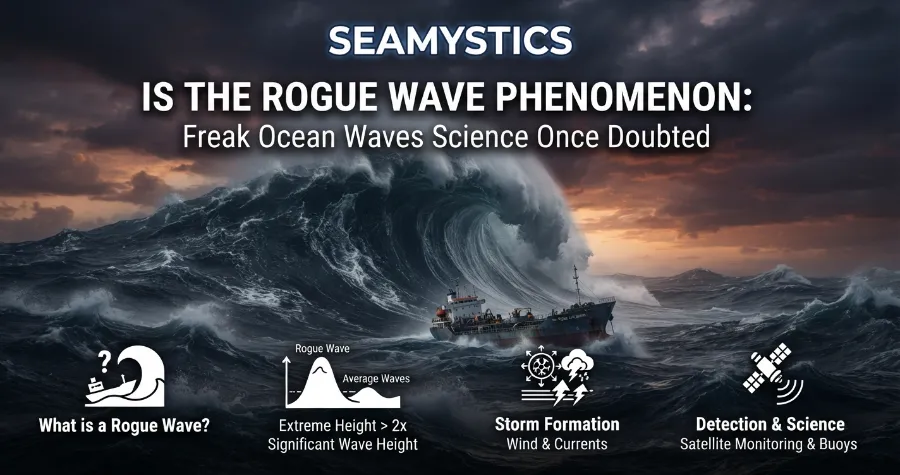
Let me start with the simplest answer. A rogue wave is a very large wave that appears suddenly and does not match the sea around it. Scientists use a clear rule to define one. First, they measure the significant wave height. This is the average height of the tallest third of waves in a sea state. Then they check any single wave against it. If that wave is more than twice the significant wave height, it counts as a rogue wave.
This rule matters because it separates rogue waves from simple big waves. In a storm with 12 meter seas, a 14 meter wave is normal. A 25 meter wave in that same storm is a rogue. The size is relative, so a rogue wave can happen in moderate seas too. If you want a short, boater friendly version of this idea, the team at Deckee explains what causes a rogue wave in plain language.
Unmapped Ocean Zones: Why Some Deep-Sea Areas Have Never Been Charted
Rogue Waves Are Not Tsunamis
Many readers mix these two up, so let me clear it up. A tsunami starts with a sudden shift of the seafloor, such as an earthquake. It has a very long wavelength and may cross an entire ocean. A rogue wave forms in open water from wind driven waves and has a short life. It lasts a few minutes at most. In my experience talking with sailors, this is the most common mix-up, and it leads to the wrong safety advice.
Why the Wave Height Rule Surprised Scientists
For decades, ocean models used a bell curve to describe waves. Under that math, a wave twice the average storm height should appear about once in 10,000 years of ocean time. Real data now shows they appear far more often than that. As a result, wave models had to change.
From Sailor Stories to Hard Proof
Long before instruments existed, mariners described “walls of water” and “holes in the sea.” Records from the 1800s mention ships that vanished without a distress call. Many scientists blamed bad weather or poor seamanship. Without measurements, nobody could prove the stories right.
The Draupner Wave of 1995
The proof arrived on 1 January 1995. The Draupner gas platform sits in the North Sea off Norway. During a storm, its downward facing laser recorded a wave with a maximum height of 25.6 meters. The surrounding seas had a significant wave height of about 12 meters. That ratio put the wave well past the rogue threshold.
Engineers at first questioned the sensor. They checked it, tested it, and compared it with other instruments on the platform. The reading held up. For the first time, researchers had a clean measurement of a freak wave. If you want the story of how the physics community reacted, the American Physical Society wrote a useful piece on the existence of rogue waves.
Ships That Met the Same Giants
The Draupner reading fit a pattern that ship crews already knew. Consider these cases:
- MS München, December 1978: This German cargo ship sent a distress call in the North Atlantic and was never found. All 28 crew were lost. Investigators later found a lifeboat that appeared to have been ripped from a high deck.
- Queen Elizabeth 2, September 1995: In the North Atlantic, during the tail of Hurricane Luis, the ship met a wave of about 29 meters. The captain described it as looking like the white cliffs of Dover.
- Louis Majesty, March 2010: In the Mediterranean off the Spanish coast, a cruise ship was hit by waves around 8 meters. Windows broke, two passengers died, and many more were hurt.
These events show that rogue waves do not only hit small boats. Large, well built ships have suffered damage too.
What Satellites Added
In 2000 and 2001, the European Space Agency ran the MaxWave project. Researchers analyzed radar images from satellites over three weeks. They found about ten giant waves taller than 25 meters across the world’s oceans. This result shocked many people. It showed that freak waves were not once in a lifetime events. They happen somewhere on Earth much more often than old models predicted.
Freak Wave Science: How These Giants Form
Scientists have found more than one way to build a rogue wave. No single cause explains all of them. Here are the main ones, from simple to complex.
Simple Stacking of Waves
The sea holds many waves at once, each with its own speed and size. Faster, longer waves can catch slower ones. Sometimes the crests line up at the same spot and time. When that happens, their heights add together. This is called constructive interference, and it explains many large waves in normal seas.
Nonlinear Focusing
Stacking alone cannot explain the biggest events. Here is where it gets interesting. In a real ocean, large waves change the speed of nearby waves. Energy from neighbors can flow into one wave and make it grow taller and steeper. Researchers describe this using the nonlinear Schrödinger equation. In 1983, the mathematician Howell Peregrine described a solution that grows out of nowhere and then fades away. Scientists call it the Peregrine soliton. Teams later reproduced this kind of wave in optical fibers and in water tanks, which supports the theory.
The Devil’s Sea: Japan’s Own Version of the Bermuda Triangle
Currents and Wind
Ocean currents can squeeze wave energy into a smaller area. When waves travel against a strong current, they slow down, bunch up, and grow steeper. The Agulhas Current off South Africa is a famous example. Storm waves from the Southern Ocean run head on into it, and the area has a long record of ship damage. Wind adds to the problem because it keeps feeding energy into the waves.
Crossing Seas
Sometimes two wave systems meet at an angle. A 2019 study by researchers at the Universities of Oxford and Edinburgh recreated the Draupner wave in a lab. They found that two wave groups crossing at about 120 degrees could produce a wave with the same shape as the one recorded in 1995. This was one of the best matches between theory and a real world measurement.
Quick Summary of Causes
- Linear stacking: Wave crests line up by chance.
- Nonlinear focusing: Energy moves into one wave and builds it up.
- Current effects: Waves meet a strong opposing current and steepen.
- Crossing seas: Two wave systems meet at a sharp angle.
- Strong, steady wind: The wind feeds more energy into the whole system.
In practice, I see these causes mix together. A storm with crossing seas over a strong current is the worst case, and it is exactly where most ship losses have clustered.
Rogue Wave Facts That Surprise Most Readers
Some details from the research change how people think about the sea. Here are the ones I share most often in talks.
| Fact | Detail |
|---|---|
| Frequency | Satellite data suggests dozens of giant waves may form somewhere each day, though most never meet a ship |
| Shape | They can come as a single wall, or as a set of two or three big waves in a row |
| Trough | Some arrive with a deep hole in front, which sailors call a “hole in the sea” |
| Lifespan | Most last only minutes before the energy spreads out again |
| Weather | They can appear in moderate seas, not only in hurricanes |
| Lab proof | Scientists can now make them in wave tanks |
| Location | They are not limited to one ocean; reports come from every major basin |
One more point deserves attention. Many ship losses before 1995 had no clear cause. Today, researchers believe a share of them involved extreme waves. We will probably never know the exact number.
Sunken City Ruins: Real Underwater Cities Found Beneath the Sea
The Largest Rogue Wave Ever Recorded
People often ask me a direct question: what is the largest rogue wave on record? The honest answer depends on what you count. Instruments measure height in different ways, and many giant waves hit places with no sensors at all. Here are the best documented cases.
| Event | Date | Place | Measured Height |
|---|---|---|---|
| Draupner wave | 1 Jan 1995 | North Sea, Norway | 25.6 m maximum wave height |
| Campbell Island buoy wave | 8 May 2018 | Southern Ocean, south of New Zealand | 23.8 m, the largest recorded in the Southern Hemisphere |
| Ucluelet wave | 17 Nov 2020 | Off Vancouver Island, Canada | 17.6 m, a rare, well measured rogue |
| Rockall Trough record | Feb 2013 | North Atlantic | 19 m significant wave height, a record for sea state |
The Draupner wave remains the best known example because researchers measured it so cleanly and studied it in so much detail. The Ucluelet wave is also important. Ocean scientists estimated it to be a once in thousands of years event for that location, yet the buoy caught it. This tells us that sensors placed in the right spot can capture these rare events.
A note of care is needed here. Some sources list a 524 meter wave at Lituya Bay, Alaska, in 1958. That was a megatsunami caused by a landslide in a narrow bay. It was not a rogue wave, so it does not belong in this list.
How Tall Is Tall?
To picture these numbers, think about a nine story building. That is roughly 25 meters. Now imagine that wall of water moving at highway speed toward a ship that is 150 meters long. The force can reach tens of tons per square meter. Most ships are built for about 15 tons per square meter. This gap explains why windows, hatches, and bridge equipment fail first.
Where Rogue Waves Strike Most Often
Reports cluster in a handful of places. Many of them are well known to commercial fleets.
- North Atlantic: Strong storms and long travel distances give waves plenty of room to grow.
- North Sea: Shallow areas, strong wind, and crossing seas make it a hotspot. Draupner sits here.
- Agulhas Current, South Africa: Opposing current and Southern Ocean swell combine.
- Bay of Biscay: Large Atlantic swells enter a shaped coastline.
- Drake Passage and the Southern Ocean: Few land barriers allow waves to build for thousands of kilometers.
- Mediterranean: Less often, but the 2010 Louis Majesty event shows the risk is real.
Rogue wave reports also tie into other deep sea puzzles. Sailors have long blamed strange losses on dangerous patches of ocean. One example is the Devil’s Sea near Japan, where ships disappeared in the 1950s. Scientists now think natural hazards like extreme waves may explain part of such stories, though weather, volcanic activity, and poor records played a role too.
How Scientists Track and Predict Rogue Waves Today
Prediction is the hardest part. A rogue wave forms and fades in minutes, so forecasts must be fast. Here is how work stands today.
Buoys, Platforms, and Satellites
Buoys and platform lasers give precise data at one location. Satellites with radar cover far larger areas but with less detail. Together, they now give researchers a much stronger record than we had 30 years ago. Mapping the sea surface also connects with mapping the sea floor, because depth shapes how waves behave. If you want to see how seafloor science works, our guide to ocean floor mapping explains the tools in simple steps.
Computer Models and Machine Learning
Researchers have built models that watch wave groups and flag the ones likely to turn into a rogue. A team at MIT showed that a model could give warnings of a couple of minutes in advance. That is short, but a few minutes can be enough for a crew to turn the ship, close hatches, and move people to safe areas. Newer machine learning tools are also being tested on buoy data.
What Still Stands in the Way
There are three main gaps. First, we have too few sensors in the most dangerous zones. Second, ocean conditions change fast. Third, researchers still debate which cause matters most in each region. In my view, the missing piece is not more equations. It is more long term open ocean data, collected the same way, in the same places, for decades.
What Rogue Waves Mean for Ships, Offshore Work, and Sea Life
Ship and Platform Design
After the Draupner reading, the offshore industry began to review its design rules. Engineers had to ask whether platforms were built with enough air gap, which is the space between the water and the lowest deck. Several design codes now take extreme waves more seriously than they did before 1995.
Safety Steps for Boaters and Crews
If you spend time on open water, small habits make a big difference. Here is a simple routine based on advice from experienced skippers and on guidance like the one in this post from Formula Boats on rogue waves.
- Check the forecast for swell and current, not just wind. Wind against current is the classic setup for steep waves.
- Avoid crossing sea zones in poor weather. If you can wait a day, wait.
- Keep hatches and ports closed. Water in the cabin is the biggest danger after the first impact.
- Wear a lifejacket and clip on. A rogue wave does not give time to prepare.
- Point the bow into big waves. Taking a wave from the side raises the risk of a roll.
- Brief everyone on board. People should know where the safety gear is before they need it.
NOAA also offers a short public explainer on this topic through its National Ocean Service page on rogue waves, which is useful as a quick refresher.
Effects on Marine Life
As a marine biologist, I also think about the animals. Extreme waves mix the upper ocean, throw sediment into the water column, and wash seabirds and small animals off rocks. Near coasts, they can strip intertidal communities in a few minutes. Because these events are rare, long term studies of their effects are scarce. This is an area where I would like to see far more research.
My Practical Takeaways After Years Around the Ocean
I want to share the lessons I rely on most. These are my own conclusions from reading the data and speaking with ship crews and ocean scientists.
- Rare does not mean ignorable. A one in a thousand wave becomes a daily risk when thousands of ships sail every day.
- The sea state label hides detail. Two storms with the same average wave height can produce very different extremes.
- Old reports deserve respect. Sailors were right long before science caught up. I now treat unusual eyewitness accounts as data worth testing.
- Good measurement beats good theory. The Draupner sensor changed the field more than any equation did.
The wider lesson applies to many ocean mysteries. Strange sounds, lost ships, and odd readings often turn out to have natural causes that need better tools to see. For example, the Julia sound mystery was once a puzzle in the same way. Careful listening and analysis later pointed toward an explanation tied to natural ice and ocean processes.
Frequently Asked Questions
What is a rogue wave?
A rogue wave is a sea wave more than twice the significant wave height of the surrounding waves. It appears suddenly and often lasts only minutes.
Are rogue waves real?
Yes. The Draupner platform measured one in 1995, satellites have found many more, and labs have now recreated them.
What is the largest rogue wave ever recorded?
The Draupner wave is the best documented, at 25.6 meters in 1995. Other buoys have recorded high waves too, such as 23.8 meters in the Southern Ocean in 2018.
How often do rogue waves happen?
They are rare at any single spot, but satellite studies suggest giant waves occur somewhere in the ocean far more often than old models predicted.
Can rogue waves be predicted?
Only in part. Current models can give warnings of just a few minutes, and sensors are still too few in many dangerous regions.
Are rogue waves the same as tsunamis?
No. Tsunamis come from seafloor movement, while rogue waves form from wind driven waves in open water.
Can a rogue wave sink a large ship?
It can. A wave with enough height and steepness can damage hatches, windows, and the hull, and some ship losses are linked to this cause.
Conclusion
The rogue wave phenomenon shows how science grows. Sailors reported the waves for hundreds of years, researchers doubted them, and a single laser reading changed the conversation. Today we know these waves form through stacking, nonlinear focusing, currents, and crossing seas. We also know they can reach heights above 25 meters. Prediction still has a long way to go, so respect for the open ocean remains the best protection. Next time you read a strange sea story, remember that it may hold more truth than it first seems.
Quick Quiz: Test What You Learned
1. A rogue wave is usually defined as a wave that is at least how many times the significant wave height?
A) 1.5 times
B) 2 times
C) 5 times
D) 10 times
2. Which event gave scientists the first clear measurement of a rogue wave?
A) The 2004 Indian Ocean tsunami
B) The Lituya Bay event of 1958
C) The Draupner wave of 1995
D) The Louis Majesty incident of 2010
3. Which of these helps rogue waves form?
A) Waves meeting a strong opposing current
B) A completely flat sea
C) Warm water only
D) Low tide
4. True or false: A rogue wave and a tsunami form in the same way.
5. True or false: Rogue waves can only happen in hurricanes.
Answers: 1) B. 2) C. 3) A. 4) False. Tsunamis come from seafloor movement, rogue waves from wind driven waves. 5) False. They can appear in moderate seas as well.
About the Author
Dr. Maren Rabica is a marine biologist with a PhD in marine science and more than 20 years of research experience in the North Atlantic and Southern Ocean. She writes and leads research content for Sea Mystics, where she turns ocean data into clear, practical stories.
References
- Draupner wave records and analysis, Norwegian offshore wave measurement studies, 1995 onward
- European Space Agency, MaxWave project and WaveAtlas results, 2000 to 2003
- Adcock, McAllister, and colleagues, Draupner wave laboratory recreation, University of Oxford and University of Edinburgh, 2019
- Peregrine, D. H., “Water waves, nonlinear Schrödinger equations and their solutions,” 1983
- Durrant and colleagues, Campbell Island wave record, Southern Ocean, 2018
- Ocean Networks Canada and MarineLabs, Ucluelet wave study, 2020 event
- American Physical Society, APS News, “The existence of rogue waves”
- NOAA National Ocean Service, “What is a rogue wave?”
- Cousins and Sapsis, MIT, rogue wave prediction research