
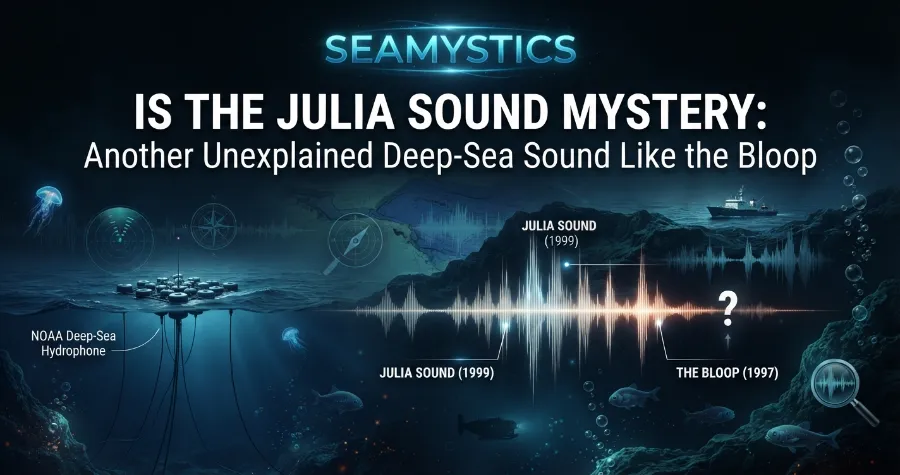

Imagine you sit in a quiet lab and press play on a recording from the bottom of the Pacific. Then a long, low moan comes out of the static, and it sounds like a woman humming to herself. That is the Julia sound mystery, and it has fascinated listeners since 1999. In this guide, I will explain what NOAA recorded, why people compare it to the Bloop, and what the best science says today.
I am Dr. Rabica, and I have spent years reading ocean sound data. For that reason, I will keep this simple and honest. Some parts of this story are solved, but other parts are still open.
Key Takeaways
| Question | Short answer |
|---|---|
| What is Julia? | A loud, odd ocean sound recorded by NOAA on March 1, 1999 |
| Where was it heard? | On NOAA’s eastern equatorial Pacific hydrophone array |
| What does NOAA think caused it? | A large iceberg that ran aground off Antarctica |
| Why the name “Julia”? | Sped up 16 times, it sounds like a human voice |
| How is it linked to the Bloop? | Both likely came from Antarctic ice, and both traveled thousands of miles |
| Is it fully solved? | The source is likely ice, but the exact spot is still uncertain |
TL;DR
Julia is a strange ocean sound that NOAA recorded on March 1, 1999. NOAA says the most likely source is a big iceberg that hit the seafloor near Antarctica. However, the exact location is still unknown, so many people still call it unexplained ocean audio.
What Is the Julia Sound? A Plain Answer
The Julia sound is an underwater recording made by NOAA’s Pacific Marine Environmental Laboratory (PMEL). Hydrophones, which are underwater microphones, picked it up in the eastern equatorial Pacific on March 1, 1999. According to the NOAA PMEL acoustics page, the origin time was 21:05 GMT on Julian day 60.
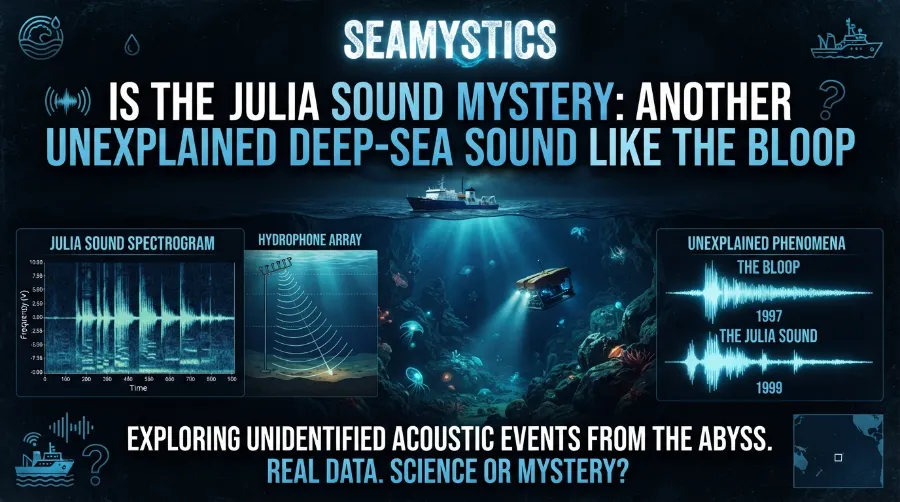
Here is the part that surprises most people. The version you hear online is not the raw recording, because NOAA sped the signal up 16 times. The original sound sits so low that human ears cannot catch it. Once the clip speeds up, it moves into a range we can hear, and that is when it starts to sound like a voice.
Unmapped Ocean Zones: Why Some Deep-Sea Areas Have Never Been Charted
So when a headline says “haunting woman’s voice,” remember the speed trick. The ocean did not hum a tune. Instead, the data just sounds that way after processing.
Why Is It Called Julia?
NOAA researchers often give nicknames to odd sounds so they can talk about them fast. For example, names like Bloop, Train, Slow Down, and Julia helped the team sort the recordings. Julia earned its name from the human feel of the sped-up audio.
The Free the Ocean write-up describes it as a sound that resembles a woman softly humming or mumbling. As a result, that picture stuck. It also explains why this strange ocean sound spreads so well on social media.
The Julia Sound NOAA Report: What the Data Says
Next, let me walk through what the Julia sound NOAA page actually claims. It makes three points:
- The recording came from the eastern equatorial Pacific autonomous hydrophone array.
- The most likely source is a large iceberg that ran aground off Antarctica.
- The arrival direction was not precise, so the origin could sit anywhere between the Bransfield Strait and Cape Adare.
That last point matters a lot. The Bransfield Strait lies near the Antarctic Peninsula, while Cape Adare sits far away on the other side of the continent, near the Ross Sea. Because the gap is huge, NOAA could not name one spot. The sound reached the array from a long way off, and the direction fix had some error.
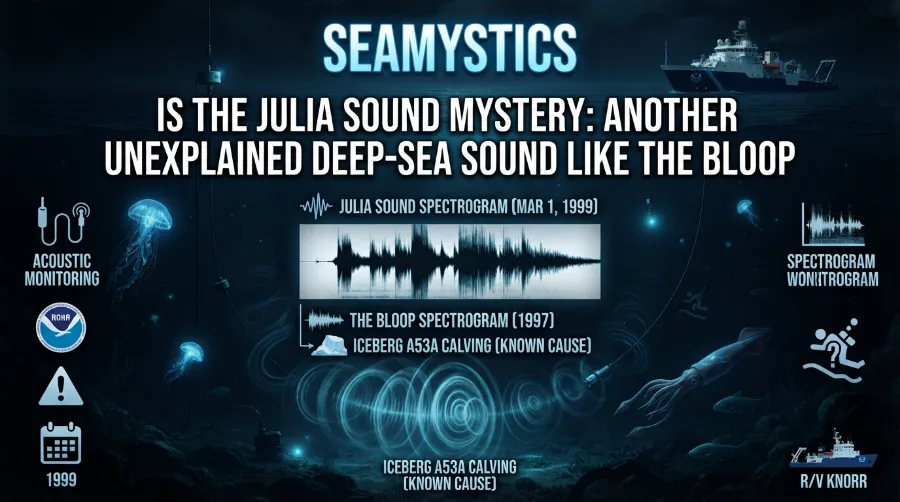
If you want to see the spectrogram, you can find it on the same NOAA page. A spectrogram is a picture of sound, with pitch on one side and time on the other. In this picture, Julia shows up as a bright, strong band.
Ocean Nuclear Testing: How Cold War Blasts Changed the Ocean Floor
A quick note on dates
Some articles repeat the wrong year. For instance, one popular news piece said NOAA captured Julia in 1991. However, NOAA’s own page says March 1, 1999. When I check facts for a post like this, I go back to the lab’s page first, since it takes two minutes and saves a lot of wrong claims.
How Julia Compares With the Bloop
The Bloop is the most famous of all NOAA unexplained sounds. NOAA hydrophones detected it in 1997, and it reached sensors up to 4,800 km (about 3,000 miles) apart. In fact, it ranks among the loudest unidentified sounds ever picked up.
At first, people guessed it was a giant creature. That idea spread fast, and some fans even linked it to the fictional monster Cthulhu. Later, though, NOAA tied the Bloop to an icequake, which is the sound of a huge piece of ice cracking and breaking away.
Julia follows the same story. Both sounds were low, strong, and heard over huge distances, and both point back to Antarctic ice. This is why the title of this article calls Julia another unexplained deep-sea sound like the Bloop.
Sunken City Ruins: Real Underwater Cities Found Beneath the Sea
| Sound | Year recorded | Likely cause (NOAA view) | Notes |
|---|---|---|---|
| Bloop | 1997 | Icequake from a big iceberg | Heard by sensors up to 4,800 km apart |
| Julia | March 1, 1999 | Iceberg grounding off Antarctica | Sped up 16 times for human ears |
| Slow Down | May 19, 1997 | Iceberg grounding on the seafloor | Heard several times a year |
| Train | March 5, 1997 | Iceberg dragging its keel on the seabed | Likely from the Ross Sea region |
What makes Julia different?
The Bloop had a sharp rise. Julia, on the other hand, has a longer, moaning shape, and that shape is why people hear a voice in it. A grounding iceberg does not snap once like a cracking sheet. Instead, it scrapes, shudders, and slows down, so the motion can make a long, wobbling sound.
For this reason, NOAA grouped Julia with the Slow Down sound. Both match a drifting iceberg that hits the seafloor and grinds to a stop.
How Can a Sound Travel So Far?
This is the question I get most from students. How can a sound near Antarctica reach a microphone in the equatorial Pacific?
The answer lies in how sound moves in the sea. First, water carries low-pitched sound very well. Second, at certain depths, a layer called the SOFAR channel traps sound waves and keeps them from fading fast. Think of it as a tunnel made of water, where low tones can travel for thousands of miles.
Here is a simple example with real numbers. Sound moves through seawater at about 1,500 meters per second. Therefore, a sound that crosses 4,800 km, like the Bloop did, needs about 3,200 seconds. That is roughly 53 minutes, so the sensors hear it nearly an hour after the ice cracked.
This is also why timing matters. When two or more hydrophones record the same event, scientists compare the arrival times and work out where it came from. With only a weak direction fix, like the one for Julia, the answer stays fuzzy.
Train Sound Antarctica: The Deep Sea Noise Linked to Icebergs
What Do Unexplained Ocean Audio Clips Teach Us?
Strange recordings are not only fun stories. In addition, they teach us how the ocean really works.
When I teach people to read a spectrogram, I start with one rule: do not trust your ears first. Your ears want a creature, a voice, or a machine. The picture of the sound, however, tells a more honest story. A living animal usually leaves a repeating pattern with changing pitch, whereas ice leaves a rough, broad band with a sudden start and a slow fade.
Here are three things I have learned from this kind of work:
- A huge-looking sound can come from a small event close to the sensor.
- On the other hand, a faint sound can come from a giant event far away.
- Processing, such as speeding up a file, changes how a sound feels, so always ask what was done to the clip.
This habit protects you from fake claims. Many viral clips online have no source, no date, and no raw data. By contrast, a real NOAA clip always has a date, a place, and a method.
Could Julia Be a Sea Creature?
It is a fair question, since the ocean hides many animals we barely know. Still, the scientific community mostly accepts the iceberg grounding idea, as the Free the Ocean summary notes.
Let me give you three reasons why a creature does not fit well:
- Size of the sound. Julia and the Bloop reached sensors far apart, and known animals do not make sounds that strong at that range.
- Matching sounds. NOAA kept hearing similar signals over the years, especially in Antarctic seasons, and a single creature is unlikely to repeat them in such a steady pattern.
- Matching ice events. Researchers later recorded icequakes that sounded like the Bloop.
The blue whale is the loudest known animal, and its calls can travel far. Even so, whale calls have clear, repeating patterns, and Julia does not behave like that.
The Rogue Wave Phenomenon: Freak Ocean Waves Science Once Doubte
Why NOAA Unexplained Sounds Went From Mystery to Method
In the 1990s, NOAA had only a few hydrophone arrays. As a result, scientists could not always pin down where a sound came from, and that is why Julia stayed unclear.
Later, NOAA added more hydrophones. Seismologist Robert Dziak told WIRED in 2012 that the extra sensors helped the team record many Bloop-like sounds. This change matters because one sound can look like a mystery, but a hundred matching sounds look like a pattern.
There is another good example. In early 2008, researchers followed the iceberg A53a as it broke up near South Georgia Island. Since the sounds from that break matched the Bloop family of signals, scientists gained a real-world test case for the icequake idea.
I think this is the best lesson in the whole story. Good science does not end at “we do not know.” Rather, it adds more tools, collects more data, and tests the guess again.
Slow Down Sound: NOAA’s Strangest Underwater Audio Recording
The Human Side: Why We Love a Strange Ocean Sound
Reddit users reacted to the Julia clip with jokes about the Kraken and extinct dinosaurs, as covered by Surfer. Others said it felt scary. Humans react this way because the deep sea is dark, cold, and mostly unseen, so our brains fill the blanks.
I do not think that is a bad thing. In fact, curiosity pulls people toward ocean science, and I see it in classrooms and at public talks. A spooky clip often gets people to ask real questions about ice, sound, and the seafloor.
If you want to dig into how scientists map the places where these sounds may begin, our guide on ocean floor mapping shows how sonar builds a picture of the seabed. Mapping and listening work together, because one shows the shape of the sea bottom and the other tells us what moves above it.
You can also browse more deep-sea stories on the Sea Mystics homepage.
What Climate Change Adds to the Story
More ice is breaking and moving in a warming world. Dziak noted to WIRED that rising ice loss and melting glaciers have led to more odd sounds like the Bloop and Julia, according to a recap of that interview.
That does not mean each new sound proves a climate event. Instead, it means ocean listening now doubles as a way to watch polar ice. Because hydrophones hear through darkness and clouds, they can catch ice breaking when satellites cannot see it.
Here is a short summary of what scientists can learn from icy ocean sounds:
- When and where large icebergs ground or crack
- How often ice events happen each season
- How ice sound changes over many years
- Where to point satellites and research ships next
What Is Still Unknown About the Julia Sound Mystery
Let me be clear about what we do not know, because this is where trust matters most.
NOAA says the most likely source is a grounded iceberg, but it does not say it is certain. Likewise, the range between the Bransfield Strait and Cape Adare is wide. Since no camera saw the event and no ship stood nearby, nobody can replay the day and point to one iceberg with full proof.
So the Julia sound mystery is partly solved and partly open. The source type has strong support, but the exact spot and the exact iceberg do not. That is a normal state in field science. I often tell my students that “likely” is a strong word in research, because it means the evidence leans one way while we stay open to new data.
Facts and Figures at a Glance
| Fact | Number or date |
|---|---|
| Julia recorded | March 1, 1999, at 21:05 GMT |
| Playback speed used for the public clip | 16 times faster |
| Bloop first detected | 1997 |
| Bloop sensor distance | Up to 4,800 km (about 3,000 miles) |
| Speed of sound in seawater | About 1,500 meters per second |
| Time for sound to cross 4,800 km | About 53 minutes |
| Iceberg A53a break up tracked | Early 2008 |
| NOAA statement on extra hydrophones | Reported in 2012 |
If you want a chart, a simple bar chart of “year recorded” for the four sounds works well. A line showing how travel time grows with distance works too, and I can build either one for you.
The Devil’s Sea: Japan’s Own Version of the Bermuda Triangle
Case Study: Reading a Julia-Type Event Step by Step
Here is how an analyst works through a case like Julia. I use this exact flow when I explain it to new students.
- Find the time. Julia has a clear time stamp: Julian day 60, 21:05 GMT, in 1999.
- Check each sensor. Did several hydrophones hear it? If so, the source is likely strong or large.
- Measure the delay. Compare arrival times to estimate direction.
- Compare with known sounds. Does it look like a whale, a ship, an earthquake, or ice?
- Test the idea. Look at ice records and satellite images for the same days.
- Report the confidence. Say “most likely” when you cannot prove it.
In the Julia case, the first four steps pointed toward ice. However, the satellite tools and records of that time limited step five. For that reason, NOAA still words the claim with care.
Why This Matters for Readers in the US and Europe
If you live in the United States, NOAA is the agency behind these recordings, and its data is open to the public. Meanwhile, readers in the UK and Europe may know similar work from polar research groups and ocean sound programs that track ships, whales, and ice.
You do not need to be a scientist to follow this field. Instead, you can listen to public audio, read the spectrograms, and learn what each shape means. To start, try the NOAA PMEL pages linked above, because they are short and clear.
Frequently Asked Questions
What is the Julia sound?
It is an unusual underwater sound that NOAA recorded on March 1, 1999. When sped up 16 times, it sounds like a woman humming.
Did NOAA solve the Julia sound mystery?
NOAA gives a most likely answer: a large iceberg that ran aground off Antarctica. However, the exact location is still uncertain, so many people still list it with unexplained sounds.
Is Julia the same as the Bloop?
No, they are two different recordings. Still, both likely came from Antarctic ice, and both traveled very far through the ocean.
Could a giant sea animal make the Julia sound?
That is very unlikely, because the sound’s strength, range, and pattern fit ice better than any known animal.
Why does Julia sound like a voice?
The raw sound sits too low for human hearing. After NOAA sped it up 16 times, the changing tones sound like humming or mumbling.
Where can I listen to the original files?
NOAA PMEL keeps the audio and spectrogram on its Julia page.
Conclusion
The Julia sound began as a weird file from the Pacific, and it became one of the most talked about NOAA unexplained sounds. Based on the best evidence, a huge iceberg hit the seafloor near Antarctica, and the sound then crossed thousands of miles of ocean. What remains unclear is where it happened and which iceberg did it.
Next time you see a viral clip of a strange ocean sound, check the date, the source, and the speed of playback. After that, ask what the picture of the sound says. In the end, this small habit turns fear into learning.
Test Yourself: 5 Question Quiz
1. When did NOAA record the Julia sound?
A. May 19, 1997
B. March 1, 1999
C. March 5, 1997
2. What does NOAA say is the most likely source of Julia?
A. A giant squid
B. A submarine
C. A large iceberg that ran aground off Antarctica
3. How much was the public Julia clip sped up?
A. 4 times
B. 16 times
C. 60 times
4. True or false: The Bloop was heard by sensors up to 4,800 km apart.
5. True or false: NOAA knows the exact iceberg that made the Julia sound.
Answers: 1. B. 2. C. 3. B. 4. True. 5. False. NOAA only gives a likely range between the Bransfield Strait and Cape Adare.
References
- NOAA PMEL Acoustics Program, “Iceberg Grounding on Seafloor (Julia)”
- Surfer, “Haunting Underwater Voice Remains Mystery 25 Years Later”
- Free the Ocean, “Scientists Record Chilling Sound Deep in the Pacific That Mimics a Woman’s Voice”
- NBC News, “Spooky Science: Unexplained Sounds from the Deep”
- Wikipedia, “Bloop” and “List of unexplained sounds”