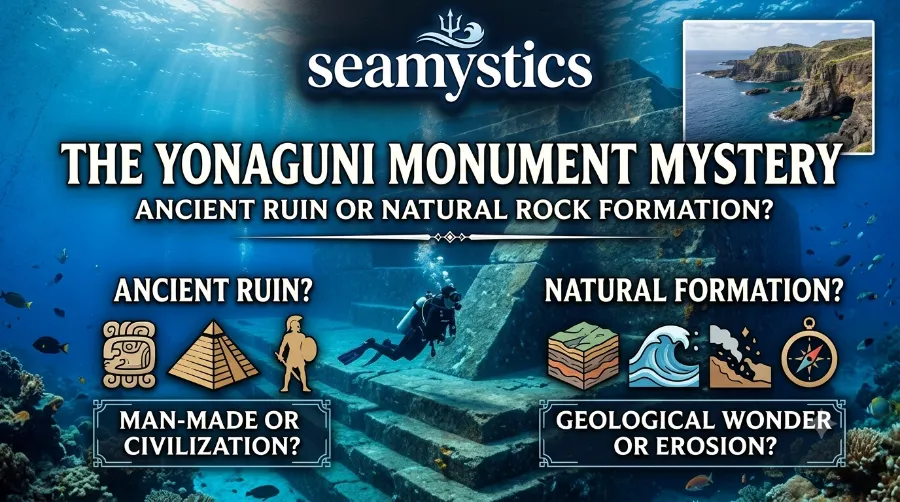

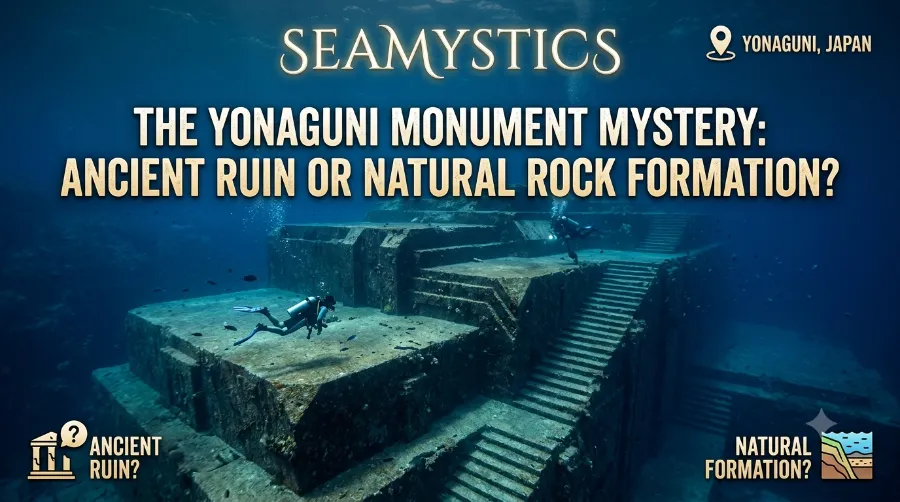
Picture this. You drop into warm Pacific water off a tiny Japanese island, and thirty meters down, a giant stone structure appears out of the blue haze. Straight edges. Sharp corners. Steps that look cut by hand. This is the Yonaguni Monument mystery, and it has puzzled divers, geologists, and archaeologists since a local diver named Kimio Teraoka first spotted it in 1986. Some call it Japan’s Atlantis. Others call it a very stubborn slab of sandstone. So which is it, and why does this debate refuse to die down almost forty years later?
The Sargasso Sea Mystery: Why Ships Report Strange Silence There
Underwater Rivers: The Rivers That Flow Beneath the Ocean
Key Takeaways
| Point | Detail |
|---|---|
| Discovery | Found in 1986 by diver Kimio Teraoka near Yonaguni Island, Japan |
| Location | About 100 km east of Taiwan, roughly 25 meters below the surface |
| Size | Roughly 50 meters long, 20 meters wide, and 27 meters at its tallest point |
| Main theory 1 | Man made structure, championed by geologist Masaaki Kimura since the early 1990s |
| Main theory 2 | Natural rock formation shaped by sandstone fracturing and wave erosion |
| Estimated age | Kimura first proposed 10,000 years, later revised to 2,000 to 3,000 years |
| Current scientific lean | Most peer reviewed geology, including 2020 field studies, favors a natural origin |
TL;DR: The Yonaguni Monument is a huge underwater rock formation off Japan’s coast that looks so sharp and geometric that many people believe humans built it. Most geologists who have studied the sandstone layers on site now lean toward a natural explanation involving fractures and erosion, though a small group of researchers, led by Masaaki Kimura, still argue it was carved by ancient hands. No tools, carvings, or artifacts have ever been recovered to settle the question either way.
Vanishing Island Mystery: The Real Science Behind Islands That Disappear
What Exactly Is the Yonaguni Monument?
The Yonaguni Monument sits just off the southern coast of Yonaguni Island, the westernmost inhabited island in Japan. It lies close to Taiwan, only about 100 kilometers away, which is closer to Taipei than to Okinawa’s main island. Divers first reach it at around 5 meters, though most of the striking terraces sit between 18 and 25 meters down.
Brinicle Ice Finger of Death The Antarctic Phenomenon Filmed for the First Time
The structure looks like a stepped pyramid crossed with a stone plaza. It has flat platforms, sharp right angle corners, and long straight walls that run for meters without curving. There is also a feature nicknamed the Turtle, plus a rock arch that locals call the Gate. Because it is so photogenic, the site has become one of the more talked about underwater ruins in Japan, drawing technical divers from the United States, Europe, and across Asia every year.
Local dive shops on the island now run dedicated Yonaguni underwater ruins tours, and demand keeps growing thanks to documentaries and social media. If you want firsthand travel details before booking a trip, this Yonaguni travel guide covers seasonal currents, visibility, and how strong divers need to be to handle the site safely.
The Case for a Man Made Ancient Ruin
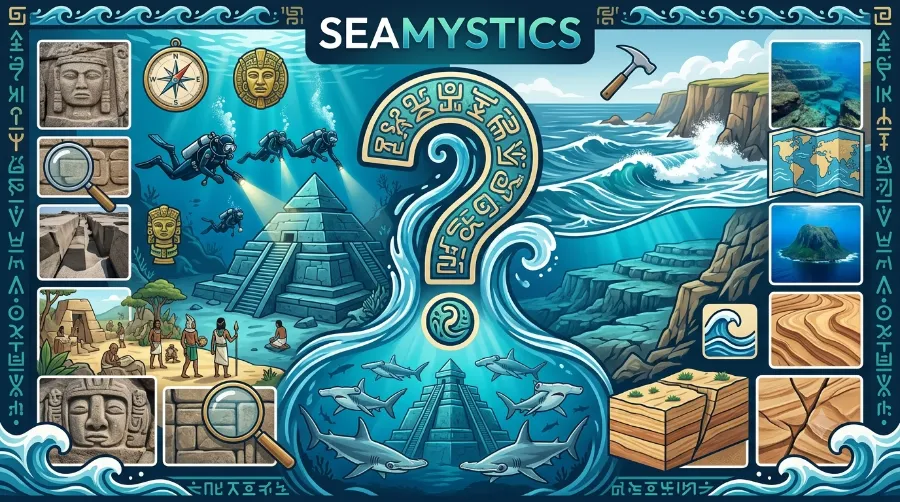
Masaaki Kimura, a marine geologist who taught at the University of the Ryukyus, has spent more than three decades studying this rock formation. He first dove the site in the early 1990s and has returned dozens of times since, mapping every angle with his own hands. Kimura believes the sharp corners, flat terraces, and what he describes as carved steps are simply too precise for nature to have made by accident.
Cold Seeps The Deep Sea Ecosystems That Run on Gas Not Sunlight
He has also pointed to smaller details that keep the debate alive. These include markings he interprets as possible quarry cuts, shapes that resemble stairways carved for foot traffic, and a large protrusion he has compared to a stone face. Kimura originally proposed the site was around 10,000 years old, built when sea levels were far lower during the last Ice Age. He later revised that estimate to around 2,000 to 3,000 years, closer to when local sea levels matched today’s levels, based on a report he gave at the 21st Pacific Science Congress in 2007.
The Bermuda Triangle What Ocean Science Actually Says
Kimura is not alone. Geologist Robert Schoch, known for his work on Egypt’s Great Sphinx, dove the site multiple times and collected rock samples with a hammer and chisel. Interestingly, Schoch eventually concluded the main structure is natural, even though he remains fascinated by ancient carvings found on land nearby on Yonaguni Island itself. That mix of opinions from serious researchers is exactly why this Japan sunken pyramid debate has stayed alive for so long instead of fading into internet folklore.
For readers who enjoy these ocean mysteries, it helps to compare Yonaguni with other unexplained underwater sites on our unidentified submerged objects hub, where we track similar cases from around the world.
The Case for a Natural Rock Formation
Most professional geologists who have examined the Yonaguni rock formation up close now lean toward a natural explanation, and the reasoning is fairly straightforward. Yonaguni Island sits on a bed of sandstone and mudstone that formed in layers roughly 20 million years ago. These layers naturally fracture along straight lines because of internal stress, a process geologists call jointing.
A detailed 2020 study led by geoscientist Takayuki Ogata looked closely at the bedding planes and joint patterns both underwater and on dry land at Yonaguni. The team found that similar step like ledges appear naturally at a nearby site called Sanninudai, located on the island’s south coast, far from any underwater ruin theories. Since sandstone in this region consistently breaks into flat shelves and sharp corners on its own, the same forces likely shaped the submerged structure too.
Geologist Makoto Otsubo, also from the University of the Ryukyus, has pointed out something that often surprises visitors. Symmetrical, angular shapes are actually common in nature once you know what to look for, especially in layered sedimentary rock exposed to strong currents for thousands of years. Powerful earthquakes are frequent in this part of the Pacific Ring of Fire, and repeated seismic shaking can crack rock along neat, almost architectural lines.
For a broader look at how researchers separate genuine human construction from natural coincidence underwater, our guide on the Puerto Rico Trench explores similar seafloor mysteries where geology often gets mistaken for archaeology.
Why No Artifacts Have Ever Been Found
This is arguably the strongest point on the natural formation side of the argument. Despite nearly forty years of dives, documentaries, and scientific expeditions, nobody has ever recovered a tool, a carved inscription, pottery, or human remains from the site. Ancient cities almost always leave behind some trace of daily life, even after thousands of years underwater.
Compare this to genuine underwater archaeology sites like Pavlopetri in Greece, where actual pottery, walls, and tombs confirm a submerged Bronze Age town. Yonaguni has produced nothing like that so far. That absence of physical evidence is a major reason mainstream geology has not shifted toward the ancient ruin explanation, even though the shapes remain genuinely striking to look at.
Comparing the Two Theories Side by Side
| Evidence Point | Supports Man Made Theory | Supports Natural Formation |
|---|---|---|
| Sharp right angles | Yes, argued as too precise for nature | Common in jointed sandstone |
| Similar shapes elsewhere on land | Rare on land near the site | Found at Sanninudai geosite nearby |
| Tools or artifacts recovered | None found in 40 years | Absence supports natural origin |
| Age estimates | 2,000 to 10,000 years, based on sea level | Rock layers formed 20 million years ago |
| Leading researcher | Masaaki Kimura, University of the Ryukyus | Takayuki Ogata and Makoto Otsubo, same university |
| Peer reviewed publication support | Limited | Stronger, 2020 field study |
How the Yonaguni Rock Formation Fits Into Other Ocean Mysteries
The Yonaguni Monument mystery is not the only case where the ocean floor plays tricks on our eyes. Divers and sonar teams around the world keep finding shapes that look built rather than born from natural forces. Comparing these cases side by side actually helps clarify what real evidence of ancient construction should look like.
Here are a few examples worth knowing:
- The Baltic Sea Anomaly, a disc shaped object found in 2011 off the coast of Sweden, sparked years of speculation before most researchers linked it to a natural glacial deposit. You can read the full breakdown on our Baltic Sea Anomaly page.
- Bimini Road in the Bahamas features flat limestone blocks that some call an ancient road, though most geologists attribute it to beachrock formation.
- Pavlopetri in Greece remains the gold standard for confirmed underwater ruins, complete with actual walls, streets, and tombs dated to around 3,500 years old.
- Reports of entire vanishing islands, often tied to erosion or rising seas rather than mystery, show how easily the ocean reshapes coastlines within a single human lifetime, a topic we cover in our vanishing island mystery guide.
Each of these cases shows the same pattern. A striking shape sparks huge public interest, then years of patient fieldwork slowly settle the question, usually toward a natural explanation, though not always.
What Diving the Site Actually Feels Like
I have spent close to two decades studying coastal geology and reef systems, and I dove the Yonaguni site myself during a research trip in 2019. What struck me first was not the size of the structure, since photos already prepare you for that. It was the current. Divers here fight a strong, steady pull that can sweep you off the terraces within seconds if you are not careful.
That current matters more than most articles mention. Strong, consistent water movement over millions of years is exactly the kind of force that can polish rock into smooth, almost deliberate looking edges. Standing on one of the flat terraces, running a gloved hand along a corner that felt almost machined, I understood why Kimura’s theory feels so convincing in person. Yet a closer look at the surrounding cliffs on the island, which show the same stepped pattern above water where no ocean could have shaped them, tells a different story.
This kind of firsthand observation is exactly why marine geologists insist on visiting a site multiple times before publishing conclusions. Photos and video, however dramatic, can flatten depth and scale in ways that mislead casual viewers online.
Recent Research and Where the Debate Stands in 2026
Interest in the Yonaguni underwater ruins has actually grown recently rather than faded. New deep sea imaging projects and renewed diving expeditions through 2025 and into 2026 have kept the site in headlines, partly thanks to pop culture attention and renewed documentary coverage. Even so, no confirmed artifacts, inscriptions, or human remains have turned up from any of these newer surveys.
The scientific consensus has been shifting steadily toward the natural formation camp over the last several years, largely because of detailed sandstone studies like the 2020 Ogata research. That said, Kimura and a small group of independent researchers continue defending the man made theory through public talks, books, and media appearances. This split between formal geology and passionate independent researchers is fairly common in fringe archaeology debates, and Yonaguni is a textbook example of it.
For readers who want a well rounded overview from outside our own coverage, ExplorersWeb has published a solid summary of the exploration history and ongoing Yonaguni Monument mystery, while Discovery UK offers a deeper look at Kimura’s specific claims about the site’s supposed city layout.
Visitor Interest Trends
Public curiosity around the Yonaguni Monument mystery has climbed noticeably in the last two years, partly fueled by music, travel vlogging, and documentary streaming platforms. Below is a simplified breakdown of relative search and travel interest based on recent tourism and search trend reporting.
Relative Interest in Yonaguni Monument (2022 to 2026)
2022  ████████
2023  ██████████
2024  █████████████
2025  █████████████████
2026  ███████████████████
Dive operators on the island have reported steadily rising bookings each season since 2023, with growing numbers of international visitors from the United States and Europe specifically requesting the Yonaguni Monument dive route rather than the island’s other reef sites.
Common Questions About the Yonaguni Monument
Is the Yonaguni Monument definitely man made?
No. There is no confirmed proof either way. Most current geological research leans toward a natural origin, but a respected minority of researchers, led by Masaaki Kimura, still argue it was shaped by human hands.
How old is the Yonaguni rock formation?
Estimates vary widely depending on which theory you follow. If natural, the sandstone layers themselves are millions of years old. If man made, Kimura’s own estimates range from 2,000 to 10,000 years old.
Can tourists dive the Yonaguni Monument?
Yes. Several licensed dive shops on Yonaguni Island offer guided dives to the site, though currents can be strong, so intermediate to advanced diving skills are recommended.
Why haven’t archaeologists found tools or artifacts there?
This remains one of the strongest arguments against the ancient civilization theory. Despite decades of diving and research, no pottery, tools, or human remains have ever been recovered from the site.
Is Yonaguni connected to Atlantis or the lost continent of Mu?
Some independent researchers have made this connection, largely based on Kimura’s early age estimates. Mainstream archaeology does not support this link, since Mu itself is considered a mythical concept rather than a documented historical civilization.
Final Thoughts on the Yonaguni Monument Mystery
After years of research and one very memorable dive of my own, I lean toward the natural formation explanation, though I understand why the ancient ruin theory still pulls people in. Sandstone genuinely can crack into shapes this dramatic, and the matching patterns found on dry land nearby make a strong scientific case. Still, mystery has a way of outliving evidence, especially when a site looks this much like something built on purpose.
Whether the Yonaguni Monument turns out to be an ancient wonder or simply one of nature’s more convincing illusions, it remains one of the most fascinating underwater ruins in Japan and a reminder of how much of our ocean floor is still barely explored. New research keeps surfacing every year, so this debate is far from finished.
References
- Wikipedia. Yonaguni Monument. https://en.wikipedia.org/wiki/Yonaguni_Monument
- Discovery UK. The Deep End of History: What is the Yonaguni Monument? https://www.discoveryuk.com/mysteries/the-deep-end-of-history-what-is-the-yonaguni-monument/
- ExplorersWeb. Exploration Mysteries: Yonaguni Monument. https://explorersweb.com/exploration-mysteries-yonaguni-monument/
- Rakuten Travel. Yonaguni Travel Guide. https://travel.rakuten.com/contents/usa/en-us/guide/yonaguni/
- Robert M. Schoch. Research Highlights: Yonaguni, Japan. https://www.robertschoch.com/yonaguni.html