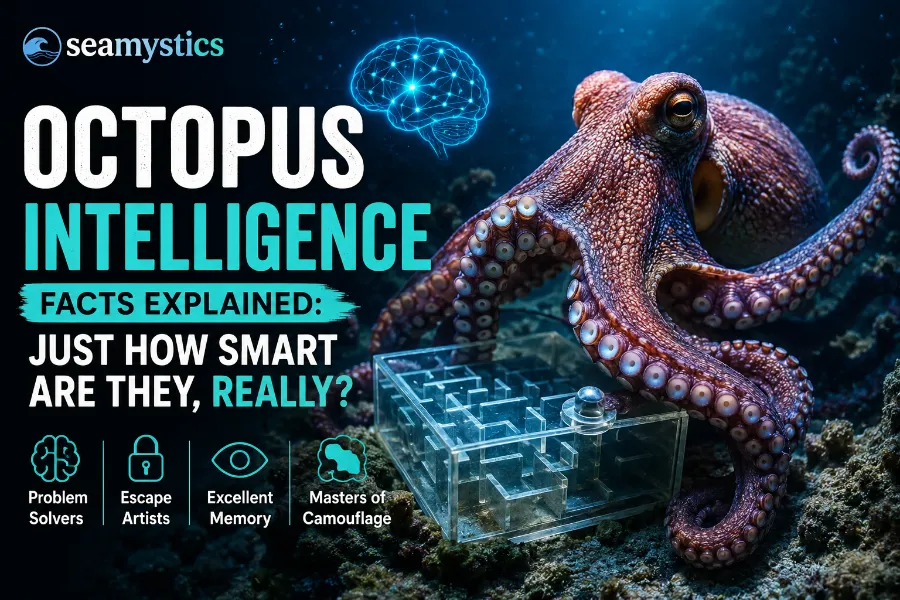

An octopus once took apart a camera inside its own tank just to see how it worked. Keepers at more than one aquarium have watched octopuses unscrew jar lids from the inside, squeeze through gaps smaller than a coin, and even short circuit lights by squirting water at them on purpose. These are not one off tricks. They are small windows into one of the strangest and most studied cases of animal intelligence on the planet. Octopus intelligence facts explained through real science show a creature that thinks in a way nothing else on Earth does, and marine biologists are still catching up with what these animals can actually do.
If you want to learn more about Write what weird ocean creatures facts out our detailed guide for practical tips and expert advice.
This guide breaks down what current research says about octopus brains, memory, and problem solving. It also looks at how their minds compare with dolphins, crows, and other famous animal thinkers, and why understanding ocean life like this matters for conservation and even robotics.
If you want to learn more about Write what anglerfish facts deep sea out our detailed guide for practical tips and expert advice.
If you want to learn more about Write what giant squid facts revealedout our detailed guide for practical tips and expert advice.
Key Takeaways
| Fact | Detail |
|---|---|
| Neuron count | Around 500 million neurons, with nearly two thirds spread through the arms, not the brain |
| Arm behavior | A September 2025 study tracked almost 7,000 arm movements across 25 wild octopuses in six habitats |
| Tool use | Coconut octopuses carry shell halves for shelter, first documented by Finn and colleagues in 2009 |
| Genetics | Octopuses share active “jumping gene” activity with humans, tied to learning and brain flexibility |
| Escape skill | An octopus named Inky escaped a New Zealand aquarium tank in 2016 through a small drainpipe |
| Lifespan | Most octopus species live only one to two years, yet still learn complex tasks quickly |
What Makes Octopus Intelligence So Unique
Octopus intelligence facts explained by scientists usually start in one place, the nervous system. Unlike humans and most animals, an octopus does not run its body from one central command center. Instead, it spreads its thinking power across its entire body, which changes everything about how it experiences the world.
If you want to learn more about out blobfish facts deep seaour detailed guide for practical tips and expert advice.
This setup sounds strange, but it works. Because so much processing happens locally in the arms, an octopus can react to its surroundings in a split second, even if its brain is focused elsewhere. Ocean life rarely produces a nervous system this unusual, which is exactly why researchers keep returning to this animal.
If you want to learn more about Write what octopus intelligence facts explained out our detailed guide for practical tips and expert advice.
A Brain Spread Across Eight Arms
The common octopus carries roughly 500 million neurons in total, and close to two thirds of them sit inside the arms rather than the central brain. Each arm can taste, touch, and even make basic decisions on its own, almost like eight small brains working alongside one main one.
To get a better understanding of how jellyfish facts ocean life breaks down exactly what to expect.
A landmark study published in Scientific Reports in September 2025 gave the clearest picture yet of this system. Researchers filmed 25 wild octopuses across six shallow water habitats and analyzed nearly 7,000 separate arm movements. They found that front arms mostly handle exploring and searching for food, while back arms focus on crawling and movement, yet every arm still keeps the flexibility to do either job when needed.
If you want to learn more about out vampire squid facts explained detailed guide for practical tips and expert advice.
This kind of distributed control means an octopus can literally think with its limbs. If one arm grabs a crab, it does not need to wait for a signal from the brain to start reacting. That alone puts octopus cognition in a category that few other animals share.
To get a better understanding of how seahorse facts ocean life breaks down exactly what to expect.
Jumping Genes and Rapid Learning
Genetics adds another twist. In 2022, researchers led by scientists from the Stazione Zoologica Anton Dohrn in Naples found that octopuses carry highly active transposons, often called jumping genes, in brain regions linked to behavioral flexibility. Humans carry similar genetic elements tied to learning and memory.
This does not mTo get a better understanding of how colorful sea slug species facts breaks down exactly what to expect.ean octopuses think like people. It does suggest that both species arrived at a similar genetic trick for building adaptable brains, even though octopuses and humans split onto separate evolutionary paths more than 500 million years ago. That kind of convergence is rare, and it is one reason marine life researchers describe octopus minds as almost alien yet oddly familiar at the same time.
Octopus Intelligence Facts Explained Through Real Experiments
Lab and field studies give the strongest proof of octopus smarts, since watching real behavior avoids guesswork. Several classic and recent experiments show these animals solving problems that once seemed limited to birds and mammals.
Below is a quick look at some of the most cited examples researchers point to when discussing cephalopod cognition.
| Behavior | Example | Year | Source Type |
|---|---|---|---|
| Tool use | Coconut octopuses carrying shell halves for later shelter | 2009 | Peer reviewed study, Finn et al. |
| Escape and navigation | Inky the octopus escaped a tank through a drainpipe into the ocean | 2016 | National Aquarium of New Zealand |
| Object manipulation | Otto the octopus repeatedly shorted out aquarium lights with water jets | 2008 | Sea Star Aquarium, Germany |
| Distributed decision making | Arm specific roles documented in wild octopuses | 2025 | Scientific Reports |
Tool Use in the Wild
One of the strongest pieces of evidence for octopus intelligence comes from tool use, a trait once thought to belong mostly to primates and a handful of birds. In 2009, marine biologist Julian Finn and his team documented veined octopuses carrying coconut shell halves across the seafloor, then assembling them into a shelter later on.
This behavior matters because the octopus was not using the shell in the moment. It was planning ahead, carrying a tool for future use, which is a more advanced form of thinking than simple reflex or instinct. According to the Compassion in World Farming overview of octopus cognition, this kind of forward planning places octopuses among a small group of animals known to prepare tools before they need them.
Escape Artists and Problem Solvers
Octopus escape stories are not internet myths, they are well documented events. In April 2016, an octopus named Inky slipped out of his tank at the National Aquarium of New Zealand overnight, squeezed through a small gap, and traveled through a drainpipe back into the ocean.
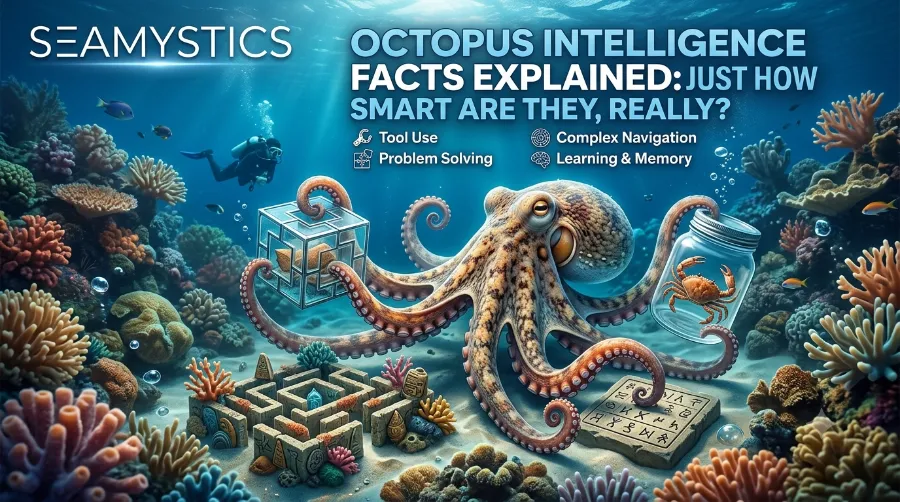
Aquarium staff confirmed the escape happened because Inky found an unsecured gap at the top of his tank. Since octopuses have no rigid skeleton, they can squeeze through any opening larger than their beak, the only hard part of their body. Similar escape and puzzle solving behavior has been recorded at aquariums in Germany, the United States, and the United Kingdom, and the Seattle Aquarium’s own research page lists jar opening and maze solving as standard tests keepers use to study octopus learning.
A few well documented problem solving skills include the following.
- Opening childproof jars from the inside to reach food
- Learning to associate colors or shapes with rewards after repeated trials
- Recognizing individual human caretakers and reacting differently to strangers
- Squeezing through gaps as small as their beak, which is roughly the size of a parrot’s beak
Ocean Life Comparisons: Octopus vs Other Smart Animals
Understanding where octopuses fit among ocean life and the wider animal kingdom helps put their intelligence in context. Comparing them with dolphins and crows shows both similarities and sharp differences in how intelligence can evolve.
Dolphins rely on social learning, cooperation, and long term memory built through group living. Crows use tools and can plan several steps ahead, often within family groups that pass down knowledge. Octopuses do almost none of this socially, since most species live alone and never meet their own parents.
That solitary lifestyle makes their intelligence even more surprising. Without a group to learn from, each octopus has to figure things out largely on its own, often within a lifespan of only one to two years. For context, if you enjoy learning about other strange ocean life with unusual biology, our guide to weird ocean creatures covers several more examples worth exploring.
Quick Comparison Table
| Trait | Octopus | Dolphin | Crow |
|---|---|---|---|
| Brain structure | Distributed, arms hold two thirds of neurons | Centralized, large forebrain | Centralized, dense forebrain |
| Social learning | Rare, mostly solitary | High, strong group bonds | High, family based teaching |
| Tool use | Documented, shell carrying | Documented, sponge use for foraging | Documented, stick tool crafting |
| Typical lifespan | 1 to 2 years for most species | 20 to 45 years | 10 to 15 years in the wild |
| Memory type | Short and medium term, arm level and brain level | Long term, social memory | Long term, cross season memory |
How Scientists Test Octopus Intelligence
Researchers rely on a handful of trusted methods to measure cognition in octopuses, since these animals cannot be tested with the same tools used for primates. Most studies combine lab experiments with careful field observation to avoid drawing conclusions from a single behavior.
Common testing methods include the following steps.
- Maze tests, where an octopus must navigate a path to reach food
- Jar opening tasks, which measure manual dexterity and persistence
- Color and shape association trials, which test memory and learning speed
- Camera and video tracking of wild arm movement, as used in the 2025 Scientific Reports study
- Mirror and self recognition trials, though results here remain mixed and debated among scientists
These octopus intelligence facts explained through structured testing give researchers a clearer, repeatable way to compare results across species and locations. Without this structure, claims about animal intelligence tend to rely too heavily on anecdotes.
Why Octopus Intelligence Matters Beyond Marine Biology
Octopus cognition is not just an academic curiosity anymore. Engineers now study octopus arm control to design soft robots that can bend, grip, and squeeze through gaps the way a real arm does. Several robotics labs have already built prototype grippers based on octopus arm mechanics for use in search and rescue work.
Conservation groups also use octopus intelligence findings to argue for better welfare standards in fishing and aquaculture. Because these animals show clear signs of memory, problem solving, and even apparent stress responses, several countries in Europe have added legal protections for cephalopods in research settings.
If you want to explore another deep sea creature with equally strange biology, our detailed piece on anglerfish facts from the deep sea shows how different evolutionary paths can lead to very different survival strategies.
Common Questions About Octopus Intelligence
Are octopuses smarter than dogs?
It depends on the measure used. Octopuses often outperform dogs on certain puzzle and manipulation tasks, but dogs show stronger social intelligence and long term bonding, so a direct ranking is not really fair to either species.
Do octopuses feel pain or emotions?
Most marine biologists agree octopuses show behavior consistent with stress and possibly discomfort, which is part of why the European Union now includes cephalopods under certain animal welfare research rules.
How long does an octopus remember something it learned?
Lab studies show octopuses can retain learned tasks for at least several weeks, and some evidence suggests longer retention depending on the species and the complexity of the task.
Why do octopuses die so young if they are this intelligent?
Most species live only one to two years because of their reproductive biology, not because of any limit on their brain power, so their short lifespan and high intelligence exist somewhat independently of each other.
Can octopuses recognize individual people?
Yes, several aquarium studies and keeper reports describe octopuses reacting differently to familiar staff compared with strangers, often squirting water only at people they seem to dislike.
Conclusion
Octopus intelligence facts explained through real research paint a picture of an animal that thinks in a completely different way from almost everything else alive today. From arms that make their own decisions to genetics that echo human learning systems, these creatures challenge simple ideas about what counts as smart. As research continues, ocean life like the octopus keeps reminding scientists that intelligence can take far more shapes than we once assumed, and there is likely much more still waiting to be discovered beneath the surface.
References
- Compassion in World Farming, The Incredible Intelligence of Octopuses, https://www.ciwf.com/media-and-news/blog/the-incredible-intelligence-of-octopuses/
- Seattle Aquarium, Facts About Octopus, https://scaquarium.org/blog/posts/facts-about-octopus
- Finn, J. K., Tregenza, T., and Norman, M. D., Defensive tool use in a coconut carrying octopus, Current Biology, 2009
- Scientific Reports, arm specific behavior study in wild octopuses, September 2025
- Nature, Do octopus brains work like humans, or is there another way to be smart, 2026