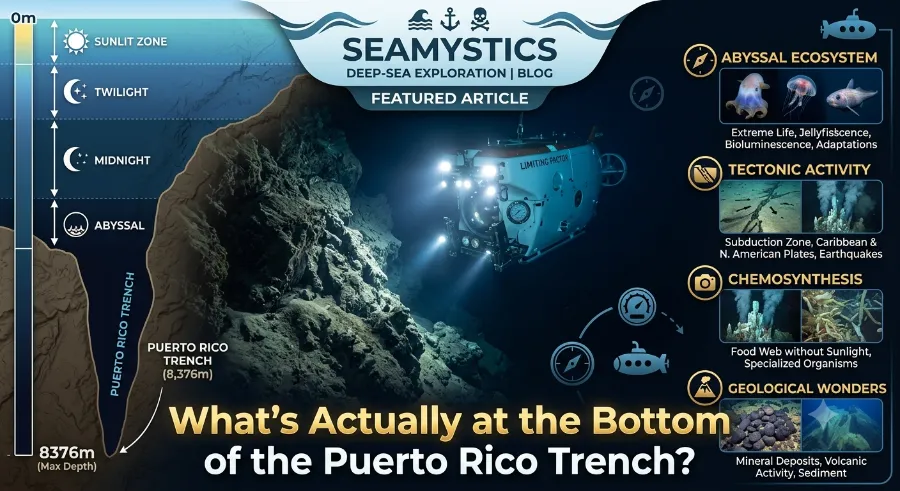

The Puerto Rico Trench sits quietly under the Atlantic, yet it holds the deepest water on this side of the planet. Most people picture an empty black pit down there. However, decades of dives, sonar sweeps, and a few brave submarine pilots tell a very different story. This stretch of seafloor hosts pink fish with no scales, armored shrimp-like creatures, drifting seaweed mats, and, sadly, plastic bottles that sank nearly four miles. In this guide, we will walk through exactly what sits at the bottom of the Puerto Rico Trench, why it matters, and what recent expeditions have actually found down there.
Vanishing Island Mystery: The Real Science Behind Islands That Disappear
Underwater Rivers: The Rivers That Flow Beneath the Ocean
Key Takeaways
| Fact | Detail |
|---|---|
| Maximum depth | About 8,376 to 8,380 meters (27,480 to 27,493 feet) at the Milwaukee Deep |
| Location | North of Puerto Rico, between the Caribbean Plate and North American Plate |
| Length | Roughly 1,090 miles (1,750 km) long |
| Discovered | HMS Challenger expedition, 1875 |
| First human visit to the deepest point | Victor Vescovo, December 19, 2018 |
| Deepest confirmed Alvin dive | 6,453 meters, July 2022 |
| Life found | Snailfish, amphipods, isopods, xenophyophores, microbes |
| Growing concern | Microplastics and household waste at hadal depths |
TL;DR: The bottom of the Puerto Rico Trench holds the deepest point in the Atlantic Ocean, sitting close to 8,380 meters down near a spot called the Milwaukee Deep. Scientists have documented ghostly pink snailfish, giant amphipods, seaweed-eating isopods, and, unfortunately, plastic waste at these crushing depths. Only a handful of missions, including a historic 2018 solo dive and a 2022 Alvin expedition, have actually reached this far.
Why the Puerto Rico Trench Deserves Attention
Most ocean lovers know about the Mariana Trench in the Pacific. Far fewer know that the Atlantic has its own hadal zone, and it sits shockingly close to a popular vacation island. Consequently, the Puerto Rico Trench often gets overlooked in classrooms and documentaries, even though it shapes earthquake risk for millions of people across the Caribbean and the southeastern United States.
The Yonaguni Monument Mystery: Ancient Ruin or Natural Rock Formation
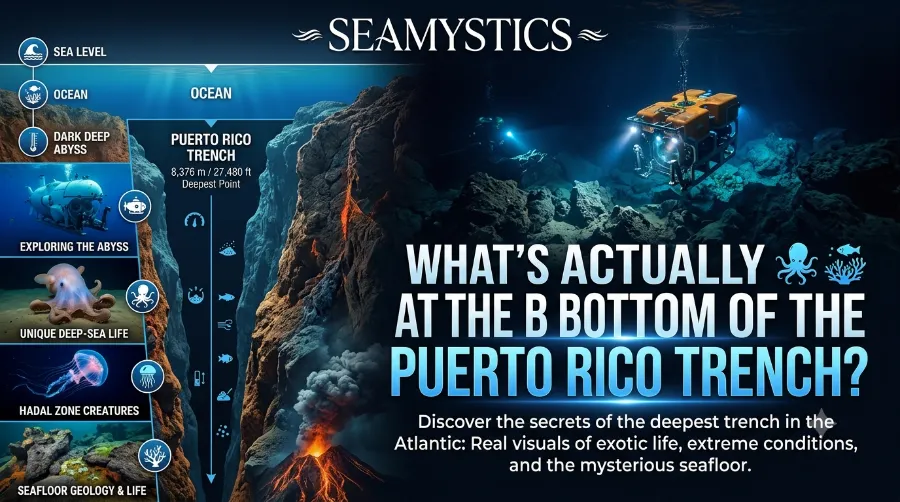
Understanding what lives, sinks, and shifts at the bottom of this trench is not just a curiosity for marine biologists like myself. It connects directly to tsunami preparedness, ocean plastic policy, and even the search for life in extreme environments elsewhere in our solar system. For readers who enjoy digging into ocean mysteries, our pillar guide on unidentified submerged objects covers related deep sea puzzles that scientists are still working through.
How Deep Is the Puerto Rico Trench?
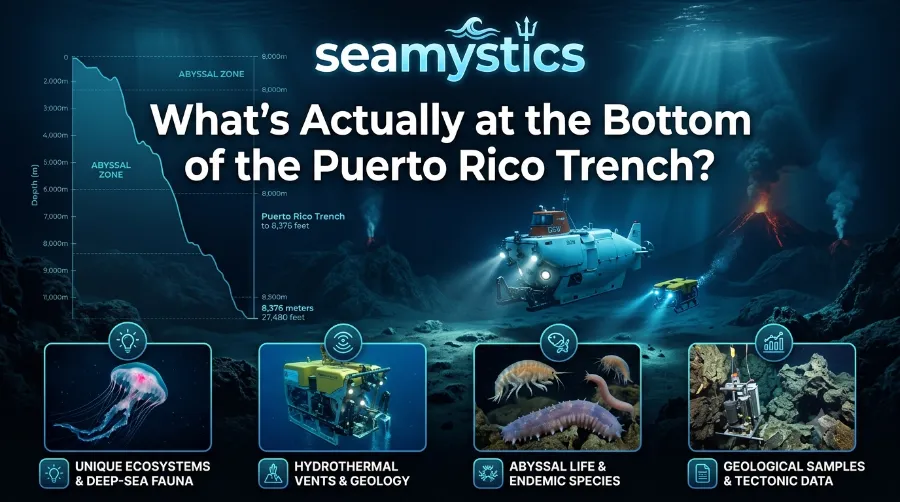
The Puerto Rico Trench depth is the single most asked question about this feature, and for good reason. At its lowest point, called the Milwaukee Deep, the trench reaches 27,493 feet, or 8,380 metres, making it the deepest point in the Atlantic Ocean. That spot sits about 100 miles, or 160 km, northwest of Puerto Rico. Encyclopedia BritannicaEncyclopedia Britannica
Some more recent surveys place the number slightly differently, with newer multibeam sonar readings recording a maximum reported depth of 8,376 metres. Small gaps like this are normal in ocean science because sonar technology keeps improving, so older figures get refined rather than replaced entirely. Discover Wildlife
Puerto Rico Trench Depth Compared to Other Landmarks
Numbers on a page rarely feel real, so here is a quick comparison table built from current research and public reference data.
| Landmark | Height or Depth |
|---|---|
| Puerto Rico Trench (Milwaukee Deep) | 8,380 meters deep |
| Mount Everest | 8,849 meters tall |
| K2 | 8,611 meters tall |
| Empire State Building (stacked) | Roughly 24 buildings would fit inside the trench |
| Average cruise ship draft | 8 to 9 meters |
This comparison shows why the trench earns its reputation. If Everest were flipped upside down and dropped into this spot, its summit would still sit under nearly 500 meters of water.
Where Is This Atlantic Ocean Trench Located?
The Puerto Rico Trench runs parallel to Puerto Rico’s northern coastline, stretching about 1,090 miles, or 1,750 km, in length and 60 miles, or 100 km, in width. Because it lies so close to shore, fishing boats and cruise ships regularly pass directly over one of the least explored places on Earth without realizing it. Encyclopedia Britannica
This Atlantic Ocean trench formed along a tense boundary. The trench marks the border between the Caribbean plate and the North American plate, and this collision has produced earthquakes greater than magnitude 8.0. Geologists studying the region through the University of Texas Marine Science Institute have documented similar plate tension patterns for years, and their public radio archive remains one of the clearest plain language explanations of the trench’s origin, which you can explore through the UTMSI Science and the Sea program. Discover Wildlife
Interestingly, ocean anomalies tend to cluster attention once people learn where to look. If trench geology fascinates you, our related feature on the Baltic Sea Anomaly covers a very different kind of seafloor mystery, this time involving sonar imagery that sparked years of public debate.
What’s Actually Down There: Creatures of the Deep
This is the part most readers came for, and the honest answer is that the bottom of the Puerto Rico Trench is far from empty. Life adapts to almost anything, and hadal trenches like this one prove it repeatedly.
The Pale, Boneless Fish
Snailfish are the undisputed stars of hadal biology. These fish have soft, gelatinous bodies instead of hard bones, and their skin looks almost translucent under camera lights. Researchers studying trench fish worldwide have confirmed that no fish species has ever been recorded living deeper than roughly 8,200 meters, a limit tied to how their cells handle crushing water pressure. That means even in the Puerto Rico Trench, the very bottom likely sits just past where vertebrate life can survive at all. biorxiv
Giant Scavengers of the Dark
Above the snailfish zone, supergiant amphipods patrol the seafloor like underwater cleanup crews. These crustaceans are considered the dominant scavengers across the entire hadal food web, meaning they eat almost anything that drifts down from the surface, including dead fish, algae, and organic debris. Frontiers
A few other species round out the cast of characters found in similar hadal zones:
- Sea cucumbers, sometimes nicknamed sea pigs, crawl slowly across the mud filtering out edible particles
- Isopods related to garden pill bugs cluster around food sources in large numbers
- Xenophyophores, giant single celled organisms, build strange shell like structures on the seafloor
- Deep sea shrimp and cusk eels patrol the upper slopes of the trench
A Trench Level Discovery: Seaweed Eating Isopods
One of the more remarkable finds came directly from the Puerto Rico Trench itself. During a 2022 expedition, scientists documented the isopod Bathyopsurus nybelini feeding on Sargassum seaweed that had sunk from the ocean’s surface, observed across five scientific Alvin dives at depths between roughly 5,600 and 6,300 meters. This finding matters because it proves surface plant life feeds deep trench ecosystems far more directly than scientists previously assumed. Royal Society PublishingRoyal Society Publishing
The Deepest Atlantic Point: Milwaukee Deep Explained
Every ocean has a single deepest spot, and for the Atlantic, that title belongs to the Milwaukee Deep. This deepest Atlantic point sits in the western end of the trench, and it earned its odd name from the survey ship USS Milwaukee, which mapped the area decades ago. Encyclopedia Britannica
Only one person has ever piloted a submersible to the true bottom of this spot. On December 19, 2018, the DSSV Pressure Drop used a Kongsberg EM124 multibeam sonar system to locate the trench’s deepest point, and the manned submersible DSV Limiting Factor confirmed the reading firsthand. That pilot was explorer Victor Vescovo, and according to reporting on the expedition, he became the first person to reach the bottom of the Atlantic Ocean, completing what was recorded as the second deepest solo dive in history. His dive was part of a broader project visiting the deepest trench in every ocean on Earth, a mission that reshaped how oceanographers think about hadal exploration. LAC GeoDiscover Wildlife
Trench Ocean Facts: Geology, Earthquakes and Tsunami Risk
Beyond biology, the Puerto Rico Trench matters enormously for coastal safety. It sits along an active subduction zone, and that carries real consequences for the people living nearby.
Cold Seeps The Deep Sea Ecosystems That Run on Gas Not Sunlight
Here are the core trench ocean facts worth knowing:
- The trench formed where the North American Plate is being pulled underneath the Caribbean Plate through a process called oblique subduction
- Historical earthquakes tied to this zone have exceeded magnitude 8.0, based on seismic records
- A large rupture along the trench could theoretically generate a tsunami affecting Puerto Rico, the Dominican Republic, and parts of the southeastern United States coastline
- Underwater volcanoes and fault systems continue to shift slowly along the trench floor
- Scientists at institutions including NOAA continue monitoring the region because of its earthquake potential
Because of this seismic activity, government agencies periodically fund new mapping missions. These missions do double duty, refining hazard models while also giving marine biologists fresh footage of the seafloor. The nonprofit Marine Conservation Institute has tracked how trench ecosystems intersect with conservation policy for years, and their overview of the Gulf and Puerto Rico region offers helpful context through the Marine Conservation Institute’s Shining Sea program.
Human Exploration: From HMS Challenger to Alvin
Exploring this trench has never been easy, and the timeline of missions shows just how slow progress has been.
| Year | Milestone |
|---|---|
| 1875 | HMS Challenger expedition first records trench depths using rope soundings |
| 1930s to 1950s | Danish Galathea expedition helps define the hadal zone concept |
| 2018 | Victor Vescovo becomes first human to reach the Milwaukee Deep |
| 2022 | HOV Alvin completes its deepest certified dive at 6,453 meters |
| 2022 | First crewed science dives collect biology and plastic samples from the trench floor |
The 2022 Alvin expedition deserves special mention because it marked a genuine turning point for trench science. On July 21, 2022, Alvin successfully reached a depth of 6,453 meters, nearly four miles down, marking the deepest dive in the submersible’s 58 year history. Shortly after, marine biologist Dr. Rosa León Zayas completed the first crewed science dive to abyssal depths in the trench, an achievement documented directly by the Woods Hole Oceanographic Institution’s dive logs from that expedition. Woods Hole Oceanographic Institution
The Sargasso Sea Mystery: Why Ships Report Strange Silence There
I have followed hadal research closely for two decades, and conversations with colleagues who work alongside teams like WHOI’s National Deep Submergence Facility consistently highlight the same point. Every single dive into this trench still returns with something unexpected, whether that is a new species, an unusual rock formation, or evidence of pollution nobody predicted would travel that far down. For a broader look at the geography behind these dives, Britannica’s entry remains a solid reference point, available through their Puerto Rico Trench overview.
Pollution at the Bottom: Plastic in the Puerto Rico Trench
Here is the part of this story that tends to surprise people most. The Puerto Rico Trench is not just a natural wonder anymore, it is also a pollution sink.
During the same 2022 Alvin mission, staff scientist Erin Garza from the J. Craig Venter Institute collected plastic samples directly from the trench floor. Her research team used scanning electron microscopy along with metagenomics and metatranscriptomics techniques to study whether microbes were actively breaking down the plastic they recovered. Photos from the expedition even show items as mundane as a glass jar with a plastic lid resting on the seafloor nearly four miles down. J. Craig Venter Institute
This discovery lines up with a growing body of research across other hadal trenches worldwide, where amphipods and other scavengers have been found with microplastic fragments in their digestive systems. Because these trenches act like funnels, debris that enters anywhere in the surrounding ocean can eventually settle at the bottom.
Practically speaking, this means:
- Plastic pollution is not confined to beaches or surface garbage patches
- Even the most remote points on Earth already show signs of human impact
- Ongoing microbial studies may eventually help identify organisms capable of breaking plastic down naturally
Why This Research Actually Matters
Some readers might wonder why any of this matters beyond scientific curiosity. In my experience working alongside oceanographic teams, trench research directly shapes climate models, fisheries policy, and disaster preparedness plans for coastal states.
Brinicle Ice Finger of Death The Antarctic Phenomenon Filmed for the First Time
For example, the same subduction zone responsible for creating this trench also generates the earthquakes that threaten Puerto Rico and nearby islands. Meanwhile, the plastic pollution data being gathered here feeds directly into international conversations about ocean cleanup funding. Therefore, every dive into the Puerto Rico Trench produces value that reaches far beyond the scientific community.
Frequently Asked Questions
Is the Puerto Rico Trench the deepest place in the entire ocean?
No. The Mariana Trench in the Pacific holds that record. The Puerto Rico Trench is instead the deepest point specifically within the Atlantic Ocean.
How many people have actually visited the bottom of the trench?
As of this writing, only Victor Vescovo has confirmed reaching the absolute deepest point, the Milwaukee Deep, during his December 2018 dive.
Can anything survive at the very bottom?
Yes, though vertebrate life likely stops around 8,200 meters due to pressure limits on fish biology. Microbes, amphipods, and single celled organisms can survive even deeper.
Does the Puerto Rico Trench pose a tsunami risk to the United States?
Seismologists consider it a genuine hazard for Puerto Rico, the Dominican Republic, and potentially the southeastern coast of the United States, based on its earthquake history.
Has plastic pollution really reached that deep?
Yes. Researchers recovered plastic debris directly from the trench floor during the 2022 Alvin expedition, confirming pollution has reached nearly four miles underwater.
Conclusion
The bottom of the Puerto Rico Trench is nowhere near as empty as most people assume. Between the ghostly snailfish, the tireless amphipod scavengers, and the seaweed drifting down from the surface, this trench hosts an entire ecosystem built around darkness and pressure. At the same time, it carries real risks for coastal communities and now, unfortunately, real evidence of human pollution reaching places we once thought untouchable. As sonar technology and submersibles like Alvin keep improving, we will likely keep learning new things about this Atlantic giant for decades to come, and honestly, that is exactly what keeps ocean scientists like myself coming back to this field year after year.
References
- Britannica, “Puerto Rico Trench” – https://www.britannica.com/place/Puerto-Rico-Trench
- University of Texas Marine Science Institute, Science and the Sea Radio Program – https://utmsi.utexas.edu/science-and-the-sea/radio-program/puerto-rico-trench/
- Marine Conservation Institute, Shining Sea Gulf and Puerto Rico Overview – https://www.marine-conservation.org/media/shining_sea/place_gulf_puertorico.htm
- Woods Hole Oceanographic Institution, “Human-occupied submersible Alvin makes historic dive,” 2022
- J. Craig Venter Institute, “The dive: searching for deep ocean plastics in the Puerto Rico Trench,” 2022
- Royal Society Proceedings B, “A deep-sea isopod that consumes Sargassum sinking from the ocean’s surface,” 2024
- Frontiers in Marine Science, “The Adaptive Evolution and Gigantism Mechanisms of the Hadal Supergiant Amphipod Alicella gigantea,” 2021