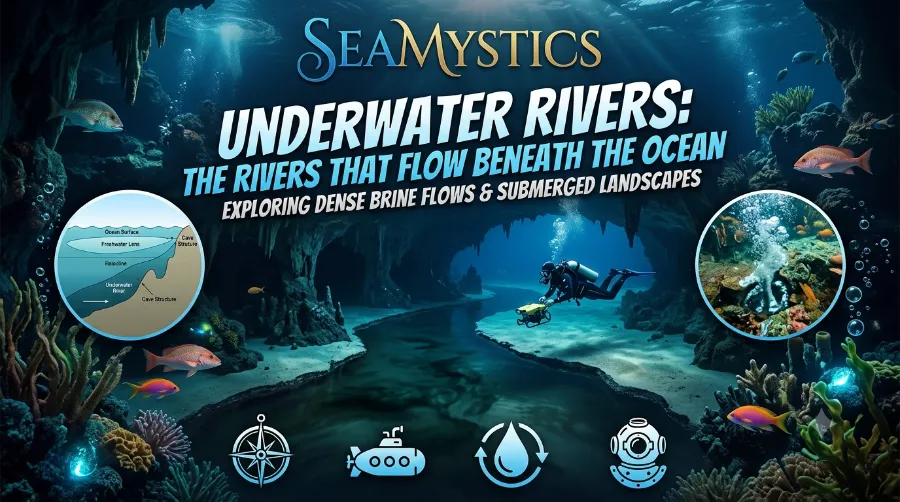

Picture a river with banks, waterfalls, and rapids, except it sits at the bottom of the sea, hidden under tons of saltwater. That is not a scene from a fantasy film. It is the underwater river mystery that has puzzled divers, geologists, and ocean explorers for years, and it is very real. From the ghostly waters of Cenote Angelita in Mexico to a massive salt current beneath the Bosphorus Strait, these hidden waterways prove that our oceans still hide secrets we are only beginning to understand.
Vanishing Island Mystery: The Real Science Behind Islands That Disappear
Underwater Rivers: The Rivers That Flow Beneath the Ocean
Key Takeaways
| Fact | Detail |
|---|---|
| What it really is | A dense layer of salty or gas filled water flowing along the ocean floor, not an actual freshwater river |
| Most famous example | Cenote Angelita in Mexico, discovered by divers and made famous by photographer Anatoly Beloshchin in 2013 |
| Largest confirmed one | The Black Sea undersea river below the Bosphorus, found by University of Leeds scientists in 2010 |
| Size comparison | If placed on land, the Black Sea underwater river would rank as the sixth largest river on Earth |
| Flow speed | About four miles per hour, carrying roughly 22,000 cubic metres of water every second |
| Danger level | Brine pool rivers can kill fish, crabs, and other creatures within minutes due to extreme salt content |
TL;DR: Underwater rivers are not freshwater streams running through the sea. They form when salty, oxygen poor, or gas filled water sinks and flows along the ocean or cenote floor because it is denser than the water above it. The most studied examples sit in Mexico’s Cenote Angelita, the Gulf of Mexico’s brine pools, and the Black Sea, where scientists confirmed a genuine undersea river system in 2010.
The Yonaguni Monument Mystery: Ancient Ruin or Natural Rock Formation?
What Is an Underwater River, Really?
The term sounds like something out of a monster movie, and honestly, the first time I saw footage of one during a research trip briefing, I understood why divers get spooked by it. However, the science behind it is grounded and fairly straightforward once you break it down.
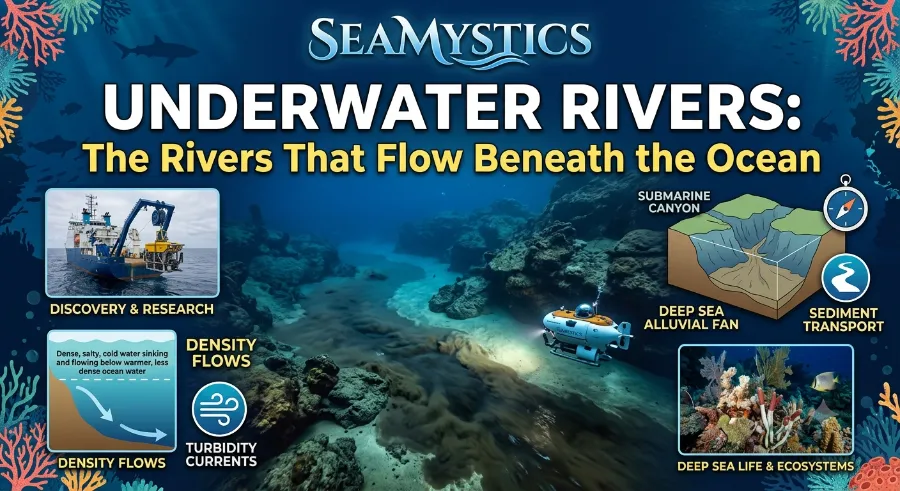
An underwater river forms when a layer of water becomes denser than the water surrounding it, usually because of higher salt content, dissolved gas, or sediment. Because of this density difference, the heavier water sinks and hugs the ocean floor instead of mixing with the lighter water above. As a result, it creates a visible flow that behaves almost exactly like a surface river, complete with banks, curves, and even small waterfalls.
The Sargasso Sea Mystery: Why Ships Report Strange Silence There
How Underwater Rivers Form
Three main ingredients cause this phenomenon, and understanding them clears up most of the underwater river mystery right away.
- Salinity differences. Salt water is heavier than fresh water, so when the two meet, the saltier layer sinks and creates a distinct flow beneath the fresher water.
- Gas layers. Hydrogen sulfide, released by decomposing plant matter, can form a thick cloud that settles at a specific depth and looks like a flowing river.
- Temperature and pressure. Cold, dense water sinks below warmer water, and this movement can carve channels along the seabed over thousands of years.
-
Cold Seeps The Deep Sea Ecosystems That Run on Gas Not Sunlight
Because these forces work quietly and out of sight, most people never realize such systems exist. Meanwhile, scientists have only mapped a small fraction of the ocean floor, so more of these hidden currents likely remain undiscovered.
Underwater River Mexico: The Cenote Angelita Story
If you search for real footage of an underwater river, chances are the first video that pops up is from Cenote Angelita, located about 10 to 15 minutes south of Tulum in Mexico. This site has become the poster child for the underwater river mystery, and for good reason.
Cenote Angelita River Explained
At around 30 meters below the surface, divers reach a thick, misty layer of hydrogen sulfide roughly 2 to 3 meters thick, formed by decades of decomposing leaves and branches that fell into the sinkhole. This cloud sits directly on top of the halocline, the point where fresh water above meets salt water below. Consequently, the scene looks exactly like a river winding through a forest, complete with fallen tree trunks acting as riverbanks.
Brinicle Ice Finger of Death The Antarctic Phenomenon Filmed for the First Time
In fact, the cenote itself descends close to 60 meters, and the water below the gas layer turns crystal clear again, this time with an eerie amber tint. Photographer Anatoly Beloshchin captured this scene in 2013, and his images went viral, introducing millions of people to the term “underwater river” for the first time. Even so, geologists are quick to clarify that this is technically a halocline effect rather than a true flowing current, since the water does not travel from one point to another the way a real river does.
What Divers Experience
Ask any diver who has been there, and they will tell you it feels less like scuba diving and more like flying above a foggy valley. Visibility drops to almost nothing while passing through the hydrogen sulfide layer, and then it clears again once divers descend past it. This dramatic shift is one reason Cenote Angelita ranks among the most requested dive sites in the Yucatan Peninsula, alongside other unexplained ocean phenomena covered in our guide to unidentified submerged objects.
Because the cave has no connection to nearby cenotes, the gas layer stays trapped and does not disperse the way it might in open water. This isolation is exactly what keeps the illusion of a river so intact, year after year.
The Bermuda Triangle What Ocean Science Actually Says
Brine Pool River: Nature’s Deadliest Underwater Lakes
While Cenote Angelita gets most of the attention, the Gulf of Mexico hides something even stranger, brine pools that behave like lakes and rivers at the bottom of the sea. NOAA researchers first documented one of these formations in detail during their 2014 and 2017 expeditions, and the footage still surprises marine biologists today.
How Brine Pools Form
Brine pools form when ancient salt deposits, left behind from a sea that evaporated millions of years ago during the Jurassic period, dissolve into the surrounding seawater. This creates a fluid so dense and salty that it refuses to mix with normal seawater, so it pools and even ripples like a lake with a shoreline, despite sitting more than 650 feet underwater. According to NOAA Ocean Exploration, one brine pool discovered during a 2018 expedition even produced a visible “brine waterfall,” where dense fluid poured over a ledge on the seafloor. NOAA Ocean Exploration
Real Discoveries in the Gulf of Mexico
Here are a few documented cases that show just how strange these formations can get.
- In 2014, NOAA’s Okeanos Explorer team mapped a brine pool about 32 feet wide and 328 feet long, surrounded by tubeworms, anemones, and crustaceans that had adapted to live at its edges. Fox News
- In 2015, researchers investigating cold seeps nicknamed one particularly toxic pool the “Hot Tub of Despair” after finding it littered with the pickled remains of crabs and amphipods that had wandered in and never left.
- In 2017, a new brine pool was documented and later featured in NOAA’s photo contest, described by the agency as “essentially an underwater lake” that flows along the seafloor because brine is denser than the seawater around it. NOAA Ocean Exploration
These pools rarely allow any life to survive inside them, yet the mussel beds and tubeworm colonies that ring their edges show how even the harshest underwater environments can support unique ecosystems. This mix of danger and biological richness is part of what makes ocean mysteries like the Puerto Rico Trench so fascinating to study.
Submarine River Facts: The Black Sea’s Hidden Giant
Out of every underwater river ever studied, none compares in scale to the one discovered beneath the Black Sea. This is the case that finally convinced skeptical scientists that submarine rivers were not just an optical illusion caused by gas clouds, but genuine, measurable currents.
Leeds University Discovery (2010)
On August 1, 2010, a team led by Dr. Jeff Peakall and Dr. Dan Parsons from the University of Leeds announced they had confirmed a true underwater river flowing through the Bosphorus Strait and along the floor of the Black Sea. Working with scientists from the University of Southampton, Memorial University of Newfoundland, and Turkey’s Institute of Marine Sciences, the team used a torpedo shaped autonomous submarine named Autosub3 to track the current directly. As Dr. Parsons explained to Hydro International, “The water in the channels is denser than the surrounding seawater because it has higher salinity and is carrying so much sediment.” Hydro International
This discovery mattered because scientists had only ever detected channel like features on the seafloor through sonar, without proof that water was actually flowing through them the way a surface river does. The Black Sea study changed that, confirming actual banks, floodplains, and even rapids and waterfalls underwater, features nobody expected to find below the surface.
Numbers That Prove It’s a Real River
The measurements from this discovery are what turned a theory into a documented fact, and they remain some of the most cited submarine river facts in ocean science today.
| Measurement | Figure |
|---|---|
| Length | About 60 kilometers (37 miles) |
| Depth | Up to 35 meters (115 feet) |
| Width | Roughly 1 kilometer (0.6 miles) |
| Flow speed | Around 4 miles per hour |
| Water volume | Approximately 22,000 cubic metres per second |
| World rank if on land | Sixth largest river on Earth |
| Water carried compared to the Rhine | Ten times more |
What makes this river even stranger is its behavior around bends. On land, rivers curve in one rotational direction because of the way water interacts with gravity and the riverbed. Underwater, though, this current spins in the opposite direction, a detail researchers only confirmed once Autosub3 mapped the flow in three dimensions.
Since 2008, at least three separate research cruises have returned to the Black Sea channels to study how these currents move sediment and nutrients across the ocean floor. According to a report published by researchers at the University of Leeds, these channels act like delivery systems, carrying food and minerals out to the abyssal plain the same way rivers feed floodplains on land.
Other Underwater Rivers and Ocean Mysteries Worth Knowing
The Black Sea and Cenote Angelita are not isolated cases. Similar density driven currents have been mapped near the mouth of the Amazon River, where sediment rich water sinks into a channel on the Atlantic seafloor, and researchers suspect many more remain unmapped in deep ocean trenches. If underwater rivers intrigue you, you will probably enjoy digging into other unexplained oceanic sites too, including the Baltic Sea Anomaly, a strange rock like formation that has fueled debate for over a decade, or the Yonaguni Monument, an underwater rock structure off the coast of Japan that some believe shows signs of ancient construction.
For readers who enjoy travel focused storytelling around these locations, Wanderlust Magazine has also covered the visual side of underwater rivers in detail, which pairs well with the more scientific angle we take here at Sea Mystics. Similarly, FDC’s roundup of global underwater mysteries offers a broader look at how these formations fit into the wider picture of ocean exploration.
Underwater River Mystery Data: A Quick Comparison
To put these formations side by side, here is a simple comparison chart based on the latest confirmed research and expedition data.
| Location | Type | Depth | Notable Feature | Year Documented |
|---|---|---|---|---|
| Cenote Angelita, Mexico | Halocline and gas layer | 30 to 60 meters | Hydrogen sulfide cloud resembling a river | 2013 (widely publicized) |
| Black Sea, Bosphorus | True density current | Up to 35 meters | Confirmed banks, rapids, and waterfalls | 2010 |
| Gulf of Mexico brine pools | Brine density flow | Around 200 to 1,000 meters | Kills marine life on contact | 2014 to 2018 (multiple NOAA expeditions) |
| Amazon submarine channel | Sediment density current | Deep ocean floor | One of the largest known seafloor channels | Ongoing research since the 1990s |
This kind of side by side view helps explain why not every “underwater river” you read about online is the same phenomenon. Some are optical effects caused by gas, others are measurable currents with real flow rates, and a few are simply deadly pools of trapped brine.
Why This Matters for Ocean Science
During conversations with dive instructors who guide tours through Cenote Angelita regularly, one thing comes up again and again, most visitors assume the river is fake once they learn about the halocline, but that reaction misses the bigger picture. Even though the Angelita “river” is a visual effect rather than a flowing current, the underlying science behind density driven layers is the exact same mechanism that creates the very real Black Sea river. Because of this connection, studying cenotes actually helps researchers understand larger ocean systems too.
This matters beyond curiosity as well. Submarine channels like the one in the Black Sea move nutrients, sediment, and even pollutants across long distances on the seafloor. As climate patterns shift ocean salinity and temperature, these density driven currents may change speed or direction, which could affect deep sea ecosystems that depend on them for food delivery.
Frequently Asked Questions
Is there really a river underwater?
Yes, in some cases. The Black Sea undersea river, confirmed in 2010, is a genuine flowing current with banks and rapids. Other examples, like Cenote Angelita, are visual effects caused by gas layers rather than true flowing rivers.
What causes an underwater river to form?
Density differences cause it. When water becomes saltier, colder, or filled with dissolved gas, it becomes heavier than the water around it and sinks, flowing along the seafloor much like a river flows across land.
Is the underwater river in Mexico dangerous to divers?
Cenote Angelita is safe for advanced certified divers who follow proper depth guidelines, though the hydrogen sulfide layer itself is toxic if ingested and should never be tasted or touched directly.
How big is the Black Sea underwater river?
It stretches about 60 kilometers, reaches depths of 35 meters, and carries around 22,000 cubic metres of water per second, making it comparable to the sixth largest river on Earth if it existed on land.
Are brine pools the same thing as underwater rivers?
Not exactly. Brine pools are stationary pools of extremely salty water, while underwater rivers involve continuous flowing movement, though both form because of similar density differences in the water.
Can new underwater rivers still be discovered?
Very likely, yes. Less than a quarter of the ocean floor has been mapped in detail, so researchers expect more density driven currents and channels to be found as exploration technology improves.
Conclusion
The underwater river mystery turns out to be a mix of real science and stunning illusion, depending on where you look. Cenote Angelita shows how a simple gas layer can trick the eye into seeing a river that isn’t really flowing anywhere, while the Black Sea proves that true rivers can exist beneath the waves, complete with banks, rapids, and a flow rate that rivals some of the largest rivers on land. Brine pools add another layer to this story, reminding us that the ocean floor still holds environments capable of both wonder and danger. As underwater mapping technology keeps improving, it is likely that more of these hidden systems will surface in research in the years ahead, giving us an even clearer picture of what actually moves beneath the sea.
References
- NOAA Ocean Exploration, Brine Pool documentation, oceanexplorer.noaa.gov
- University of Leeds, Black Sea undersea river research, 2010
- Hydro International, Undersea River Discovery report
- Atlas Obscura, The Yucatan’s Hidden Underwater River
- ScienceAlert, coverage of Cenote Angelita diving expeditions
- LiveScience, Hot Tub of Despair brine pool investigation