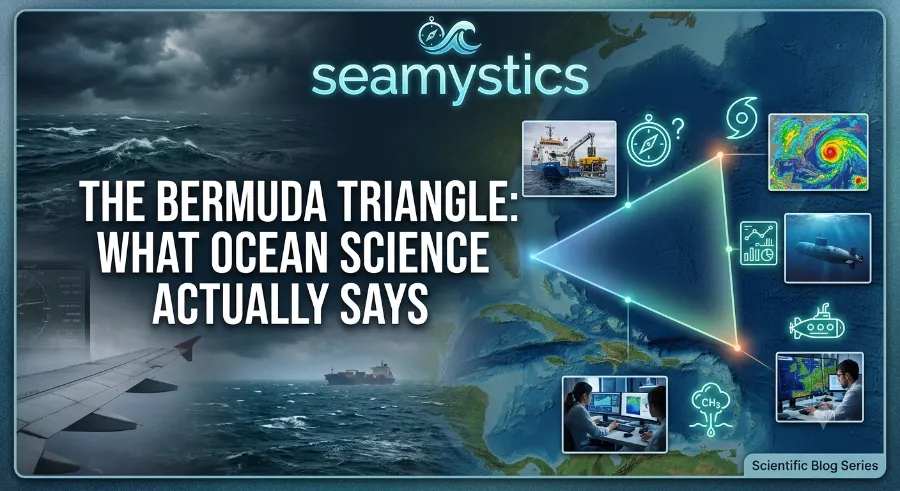

The Bermuda Triangle has swallowed ships, planes, and imaginations for more than a century. Ask most people what causes it, and you will hear about aliens, lost cities, or holes in time. Ask an oceanographer, instead, and you get a much duller, much more useful answer. Bermuda Triangle science points to storms, strong currents, heavy sea traffic, and plain old human error, not portals to another dimension.
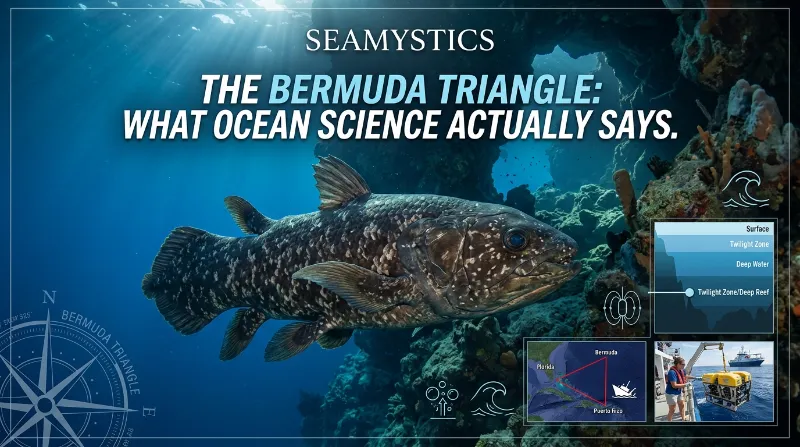
This piece looks at what agencies like NOAA, insurers like Lloyd’s of London, and working ocean scientists have actually found. Specifically, it walks through the real incidents that built the legend. It also covers the physical theories that hold up under testing, and the ones that fall apart. Along the way, you will find comparisons to other mystery zones in the ocean, including places we cover in detail elsewhere on Sea Mystics.
TL;DR
Bermuda Triangle facts do not support anything supernatural. NOAA and Lloyd’s of London have both stated that loss rates in the region are no higher than in any other busy stretch of ocean. Most disappearances trace back to sudden storms, the unpredictable Gulf Stream, magnetic compass confusion, or human error. A handful of open questions, including rogue waves and undersea methane, still get studied through legitimate marine science.
Key Takeaways
| Topic | What the evidence shows |
|---|---|
| Disappearance rate | No higher than other heavily trafficked ocean zones, according to NOAA and Lloyd’s of London |
| Leading real-world causes | Storms, the Gulf Stream, human navigation error, mechanical failure |
| Leading scientific theories | Rogue waves, magnetic compass variation, methane gas release |
| Debunked ideas | Alien abduction, Atlantis, time portals, sea monsters |
| Most famous case | Flight 19, December 5, 1945, 14 airmen lost with a rescue plane and its 13-man crew |
| Region size | Roughly 500,000 to 1,510,000 square miles between Florida, Bermuda, and Puerto Rico |
Where the Bermuda Triangle Actually Is
The Bermuda Triangle is not an official geographic zone. No line on a nautical chart marks it. It is a loosely drawn triangle stretching from the Atlantic coast of Florida, to Bermuda, down to the Greater Antilles near Puerto Rico. Its size ranges anywhere from about 500,000 to 1,510,000 square miles, depending on who tells the story. That is a wide margin for a place people treat as a fixed danger zone.
Naturally, that vagueness matters. Because the boundaries shift from one retelling to the next, it becomes easy to fold almost any Atlantic mishap into the legend after the fact. A ship lost hundreds of miles outside the usual boundary can still get labeled a “Bermuda Triangle disappearance” once a writer decides it fits the story.
Why This Stretch of Ocean Gets Blamed So Often
Three ordinary features of this patch of the Atlantic explain a lot of the confusion. First, it sits directly in the path of tropical storms and hurricanes moving north through the Caribbean. Second, the Gulf Stream runs straight through it, a fast, warm current that can shift sea conditions within hours. Third, it is genuinely busy. Cargo ships, cruise liners, private boats, and commercial flights cross this water constantly. More traffic produces more accidents in raw numbers, even when the rate stays normal.
The region also holds a maze of shallow banks and small islands around the Bahamas and the Caribbean. That combination has always demanded real navigation skill. Early 20th century sailors and pilots worked without GPS or modern radar, so they had far less room for error here than they might have realized.
Bermuda Triangle Facts vs. Bermuda Triangle Myths
Public fascination with this region did not happen by accident. Magazine writers in the 1950s and 1960s built a myth economy around it, often reusing the same handful of stories while adding new flourishes each time. Researcher Larry Kusche took the myth apart piece by piece in his 1975 book, “The Bermuda Triangle Mystery Solved.” He dug through original ship logs, weather reports, and Coast Guard records. He found that writers had exaggerated, misdated, or simply invented many of the most dramatic claims. In addition, he found that official records explained or located some “vanished” vessels, records that later writers never checked.
That gap between folklore and paperwork is the heart of Bermuda Triangle science. The ocean is dangerous everywhere. What changed in the Bermuda Triangle’s case is that danger got a name, a shape on a map, and a decades-long marketing push.
The name itself only entered common use in 1964, when writer Vincent Gaddis coined it in a magazine article. Before that, most of these incidents were treated as separate, unrelated maritime tragedies. Once a catchy label existed, writers began grouping decades of unconnected losses under one umbrella. Each retelling tended to strip away inconvenient details, such as bad weather on the night in question or a documented mechanical fault, in favor of a cleaner mystery.
Common Myths Worth Retiring
A few claims resurface in almost every Bermuda Triangle documentary, and none of them hold up against the primary sources.
- Compasses always fail there. Magnetic variation is real in this region, but it is a known, mapped, predictable effect, not a random malfunction unique to the Triangle.
- Ships vanish without any trace, every time. Salvage crews and insurers later found or explained many “vanished” vessels, details that popular retellings simply left out.
- The area has a uniquely high death toll. Coast Guard and NOAA data tell a different story. Once you factor in traffic volume, the region’s incident rate lines up with other busy ocean corridors.
- Every case remains completely unexplained. Several of the most cited stories, including some 19th-century sailing ship losses, come with documented weather records. Those records account for the loss without any mystery left over.
Clearing away these myths does not make the ocean any less powerful. It just means the danger comes from wind, water, and human limits, not from anything beyond them.
What NOAA and Lloyd’s of London Actually Found
The clearest statement on record comes from the U.S. National Oceanic and Atmospheric Administration. Indeed, it has said plainly that <cite index=”5-1″>there is no evidence that mysterious disappearances occur with any greater frequency in the Bermuda Triangle than in any other large, well-traveled area of the ocean</cite>. NOAA also mentions oceanic flatulence and geomagnetic disruptions as scientific-sounding causes some writers float, though these stay more speculative than proven.
Lloyd’s of London, the insurance market that has spent over a century pricing maritime risk, backs this up from the financial side. After all, if ships genuinely vanished at a higher rate in this region, premiums there would reflect it, and they simply do not. Marine science communicator Karl Kruszelnicki has made the same point publicly for years. He notes that the share of ships and planes that go missing here tracks closely with the share missing anywhere else. That holds true on a percentage basis. Likewise, the U.S. Coast Guard supports that same conclusion, according to multiple public statements over the past decade.
You can read NOAA’s full statement on their Ocean Facts page. For a detailed overview of the region’s history and boundaries, see Britannica’s Bermuda Triangle entry.
The Famous Cases That Built the Legend
Bermuda Triangle disappearances did not start with a single dramatic event. They accumulated over more than a century, and a handful of specific cases still anchor almost every retelling.
USS Cyclops, March 1918
The USS Cyclops was a 542-foot Navy collier. It carried more than 300 crew and roughly 10,800 tons of manganese ore when it left Barbados bound for Baltimore on March 4, 1918. In the end, it never arrived. The ship carried equipment to send an SOS, yet no distress call ever came, and searchers never recovered any wreckage. To this day, it remains the largest single loss of life in U.S. Naval history outside of combat. President Woodrow Wilson later remarked that only the sea knew what became of it. Two of its sister ships vanished along a similar route in 1941. That only deepened the mystery for later writers, even though wartime conditions offer a far more plausible explanation for those losses.
Flight 19, December 5, 1945
This is the case most people picture first. Five Navy TBM Avenger torpedo bombers took off from Naval Air Station Fort Lauderdale at 2:10 p.m. on a routine three-hour training run. About two hours in, flight leader Lieutenant Charles Taylor, an experienced pilot, reported a failed compass and a lost squadron. Confused radio transmissions continued for hours as the planes’ fuel ran low. Meanwhile, the Navy dispatched a rescue Mariner aircraft carrying 13 men, and it vanished too. A tanker off the Florida coast reported a visible explosion around the same time. In the end, searchers never confirmed a trace of any of the six aircraft or 27 men. This ranks as one of the largest unresolved air-sea search efforts in U.S. history.
The Witchcraft, December 22, 1967
A 23-foot luxury cruiser disappeared just off Miami on the evening of December 22, 1967. Its owner and a friend had gone out to view the Christmas lights along the shore. The boat sat less than a mile from the coast, near a known hazard. Yet searchers never found a trace, a detail that has kept this case alive in the retelling despite its closeness to help.
A Quick Timeline of Notable Incidents
| Year | Incident | Outcome |
|---|---|---|
| 1918 | USS Cyclops disappears with 306 aboard | No wreckage or distress call ever found |
| 1941 | Two Cyclops-class sister ships lost on a similar route | Attributed largely to wartime conditions |
| 1945 | Flight 19 and rescue Mariner vanish, 27 men lost | Compass failure and disorientation reported before loss |
| 1963 | SS Marine Sulphur Queen disappears with 39 crew | Structural failure suspected by investigators |
| 1967 | The Witchcraft vanishes near Miami | No wreckage recovered despite proximity to shore |
The Leading Scientific Theories, Explained Simply
None of the theories below claim anything supernatural. They compete as physical explanations, and marine scientists disagree on which one deserves the most weight for any given case.
Forces of Wind and Water
- Rogue waves. Oceanographer Dr. Simon Boxall points to rogue waves as high as 30 meters as a plausible cause for sudden ship losses like the USS Cyclops. Specifically, scale-model tests show that a wave can suspend a flat-bottomed hull between two peaks. The hull snaps in the middle and sinks fast, too fast for any distress signal.
- Gulf Stream weather shifts. The Gulf Stream can turn calm water rough within a short window. This happens especially when it collides with a storm system moving up from the Caribbean. Older vessels without radar or satellite forecasting had little warning before conditions turned dangerous.
Compass Confusion, Gas, and Ordinary Odds
- Magnetic compass variation. This is one of the few genuinely unusual features of the region. The Bermuda Triangle sits near one of two places on Earth where a compass can point toward true north instead of magnetic north. This real phenomenon is called agonic variation. For a pilot like Flight 19’s Lieutenant Taylor, unexpected compass behavior combined with disorientation offers a plausible explanation. The squadron may have simply flown the wrong direction until fuel ran out.
- Methane gas release. Large deposits of methane hydrate sit on the seafloor near the Blake Ridge, north of the Bermuda Triangle. For instance, a 2003 study in the American Journal of Physics found that a large gas bubble beneath a scale-model hull can strip away its buoyancy and sink it within seconds. Earth scientist Benjamin Phrampus of Southern Methodist University confirms that gas hydrate deposits exist in the wider region. However, he also cautions that no one has proven this mechanism caused a real historical sinking. It stays a demonstrated possibility, not a confirmed cause.
- Human error and heavy traffic. This is the least dramatic explanation. According to NOAA and the Coast Guard, it is also the most statistically important one. More ships and planes cross this water than almost anywhere else in the Atlantic. So raw incident counts will always look high here, even when the underlying rate stays ordinary.
Theories Compared at a Glance
| Theory | Scientific support | Best-fit case |
|---|---|---|
| Rogue waves | Demonstrated in scale-model testing | USS Cyclops, 1918 |
| Magnetic compass variation | Confirmed real phenomenon in this region | Flight 19, 1945 |
| Methane gas release | Lab-tested, not field-confirmed | Older unexplained sinkings |
| Human error and traffic volume | Backed by NOAA, USCG, and Lloyd’s data | Most cases overall |
| Alien or supernatural forces | No scientific evidence | None |
What This Region Shares With Other Ocean Mysteries
The Bermuda Triangle is far from the only stretch of water with a mysterious reputation. Comparing it to other cases, in fact, helps put the science in perspective. The Sargasso Sea sits partly inside the same general area. It has its own long history of becalmed ships and floating seaweed mats that early sailors found unsettling. Farther north, the Baltic Sea anomaly shows a similar pattern. An unusual sonar reading spiraled into a full-blown legend, long before scientists got a clear look at the seafloor.
Deep trenches carry their own mythology too. The Puerto Rico Trench lies close to the southern edge of the Bermuda Triangle and ranks among the deepest points in the Atlantic. Writers have floated it as everything from a gravitational anomaly to a magnetic hotspot, despite a far more mundane geological explanation. For a broader look, our pillar guide on unidentified submerged objects covers the pattern behind these stories. It breaks down how sonar artifacts and unexplained sightings turn into legends across the world’s oceans.
For readers drawn to the geology side of these mysteries, the Yonaguni Monument mystery and the vanishing island mystery are worth a look too. Both show how natural formations get reinterpreted as evidence of lost civilizations once a compelling photo starts circulating.
How Scientists Actually Investigate These Claims
Marine researchers do not chase down every Bermuda Triangle disappearances story with a diving crew. Instead, most investigations start on paper, cross-referencing shipping logs, insurance claims, weather records, and Coast Guard search reports. That is exactly what Kusche did in the 1970s, and it is still the standard approach today.
Researchers usually test physical mechanisms at small scale first. For example, the methane bubble experiments used scaled hull models in tanks, not full-size ships in the open ocean, because no one can safely reproduce a real disaster. Rogue wave research similarly relies on wave-tank modeling and years of satellite altimetry data, since no one can summon a 30-meter wave on demand for study.
This matters because it explains why so many Bermuda Triangle theories sound scientific without solid proof behind them. A mechanism can be physically real and still lack confirmation as the actual cause of a specific historical loss, simply because searchers never found the wreckage.
The Traffic Numbers Nobody Mentions
It helps to put actual numbers next to the mystery. Estimates place the total count of ships and aircraft lost in and around the Bermuda Triangle since the 19th century at more than 50 vessels and 20 planes. That sounds alarming until you compare it against traffic volume. After all, this corridor carries a steady stream of cargo shipping between the U.S. East Coast, the Caribbean, and South America, plus cruise routes out of Florida and commercial flights heading to and from the islands.
Busy shipping lanes anywhere in the world produce a steady trickle of accidents simply because so many vessels pass through them. The North Atlantic shipping lanes further north, the English Channel, and the Strait of Malacca all see comparable or higher loss counts over the same time span. Yet none of them carry a nickname that sells documentaries. Once traffic density enters the equation, the Bermuda Triangle’s numbers stop looking unusual and start looking like ordinary maritime risk spread across a heavily used corridor.
Human Error Still Explains the Most Cases
Investigators who have reviewed the available Coast Guard files consistently point to the same handful of contributing factors. Pilots and captains flew or sailed beyond their experience level. Crews relied on outdated or poorly maintained equipment. People made decisions under pressure during sudden weather changes. Flight 19’s leader was experienced. But training flights in unfamiliar conditions, mixed with equipment trouble, have caused fatal outcomes in plenty of places that never got a catchy name.
None of this makes the losses any less tragic. It simply means the pattern matches ordinary aviation and maritime accident data rather than pointing to something unique about the water itself.
Newer Research and Where the Debate Stands Now
Ocean science on this topic has not stood still. In 2026, University of Miami researchers teamed up with the Woods Hole Oceanographic Institution on a new mapping project. They used high-resolution sonar to survey the seafloor beneath some of the Triangle’s most historically active zones. The early findings did not match the cratered, heavily vented seafloor that the older methane hydrate model predicted. That gap has pushed some researchers back toward weather and human-factor explanations, while others keep studying the region’s electromagnetic profile. As with earlier theories, headline writers tend to inflate this kind of finding into something more dramatic than the underlying data supports. It pays to read the original research summaries rather than the recycled versions that circulate online later.
This is a useful reminder for anyone following ocean mystery coverage. Preliminary survey data and confirmed causation are not the same thing, even when a headline sounds definitive.
Currents, Seeps, and Other Real Ocean Forces Worth Knowing
Some of the physical processes behind Bermuda Triangle theories show up in other well-documented parts of the ocean too. That is part of why marine scientists take them seriously, even without a confirmed case in this specific region. Cold seep zones, where gas and fluid escape from the seafloor, support entire ecosystems and produce measurable changes in water chemistry. We cover that phenomenon in more depth in our guide to cold seep ecosystems. Strong subsurface currents can disorient vessels near the Gulf Stream in a similar way. Our look at the underwater river mystery shows how dense, fast-moving water flows beneath the surface and can catch even experienced crews off guard.
These documented ocean processes make it easier to judge the Bermuda Triangle theories. Some rest on real physics. Others are just good storytelling dressed up in scientific language.
Frequently Asked Questions
Is the Bermuda Triangle actually more dangerous than other parts of the ocean? No. NOAA and Lloyd’s of London have both stated that loss rates there are consistent with any other heavily trafficked ocean region once traffic volume is accounted for.
What is the most likely explanation for Flight 19? Aviation investigators point to compass malfunction, disorientation, and worsening weather. No external or supernatural force enters the leading explanation.
Do scientists take the methane gas theory seriously? Some do, cautiously. Lab testing shows the mechanism is physically possible, but no historical Bermuda Triangle sinking has ever been directly confirmed as methane-related.
Why does this region get so much media attention compared to equally busy waters? Dramatic early magazine writing gave it a catchy name. Decades of documentaries kept the story alive, long after most individual cases had reasonable explanations on record.
Are there official boundaries for the Bermuda Triangle? No government agency recognizes official boundaries. The shape and size vary depending on the source, which is part of why so many unrelated incidents get folded into the legend.
Conclusion
Bermuda Triangle science tells a far less thrilling story than the documentaries suggest, and that is exactly the point. Strip away the alien theories and lost civilizations. What remains is a busy, storm-prone stretch of ocean where compasses can behave strangely and waves can turn violent without warning. Human error plays out here the same way it does everywhere else on Earth. The mystery was never really about the water. It was about how a handful of tragic, explainable losses turned into a legend that outlived the facts.
References
- National Oceanic and Atmospheric Administration, “What is the Bermuda Triangle?” oceanservice.noaa.gov
- Britannica, “Bermuda Triangle.” britannica.com
- Science Focus, “Bermuda Triangle: What’s the real science behind the mystery?” sciencefocus.com
- Bibliotheca Alexandrina SciPlanet, article on Bermuda Triangle phenomena. bibalex.org
- Smithsonian Magazine, “How the Disappearance of Flight 19 Fueled the Legend of the Bermuda Triangle”
- HISTORY.com, “Bermuda Triangle: Location, Disappearances, Flight 19”
- Live Science, “Could Gas Explosions Explain Bermuda Triangle Mystery?”