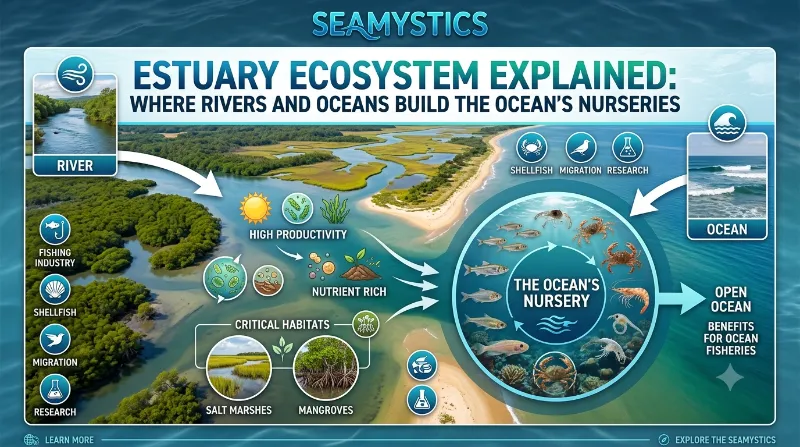

Stand at the mouth of any major river and you will notice something odd. The water does not taste fully salty, yet it is not fresh either. Birds dive for fish that seem to appear from nowhere, oysters cling to old pilings in thick clusters, and the mud beneath your feet smells like life itself. This mixing zone is an estuary, and it is one of the hardest working ecosystems on the planet.
Coastal Upwelling Ecosystems Why Some Waters Explode With Life
Salt Marsh Ecosystem The Coastal Buffer Most People Overlook
Dr. Rabica has spent years wading through tidal creeks, tagging juvenile striped bass, and watching oyster reefs rebuild themselves acre by acre. What follows is not a textbook summary. It is a grounded, plainly written look at how estuaries actually function, why marine life depends on them, and what current data tells us about their health today.
TL;DR: An estuary is the place where a river’s fresh water meets the ocean’s salt water, creating a brackish, nutrient rich habitat that scientists call a nursery of the sea. Roughly 75 percent of the fish Americans catch and eat spend part of their life cycle in an estuary. Understanding this estuary ecosystem matters because these waters filter pollution, protect coastlines from storms, and support millions of jobs and livelihoods across the United States and Europe.
Key Takeaways at a Glance
| Topic | Fact |
|---|---|
| Definition | An estuary forms where river fresh water mixes with ocean salt water |
| Productivity | Estuaries rank among the most biologically productive habitats on Earth |
| Nursery role | About 68 percent of U.S. commercial fish and shellfish rely on estuary habitat at some life stage |
| Human connection | 22 of the world’s 32 largest cities sit on an estuary |
| Population | Nearly 40 percent of Americans live on or near an estuary coastline |
| Threats | Pollution, warming water, and habitat loss are shrinking estuary health worldwide |
| Restoration wins | Chesapeake Bay partners finished restoring oyster reefs across 10 tributaries by late 2025 |
What Is an Estuary, Really?
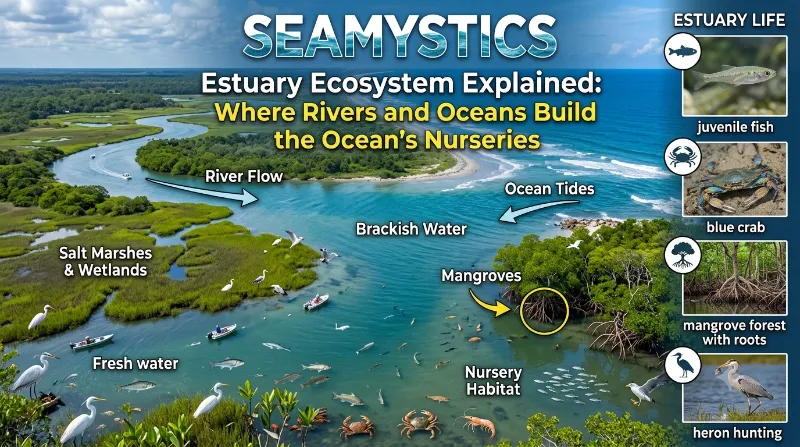
An estuary is a partly enclosed body of water where a river or stream flows into the sea, and the fresh water blends with salt water carried in by tides. This creates a brackish environment, meaning the salinity sits somewhere between a mountain stream and the open ocean. Because conditions shift constantly with the tide, life here has to be tough, flexible, and endlessly adaptable.
Tide Pool Ecosystem A Complete Guide to Life Between the Tides
Scientists sometimes describe estuaries as the transition zone between land and sea. However, that description undersells them. They are not simply a boundary. They are a self sustaining engine that feeds coastal food chains far beyond their own borders.
Mesopelagic Zone Ecosystem Life in the Ocean’s Twilight Zone
According to NOAA, estuaries are areas of water and shoreline where rivers meet the ocean or another large body of water, and organisms living there must adapt to constant variation in salinity and tide driven physical change, where there are variations in water chemistry including salinity, as well as physical changes like the rise and fall of tides. Despite this instability, these waters still manage to support extraordinary volumes of life, which is exactly why the label “nursery of the sea” keeps showing up in marine science literature. National Oceanic and Atmospheric Administration
If you want a deeper dive into how tidal mixing actually works day to day, our estuarine habitat guide breaks the physical process down step by step.
The Three Main Ways Estuaries Form
Estuaries are not all built the same way. Geology, sea level history, and coastal shape all play a role in how each one develops. Here are the main types you will encounter along coastlines in the United States and Europe.
- Coastal plain estuaries: formed when rising sea levels flooded old river valleys, such as Chesapeake Bay
- Bar built estuaries: shallow basins protected by sandbars or barrier islands, common along the Gulf Coast and parts of the Netherlands
- Tectonic estuaries: created by land movement that sinks a basin, such as San Francisco Bay
- Fjord estuaries: carved by glaciers and later flooded by the sea, common in Norway and parts of Scotland
Each type develops its own mix of salinity zones, sediment patterns, and resident species. Yet all of them share the same basic function: they slow the river down long enough for nutrients to settle and for young marine life to find shelter.
Estuary Ecosystem Explained: The Science Behind the Mix
To really get how an estuary ecosystem works, picture layers rather than a single blended soup. Fresh water is lighter than salt water, so it often sits closer to the surface while denser salt water pushes in along the bottom. This layering, sometimes called stratification, changes constantly with rainfall, tide, and wind.
Tide Pool Ecosystem A Complete Guide to Life Between the Tides
As a result, an estuary is divided into rough salinity zones. Near the river mouth, water stays mostly fresh. Moving seaward, salinity climbs in stages until it matches the open ocean. Species position themselves along this gradient based on what their bodies can tolerate, which is why you will find freshwater catfish near the headwaters and full marine species like flounder closer to the inlet.
Oyster Reef Ecosystems The Underrated Filter of Coastal Waters
Quick Chart: Estuary Salinity Zones and Typical Residents
| Zone | Salinity Level | Common Species |
|---|---|---|
| Tidal freshwater | 0 to 0.5 ppt | Largemouth bass, freshwater mussels |
| Oligohaline | 0.5 to 5 ppt | Blue crab juveniles, killifish |
| Mesohaline | 5 to 18 ppt | Striped bass, eastern oyster |
| Polyhaline | 18 to 30 ppt | Flounder, shrimp, seagrass beds |
| Euhaline | 30+ ppt | Full marine species near the inlet |
This layered structure matters because it directly shapes the estuary food web. Nutrients washed down from the river settle into the slower moving water, feeding algae and plankton blooms. Those blooms feed small fish and shellfish, which then feed larger predators. Nothing here goes to waste.
Estuary Marine Life: Who Actually Lives Here
The list of species that depend on estuaries is genuinely long, and it stretches across every level of the food chain. Oysters filter water and build reef structure. Blue crabs scavenge the muddy bottom. Herons and egrets stalk the shallows. Meanwhile juvenile sharks, striped bass, and salmon use these calm waters as a safe place to grow before heading out to open ocean.
Polar Ocean Ecosystems How Life Survives Beneath Arctic Ice
NOAA notes that most of the fish and shellfish eaten in the United States, including salmon, herring, crabs, and oysters, spend some or all of their life in estuariesMost of the fish and shellfish eaten in the United States, including salmon, herring, crabs, and oysters, spend some or all of their life in estuaries. In fact, estuaries provide habitat for about 68 percent of the commercially harvested fish and shellfish species in the countryEstuaries provide habitat for about 68 percent of the U.S. total catch, which is a staggering number when you consider how small estuaries are compared to the open ocean. NOAA FisheriesNOAA Fisheries
The Hudson River estuary offers a strong real world example. It stretches roughly 153 miles inland from the Atlantic and supports more than 200 fish species, acting as a nursery ground for sturgeon, striped bass, and American shadNew York City, with a population of over eight million people, is located at the mouth of the Hudson River Estuary which stretches 153 miles inland from the Atlantic Ocean and includes a wide range of wetland habitats. Home to more than 200 species of fish, the Hudson River Estuary serves as a nursery ground for sturgeon, striped bass, and American shad. That is one river system quietly supporting an entire regional fishery. NOAA National Ocean Service
Common Groups of Estuarine Marine Life
- Filter feeders such as oysters, mussels, and clams
- Crustaceans including blue crabs, shrimp, and fiddler crabs
- Juvenile and forage fish like menhaden, mullet, and anchovies
- Predatory fish such as striped bass, flounder, and redfish
- Birds including herons, egrets, ospreys, and migratory shorebirds
- Marine mammals like harbor seals and, seasonally, dolphins
If you are curious how these species interact with each other on a daily basis, our guide on marine food chains explained walks through predator and prey relationships in more detail.
The Estuary Food Web: From Mud to Predator
The estuary food web starts with something unglamorous, decaying plant matter called detritus. Marsh grasses, mangrove leaves, and algae break down into small particles that bacteria and fungi then colonize. This detritus becomes food for tiny invertebrates, which in turn feed small fish and crustaceans.
Seamount Ecosystems The Underwater Mountains Teeming With Life
From there, the chain builds upward quickly. Small fish feed wading birds and larger predatory fish. Those larger fish eventually feed seabirds, seals, and, of course, human fisheries. Every link depends on the one below it, which is why a disruption at the bottom of the chain, like a pollution event killing off marsh grass, can ripple all the way up to commercial fish stocks.
Deep Sea Coral Ecosystems The Reefs That Never See Sunlight
Quick Chart: Simplified Estuary Food Chain
| Level | Organisms | Role |
|---|---|---|
| Producers | Marsh grass, algae, phytoplankton | Convert sunlight into energy |
| Decomposers | Bacteria, fungi | Break plant matter into detritus |
| Primary consumers | Zooplankton, small crustaceans | Feed on detritus and algae |
| Secondary consumers | Killifish, juvenile shrimp | Feed on primary consumers |
| Top predators | Striped bass, herons, ospreys | Feed on smaller fish and crustaceans |
This layered structure is one reason marine biologists treat estuaries as productivity hotspots rather than simple transition zones. According to the Ocean Blue Project, estuaries act as nurseries because their calm, nutrient rich waters give young marine animals shelter from predators and rough surf while they grow strong enough to survive in open water, a point covered well in their explainer on what an estuary is.
Real Life Case Studies: Estuaries in Action
Chesapeake Bay Oyster Restoration
Chesapeake Bay offers one of the best documented estuary recovery stories in recent memory. Historic overharvesting and disease left only 1 to 2 percent of the bay’s native oyster population intactOnly 1 to 2 percent of the historic Chesapeake Bay native oyster population remains. In response, NOAA and its partners committed to restoring oyster reefs across 10 tributaries under the 2014 Chesapeake Bay Watershed Agreement. NOAA Fisheries
That work reached a milestone in September 2025, when partners celebrated completing large scale oyster reef restoration across all 10 tributaries, marking what officials called the world’s largest oyster reef restoration projectChesapeake Bay Program partners recently came together to celebrate achieving a major outcome under the 2014 Chesapeake Bay Watershed Agreement, restoring oyster reef habitat in 10 tributaries by the end of 2025. By that point, restoration efforts had already surpassed 2,300 acres of rebuilt reef, an area larger than 1,300 football fieldsMore than 2,294 acres of oyster reefs have been restored to date, an area larger than 1,340 football fields. That is not a small experiment. That is a functioning proof of concept for large scale estuary repair. Chesapeake BayCBS News
For a deeper look at how oyster reef projects like this actually get built and monitored, see our oyster reef restoration guide, or read the field level detail in the Mississippi River Delta estuaries primer, which covers similar delta restoration work along the Gulf Coast.
Tampa Bay’s Urban Estuary
Tampa Bay shows a different side of the story, the human side. This estuary is now home to more than 3 million peopleTampa Bay and its estuary in Florida is home to more than 3 million people. That density brings runoff, development pressure, and habitat loss, yet local restoration programs have still managed to bring seagrass coverage back in several areas over the past decade. It is proof that dense human population and estuary health are not automatically at odds, provided the right management choices get made. NOAA Fisheries
New York Harbor and the Billion Oyster Project
New York Harbor was once one of the most oyster rich estuaries on the planet before industrial pollution wiped most of that population out. Restoration groups have spent the last decade rebuilding reef structure and reintroducing native oysters back into the harbor, a project that ties directly into global World Oceans Day efforts each June. The Billion Oyster Project’s recap of World Oceans Day 2025 highlights just how much momentum citizen science and community reef building have gained in coastal cities.
Estuary Ecosystem Facts Worth Remembering
Estuaries are easy to underestimate because they often look like quiet, muddy backwaters. The numbers tell a very different story.
- Estuaries serve as nursery grounds for roughly 75 percent of the fish species that anglers and commercial fishers catchThis salty freshwater mix is where life begins and is the nursing grounds for 75 percent of the fish we catch NOAA National Ocean Service
- 22 of the 32 largest cities in the world sit on estuariesTwenty two of the 32 largest cities in the world are located on estuaries NOAA Fisheries
- Nearly 40 percent of Americans live on or near an estuaryNearly 40 percent of Americans live on or near one NOAA Fisheries
- More than one million acres of estuarine land and water sit under formal federal protection through the National Estuarine Research Reserve SystemCongress created the National Estuarine Research Reserve System to protect more than one million acres of estuarine land and water NOAA National Ocean Service
- Marsh grasses and seagrass beds filter pollutants out of water before it reaches the open oceanEstuaries are lined with marshes and sea grasses that filter water flowing to the ocean and act as a buffer protecting us from coastal storms NOAA National Ocean Service
Estuarine Habitat Guide: The Building Blocks
Every estuary is really a patchwork of smaller habitat types stitched together. Understanding each piece helps explain why these ecosystems support so much biodiversity in such a small footprint.
Salt Marshes
Salt marshes are grassy wetlands that flood and drain with the tide. Their root systems trap sediment, stabilize shorelines, and store carbon at a rate that rivals many forests. They also serve as nesting ground for shorebirds and nursery habitat for juvenile fish hiding among the grass stems.
Abyssal Plain Ecosystem What Lives on the Ocean’s Flattest Floor
Mangroves
In warmer coastal regions, mangroves take over the role that marshes play further north. Their tangled roots create underwater shelter that young fish and crustaceans use to avoid predators. Mangrove loss has slowed in several regions recently thanks to replanting programs, though pressure from coastal development remains a real concern.
Seagrass Beds
Seagrass meadows grow in the shallower, saltier zones of an estuary. They oxygenate the water, stabilize sediment, and provide grazing habitat for species ranging from small crabs to manatees. Seagrass loss is often one of the first warning signs that an estuary’s water quality is slipping.
Oyster Reefs
Oyster reefs act almost like a living water treatment plant. A single adult oyster can filter dozens of gallons of water per day, removing excess nutrients and sediment. Reef structure also buffers wave energy, which protects marshes and shorelines behind it from erosion.
Threats Facing Estuaries Today
Estuaries sit at the collision point between land based human activity and marine ecosystems, so they absorb pressure from both directions. Pollution running off farms and cities carries excess nitrogen and phosphorus into these waters, feeding algae blooms that strip oxygen from the water column. Warmer temperatures are shifting species ranges and timing, sometimes faster than local food webs can adjust.
Meanwhile, coastal development continues to fill in marshes and dredge channels, removing natural buffer zones. Human activities on land can degrade estuary health and worsen conditions for the species that depend on themHuman activities on land can harm estuary health, degrading living conditions for species that live in or visit them. Despite ongoing restoration wins like Chesapeake Bay, coastal habitat loss continues in many other regions, which is why long term monitoring remains essential. NOAA Fisheries
Dr. Rabica has personally observed this tension firsthand while surveying tidal creeks along the mid Atlantic coast, where a single heavy storm season can undo years of seagrass regrowth almost overnight. That kind of on the ground volatility rarely shows up in summary statistics, yet it shapes almost every restoration decision scientists make in the field.
Steps Communities Are Taking to Protect Estuaries
- Restoring native oyster and mussel reefs to filter water naturally
- Replanting marsh grass and mangroves along eroding shorelines
- Reducing agricultural runoff through buffer zones and better fertilizer timing
- Expanding protected reserve areas under programs like NERRS
- Running citizen science monitoring programs that track water quality year round
For readers who want to get hands on, our related guide lists volunteer restoration programs currently active across coastal states in the U.S. and parts of Western Europe.
Why This Matters Beyond the Coastline
It is tempting to think of estuaries as a niche coastal topic, relevant mainly to people who live near the water. That framing misses the bigger picture. Estuaries support commercial fisheries that stock grocery stores far inland, filter pollution before it reaches open ocean ecosystems, and buffer coastal cities from storm surge, which increasingly matters as storm intensity trends upward.
In short, a healthy estuary ecosystem quietly supports economies, food supplies, and storm protection well beyond its own shoreline. That is worth protecting, and it is worth understanding properly rather than treating as background scenery.
Frequently Asked Questions
What is the simplest definition of an estuary?
An estuary is a body of water where a river’s fresh water mixes with the ocean’s salt water, creating a brackish habitat that shifts with the tides.
Why are estuaries called nurseries of the sea?
Because so many marine species use their calm, food rich waters as a safe place to grow before moving into open ocean habitats.
Are estuaries freshwater or saltwater?
Neither exclusively. They contain brackish water, a changing blend of fresh river water and salty ocean water.
What is the biggest threat to estuary ecosystems right now?
Nutrient pollution from agricultural and urban runoff remains one of the largest ongoing threats, alongside habitat loss from coastal development.
Can estuary ecosystems actually recover once damaged?
Yes. The Chesapeake Bay oyster restoration project, completed across 10 tributaries by the end of 2025, shows that large scale recovery is achievable with sustained effort and funding.
Conclusion
Estuaries do not announce themselves the way coral reefs or open ocean predators do, yet they quietly hold together entire coastal food systems. From the muddy nursery grounds of the Hudson River to the rebuilt oyster reefs of Chesapeake Bay, these ecosystems prove that the boundary between river and sea is actually one of the most productive places in nature. Protecting them means protecting fisheries, coastlines, and clean water all at once, and that is a return on investment worth paying attention to.
References
- NOAA Fisheries, 5 Reasons to Love Estuaries, fisheries.noaa.gov
- NOAA Ocean Service, Estuaries Tutorial, oceanservice.noaa.gov
- NOAA Fisheries, Estuary Habitat, fisheries.noaa.gov
- NOAA Fisheries, Chesapeake Bay Oyster Restoration Update, fisheries.noaa.gov
- Chesapeake Bay Program, Partners Complete the World’s Largest Oyster Reef Restoration Project, chesapeakebay.net
- CBS News, Maryland on Track to Meet 2025 Oyster Reef Restoration Goal, cbsnews.com
- Ocean Blue Project, What Is an Estuary, oceanblueproject.org
- Mississippi River Delta, Estuaries 101, mississippiriverdelta.org
- Billion Oyster Project, World Oceans Day 2025 Recap, billionoysterproject.org
TAGS: estuary ecosystem, marine biology, estuarine habitat, coastal conservation, ocean nurseries, marine food web, wetland ecology, blue carbon
Estuary Ecosystem Explained: Where Rivers and Oceans Build the Ocean’s Nurseries
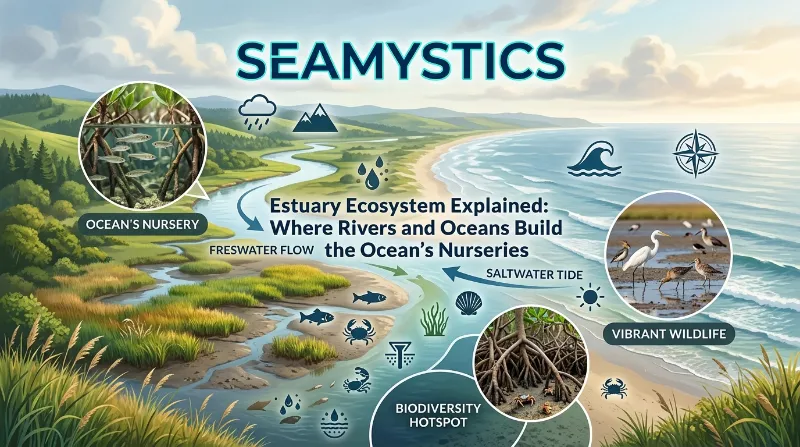
Stand at the mouth of any major river and you will notice something odd. The water does not taste fully salty, yet it is not fresh either. Birds dive for fish that seem to appear from nowhere, oysters cling to old pilings in thick clusters, and the mud beneath your feet smells like life itself. This mixing zone is an estuary, and it is one of the hardest working ecosystems on the planet.
Dr. Rabica has spent years wading through tidal creeks, tagging juvenile striped bass, and watching oyster reefs rebuild themselves acre by acre. What follows is not a textbook summary. It is a grounded, plainly written look at how estuaries actually function, why marine life depends on them, and what current data tells us about their health today.
TL;DR: An estuary is the place where a river’s fresh water meets the ocean’s salt water, creating a brackish, nutrient rich habitat that scientists call a nursery of the sea. Roughly 75 percent of the fish Americans catch and eat spend part of their life cycle in an estuary. Understanding this estuary ecosystem matters because these waters filter pollution, protect coastlines from storms, and support millions of jobs and livelihoods across the United States and Europe.
Key Takeaways at a Glance
| Topic | Fact |
|---|---|
| Definition | An estuary forms where river fresh water mixes with ocean salt water |
| Productivity | Estuaries rank among the most biologically productive habitats on Earth |
| Nursery role | About 68 percent of U.S. commercial fish and shellfish rely on estuary habitat at some life stage |
| Human connection | 22 of the world’s 32 largest cities sit on an estuary |
| Population | Nearly 40 percent of Americans live on or near an estuary coastline |
| Threats | Pollution, warming water, and habitat loss are shrinking estuary health worldwide |
| Restoration wins | Chesapeake Bay partners finished restoring oyster reefs across 10 tributaries by late 2025 |
What Is an Estuary, Really?
An estuary is a partly enclosed body of water where a river or stream flows into the sea, and the fresh water blends with salt water carried in by tides. This creates a brackish environment, meaning the salinity sits somewhere between a mountain stream and the open ocean. Because conditions shift constantly with the tide, life here has to be tough, flexible, and endlessly adaptable.
Scientists sometimes describe estuaries as the transition zone between land and sea. However, that description undersells them. They are not simply a boundary. They are a self sustaining engine that feeds coastal food chains far beyond their own borders.
According to NOAA, estuaries are areas of water and shoreline where rivers meet the ocean or another large body of water, and organisms living there must adapt to constant variation in salinity and tide driven physical change, where there are variations in water chemistry including salinity, as well as physical changes like the rise and fall of tides. Despite this instability, these waters still manage to support extraordinary volumes of life, which is exactly why the label “nursery of the sea” keeps showing up in marine science literature. National Oceanic and Atmospheric Administration
If you want a deeper dive into how tidal mixing actually works day to day, our estuarine habitat guide breaks the physical process down step by step.
The Three Main Ways Estuaries Form
Estuaries are not all built the same way. Geology, sea level history, and coastal shape all play a role in how each one develops. Here are the main types you will encounter along coastlines in the United States and Europe.
- Coastal plain estuaries: formed when rising sea levels flooded old river valleys, such as Chesapeake Bay
- Bar built estuaries: shallow basins protected by sandbars or barrier islands, common along the Gulf Coast and parts of the Netherlands
- Tectonic estuaries: created by land movement that sinks a basin, such as San Francisco Bay
- Fjord estuaries: carved by glaciers and later flooded by the sea, common in Norway and parts of Scotland
Each type develops its own mix of salinity zones, sediment patterns, and resident species. Yet all of them share the same basic function: they slow the river down long enough for nutrients to settle and for young marine life to find shelter.
Estuary Ecosystem Explained: The Science Behind the Mix
To really get how an estuary ecosystem works, picture layers rather than a single blended soup. Fresh water is lighter than salt water, so it often sits closer to the surface while denser salt water pushes in along the bottom. This layering, sometimes called stratification, changes constantly with rainfall, tide, and wind.
As a result, an estuary is divided into rough salinity zones. Near the river mouth, water stays mostly fresh. Moving seaward, salinity climbs in stages until it matches the open ocean. Species position themselves along this gradient based on what their bodies can tolerate, which is why you will find freshwater catfish near the headwaters and full marine species like flounder closer to the inlet.
Quick Chart: Estuary Salinity Zones and Typical Residents
| Zone | Salinity Level | Common Species |
|---|---|---|
| Tidal freshwater | 0 to 0.5 ppt | Largemouth bass, freshwater mussels |
| Oligohaline | 0.5 to 5 ppt | Blue crab juveniles, killifish |
| Mesohaline | 5 to 18 ppt | Striped bass, eastern oyster |
| Polyhaline | 18 to 30 ppt | Flounder, shrimp, seagrass beds |
| Euhaline | 30+ ppt | Full marine species near the inlet |
This layered structure matters because it directly shapes the estuary food web. Nutrients washed down from the river settle into the slower moving water, feeding algae and plankton blooms. Those blooms feed small fish and shellfish, which then feed larger predators. Nothing here goes to waste.
Estuary Marine Life: Who Actually Lives Here
The list of species that depend on estuaries is genuinely long, and it stretches across every level of the food chain. Oysters filter water and build reef structure. Blue crabs scavenge the muddy bottom. Herons and egrets stalk the shallows. Meanwhile juvenile sharks, striped bass, and salmon use these calm waters as a safe place to grow before heading out to open ocean.
NOAA notes that most of the fish and shellfish eaten in the United States, including salmon, herring, crabs, and oysters, spend some or all of their life in estuariesMost of the fish and shellfish eaten in the United States, including salmon, herring, crabs, and oysters, spend some or all of their life in estuaries. In fact, estuaries provide habitat for about 68 percent of the commercially harvested fish and shellfish species in the countryEstuaries provide habitat for about 68 percent of the U.S. total catch, which is a staggering number when you consider how small estuaries are compared to the open ocean. NOAA FisheriesNOAA Fisheries
The Hudson River estuary offers a strong real world example. It stretches roughly 153 miles inland from the Atlantic and supports more than 200 fish species, acting as a nursery ground for sturgeon, striped bass, and American shadNew York City, with a population of over eight million people, is located at the mouth of the Hudson River Estuary which stretches 153 miles inland from the Atlantic Ocean and includes a wide range of wetland habitats. Home to more than 200 species of fish, the Hudson River Estuary serves as a nursery ground for sturgeon, striped bass, and American shad. That is one river system quietly supporting an entire regional fishery. NOAA National Ocean Service
Common Groups of Estuarine Marine Life
- Filter feeders such as oysters, mussels, and clams
- Crustaceans including blue crabs, shrimp, and fiddler crabs
- Juvenile and forage fish like menhaden, mullet, and anchovies
- Predatory fish such as striped bass, flounder, and redfish
- Birds including herons, egrets, ospreys, and migratory shorebirds
- Marine mammals like harbor seals and, seasonally, dolphins
If you are curious how these species interact with each other on a daily basis, our guide on marine food chains explained walks through predator and prey relationships in more detail.
The Estuary Food Web: From Mud to Predator
The estuary food web starts with something unglamorous, decaying plant matter called detritus. Marsh grasses, mangrove leaves, and algae break down into small particles that bacteria and fungi then colonize. This detritus becomes food for tiny invertebrates, which in turn feed small fish and crustaceans.
From there, the chain builds upward quickly. Small fish feed wading birds and larger predatory fish. Those larger fish eventually feed seabirds, seals, and, of course, human fisheries. Every link depends on the one below it, which is why a disruption at the bottom of the chain, like a pollution event killing off marsh grass, can ripple all the way up to commercial fish stocks.
Quick Chart: Simplified Estuary Food Chain
| Level | Organisms | Role |
|---|---|---|
| Producers | Marsh grass, algae, phytoplankton | Convert sunlight into energy |
| Decomposers | Bacteria, fungi | Break plant matter into detritus |
| Primary consumers | Zooplankton, small crustaceans | Feed on detritus and algae |
| Secondary consumers | Killifish, juvenile shrimp | Feed on primary consumers |
| Top predators | Striped bass, herons, ospreys | Feed on smaller fish and crustaceans |
This layered structure is one reason marine biologists treat estuaries as productivity hotspots rather than simple transition zones. According to the Ocean Blue Project, estuaries act as nurseries because their calm, nutrient rich waters give young marine animals shelter from predators and rough surf while they grow strong enough to survive in open water, a point covered well in their explainer on what an estuary is.
Real Life Case Studies: Estuaries in Action
Chesapeake Bay Oyster Restoration
Chesapeake Bay offers one of the best documented estuary recovery stories in recent memory. Historic overharvesting and disease left only 1 to 2 percent of the bay’s native oyster population intactOnly 1 to 2 percent of the historic Chesapeake Bay native oyster population remains. In response, NOAA and its partners committed to restoring oyster reefs across 10 tributaries under the 2014 Chesapeake Bay Watershed Agreement. NOAA Fisheries
That work reached a milestone in September 2025, when partners celebrated completing large scale oyster reef restoration across all 10 tributaries, marking what officials called the world’s largest oyster reef restoration projectChesapeake Bay Program partners recently came together to celebrate achieving a major outcome under the 2014 Chesapeake Bay Watershed Agreement, restoring oyster reef habitat in 10 tributaries by the end of 2025. By that point, restoration efforts had already surpassed 2,300 acres of rebuilt reef, an area larger than 1,300 football fieldsMore than 2,294 acres of oyster reefs have been restored to date, an area larger than 1,340 football fields. That is not a small experiment. That is a functioning proof of concept for large scale estuary repair. Chesapeake BayCBS News
For a deeper look at how oyster reef projects like this actually get built and monitored, see our oyster reef restoration guide, or read the field level detail in the Mississippi River Delta estuaries primer, which covers similar delta restoration work along the Gulf Coast.
Tampa Bay’s Urban Estuary
Tampa Bay shows a different side of the story, the human side. This estuary is now home to more than 3 million peopleTampa Bay and its estuary in Florida is home to more than 3 million people. That density brings runoff, development pressure, and habitat loss, yet local restoration programs have still managed to bring seagrass coverage back in several areas over the past decade. It is proof that dense human population and estuary health are not automatically at odds, provided the right management choices get made. NOAA Fisheries
New York Harbor and the Billion Oyster Project
New York Harbor was once one of the most oyster rich estuaries on the planet before industrial pollution wiped most of that population out. Restoration groups have spent the last decade rebuilding reef structure and reintroducing native oysters back into the harbor, a project that ties directly into global World Oceans Day efforts each June. The Billion Oyster Project’s recap of World Oceans Day 2025 highlights just how much momentum citizen science and community reef building have gained in coastal cities.
Estuary Ecosystem Facts Worth Remembering
Estuaries are easy to underestimate because they often look like quiet, muddy backwaters. The numbers tell a very different story.
- Estuaries serve as nursery grounds for roughly 75 percent of the fish species that anglers and commercial fishers catchThis salty freshwater mix is where life begins and is the nursing grounds for 75 percent of the fish we catch NOAA National Ocean Service
- 22 of the 32 largest cities in the world sit on estuariesTwenty two of the 32 largest cities in the world are located on estuaries NOAA Fisheries
- Nearly 40 percent of Americans live on or near an estuaryNearly 40 percent of Americans live on or near one NOAA Fisheries
- More than one million acres of estuarine land and water sit under formal federal protection through the National Estuarine Research Reserve SystemCongress created the National Estuarine Research Reserve System to protect more than one million acres of estuarine land and water NOAA National Ocean Service
- Marsh grasses and seagrass beds filter pollutants out of water before it reaches the open oceanEstuaries are lined with marshes and sea grasses that filter water flowing to the ocean and act as a buffer protecting us from coastal storms NOAA National Ocean Service
Estuarine Habitat Guide: The Building Blocks
Every estuary is really a patchwork of smaller habitat types stitched together. Understanding each piece helps explain why these ecosystems support so much biodiversity in such a small footprint.
Salt Marshes
Salt marshes are grassy wetlands that flood and drain with the tide. Their root systems trap sediment, stabilize shorelines, and store carbon at a rate that rivals many forests. They also serve as nesting ground for shorebirds and nursery habitat for juvenile fish hiding among the grass stems.
Mangroves
In warmer coastal regions, mangroves take over the role that marshes play further north. Their tangled roots create underwater shelter that young fish and crustaceans use to avoid predators. Mangrove loss has slowed in several regions recently thanks to replanting programs, though pressure from coastal development remains a real concern.
Seagrass Beds
Seagrass meadows grow in the shallower, saltier zones of an estuary. They oxygenate the water, stabilize sediment, and provide grazing habitat for species ranging from small crabs to manatees. Seagrass loss is often one of the first warning signs that an estuary’s water quality is slipping.
Oyster Reefs
Oyster reefs act almost like a living water treatment plant. A single adult oyster can filter dozens of gallons of water per day, removing excess nutrients and sediment. Reef structure also buffers wave energy, which protects marshes and shorelines behind it from erosion.
Threats Facing Estuaries Today
Estuaries sit at the collision point between land based human activity and marine ecosystems, so they absorb pressure from both directions. Pollution running off farms and cities carries excess nitrogen and phosphorus into these waters, feeding algae blooms that strip oxygen from the water column. Warmer temperatures are shifting species ranges and timing, sometimes faster than local food webs can adjust.
Meanwhile, coastal development continues to fill in marshes and dredge channels, removing natural buffer zones. Human activities on land can degrade estuary health and worsen conditions for the species that depend on themHuman activities on land can harm estuary health, degrading living conditions for species that live in or visit them. Despite ongoing restoration wins like Chesapeake Bay, coastal habitat loss continues in many other regions, which is why long term monitoring remains essential. NOAA Fisheries
Dr. Rabica has personally observed this tension firsthand while surveying tidal creeks along the mid Atlantic coast, where a single heavy storm season can undo years of seagrass regrowth almost overnight. That kind of on the ground volatility rarely shows up in summary statistics, yet it shapes almost every restoration decision scientists make in the field.
Steps Communities Are Taking to Protect Estuaries
- Restoring native oyster and mussel reefs to filter water naturally
- Replanting marsh grass and mangroves along eroding shorelines
- Reducing agricultural runoff through buffer zones and better fertilizer timing
- Expanding protected reserve areas under programs like NERRS
- Running citizen science monitoring programs that track water quality year round
For readers who want to get hands on, our related guide lists volunteer restoration programs currently active across coastal states in the U.S. and parts of Western Europe.
Why This Matters Beyond the Coastline
It is tempting to think of estuaries as a niche coastal topic, relevant mainly to people who live near the water. That framing misses the bigger picture. Estuaries support commercial fisheries that stock grocery stores far inland, filter pollution before it reaches open ocean ecosystems, and buffer coastal cities from storm surge, which increasingly matters as storm intensity trends upward.
In short, a healthy estuary ecosystem quietly supports economies, food supplies, and storm protection well beyond its own shoreline. That is worth protecting, and it is worth understanding properly rather than treating as background scenery.
Frequently Asked Questions
What is the simplest definition of an estuary?
An estuary is a body of water where a river’s fresh water mixes with the ocean’s salt water, creating a brackish habitat that shifts with the tides.
Why are estuaries called nurseries of the sea?
Because so many marine species use their calm, food rich waters as a safe place to grow before moving into open ocean habitats.
Are estuaries freshwater or saltwater?
Neither exclusively. They contain brackish water, a changing blend of fresh river water and salty ocean water.
What is the biggest threat to estuary ecosystems right now?
Nutrient pollution from agricultural and urban runoff remains one of the largest ongoing threats, alongside habitat loss from coastal development.
Can estuary ecosystems actually recover once damaged?
Yes. The Chesapeake Bay oyster restoration project, completed across 10 tributaries by the end of 2025, shows that large scale recovery is achievable with sustained effort and funding.
Conclusion
Estuaries do not announce themselves the way coral reefs or open ocean predators do, yet they quietly hold together entire coastal food systems. From the muddy nursery grounds of the Hudson River to the rebuilt oyster reefs of Chesapeake Bay, these ecosystems prove that the boundary between river and sea is actually one of the most productive places in nature. Protecting them means protecting fisheries, coastlines, and clean water all at once, and that is a return on investment worth paying attention to.
References
- NOAA Fisheries, 5 Reasons to Love Estuaries, fisheries.noaa.gov
- NOAA Ocean Service, Estuaries Tutorial, oceanservice.noaa.gov
- NOAA Fisheries, Estuary Habitat, fisheries.noaa.gov
- NOAA Fisheries, Chesapeake Bay Oyster Restoration Update, fisheries.noaa.gov
- Chesapeake Bay Program, Partners Complete the World’s Largest Oyster Reef Restoration Project, chesapeakebay.net
- CBS News, Maryland on Track to Meet 2025 Oyster Reef Restoration Goal, cbsnews.com
- Ocean Blue Project, What Is an Estuary, oceanblueproject.org
- Mississippi River Delta, Estuaries 101, mississippiriverdelta.org
- Billion Oyster Project, World Oceans Day 2025 Recap, billionoysterproject.org