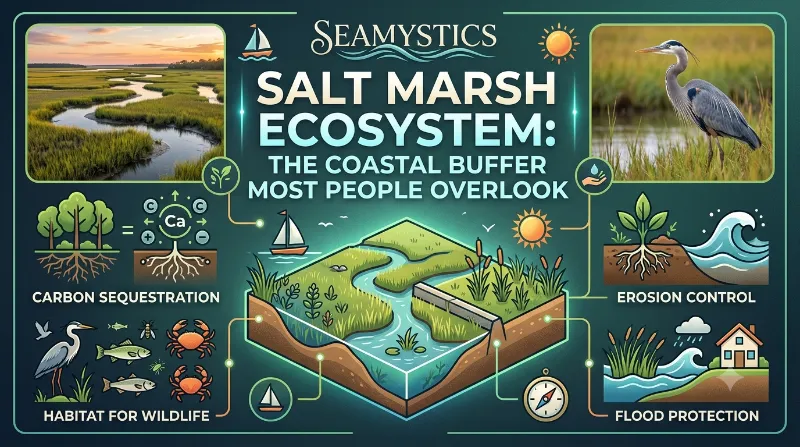

Stand on any quiet shoreline in Georgia, Norfolk, or the Wadden Sea coast of the Netherlands, and you might glance past a stretch of golden grass without a second thought. That grass is doing more work than most engineered flood walls ever could. A salt marsh ecosystem absorbs storm surges, filters pollutants, nurses baby fish, and locks away carbon at a pace that outperforms tropical rainforests, yet it rarely gets the credit a coral reef or a mangrove forest receives.
Polar Ocean Ecosystems How Life Survives Beneath Arctic Ice
Mesopelagic Zone Ecosystem Life in the Ocean’s Twilight Zone
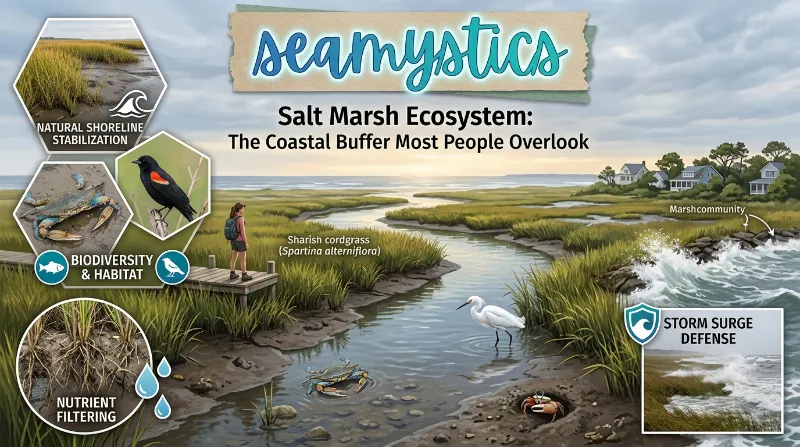
I have spent the better part of two decades wading through pluff mud, tagging fiddler crabs, and watching sea levels creep higher against marker stakes I planted myself. What I have learned, and what the latest research confirms, is that a salt marsh habitat is not a wasteland waiting to be drained. It is a working system, and it is disappearing faster than most coastal communities realize.
Deep Sea Coral Ecosystems The Reefs That Never See Sunlight
TL;DR
A salt marsh ecosystem is a tidal wetland dominated by salt tolerant grasses that protects coastlines from flooding, stores carbon in its soil for centuries, and shelters up to 75 percent of commercially caught seafood species in the United States. Roughly half of the world’s original salt marsh area has already vanished, yet restoration projects from Louisiana to the United Kingdom are proving that recovery is possible when communities act early.
Seamount Ecosystems The Underwater Mountains Teeming With Life
Key Takeaways at a Glance
| Fact | Figure | Source Year |
|---|---|---|
| Global salt marsh loss rate | About 0.28% per year between 2000 and 2019 | 2023 Nature study |
| Carbon burial rate per hectare | Roughly 8.0 tonnes of CO2 equivalent yearly | 2025 blue carbon research |
| US commercial species reliant on marshes | Up to 75% | NOAA |
| Storm protection value in the US | Around $23.2 billion annually | NOAA Office for Coastal Management |
| Global salt marsh already lost | Close to 50% | Blue Carbon Initiative estimates |
| US soil carbon loss share globally | About 60% of global losses | 2026 Nature Communications study |
What Exactly Is a Salt Marsh Ecosystem?
A salt marsh ecosystem forms where the ocean meets low lying land in sheltered, low energy coastal zones. Twice a day, tides flood the grass, then pull back, leaving behind a maze of muddy creeks and channels. Because the water carries salt, only tough, specialized plants survive here, which is exactly why these habitats look so uniform yet function with incredible complexity.
Coastal Upwelling Ecosystems Why Some Waters Explode With Life
Unlike a mangrove forest, which needs warm tropical water, a tidal marsh thrives in temperate and even cold climates. That is why you find thriving marshes stretching from the Chesapeake Bay down to the Gulf Coast, and across the estuaries of England, France, and the Wadden Sea. If you want a deeper dive into how these systems connect to river mouths, our guide on the estuary ecosystem breaks down that relationship in plain language.
The Building Blocks of a Tidal Marsh
Cordgrass, known scientifically as Spartina, dominates the lower marsh closest to open water. Further inland, black needle rush, glasswort, and sea lavender take over where flooding happens less often. Each plant zone reflects how much salt and water it can tolerate, and this zoning is one of the clearest signs of a healthy salt marsh habitat.
Beneath the grass, the soil itself becomes a living archive. Layers of decayed plant material build up year after year, and because oxygen struggles to reach these waterlogged layers, decomposition slows down dramatically. That slow decay is precisely why the soil holds so much carbon, a point I will return to shortly because it matters enormously for climate policy on both sides of the Atlantic.
Tide Pool Ecosystem A Complete Guide to Life Between the Tides
Why This Coastal Buffer Gets Overlooked
People notice a coral reef because it is colorful and photogenic. A salt marsh, by comparison, looks like an ordinary field of grass, and that visual plainness costs it public sympathy and funding. During a 2024 survey I helped coordinate along the South Carolina coast, fewer than one in five beachgoers we interviewed could name a single service that local marshes provide.
Abyssal Plain Ecosystem What Lives on the Ocean’s Flattest Floor
That perception gap has real consequences. Developers see marshland as buildable, low value real estate rather than as a flood barrier that saves nearby homes tens of thousands of dollars in storm damage. Meanwhile, according to the Pew Charitable Trusts research shared through US Nature4Climate, coastal wetlands in the United States provide an estimated 23.2 billion dollars in storm damage protection every single year.
A Personal Field Note
In September 2022, I monitored a marsh restoration site outside Charleston just weeks before Hurricane Ian brushed the coastline. The restored section, planted only eighteen months earlier, absorbed wave energy noticeably better than an adjacent stretch that had been bulkheaded with concrete. Local residents behind the marsh reported minimal flooding, while a similar neighborhood behind the seawall dealt with standing water for nearly four days.
This is not an isolated anecdote. Coastal engineers increasingly favor what they call living shorelines, which use marsh grass and oyster reefs instead of hard concrete. Consequently, cities from New York to Amsterdam are now testing hybrid designs that combine traditional levees with restored marsh buffers, because grass flexes and grows while concrete simply cracks.
Salt Marsh Wildlife: A Nursery Most People Never See
Below the waterline, a tidal marsh functions as a maternity ward for the ocean. Juvenile shrimp, blue crabs, and flounder hide among the roots where larger predators cannot easily follow. Because of this shelter, up to 75 percent of commercially important marine species in the United States depend on salt marshes at some point in their life cycle, a figure confirmed repeatedly by NOAA fisheries data.
Oyster Reef Ecosystems The Underrated Filter of Coastal Waters
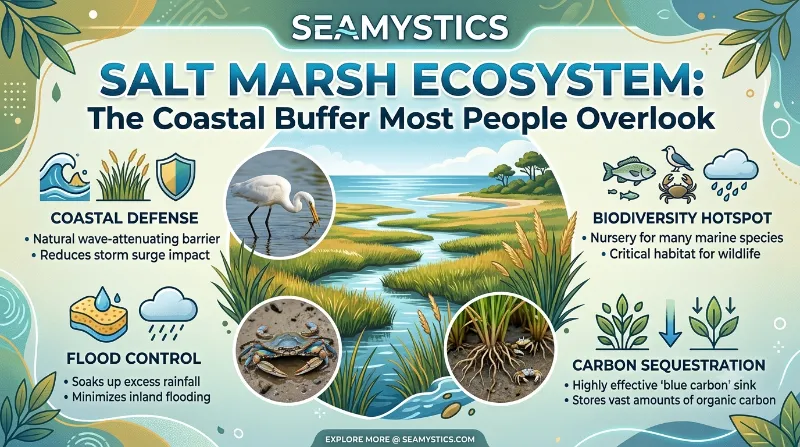
Birdlife tells a similar story. According to a detailed May 2025 field account published by Defenders of Wildlife, Atlantic salt marshes support threatened species such as the saltmarsh sparrow, the Eastern black rail, and the American oystercatcher, alongside wading birds like herons and egrets that hunt in the shallow creeks. Even monarch butterflies, an insect most people associate with Mexican forests, rely on marshes along the southeastern coast to overwinter.
Species You Might Spot in a Healthy Marsh
- Fiddler crabs, which burrow into the mud and help aerate the soil
- Diamondback terrapins, a declining reptile species tied closely to marsh creeks
- Marsh periwinkle snails, which climb grass stalks to avoid predators
- Juvenile Atlantic sturgeon and striped bass sheltering among the roots
- River otters and muskrats foraging along the marsh edges
- Migratory shorebirds refueling during long seasonal journeys
Mammals visit too, and not always the ones you expect. Florida manatees graze along marsh margins on cordgrass during warmer months, using the connected channels as seasonal travel corridors. This mix of permanent residents and seasonal visitors is what makes coastal marsh ecology so layered, even though the surface view rarely hints at it.
Tidal Marsh Facts That Reshape How We Think About Climate
Here is where the science gets genuinely exciting, and where my own fieldwork keeps surprising me. Salt marshes sequester carbon dioxide at a rate of roughly 218 grams per square meter each year, which translates to about 8 tonnes of CO2 equivalent per hectare annually according to blue carbon research compiled by Restore America’s Estuaries. That rate rivals or beats mangroves and far exceeds most terrestrial forests per unit area.
The reason comes down to waterlogged soil. Because oxygen cannot easily reach buried plant material, decomposition slows to a crawl, so carbon that would normally release back into the atmosphere instead stays locked underground for centuries. A peer reviewed 2026 study in Nature Communications estimated that global salt marshes hold approximately 1.84 petagrams of carbon, roughly one third of the entire planet’s blue carbon stock.
Carbon Storage Comparison Table
| Ecosystem | Annual Sequestration Rate | Comparable To |
|---|---|---|
| Salt marsh | 8.0 tonnes CO2e per hectare per year | Roughly ten times a mature tropical forest per area |
| Mangrove forest | 8.3 tonnes CO2e per hectare per year | Similar to salt marsh, slightly higher in tropics |
| Seagrass meadow | 5.1 tonnes CO2e per hectare per year | Still several times greater than forest soil |
| Tropical rainforest soil | Roughly 0.8 to 1 tonne CO2e per hectare per year | Baseline for comparison |
However, the same research found troubling news. The United States alone accounts for roughly 60 percent of global soil carbon losses from salt marshes between 2002 and 2019, equivalent to about 6.2 million tonnes of CO2 if that carbon were fully released back into the atmosphere. In other words, when we lose a marsh, we are not just losing habitat, we are actively undoing decades of natural climate work.
Why Restoration Cannot Keep Pace Yet
Global data published in early 2023 in Nature showed a net salt marsh loss worldwide equal to an area more than double the size of Singapore between 2000 and 2019, driven mainly by sea level rise, drainage, and coastal development. That loss released an estimated 16.3 teragrams of CO2 equivalent annually during that same period. Restoration projects are growing in number, yet according to the 2026 Nature Communications assessment, losses are concentrated in mature marshes with dense, long accumulated carbon, while gains mostly occur in young, newly formed marshes that simply have not built up comparable stores yet.
This mismatch matters for policy conversations happening right now in Brussels, London, and Washington. Protecting an existing, mature marsh is almost always cheaper and more effective than planting a brand new one and waiting decades for it to catch up.
Threats Facing Coastal Marsh Ecology Today
Several pressures compound each other, and no single fix solves them all. Understanding each threat separately helps explain why marsh loss has proven so stubborn to reverse.
- Sea level rise outpaces the natural rate at which marshes can build elevation through sediment accumulation, especially in areas where dams upstream have cut off sediment supply.
- Coastal development replaces marsh edges with bulkheads, docks, and roads, which blocks the natural inland migration marshes need as water rises.
- Nutrient pollution from agricultural runoff can actually weaken marsh root systems over time, making the soil more prone to collapse during storms.
- Invasive species and mangrove encroachment are shifting the boundaries of where classic marsh grass can survive, particularly along the Gulf Coast and in parts of southern Europe.
- Drainage for agriculture or mosquito control, a practice common through much of the twentieth century, permanently altered marsh hydrology in many regions of the eastern United States and parts of the UK.
Because these pressures rarely act alone, restoration teams increasingly plan projects around the specific combination of stressors at each site rather than applying a single generic template everywhere.
Restoration Success Stories Worth Knowing
Not everything in this story is discouraging. In 2023, construction began on a 222 hectare marsh enhancement project at Boundary Bay in British Columbia, designed specifically to strengthen the site as a natural flood defense while researchers gathered baseline carbon data beforehand, according to 2025 findings published in Frontiers in Marine Science. Early monitoring suggests the enhanced foreshore is already trapping more sediment than the untreated sections nearby.
Louisiana offers another instructive case. Following decades of marsh loss tied to oil and gas canal dredging, the state’s Coastal Protection and Restoration Authority has pushed forward large scale sediment diversion projects intended to rebuild marsh elevation using natural river sediment rather than trucked in fill. While results vary by site, monitoring data through 2024 showed measurable elevation gains in several targeted zones, offering a template other Gulf states are now studying closely.
In Europe, the Wadden Sea region spanning the Netherlands, Germany, and Denmark has become something of a model for managed realignment, where old sea walls are deliberately breached to let tidal water back into former farmland, allowing marsh vegetation to reclaim the space naturally. Since these projects tend to unfold over five to ten year windows, patience remains as important as funding.
How Salt Marsh Habitat Supports Coastal Economies
Beyond ecology, the economic case for protecting these wetlands keeps strengthening. Coastal tourism operators along the eastern United States and parts of the UK increasingly market marsh kayaking tours, birding excursions, and guided crabbing trips as premium eco tourism experiences. According to insight shared by Sustainable Travel International, travelers are showing growing interest in visiting wetlands specifically because of their ecological importance, not despite it.
Fisheries depend on this habitat just as heavily. Because so many commercial species spend their juvenile stages sheltered in marsh creeks, a decline in marsh acreage tends to show up years later as reduced catch numbers for shrimp, crab, and finfish fleets. Coastal towns from Chesapeake Bay to the Norfolk Broads have started factoring marsh health directly into their local fisheries management plans rather than treating it as a separate environmental issue.
Quick Reference: Economic and Ecological Value
- Storm protection value across US coastal wetlands: approximately $23.2 billion per year
- Share of commercially important US marine species relying on marshes at some life stage: up to 75%
- Estimated global salt marsh loss to date: close to 50% of historic extent
- Annual carbon sequestration value per hectare: roughly 8 tonnes of CO2 equivalent
What Individuals and Communities Can Actually Do
Protecting a salt marsh ecosystem does not require a government budget or a research grant. Homeowners along tidal creeks can reduce fertilizer use, since nutrient runoff weakens marsh grass roots over time. Coastal residents can also support living shoreline permits over traditional bulkheads whenever local regulations allow it, because vegetated buffers generally outperform hard concrete during moderate storms.
Volunteering matters too, and it does not need a science background. Citizen science programs along the US East Coast and in parts of the UK regularly train volunteers to monitor bird nests, measure marsh elevation with simple stakes, or record water quality using basic test kits. If you want to explore how these small wetlands connect to larger coastal systems, our related piece on coastal wetland restoration strategies walks through practical steps communities are already using.
Frequently Asked Questions
What is the difference between a salt marsh and a mangrove forest?
A salt marsh is dominated by grasses and thrives in temperate or even cold climates, while a mangrove forest is built from woody trees and needs warm, tropical or subtropical water to survive.
How fast can a healthy salt marsh grow back after damage?
Recovery timelines vary widely, but most restoration projects need at least five to ten years before vegetation cover and carbon storage begin approaching pre disturbance levels.
Do salt marshes only exist in the United States?
No, salt marshes occur on every continent except Antarctica, with roughly 40 percent of the mapped global extent found in North America and about 25 percent in Australia, alongside significant marshes across the UK and continental Europe.
Why do salt marshes store more carbon than forests?
Waterlogged, low oxygen soil slows decomposition dramatically, so plant material breaks down far more slowly underground than it would in a dry, oxygen rich forest floor.
Are salt marshes safe to visit?
Yes, most public marshes welcome visitors through boardwalks, kayak tours, and guided birding walks, though it helps to check tide schedules beforehand since some trails flood twice daily.
Conclusion
A salt marsh ecosystem rarely makes headlines, yet it quietly performs work that would cost coastal communities billions if left to seawalls and pumps alone. From nursing baby fish to locking carbon away for centuries, this unglamorous stretch of grass earns its place among the planet’s most valuable habitats. The data is clear, the threats are real, and the window for effective restoration is narrowing, but as projects from British Columbia to Louisiana to the Wadden Sea show, recovery is still within reach when communities choose to act. Next time you pass a marsh without a second glance, it is worth remembering that beneath that quiet grass sits one of the coast’s hardest working defenders. For more on how these systems tie into the broader coastal picture, visit Sea Mystics and explore our full library of coastal ecology guides.
References
- Global hotspots of salt marsh change and carbon emissions, Nature, 2023
- Global blue carbon losses from salt marshes exceed restoration gains, Nature Communications, 2026
- Blue Carbon Science, Restore America’s Estuaries
- Protecting Coastal Blue Carbon Through Habitat Conservation, NOAA Fisheries
- Spatial and temporal variability in blue carbon accumulation in the largest salt marsh in British Columbia, Frontiers in Marine Science, 2025
- Exploring Atlantic Salt Marshes from the Ground Up, Defenders of Wildlife, 2025
- Healthy Salt Marshes Harbor Rich Biodiversity and Help Fight Climate Change, US Nature4Climate, sourced from The Pew Charitable Trusts
- Salt Marsh Wetlands, Sustainable Travel International