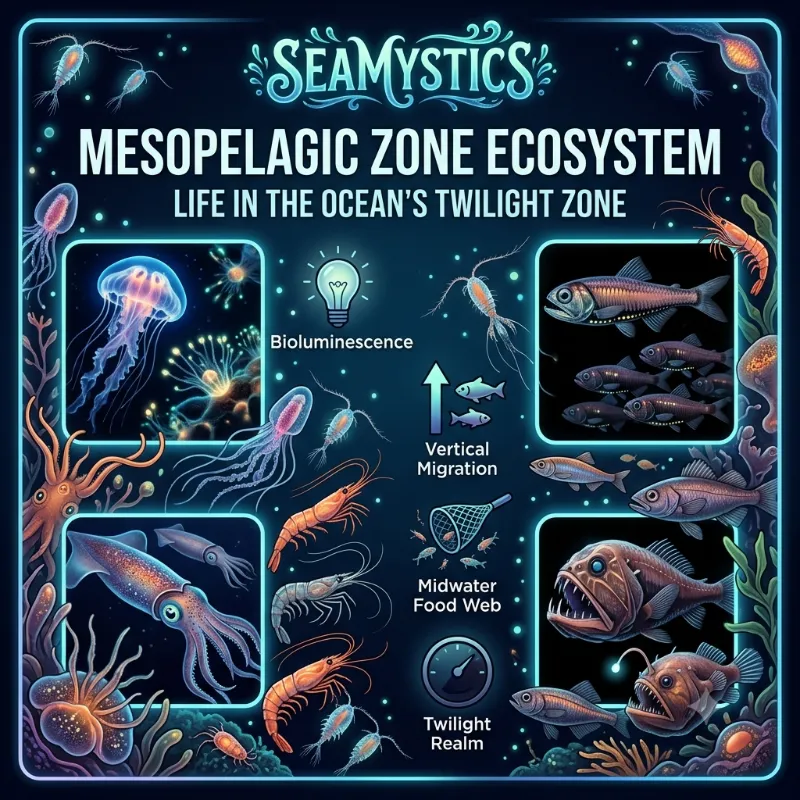

Picture a layer of ocean so vast it could swallow every rainforest on Earth. Yet it is so dim that most of its residents have never seen true daylight. In fact, that is the mesopelagic zone ecosystem, the ocean’s twilight world. It may hold more fish than every other part of the sea combined. For example, scientists at Woods Hole Oceanographic Institution call this layer the ocean twilight zone. According to their research, it hosts one of the largest animal migrations on the planet. Additionally, it plays a key role in moving carbon down to the deep sea. So, this article breaks down what actually lives there. Overall, it covers why this zone matters for climate and fisheries.
Oyster Reef Ecosystems The Underrated Filter of Coastal Waters
TL;DR: The mesopelagic zone sits between 200 and 1,000 meters deep. According to Marine Conservation Institute estimates, it may hold up to 90 percent of all fish biomass on the planet. Also, it regulates climate by locking away billions of tons of carbon every year. Meanwhile, it feeds nearly every major ocean predator, and it now faces new pressure from proposed commercial fishing.
Seamount Ecosystems The Underwater Mountains Teeming With Life
| Key Takeaway | What It Means |
|---|---|
| Depth range | 200 to 1,000 meters below the surface |
| Sunlight | Too dim for photosynthesis, but not fully dark |
| Fish biomass | Possibly up to 90 percent of the ocean’s total fish biomass |
| Carbon captured yearly | Roughly 2 to 6 gigatons of CO2 |
| Main threat | Unregulated commercial fishing interest |
| Recent milestone | IUCN Motion 035 passed in 2025 to protect the zone |
What Is the Mesopelagic Zone Ecosystem, Exactly
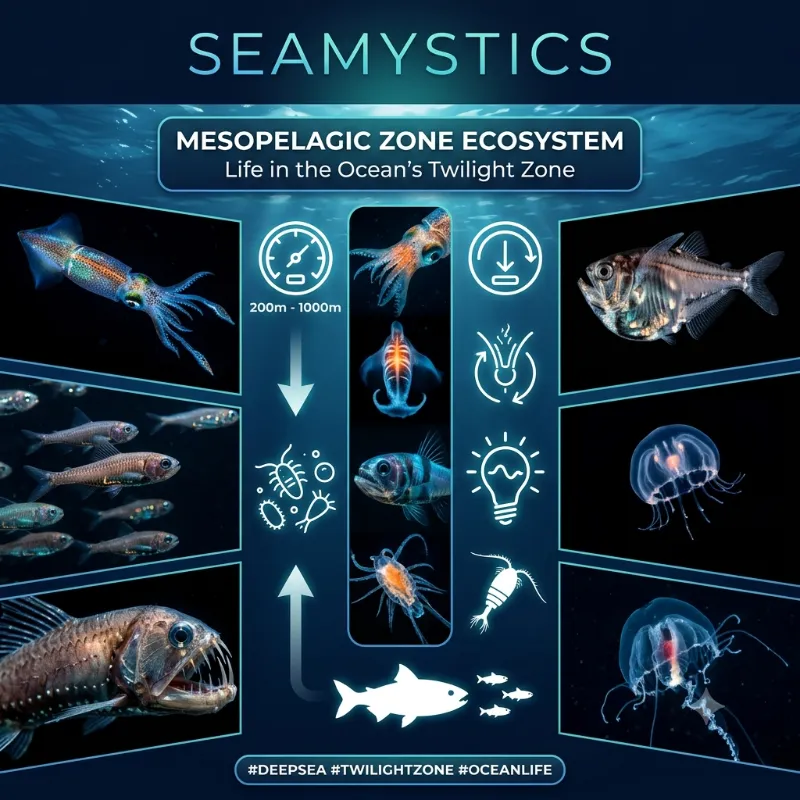
The mesopelagic zone is often nicknamed the ocean twilight zone. Specifically, it sits roughly 200 to 1,000 meters below the surface. Sunlight still reaches this layer, but only in faint traces of blue and green light. Because of that, photosynthesis cannot happen here. Even so, the water is not pitch black either. That is exactly why marine biologists call it the twilight zone.
Abyssal Plain Ecosystem What Lives on the Ocean’s Flattest Floor
This middle layer connects two very different worlds. Above it, for instance, sits the sunlit epipelagic zone, full of plankton and fast-swimming predators. Below it, meanwhile, lies the bathypelagic zone, a colder and far darker realm. In this sense, the mesopelagic zone acts like a bridge between them. According to research from Te Ara Encyclopedia, this bridge role matters a great deal. Specifically, roughly 20 percent of the food made near the surface sinks into this middle zone.
Coastal Upwelling Ecosystems Why Some Waters Explode With Life
A Wartime Discovery
During World War II, naval sonar operators stumbled onto a strange discovery here. At first, their equipment kept detecting what looked like a false sea floor at 300 to 500 meters. This appeared only during daylight hours. Strangely, that “false bottom” rose closer to the surface at night. Eventually, it turned out to be millions of living organisms rising and sinking on a daily rhythm. As a result, this discovery first hinted at just how enormous this ecosystem really is. So, want to see the opposite extreme? Our guide on the tide pool ecosystem covers a world shaped entirely by light and tides.
Meet the Animals of the Twilight Zone
Mesopelagic animals have evolved some of the strangest survival tricks in nature. Because light is scarce here, food is also patchy. As a result, nearly every trait in this zone serves one of two goals: staying hidden or finding a meal fast.
For example, here are some of the most important species you will find in this ecosystem:
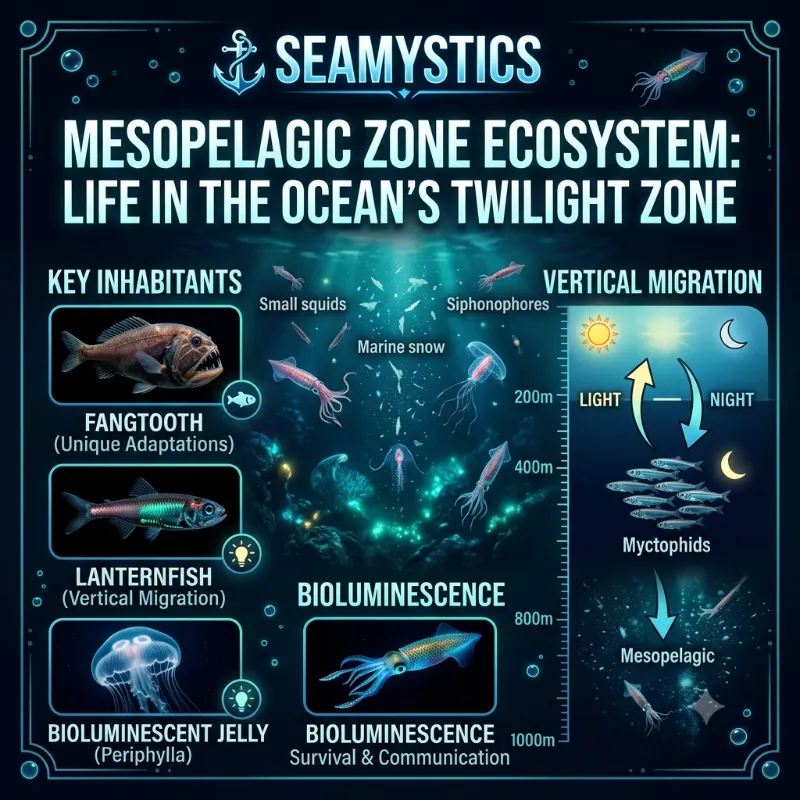
- Lanternfish (Myctophidae): Small, silvery fish with light-producing organs called photophores. Specifically, they use bioluminescence for hunting, communication, and confusing predators. In addition, their large, upward-tilted eyes help them catch faint traces of sunlight from above.
- Bristlemouths (Gonostomatidae): Tiny but almost unbelievably numerous. In fact, researchers estimate their population may reach one quadrillion individuals, roughly one million billion fish. Because of that, they would be the most abundant vertebrate on Earth.
- Deep-sea squid and jellyfish: Many produce their own glowing light to distract predators or lure in prey. According to Earth.com research, this defense is shared by an estimated 90 percent of planktonic species at these depths. Notably, anglerfish and comb jellyfish are two well-known examples.
- Anglerfish relatives: Ambush predators that conserve energy by waiting motionless rather than actively hunting. After all, food is too scarce here to burn energy chasing it.
Why So Many Species Glow
First, bioluminescence is not just a party trick. Most bioluminescent light in this zone glows blue, and that is not a coincidence. Specifically, blue light travels farther through seawater than any other color. Therefore, animals that “speak” in blue are simply using the clearest channel available to them.
Similarly, lanternfish have evolved eyes built for this exact environment. Their eyes, for instance, contain rhodopsin, a visual pigment tuned to detect blue-green wavelengths. Some species even carry tubular eyes that point straight upward. In effect, these act like built-in periscopes for spotting shadows of prey passing overhead. To see how bioluminescence compares with life near cold-water reefs, check out our piece on deep-sea coral ecosystems.
Midwater Ecosystem Facts: How Life Survives Without Sunlight
Life in a midwater ecosystem runs on a different rhythm than life near the coast. Unlike coastal habitats, this zone does not rely on local plant growth. Instead, it depends almost entirely on food falling, swimming, or migrating down from above.
Here is how the system actually functions, step by step:
- Surface plankton bloom in sunlit water during the day, feeding on nutrients and sunlight.
- Mesopelagic animals rise toward the surface at dusk, taking advantage of darkness to feed safely.
- Then, they feast through the night on plankton, small fish, and organic debris near the surface.
- At dawn, they descend back down to darker, colder water to avoid daytime predators.
- Finally, waste and dead organisms sink downward as “marine snow,” feeding animals that never migrate at all.
This daily commute is called diel vertical migration. In fact, it is considered the largest synchronized movement of biomass on Earth. According to Fiveable’s biology reference, the pattern works like this: lanternfish and similar species move upward at night to feed, then return to deeper water by day. As a result, this shapes how energy and nutrients move between ocean layers.
What Happens Near the Poles
Interestingly, this pattern breaks down entirely near the poles. Specifically, research from the University of Bergen’s Theoretical Ecology Group found something surprising. During the polar midnight sun, it is never dark enough for migrants to safely rise. Conversely, during the polar night, most of their prey sinks into a resting state, too deep and dark to reach. So, curious how marine life copes with extreme light cycles at the poles? Our guide on the polar ocean ecosystem covers that in depth.
The Ocean’s Hidden Carbon Pump
This is where the mesopelagic zone ecosystem becomes a climate story, not just a biology one. Every night, billions of migrating animals feed near the surface. Then, they carry that carbon back down with them when they descend. Essentially, scientists call this the biological carbon pump.
Overall, the scale of this process is genuinely hard to picture. According to EDF’s 2025 policy brief, this nightly migration draws down between 2 and 6 gigatons of CO2 every year. Afterward, that carbon gets locked away in deep sediments. To put that in perspective, the Marine Conservation Institute compared it to something familiar. Specifically, this annual carbon sequestration is more than double the emissions from every car on the planet combined.
| Metric | Estimated Figure | Source |
|---|---|---|
| Annual carbon sequestered | 2 to 6 gigatons of CO2 | EDF, Marine Conservation Institute |
| Share of ocean volume occupied | About 20 percent | Marine Conservation Institute |
| Share of global fish biomass | Up to 90 percent | Marine Conservation Institute |
| Estimated economic value of carbon storage | $300 to $900 billion USD annually | EDF policy brief, 2025 |
| One biomass estimate for mesopelagic fish | Around 600 million metric tons | Mongabay, citing marine science research |
Why the Numbers Vary So Much
That last figure, however, is worth pausing on. Estimates of mesopelagic fish biomass vary widely between studies. In fact, some run as high as ten times the 600 million ton figure. This gap exists mainly because the zone is so difficult and expensive to sample directly. Even so, that uncertainty is not a flaw in the science. Rather, it is a reminder of how little of this ecosystem has actually been measured firsthand.
Human Pressures: Fishing the Twilight Zone
For most of history, this ecosystem was too deep and remote for commercial fishing fleets. That, however, is changing. Because shallow-water fish stocks are declining, some operators have started eyeing mesopelagic species instead. Specifically, they are used for fishmeal, fish oil, pet food, and omega-3 supplements. Both the sheer biomass and the high fat content, therefore, make these fish attractive.
What the Latest Research Warns
A 2026 study in Global Change Biology, meanwhile, raised a pointed warning about this trend. Researchers noted that regulators currently have almost no reliable way to measure the risk. Specifically, they cannot yet calculate how much carbon transport would be lost if large volumes of mesopelagic fish were removed. In plain terms, we could start fishing an ecosystem before we finish counting what lives there.
This is not a hypothetical, either. In fact, Norway and a handful of other nations have already run pilot fishing programs. According to a Wiley-published review, industrial-scale interest in this zone has been building for decades, largely unnoticed by the public. For now, though, most experts agree that a full commercial mesopelagic fishery remains speculative. After all, locating, catching, and processing fish at these depths is still difficult and expensive.
Why Protecting the Mesopelagic Zone Ecosystem Matters
In 2025, this issue reached a genuine turning point. Specifically, the International Union for Conservation of Nature passed Motion 035. As a result, it called for a precautionary approach to any expansion of fishing or industrial activity in the zone. Essentially, regulators want a better understanding of the risks to species, food webs, and climate first. Consequently, the motion passed with strong support and is now a formal IUCN Resolution.
Where to Read the Original Research
If you want source material rather than a summary, Nature blogger Sam wrote a firsthand field account of exploring this layer of ocean. It is worth reading directly on natureaccordingtosam’s blog. Similarly, EDF has published ongoing policy coverage of the mesopelagic protection effort at edfish.org. In addition, the Woods Hole Oceanographic Institution maintains live biomass research updates at whoi.edu.
Overall, the stakes go beyond one species or one fishery. This ecosystem, after all, links surface food webs, deep-sea food webs, and the planet’s climate system all at once. For instance, tuna, swordfish, and several shark species rely on mesopelagic prey as a primary food source. As a result, the health of this zone quietly shapes commercial fisheries most people never think to connect it to. Similarly, another overlooked habitat plays an outsized ecological role. Our guide on the seamount ecosystem covers that case in shallower, rockier terrain.
For a broader view, starting from the coastline outward, our full pillar guide on the estuary ecosystem is a helpful starting point. In addition, you can browse more marine ecosystem breakdowns on the Sea Mystics homepage.
Frequently Asked Questions
What depth is the mesopelagic zone?
The mesopelagic zone generally spans 200 to 1,000 meters below the surface. Specifically, it sits between the sunlit epipelagic zone above and the dark bathypelagic zone below.
Why is it called the twilight zone?
Sunlight penetrates this deep, but only faintly, mostly in blue and green wavelengths. There is not enough light for photosynthesis, yet it is not fully dark either. That, essentially, is the definition of twilight.
What animals live in the mesopelagic zone?
Common residents include lanternfish, bristlemouths, various squid species, jellyfish, and countless zooplankton. Notably, many share one trait: the ability to produce their own light through bioluminescence.
How does the mesopelagic zone affect climate change?
Through diel vertical migration, mesopelagic animals transport carbon down to deeper ocean layers each day. As a result, this helps sequester an estimated 2 to 6 gigatons of CO2 annually.
Is commercial fishing allowed in the mesopelagic zone?
Large-scale commercial fishing is not yet widespread, though interest is growing for fishmeal and omega-3 products. Still, the 2025 IUCN Motion 035 pushed for caution before any expansion happens.
Conclusion
Overall, the mesopelagic zone ecosystem proves that some of the most important places on Earth are also the least visible. It feeds the ocean’s biggest predators. At the same time, it quietly locks away billions of tons of carbon every year. It also, notably, remains largely unmapped and undercounted. As fishing interest grows and climate pressure builds, understanding this twilight world matters more than ever. Ultimately, it is becoming a real piece of how we manage the planet’s climate and food systems going forward.
References
- Woods Hole Oceanographic Institution, Ocean Twilight Zone Biomass Research, whoi.edu
- Environmental Defense Fund, “Motion 035: Protecting the Ocean’s Mesopelagic Zone at a Critical Moment,” 2025
- Marine Conservation Institute, “Protecting the Ocean Twilight Zone”
- Mongabay, “Global conservation body takes first step to protect ocean’s twilight zone,” 2025
- Te Ara Encyclopedia of New Zealand, “The Mesopelagic Zone”
- Theoretical Ecology Group, University of Bergen, Mesopelagic Research Program
- Global Change Biology, “Hidden in Plain Sight: Decades of Industrial-Scale Fishing in the Ocean’s Twilight Zone,” 2026