
Picture a mountain range taller than the Alps, hidden completely underwater. Now picture it packed with creatures found nowhere else on Earth. That is a seamount. These underwater mountains rise from the ocean floor. Scientists have explored fewer than 300 of the roughly 200,000 seamounts believed to exist. Yet the ones we have studied reveal something remarkable. They act as oases of life in an otherwise empty deep sea. This article covers the seamount ecosystem facts that matter most. We will look at how these formations shape ocean currents, why they hold such rich seamount biodiversity, and what threatens their future.
Oyster Reef Ecosystems The Underrated Filter of Coastal Waters
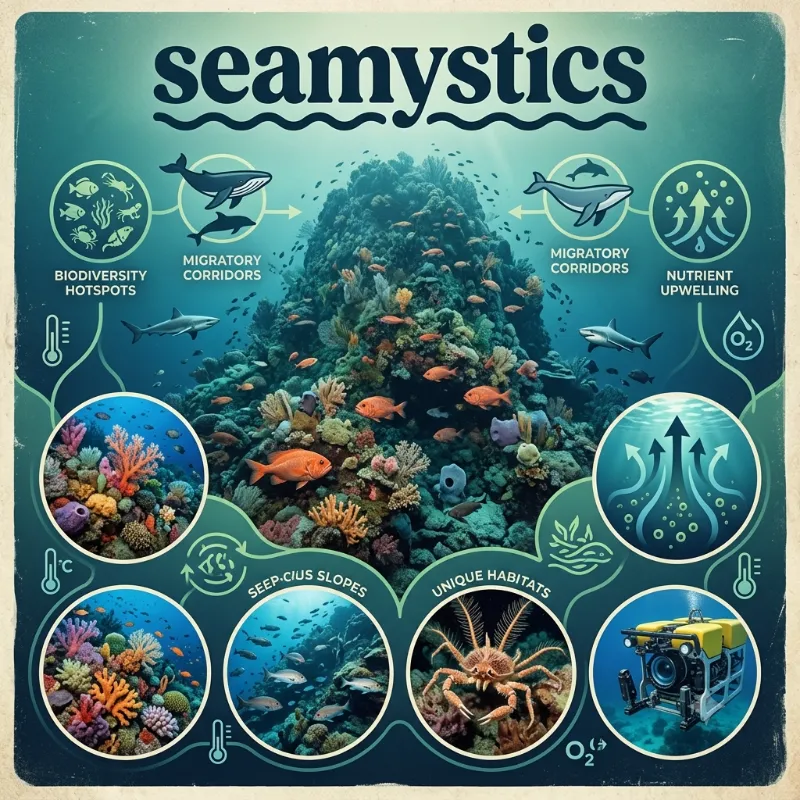
TL;DR: Seamounts are underwater volcanic mountains that boost local ocean productivity by redirecting currents and nutrients upward. This process, called the seamount effect, supports dense coral gardens, sponge fields, and large populations of fish, sharks, and marine mammals. Most seamounts remain unexplored, and slow-growing species there are highly vulnerable to fishing, mining, and warming waters.
Mesopelagic Zone Ecosystem Life in the Ocean’s Twilight Zone
Key Takeaways
| Fact | Detail |
|---|---|
| Estimated global seamount count | Around 200,000 worldwide |
| Seamounts explored so far | Fewer than 300 |
| Minimum height to qualify | Roughly 1,000 meters (about 3,280 feet) above the seafloor |
| Origin | Mostly extinct or dormant underwater volcanoes |
| Key biological process | The “seamount effect,” which traps nutrients and boosts productivity |
| Common residents | Deep-sea corals, sponges, sharks, tuna, seabirds, whales |
| Main threats | Bottom trawling, deep-sea mining, ocean warming, acidification |
| Recovery ability | Very slow; many species take centuries to regrow after damage |
What Exactly Is a Seamount
A seamount is an underwater mountain, usually of volcanic origin. It rises at least 1,000 meters above the surrounding seafloor without breaking the ocean’s surface. If it did break the surface, it would simply be called an island. Most seamounts formed millions of years ago near mid-ocean ridges or hotspots. They then drifted with the tectonic plates while slowly going dormant.
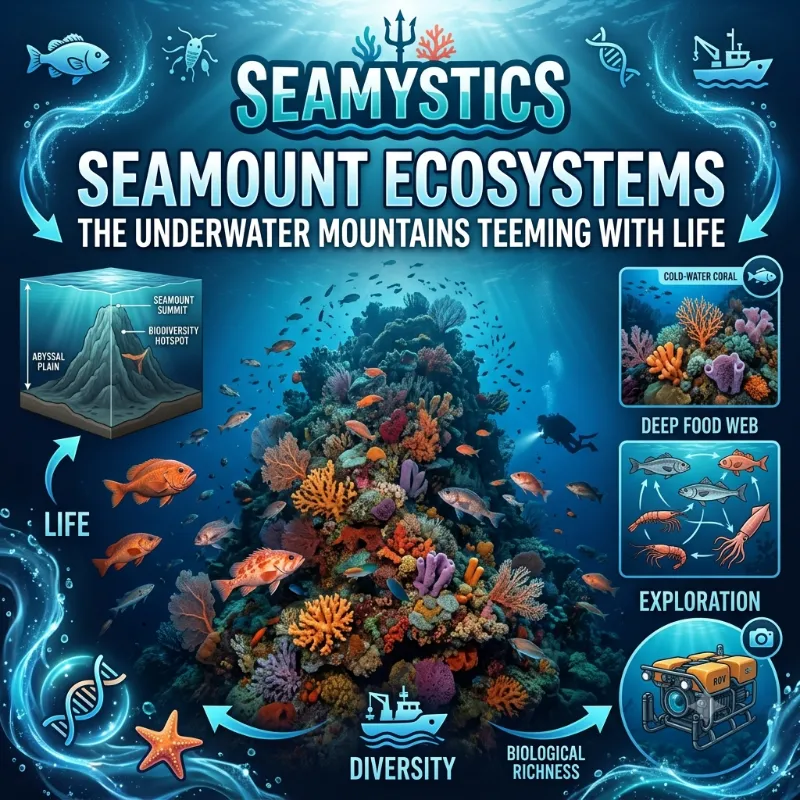
Seamount Ecosystems The Underwater Mountains Teeming With Life
This underwater mountain ocean landscape is not rare. Researchers estimate there are close to 200,000 seamounts scattered across every major ocean basin. According to the IUCN, fewer than 300 of the roughly 200,000 existing seamounts have been explored so far. That gap between what exists and what we understand is one of the biggest open questions in ocean science today. Dosi-project
For readers who want to compare seamounts with other coastal habitats, our estuary ecosystem guide breaks down how nutrient mixing works in shallower waters. The polar ocean ecosystem guide looks at productivity in colder regions.
Coastal Upwelling Ecosystems Why Some Waters Explode With Life
Why Seamounts Become Biodiversity Hotspots
The reason seamounts pack in so much life comes down to physics as much as biology. Deep ocean currents hit the steep slopes of a seamount and get pushed upward and around the structure. This creates swirling eddies and internal waves. Those waves pull cold, nutrient-rich water toward the surface.
The Nutrient Pump Effect
Complex bathymetry and mesoscale eddies create internal waves that enhance productivity above seamount summits, providing abundant food for benthic communities. In simple terms, the mountain itself becomes a nutrient pump. Phytoplankton bloom near the summit. Small fish and invertebrates feed on the phytoplankton, and larger predators follow the food chain upward. IUCN
What Makes the Habitat Work
According to NOAA’s Ocean Exploration program, several factors combine to make seamounts such reliable biodiversity hotspots:
- Hard, rocky surfaces give sessile animals like corals and sponges a place to attach. Many deep-sea animals such as corals and sponges are sessile and spend most of their lives permanently attached to rocks. PLOS
- Elevated terrain intercepts currents, concentrating food particles that would otherwise drift past in open water.
- Isolation from other habitats encourages unique, sometimes endemic, species to evolve.
- Stable hard substrate allows long-lived coral and sponge colonies to persist for centuries.
This combination is why the seamount ecosystem so often outperforms the surrounding abyssal plain in biomass. That holds true even though the open seafloor covers a vastly larger area.
Abyssal Plain Ecosystem What Lives on the Ocean’s Flattest Floor
Seamount Marine Life: Who Actually Lives There
The variety of seamount marine life depends heavily on depth, latitude, and current strength. Near the summit, in what is sometimes called the twilight zone, you find dense coral gardens and sponge fields. These form the foundation of the local food web.
The Foundation Species
Seamounts can support diverse and abundant coral and sponge grounds, which themselves create further habitat and opportunities for other organisms such as invertebrates, reef fish, sea turtles, forage fish, and their predators, including sharks, tunas, dolphins, whales, and seabirds. These communities are not quick to form. They take centuries or more to grow and are home to long-lived animals with complex interdependent relationships. That is part of why damage to a seamount can take generations to reverse, if it recovers at all. NOAA Ocean ExplorationNOAA Ocean Exploration
A Real Species Count: The Zhenbei Seamount
A 2025 study on the Zhenbei seamount in the South China Sea used environmental DNA sampling. Researchers wanted to catalogue exactly what lives in one seamount system. The numbers illustrate the scale of biodiversity involved. Scientists identified 158 species of phytoplankton, 147 invertebrate species, and 82 fish species in the area. Invertebrate and fish abundance was notably higher than in surrounding deep-sea plains. That single case study shows how much life a modest underwater mountain can support compared to flat seafloor nearby.
The Cape Verde Example
Cape Verde offers another well-documented example of seamount marine life in action. The region’s volcanic seamounts, at least 14 large mountains along with numerous smaller elevations, act as oases of life that concentrate nutrients and modify current circulation, supporting biodiversity ranging from microorganisms to deep-sea corals, sponges, sharks, turtles, seabirds, and cetaceans. Several of these formations already meet international criteria for protection. Studies show many of Cape Verde’s seamounts meet the criteria for recognition as vulnerable marine ecosystems and ecologically or biologically significant areas because of their role in productivity, ecological connectivity, and biodiversity maintenance. AuthoreaAuthorea
For a look at how similar coral communities behave in colder, darker water, see our deep-sea coral ecosystems guide. For a shallower comparison point, the tide pool ecosystem guide shows how a very different rocky habitat supports its own dense community.
Recent Expeditions Expanding Our Ocean Seamount Facts
Ocean seamount facts are still being written in real time. Recent expeditions show how quickly the picture is changing. In late 2025, researchers combined new mapping technology with biological sampling across several ocean basins.
- Near Cabo Verde, the Nola Seamount Complex mapping project produced a highly detailed digital profile of an entire seamount system in 2025. The project combined bathymetric maps with biological observations from abyssal slopes up to shallower summits, offering insight into how ecosystems change with depth and terrain. Phys.org
- In the eastern Indian Ocean, the Monsoon Rise expedition worked with the National University of Singapore and regional partners. The team mapped 8,330 square kilometers of seafloor, including 5,921 square kilometers that had never been explored before. This effort established the first comprehensive biodiversity baseline for an entire seamount chain in international waters, supporting future conservation under the UN High Seas Agreement. Phys.orgPhys.org
- On December 2, 2025, OceanX launched a new expedition with Indonesia’s national research agency BRIN into seamounts formed along the Pacific Ring of Fire, pairing detailed seafloor mapping with biodiversity research. Phys.org
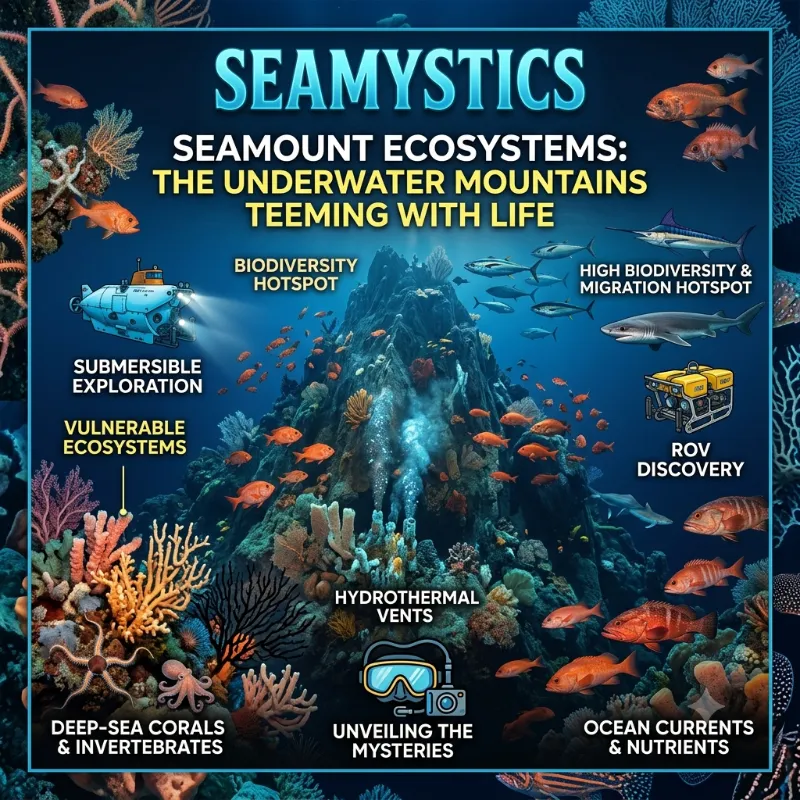
Separately, NOAA’s ongoing survey work in American Samoa is testing newer detection tools. During the 2024 E Mamana Ou Gataifale expeditions aboard E/V Nautilus, NOAA deployed the uncrewed surface vehicle DriX, the autonomous underwater vehicle Mesobot, and the Deep Autonomous Profiler to study biodiversity throughout the water column, collecting extensive eDNA samples for what is intended to be the most thorough assessment of pelagic biodiversity conducted in American Samoa. Researchers can now sample genetic material from the water itself. That speeds up discovery considerably compared to relying only on physical specimens. doaj
Threats Facing the Seamount Ecosystem
Despite their importance, seamount ecosystems face growing pressure. Recovery is not guaranteed once damage occurs. Seamount biodiversity and ecosystems face threats including deep-sea bottom fishing and deep-sea mining, and damage from overexploitation can have widespread consequences on ocean health, food security, and other benefits oceans provide to people. Dosi-project
Why Recovery Is So Difficult
The vulnerability comes down to biology as much as human activity. Many seamount species grow and reproduce slowly, making them highly vulnerable to unsustainable fishing and mineral exploration through overexploitation and habitat destruction. Seamount ecosystems recover very poorly from this kind of damage. There is no documented evidence of regrowth in these ecosystems. Additional pressures compound the problem, including pollution, invasive species, ocean warming, deoxygenation, and ocean acidification. Dosi-project + 2
A few practical realities follow from this:
- Bottom trawling can flatten centuries-old coral structures in a single pass.
- Deep-sea mining exploration is expanding into seamount-rich zones for cobalt and manganese deposits.
- Warming surface waters are shifting the depth at which productive currents form. This could disrupt the seamount effect itself.
Readers interested in how similarly fragile shallow-water habitats are managed can check our salt marsh ecosystem guide. For a look at another reef-building system under pressure, our oyster reef ecosystem guide covers comparable conservation challenges.
Why Mapping and Protection Matter Now
Scientists increasingly argue that documentation is the first real step toward protection. Mapping and documentation allow scientists and stakeholders to move from uncertainty to evidence, turning unknown terrain into defined ecosystems that can be monitored, managed, and protected. Phys.org
This is not just an academic exercise. Seamounts perform ecological work that stretches well beyond their own footprint. Seamounts play an important and only partially understood role in marine ecosystems, extending well beyond the seamounts themselves. That includes feeding grounds for migratory species like tuna and sharks. It also includes stepping stones that help larvae travel between distant habitats. Dosi-project
The Deep Ocean Stewardship Initiative sums up the ecosystem services at stake well. Their public information sheet on seamount ecosystems is a useful primary source for anyone wanting the underlying research (https://www.dosi-project.org/wp-content/uploads/seamount-info-sheet.pdf). The Woods Hole Oceanographic Institution also maintains an accessible explainer on how seamounts form and function within the wider seafloor (https://www.whoi.edu/ocean-learning-hub/ocean-topics/how-the-ocean-works/seafloor-below/seamounts/). The Ecological Society of America recently published on how individual seamounts connect into larger deep-sea networks (https://esa.org/blog/2025/12/03/revealing-ecosystem-connections-between-seamounts-in-the-deep-sea/).
Frequently Asked Questions
What is a seamount ecosystem, in simple terms?
It is the community of life, from plankton to whales, that forms around an underwater mountain. Nutrient-rich currents, which the mountain itself helps create, support that community.
How many seamounts exist in the ocean?
Estimates put the number near 200,000 globally. Fewer than 300 have been studied closely enough to describe their ecosystems in detail.
Why do seamounts have so much marine life compared to flat seafloor nearby?
Their steep slopes redirect deep currents upward. This concentrates nutrients near the summit and fuels a food chain that starts with phytoplankton and ends with large predators.
Are seamounts protected by law?
Some are, particularly those recognized as vulnerable marine ecosystems or included in marine protected areas. Most remain unmapped and unprotected under current international frameworks.
Can a damaged seamount ecosystem recover?
Recovery is extremely slow. In many documented cases, it has not been observed at all, since the corals and sponges that anchor these ecosystems can take centuries to regrow.
Conclusion
Seamounts prove that even in the darkest, most remote parts of the ocean, geography can create abundance. A single underwater mountain can concentrate more life than square kilometers of flat seafloor around it, simply by bending currents in the right direction. Mapping technology keeps improving. Expeditions like Monsoon Rise and the OceanX Ring of Fire project continue through 2025 and 2026. Our picture of seamount biodiversity is growing fast. So is the pressure these ecosystems face from fishing, mining, and a warming ocean. Protecting what we are only beginning to understand may be one of the more urgent tasks in ocean conservation today.
Dr. Rabica has spent two decades studying deep-sea habitat ecology and regularly reviews new seamount and deep-sea coral research for Sea Mystics. She holds a doctorate in marine biology with a research focus on deep-water benthic ecosystems.
References
- IUCN, Seamount Conservation Issues Brief, https://iucn.org/resources/issues-brief/seamount-conservation
- OceanX, Seamounts: Mountains of the Deep, https://oceanx.org/blog/seamounts-mountains-of-the-deep/
- Orejas et al., Seamounts of Cabo Verde: A review of their ecological and economic significance, Progress in Oceanography (2026), via Phys.org, https://phys.org/news/2025-11-seamounts-cape-verde-biodiversity-hotspot.html
- Authorea preprint, A perspective on quantifying the attractiveness of seamounts for marine megafauna, https://www.authorea.com/doi/full/10.22541/au.174599647.77520271/v2
- Deep-Ocean Stewardship Initiative, The Seamount Ecosystem Information Sheet, https://www.dosi-project.org/wp-content/uploads/seamount-info-sheet.pdf
- NOAA Ocean Exploration, Why Are Seamounts Hot Spots for Biodiversity, https://oceanexplorer.noaa.gov/facts/seamounts-biodiv.html
- NOAA National Marine Sanctuaries, Five Reasons Seamounts Matter, https://sanctuaries.noaa.gov/news/2025/reasons-seamounts-matter.html
- Chen, Jia, and Zhang, Does the Zhenbei Seamount Harbor Distinctive Biodiversity, Global Ecology and Conservation (2025), https://doaj.org/article/dc2c733c801741adb82fa29fa43b2d09
- Woods Hole Oceanographic Institution, Seamounts, https://www.whoi.edu/ocean-learning-hub/ocean-topics/how-the-ocean-works/seafloor-below/seamounts/
- Ecological Society of America, Revealing Ecosystem Connections Between Seamounts in the Deep Sea, https://esa.org/blog/2025/12/03/revealing-ecosystem-connections-between-seamounts-in-the-deep-sea/