
If you dropped a glass of murky harbor water next to a tank holding a dozen healthy oysters, you would see the difference within an hour. That is not a marketing trick. It is the daily, unpaid work of the oyster reef ecosystem, a living structure that quietly cleans, shelters, and protects our coastlines while almost nobody notices. As a marine biologist who has spent years wading through tidal flats from the Chesapeake Bay to the Gulf Coast, I have watched cloudy water turn clear near a healthy reef, and it never stops feeling like a small miracle.
This guide breaks down what an oyster reef ecosystem actually does, why it matters for coastal towns and fisheries, and what real restoration projects are proving on the ground today.
Mesopelagic Zone Ecosystem Life in the Ocean’s Twilight Zone
Key Takeaways
| Topic | Quick Fact |
|---|---|
| Filtration power | A single adult oyster can filter up to 50 gallons of water a day under ideal lab conditions, though field averages run closer to 3 to 12 gallons daily |
| Habitat value | One oyster reef can shelter more than 300 species of fish, crabs, and invertebrates |
| Restoration scale | The Billion Oyster Project has restored more than 150 million oysters to New York Harbor as of December 2025 |
| Economic role | Virginia’s oyster industry alone contributes more than 30 million dollars a year to the state economy |
| Biggest threat | More than 85 percent of the world’s oyster reefs have been lost compared to historic levels |
TL;DR: An oyster reef ecosystem is a living, self-building coastal habitat that filters pollutants, shelters marine life, and buffers shorelines from storms, all for free. Oyster reef restoration projects like the Billion Oyster Project and Chesapeake Bay efforts are proving that these reefs can bounce back with the right support. Protecting oyster bed habitats is one of the most cost-effective ways coastal communities can fight pollution and erosion at the same time.
Seamount Ecosystems The Underwater Mountains Teeming With Life
What Is an Oyster Reef Ecosystem, Really
An oyster reef ecosystem forms when oyster larvae, called spat, attach themselves to older shells or hard surfaces and grow together over years. Layer by layer, the shells fuse into a rock-like structure. That structure is not just a pile of shellfish. It is a living apartment building for hundreds of coastal species.
Marine biologists often call oysters ecosystem engineers, a term that also applies to beavers and coral. Instead of eating and moving on, oysters physically build the habitat that other species depend on. Fish hide in the crevices. Crabs forage along the edges. Shorebirds hunt the shallows around the reef at low tide.
Coastal Upwelling Ecosystems Why Some Waters Explode With Life
This is different from an oyster farm, where oysters are grown in cages mainly for the seafood market. A true oyster reef ecosystem grows wild or semi-wild, and its main job is ecological rather than commercial, even though the two often work side by side.
Where Oyster Reef Ecosystems Thrive
Oyster reefs need three things to survive long term: brackish water where salt and fresh water mix, a hard surface to attach to, and calm enough currents that spat are not swept away before they settle. That combination shows up naturally in a few coastal zones.
- Estuaries and river mouths, where tides and freshwater rivers meet
- Salt marsh edges and tidal creeks
- Shallow bays with moderate wave action
- Sheltered harbors, including urban ones like New York Harbor
If you want to understand how these zones connect, our guide on the estuary ecosystem explains the broader tidal environment that oyster reefs depend on for survival.
How the Coastal Filter Ecosystem Actually Works
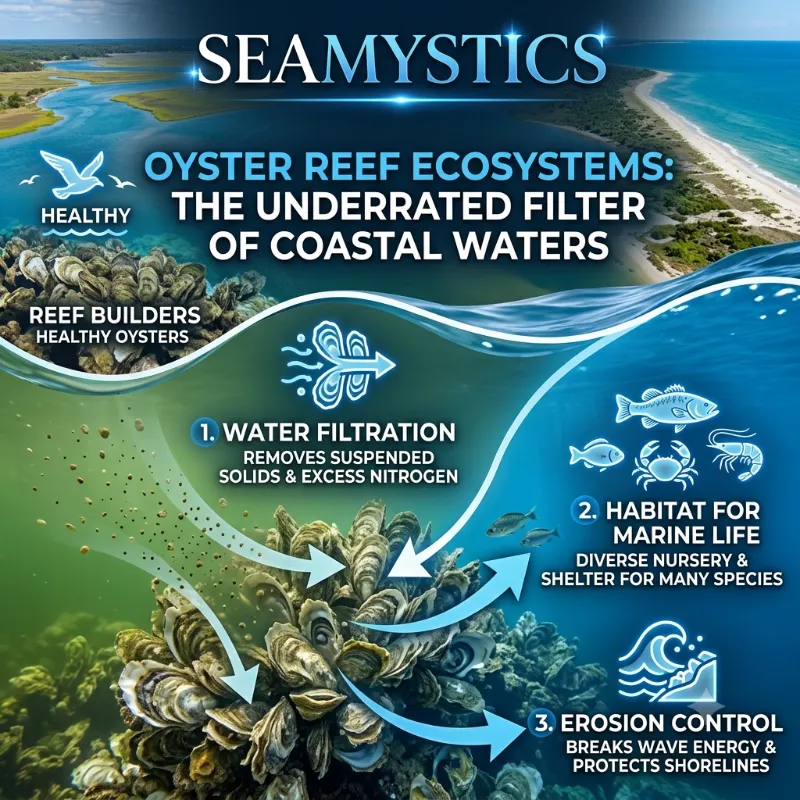
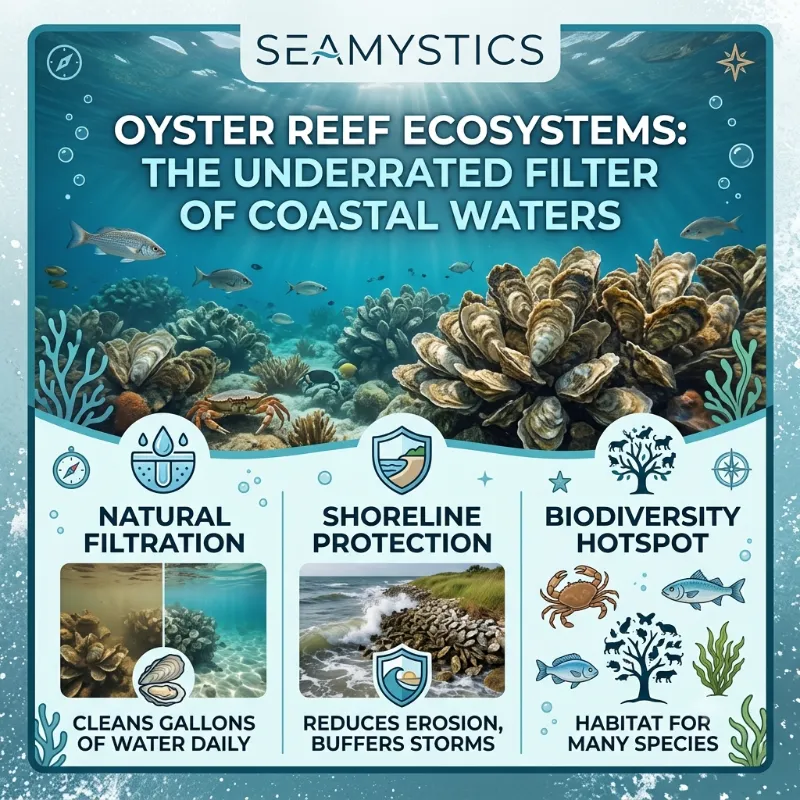
Here is where the science gets genuinely impressive. Oysters feed by pulling water through their gills and straining out algae, sediment, and organic particles. According to NOAA Fisheries, a single oyster can filter up to 50 gallons of water a day under strong conditions.
That headline number gets repeated everywhere, but it deserves context. Researchers writing in the Bay Journal have pointed out that the 50-gallon figure reflects near-maximum lab performance, and that wild filtration rates typically run closer to 3 to 12 gallons per oyster per day, depending on water temperature, food availability, and oxygen levels. Even at the lower end, a healthy reef with thousands of oysters adds up fast.
Abyssal Plain Ecosystem What Lives on the Ocean’s Flattest Floor
What Oysters Remove From the Water
As oysters filter, they strip out more than just cloudiness. This is the part of the coastal filter ecosystem that has the biggest ripple effect on water quality.
- Excess nitrogen and phosphorus from fertilizer runoff and septic systems, which they lock into their shells and tissue
- Suspended sediment, which improves how far sunlight can reach underwater plants
- Algae and phytoplankton, which prevents the algal blooms that cause low-oxygen dead zones
- Bacteria and organic debris that would otherwise accumulate on the seafloor
The Chesapeake Bay Foundation notes that historically, the Bay’s oyster population could filter a volume of water equal to the entire Bay, roughly 19 trillion gallons, in about a week. Today, with populations reduced by overharvesting and disease, it would take the remaining oysters more than a year to do the same job. That single comparison tells you almost everything about why oyster loss matters.
Filtration Snapshot by Region
| Region | Reported Filtration Rate per Oyster | Source Basis |
|---|---|---|
| Laboratory, ideal conditions | Up to 50 gallons per day | NOAA Fisheries |
| Chesapeake Bay, field average | 3 to 12 gallons per day | Bay Journal fisheries reporting |
| Virginia tidal rivers | Up to 50 gallons per day (peak) | Regional restoration monitoring |
| General estuarine bivalves | 5 to 10 gallons per day (moderate species) | Aquaculture biofiltration research |
Oyster Bed Habitat: Life Inside the Reef
Walk along the edge of a healthy oyster bed habitat at low tide and you will notice the sound first, a soft popping and clicking from thousands of tiny creatures moving through the shell layers. That noise is the sound of biodiversity at work.
A mature reef supports far more than oysters. Juvenile fish use the gaps between shells as nursery space, hiding from larger predators while they grow. Mud crabs, grass shrimp, and blennies live permanently among the shells. Larger predatory fish, including striped bass and red drum, patrol the reef edges to hunt.
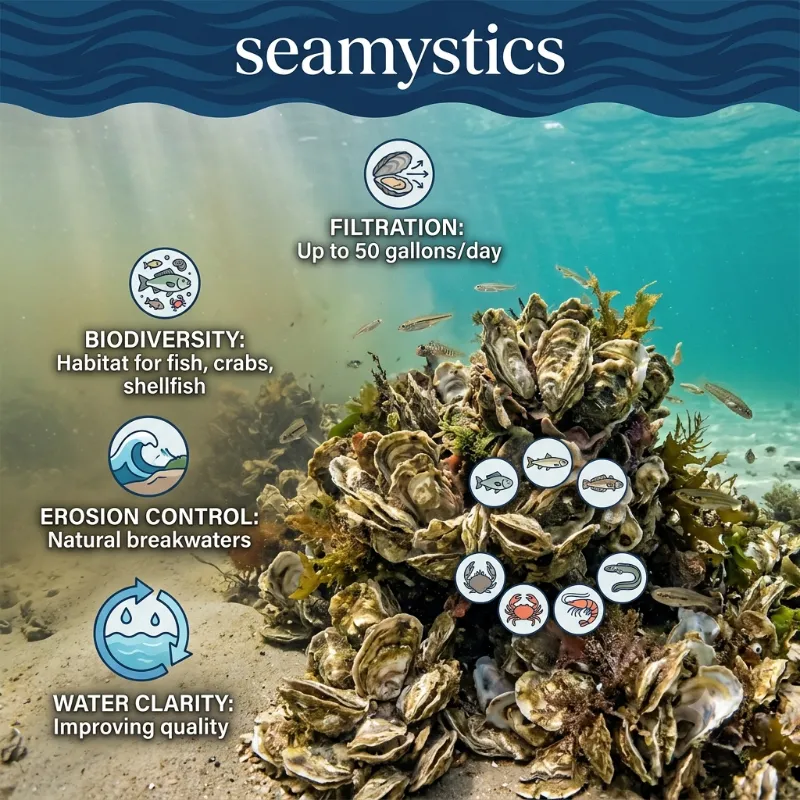
Compare that density of life to a flat, muddy seafloor nearby, and the difference is stark. Bare mud might support a handful of species. A single acre of restored oyster reef can support several hundred species when fully established, according to habitat monitoring cited by NOAA and multiple state restoration programs.
This layered habitat effect is similar to what happens in a healthy salt marsh ecosystem, where structure alone, not just food, drives biodiversity.
Storm and Shoreline Protection
Beyond biodiversity, oyster reefs act as natural breakwaters. Their hard, uneven surface absorbs wave energy before it reaches the shoreline, which reduces erosion and softens the impact of storm surges. Coastal engineers increasingly use this quality on purpose, building living shorelines that combine oyster reef structures with marsh grass planting instead of relying only on concrete seawalls.
Governor Kathy Hochul’s office announced in July 2024 that a new oyster reef project at Jamaica Bay, New York, deployed 50,000 one-year-old oysters as part of a broader plan to add roughly 20 million oysters to that single reef site, with the explicit goal of strengthening shoreline defenses against coastal flooding. That is not a small pilot project. That is a state government treating oyster reefs as real infrastructure.
Oyster Reef Restoration: Real Projects, Real Numbers
Talk is cheap in conservation. Numbers are not. A few ongoing restoration efforts show what oyster reef restoration looks like when it is properly funded and organized.
New York Harbor, Billion Oyster Project. Founded in 2014, this program set a goal of restoring one billion oysters to New York Harbor by 2035. As of December 2025, the project had restored more than 150 million oysters across roughly 17 acres of reef, working with more than 100 city schools and thousands of student volunteers. You can follow their ongoing partnership work directly on the Billion Oyster Project blog, which documents specific watershed collaborations in real time.
Chesapeake Bay, multi-state effort. The Chesapeake Bay oyster restoration program is now considered one of the largest reef restoration efforts in the world, spanning hundreds of restored acres across multiple tributaries in Maryland and Virginia. Long-term monitoring has shown that fish and crab populations on restored reefs climb noticeably compared to bare or young reefs, and the gap widens as the reefs mature over several years.
Regional advocacy and reef revival work. Organizations tracking bay-wide recovery, including the team behind Reef Revival: Counting on Oysters for a Healthier Bay, have documented how community-led shell recycling programs feed directly into new reef construction, turning restaurant waste into future habitat.
Independent restoration innovators. Smaller, more experimental groups are also pushing the field forward. The team at Oyster Heaven has been publishing detailed field notes on reef restoration techniques, including work on scaling reef-building methods that could apply well beyond a single bay or harbor.
Steps Involved in a Typical Oyster Reef Restoration Project
Restoration is not as simple as dumping shells into water and walking away. A functioning project generally follows this sequence.
- Site assessment to confirm salinity, water depth, and current strength suit oyster survival
- Shell or substrate collection, often recycled from restaurants and seafood processors
- Curing the shell for several months to remove bacteria and odor
- Seeding the cured shell with hatchery-raised spat, or placing it where wild spat naturally settle
- Deploying the reef structure to the site, often using barges or hand placement in shallow zones
- Long-term monitoring of oyster survival, density, and the species using the new habitat
Skipping steps, especially the monitoring phase, is one of the most common reasons early oyster restoration projects failed to establish self-sustaining reefs.
Oyster Reef Facts Worth Knowing
Some numbers about oyster reef ecosystems are surprising even to people who grew up near the coast.
- More than 85 percent of the world’s oyster reefs have disappeared compared to historic baselines, making them one of the most severely degraded marine habitats on the planet
- A healthy reef can grow vertically as fast as several inches per year under strong recruitment conditions
- Oysters can live 10 to 20 years or longer in the wild when reefs are protected from overharvesting
- Virginia’s oyster industry contributes more than 30 million dollars annually to the state economy, on top of the ecological filtering value
- New York Harbor’s Billion Oyster Project has recycled more than 2.5 million pounds of oyster shells from local restaurants to build new reef substrate
Threats Facing the Oyster Reef Ecosystem Today
It would be dishonest to write this without covering why so many reefs disappeared in the first place. Three pressures dominate.
Overharvesting. Wild oyster populations in places like the Chesapeake Bay were fished at unsustainable rates for more than a century, stripping reefs down to a fraction of their original mass long before modern regulation caught up.
Disease. Pathogens such as Dermo and MSX have killed off large sections of wild oyster populations, especially in warmer, more stressed waters.
Water quality decline. Ironically, the same nutrient pollution that oysters help filter can also overwhelm and kill them when concentrations spike too high, particularly during low-oxygen events in late summer.
Climate change adds a layer of uncertainty on top of all three, since warming water and shifting salinity patterns can push reefs outside the narrow conditions they need to reproduce successfully.
How Coastal Communities Can Support Oyster Bed Habitats
You do not need a marine biology degree to help protect these ecosystems. A handful of practical actions make a measurable difference over time.
- Support restaurant shell recycling programs, which supply the raw material for new reef construction
- Volunteer with local restoration groups during reef-building events, many of which welcome families and students
- Avoid disturbing wild reefs while boating or wading, since a single misplaced anchor can crush years of growth
- Push for local policy that limits nutrient runoff from lawns, farms, and septic systems near estuaries
- Choose sustainably farmed oysters when eating out, since responsible aquaculture reduces pressure on wild reef populations
If you are curious how oyster reefs compare to other coastal habitats doing similar filtering and sheltering work, our guide to the tide pool ecosystem covers a related but distinct type of intertidal environment worth exploring next.
Frequently Asked Questions
What is an oyster reef ecosystem?
It is a living coastal habitat built from generations of oyster shells fused together, providing water filtration, shelter for marine species, and shoreline protection.
How much water can oyster reefs really filter?
Individual oysters can filter up to 50 gallons a day under ideal conditions, though realistic field averages usually fall between 3 and 12 gallons per day per oyster.
Are oyster reefs the same as oyster farms?
No. Oyster farms are typically managed for seafood production, while oyster reef ecosystems are focused on ecological function, though restoration projects sometimes combine both goals.
Why are oyster reefs disappearing?
Overharvesting, disease, and declining water quality have combined to wipe out more than 85 percent of historic oyster reef habitat worldwide.
Can oyster reef restoration actually work?
Yes. Programs like the Billion Oyster Project and the Chesapeake Bay restoration effort have documented measurable increases in oyster populations, reef acreage, and associated fish and crab biodiversity over the past decade.
Conclusion
The oyster reef ecosystem does not ask for attention, and that is exactly why it gets overlooked. There is no dramatic wildlife footage, no bright coral colors, just quiet, steady filtration happening beneath the surface of harbors and bays every single day. But the numbers behind that quiet work, trillions of gallons filtered, hundreds of species sheltered, millions of dollars in economic value, tell a different story. Protecting and rebuilding these reefs is one of the most practical, cost-effective steps coastal regions in the United States and Europe can take toward cleaner water and stronger shorelines. The reefs already know how to do the job. They just need the chance to grow back.
References
- NOAA Fisheries, Oyster Reef Habitat
- Chesapeake Bay Foundation, Oyster Fact Sheet
- Bay Journal, Pumped-up performance: Oysters’ filtering feat overstated
- Billion Oyster Project, official restoration data and blog updates
- Estuaries.org, Reef Revival: Counting on Oysters for a Healthier Bay
- New York State Governor’s Office, press release on Jamaica Bay oyster reef project, July 2024
For a broader look at connected coastal habitats, see our guides on the polar ocean ecosystem and deep sea coral ecosystems, or start from our full estuary ecosystem library at seamystics.com.