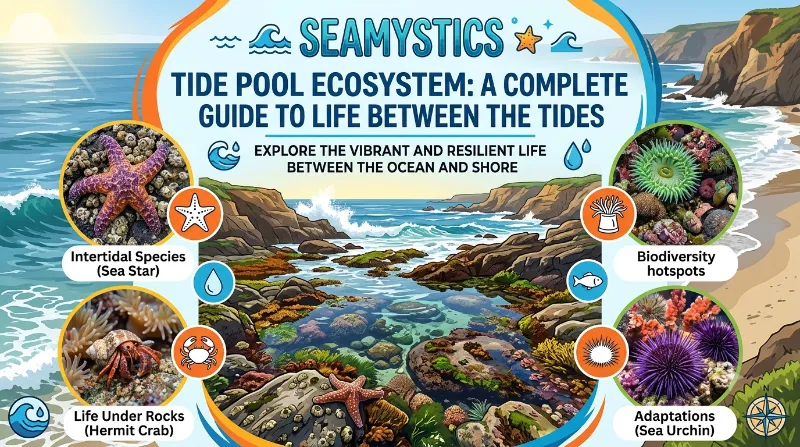

Stand at the edge of a rocky shore right after the water pulls back, and you will see something strange happen. Small pools appear between the rocks, and inside them, an entire world wakes up. This is a tide pool ecosystem, and it is one of the toughest, busiest habitats on our planet. Because the water rises and falls twice a day, the creatures living here face constant change. Even so, they still manage to grow, feed, and reproduce in record numbers. In this guide, we will walk through what makes this ecosystem tick, which animals call it home, and why scientists like myself are watching it so closely in 2026.
Polar Ocean Ecosystems How Life Survives Beneath Arctic Ice
Key Takeaways
| Topic | Quick Fact |
|---|---|
| What it is | A shoreline habitat that floods at high tide and drains at low tide, trapping seawater in rocky pools |
| Location | Found along rocky coastlines worldwide, common on the US West Coast and New England coast |
| Main zones | Spray zone, high zone, mid zone, low zone |
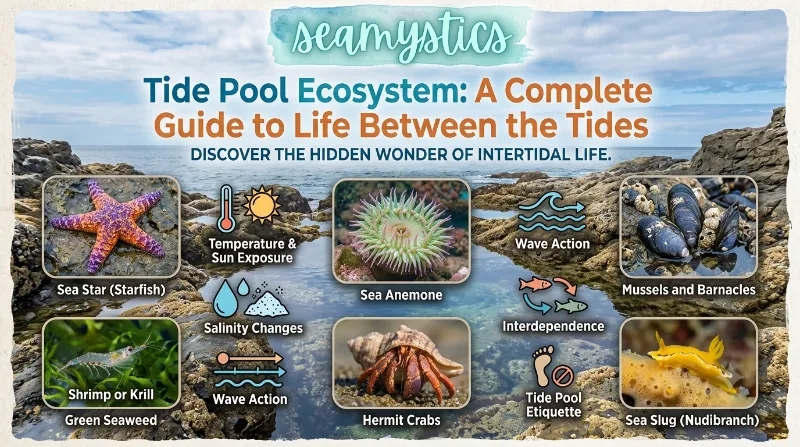
| Common creatures | Sea stars, anemones, hermit crabs, barnacles, mussels, chitons, nudibranchs |
| Biggest threat | Marine heatwaves and ocean acidification, with West Coast waters running 3 to 4°F above normal in late 2025 |
| Best time to visit | Low tide under 0.5 feet, ideally during daylight |
| Conservation tip | Look, photograph, and put every rock back exactly as you found it |
TL;DR
A tide pool ecosystem is a shoreline habitat where seawater gets trapped in rocky depressions as the tide goes out. As a result, small worlds packed with sea stars, anemones, crabs, and algae form almost overnight. These pools sit inside the intertidal zone, so they are ruled by daily flooding, blazing sun, and shifting salt levels. Only tough, adaptable creatures survive there, and right now, rising ocean temperatures and disease are testing that toughness like never before.
What Is a Tide Pool Ecosystem?
A tide pool ecosystem forms where the ocean meets rocky land, in an area scientists call the intertidal zone. Twice a day, gravity from the moon pulls seawater away from the shore. Consequently, it leaves behind pockets of water trapped in cracks, dips, and crevices. This zone stretches anywhere the ocean meets the land, from steep rocky ledges to long sloping sandy beaches and mudflats that can extend for hundreds of meters. Each pool then becomes its own miniature aquarium until the tide returns. NOAA National Ocean Service
What makes this ecosystem so interesting is the sheer amount of change packed into a few hours. Water temperature, oxygen, salt content, and light all swing wildly between high tide and low tide. During the day, algae inside these pools carry out photosynthesis. Because of this, oxygen levels can climb so high that bubbles rise from the water. Meanwhile, this same process can send the pH swinging hard in the opposite direction once night falls. Few habitats on earth ask their residents to handle that much daily stress.
The Four Zones of the Intertidal
Marine biologists split the shoreline into layers based on how often each strip of rock gets wet. Understanding these bands is the fastest way to predict which animals you will find where.
- Spray zone: Barely touched by waves, only splashed during storms or extreme high tides.
- High intertidal zone: Floods during peak high tides but stays dry for long stretches in between.
- Mid intertidal zone: Covered and exposed for roughly equal amounts of time each day.
- Low intertidal zone: Rarely exposed to air, and because of that, it holds the richest biodiversity of the four.
The low tide zone is only exposed during low tide and has the greatest biodiversity of the three main zones because it offers more favorable conditions for organisms that cannot tolerate long stretches of air exposure. This is exactly why experienced tidepoolers head toward the lowest, wettest rocks first. National Geographic
Why Tide Pools Form
Tide pools appear because rocky shorelines are uneven. When the tide drains away, gravity pulls most water back to sea. However, low spots in the rock hold small puddles behind. Consequently, these puddles become shelters for animals that cannot survive being fully exposed to sun and air.
If you would like to see how this same tidal rhythm shapes a very different coastal habitat, our guide to the estuary ecosystem breaks down how rivers and oceans mix further inland.
Tide Pool Animals: Who Actually Lives Here
Ask any beachgoer to name tide pool animals, and sea stars usually come up first. However, the real cast of characters is much bigger, and each species has carved out its own survival strategy. Because space is limited and food is seasonal, competition inside these pools stays fierce all year.
Oyster Reef Ecosystems The Underrated Filter of Coastal Waters
| Creature Group | Example Species | Survival Trick |
|---|---|---|
| Echinoderms | Ochre sea star, purple sea urchin | Tube feet grip rock; can regrow lost arms |
| Cnidarians | Giant green anemone, aggregating anemone | Retract tentacles and close up to trap water |
| Crustaceans | Hermit crab, shore crab | Borrow shells or hide in crevices |
| Mollusks | California mussel, black tegula snail | Clamp shells shut to lock in moisture |
| Chitons | Gumboot chiton, mossy chiton | Flatten body against rock to resist waves |
| Fish | Tidepool sculpin, monkeyface prickleback | Breathe air briefly and hide under wet seaweed |
California tidepool flora and fauna show a dazzling array of colors, body shapes, and adaptations that help them thrive in the harsh conditions at the ocean’s edge. This diversity is not random at all. Instead, every shape and behavior solves a specific problem tied to waves, heat, or hungry predators. calacademy
A Real Case Study: Sea Stars and the Wasting Disease Crisis
In 2013, a mysterious illness began sweeping through West Coast tide pools. Soon after, it became one of the largest marine die-off events ever documented. Sea star wasting disease has driven one of the largest marine invertebrate mass mortality events ever recorded, affecting sea star populations from Alaska all the way down to Baja California, Mexico, since 2013. Healthybay
The scale of the crash was staggering. In Oregon alone, researchers tracked the fallout closely. Sea star wasting disease first appeared in Oregon in April 2014 and had spread along most of the coast by June. By that summer, up to 90 percent of individuals showed visible signs of disease. Furthermore, density of the keystone sea star Pisaster ochraceus dropped by 59 to 84 percent at monitored sites, while biomass fell by as much as 90 percent by September 2014. PLOSPLOS
The good news is that recovery looks different depending on where you stand on the coast. Oregon and northern California sites currently show the most positive picture, with substantial recruitment and successful juvenile survivorship in recent years. In fact, some sites now hold higher star counts than before the outbreak, though size distributions still skew toward smaller individuals. Meanwhile, populations further north in Washington and Alaska have been slower to bounce back. Ucsc
From firsthand fieldwork, I can tell you this pattern is visible without a microscope. Walk a healthy Oregon tide pool bench today, and small orange and purple stars are wedged into nearly every crevice. That sight felt almost impossible a decade ago. Because of that, long-term monitoring, not one-off snapshots, matters so much in marine science.
How Tide Pool Creatures Survive Such a Harsh World
Living between the tides means adapting to conditions that would kill most animals within hours. Over millions of years, tide pool species developed clever tricks to cope with drying air, crashing waves, and shifting salt levels. Below are the main strategies that keep them alive.
Mesopelagic Zone Ecosystem Life in the Ocean’s Twilight Zone
Sealing In Moisture and Sticking Tight
Barnacles and mussels clamp their shells shut at low tide. By doing this, they trap a private supply of seawater inside their bodies. Similarly, sea stars and chitons use suction-like tube feet or a muscular foot to stay glued to rock, even as waves slam into them.
Hiding, Clustering, and Tolerating Change
Mussels and barnacles often grow in tight groups, and this cuts down how much surface area each individual exposes to drying sun. Meanwhile, crabs and small fish duck under wet seaweed mats the moment the water drains away. On top of that, as tides rise and fall, salinity constantly changes, so animals living in the intertidal zone must be able to tolerate wide swings in salt concentration. SeaWorld
These adaptations did not appear overnight, and that is part of what makes intertidal zone facts so compelling to researchers. Each trick represents thousands of years of trial and error against an unforgiving shoreline.
A Practical Tide Pool Guide: How to Explore Safely
If you want to see this ecosystem for yourself, timing and preparation matter more than almost anything else. Low tide pooling can be deeply rewarding, but it also carries real risks if you go in unprepared.
Follow these steps for a safe, respectful visit:
- Check a tide chart first. Aim for a low tide under 0.5 feet during daylight hours, since lower tides expose more pools and more species.
- Wear the right shoes. Rubber boots or sturdy, closed-toe shoes with good grip work far better than sandals on slick, algae-covered rock.
- Watch the water at all times. Waves can surge without warning, so never turn your back on the ocean while exploring.
- Step on bare rock, not living creatures. Mussel beds, barnacle clusters, and seaweed mats are homes, not stepping stones.
- Look, do not take. Leave shells, rocks, and animals exactly where you found them, since removing them can be both harmful and, in many areas, illegal.
- Put rocks back gently. If you lift a rock to peek underneath, return it to its original position so sheltered animals are not exposed or crushed.
Coastal science centers make this kind of trip much easier for beginners. For example, Seacoast Science Center in New Hampshire runs guided tide pool experiences at Odiorne Point State Park, where naturalists point out resident hermit crabs. On a lucky day, visitors even spot a sea star among the rocks. If you are on the West Coast instead, the California Academy of Sciences tidepooling guide lists beginner-friendly sites from Del Norte County down to Cabrillo National Monument, along with free apps like iNaturalist for identifying what you find.
Families visiting Oregon have another great option worth checking out too. Specifically, the Oregon coast hosts organized outings such as the Explore Lincoln City tide pool experience, which pairs a guided walk with hands-on learning for kids and adults alike. These programs are a smart first step if you have never explored a rocky shore before, since a guide can point out hazards and species you might otherwise miss entirely.
For a closer look at another coastal habitat that shares many of these same tidal rhythms, our piece on the salt marsh ecosystem is worth a read after this one.
Threats Facing Tide Pool Ecosystems Today
Tide pools have always been tough places to live, but recent years have added new layers of stress on top of the old ones. Warming oceans, disease, and human traffic are now colliding in ways that worry many marine scientists, myself included.
Coastal Upwelling Ecosystems Why Some Waters Explode With Life
Rising Ocean Temperatures
Marine heatwaves have become a near-yearly event along the West Coast, and the pattern has grown harder to ignore. Large marine heatwaves occurred in each of the last seven years from 2019 through 2025, and six of those seven were among the largest on record for the eastern North Pacific since monitoring began in 1982.
The most recent spike was dramatic. Specifically, the current heatwave raised West Coast water temperatures roughly 3 to 4 degrees Fahrenheit above normal. Then, on September 9, 2025, the northeast Pacific reached its highest ever recorded average temperature of about 69 degrees Fahrenheit. That reading was nearly half a degree warmer than any prior measurement. NOAA Fisheries
Seamount Ecosystems The Underwater Mountains Teeming With Life
| Marine Heatwave Snapshot | Detail |
|---|---|
| Peak record date | September 9, 2025 |
| Peak temperature | About 69°F (20.6°C), a new record |
| Temperature above normal | 3 to 4°F |
| Comparable past event | “The Blob,” 2013 to 2016 |
| Consecutive heatwave years | 2019 through 2025 |
| Known ecological risk | Harmful algal blooms, species range shifts, die-offs |
Warm water hits tide pool ecosystems especially hard because these pools already heat up fast under direct sun. Add a warmer starting baseline, and low tide can turn a shallow pool into something closer to a hot bath for creatures that never evolved to handle it.
Disease and Pollution
Sea star wasting disease, discussed earlier, has not fully disappeared. However, researchers recently pinpointed part of the cause. A 2025 study led by researchers at the Hakai Institute identified a novel strain of the bacteria Vibrio pectenicida, named strain FHCF-3, as a causative agent behind wasting disease in sunflower sea stars. That discovery gives conservationists a clearer target for future recovery work. Ucsc
Pollution adds a separate layer of pressure. For instance, intertidal ecosystems face an ongoing battle with human-caused pollution, from trash left behind by visitors to debris washing ashore during high tide or arriving through storm outfall pipes. Because tide pools are small and mostly enclosed, a little trash goes a long way toward disrupting water quality. Cabrillo Marine Aquarium
Ocean Acidification
As oceans absorb more carbon dioxide, the water itself becomes more acidic. As a result, that chemistry shift makes life harder for shell-building creatures. Ocean acidification makes it increasingly difficult for intertidal species that rely on calcium to grow their shells and exoskeletons. Mussels, barnacles, snails, and urchins all depend on that same calcium chemistry to survive. Cabrillo Marine Aquarium
Why Tide Pool Ecosystems Matter Beyond the Shoreline
It would be easy to think of tide pools as a small, self-contained curiosity, but their role stretches far beyond the rocks they sit on. Birds rely on them for food, storm buffers protect nearby coastlines, and scientists use them as an early warning system for ocean health.
A Vital Link in the Coastal Food Web
Larger marine animals such as seals, sea lions, and fish find ideal foraging opportunities in the intertidal zone at high tide. Meanwhile, shorebirds search for meals across that same zone once the tide drops. Because of this layered feeding pattern, tide pools connect directly into the wider coastal food web, linking rocky shorelines to open ocean and to land-based wildlife in one continuous chain. NOAA National Ocean Service
A Warning System for Ocean Health
Since tide pool species react quickly to temperature and chemistry changes, researchers also treat them as a kind of coastal thermometer. For example, when a normally rare species suddenly shows up in large numbers, it often signals a shift worth investigating further. Likewise, when a common species vanishes from a site it has occupied for decades, that absence tells its own story.
Abyssal Plain Ecosystem What Lives on the Ocean’s Flattest Floor
Frequently Asked Questions
What is a tide pool ecosystem in simple terms?
A tide pool ecosystem is a small pocket of seawater trapped in rocky dips along the shore once the tide goes out. It is home to animals like sea stars, crabs, and anemones that can handle extreme daily change.
What animals live in tide pools?
Common tide pool animals include sea stars, sea anemones, hermit crabs, barnacles, mussels, chitons, snails, and small fish such as sculpins. All of them are adapted to survive both underwater and exposed conditions.
Why do tide pools have so many different creatures packed into a small space?
Waves constantly deliver fresh nutrients and oxygen, so food stays plentiful. Meanwhile, sunlight fuels fast algae growth, and the varied rocky surface gives many species places to hide, feed, and attach.
Is it safe to touch tide pool animals?
Gentle observation is usually fine in most areas. However, touching, prying, or removing animals can injure them or violate local marine protection rules, so it is safest to look without handling anything.
When is the best time to go tide pooling?
Aim for a low tide under 0.5 feet that falls during daylight hours, since a lower tide exposes more rock and reveals more species than a moderate low tide would.
How is climate change affecting tide pool ecosystems?
Warmer ocean water and more frequent marine heatwaves are pushing some species out of their usual range. At the same time, rising acidity is making survival harder for shell-building creatures that depend on stable water chemistry.
Conclusion
A tide pool ecosystem packs an enormous amount of drama into a space barely bigger than a bathtub. Twice a day, the animals living there face flooding, baking sun, shifting salt levels, and hungry predators. Somehow, they keep coming back for more. From the ochre sea stars slowly recovering after a decade-long disease crisis to the hermit crabs swapping shells beneath New Hampshire’s rocky ledges, every tide pool tells a story about resilience under pressure. As ocean temperatures keep climbing and new threats appear, these small pools are becoming one of the clearest windows we have into the health of the wider ocean. So, the next time the tide pulls back near you, take a slow walk along the rocks, because there is likely far more life hiding in that puddle than you expect.
References
- NOAA Ocean Service, “What is a tide pool?” oceanservice.noaa.gov
- NOAA Ocean Service, “What is the intertidal zone?” oceanservice.noaa.gov
- National Geographic Education, “Intertidal Zone,” education.nationalgeographic.org
- SeaWorld, “Tide Pools, Intertidal Ecology,” seaworld.org
- Cabrillo Marine Aquarium, “Trekking the Tide Pools,” cma.recreation.parks.lacity.gov
- California Academy of Sciences, “Tidepooling 101,” calacademy.org
- MARINe, UC Santa Cruz, “Sea Star Wasting Disease,” marine.ucsc.edu
- Menge et al., “Sea Star Wasting Disease in the Keystone Predator Pisaster ochraceus in Oregon,” PLOS ONE, 2016
- NOAA Fisheries, “West Coast Waters Experiencing Another Large Marine Heatwave,” fisheries.noaa.gov
- NOAA Integrated Ecosystem Assessment, “The California Current Marine Heatwave Tracker,” integratedecosystemassessment.noaa.gov
- Communities for a Healthy Bay, “Rising Stars: Recovering Sea Star Populations,” healthybay.org
- Seacoast Science Center, “Meet Us at the Tide Pools,” seacoastsciencecenter.org