
Picture a landscape so flat that a bowling ball dropped at one end would barely notice a slope for a hundred kilometers. No mountains. No valleys. Just soft, endless sediment stretching into total darkness under crushing pressure. That is the abyssal plain ecosystem, and it covers more of our planet than every continent combined, yet most people have never heard its name.
Coastal Upwelling Ecosystems Why Some Waters Explode With Life
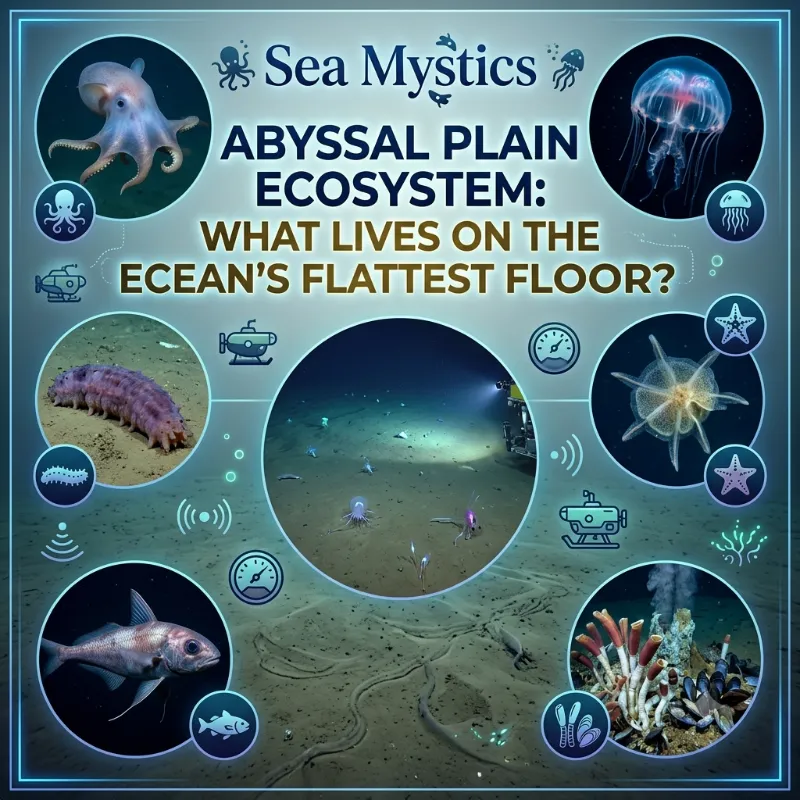
The abyssal plain ecosystem sits between 3,000 and 6,000 meters below the surface, and by some estimates it makes up more than 70 percent of the entire global seafloor. It is the largest single habitat on Earth, and until recently, we knew almost nothing about it. Scientists studying deep ocean floor life have started to change that in just the last two years, and what they are finding is reshaping how we think about biodiversity, evolution, and even the origins of oxygen itself.
This guide breaks down the abyssal zone animals that call this habitat home, the abyssal plain facts that make it one of the strangest places on the planet, and why this quiet, dark expanse is suddenly at the center of a global debate.
TL;DR
The abyssal plain ecosystem is the flat, sediment covered seafloor found at depths of 3,000 to 6,000 meters, and it forms the largest habitat on Earth. Life here survives without sunlight by relying on falling organic debris, chemical energy, and slow but steady biodiversity built over millions of years. Deep sea mining interest in mineral rich nodule fields is now colliding with new scientific discoveries, including hundreds of species new to science found in 2025 and 2026 alone.
Key Takeaways
| Topic | What You Need to Know |
|---|---|
| Depth range | 3,000 to 6,000 meters below sea level |
| Global coverage | Roughly 70 percent of the ocean floor, over half the planet’s surface |
| Temperature | Consistently between 0 and 4 degrees Celsius |
| Light | None, this is total, permanent darkness |
| Main food source | Marine snow, organic debris drifting down from the surface |
| Biggest current threat | Deep sea mining for polymetallic nodules |
| Recent discoveries | Dozens of new species described in the Clarion Clipperton Zone in 2025 and 2026 |
| Recovery time after disturbance | Estimated in decades to centuries, not years |
What Is an Abyssal Plain, Really
An abyssal plain is not a single spot on a map. It is a vast, gently rolling stretch of deep ocean floor that lies beyond the continental slope and before the mid ocean ridges rise back up. These plains formed over millions of years as fine sediment, made of dead plankton, volcanic ash, and clay particles from rivers, settled layer by layer across the seafloor.
That slow, patient sedimentation is why the terrain is so smooth. According to Britannica, abyssal plains vary in depth by only 10 to 100 centimeters per kilometer of horizontal distance, which makes them among the flattest natural surfaces anywhere on the planet. NOAA describes these plains as the largest habitat on Earth, even though they are broken up here and there by hills, seamounts, and valleys rather than being perfectly featureless.
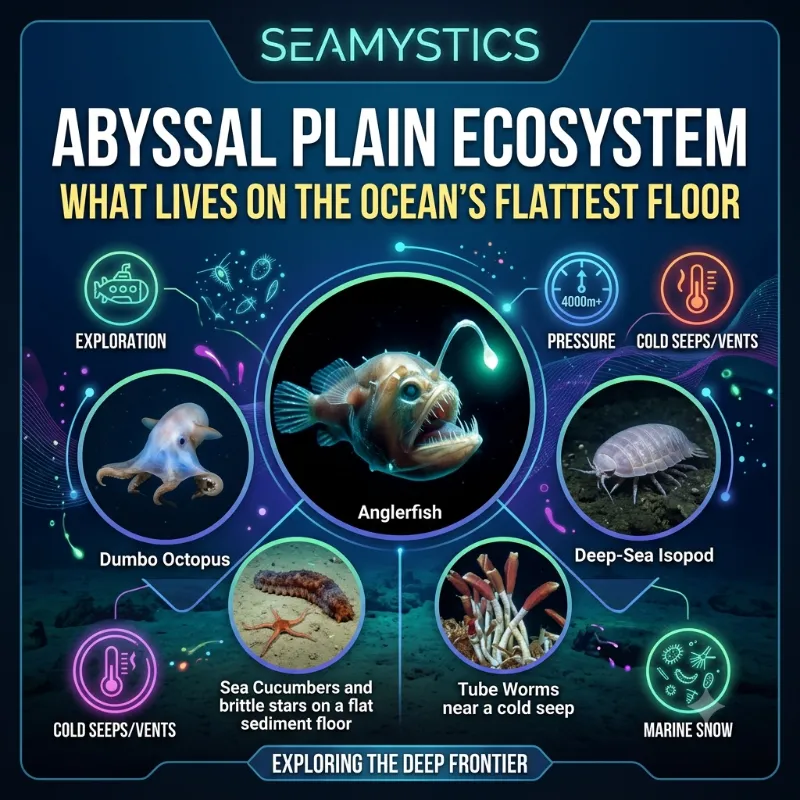
Most abyssal plains sit in the Atlantic and Indian Oceans, where river sediment has had a long, uninterrupted path to settle. The Pacific has fewer classic plains because tectonic activity and trenches interrupt the smooth sediment layers.
Where the Abyssal Zone Fits Into the Ocean
The abyssal zone is one layer in a stack of ocean depth zones, each with its own rules for survival. Above it sits the mesopelagic zone, home to animals that migrate up and down daily, a habitat we cover in detail in our mesopelagic zone ecosystem guide. Below the abyssal zone lies the hadal zone, found only in ocean trenches.
Unlike coral reefs or coastal habitats, the abyssal plain does not depend on sunlight at all. That single fact shapes everything about how deep ocean floor life has evolved to survive here.
Abyssal Plain Facts That Sound Made Up But Are Not
Before going further, here are some numbers worth sitting with. Readers researching abyssal plain facts are often surprised by just how extreme this environment is.
- Pressure at 4,000 meters is roughly 400 times greater than at sea level, equal to the weight of an elephant balanced on a postage stamp.
- Water temperature hovers between 0 and 4 degrees Celsius year round, with almost no seasonal change.
- Polymetallic nodules scattered across some plains grow at a rate of just 1 to 10 millimeters per million years, making them effectively non-renewable on any human timescale.
- The Clarion Clipperton Zone alone, a nodule rich stretch of Pacific abyssal plain between Hawaii and Mexico, covers about 4.5 million square kilometers, roughly half the land area of the entire United States.
- Scientists estimate we have visually observed less than 0.001 percent of the global seafloor, an area comparable in size to Rhode Island.
That last point matters more than it might seem. We have mapped more of the surface of Mars than we have physically seen of our own ocean floor.
What Lives on the Abyssal Plain
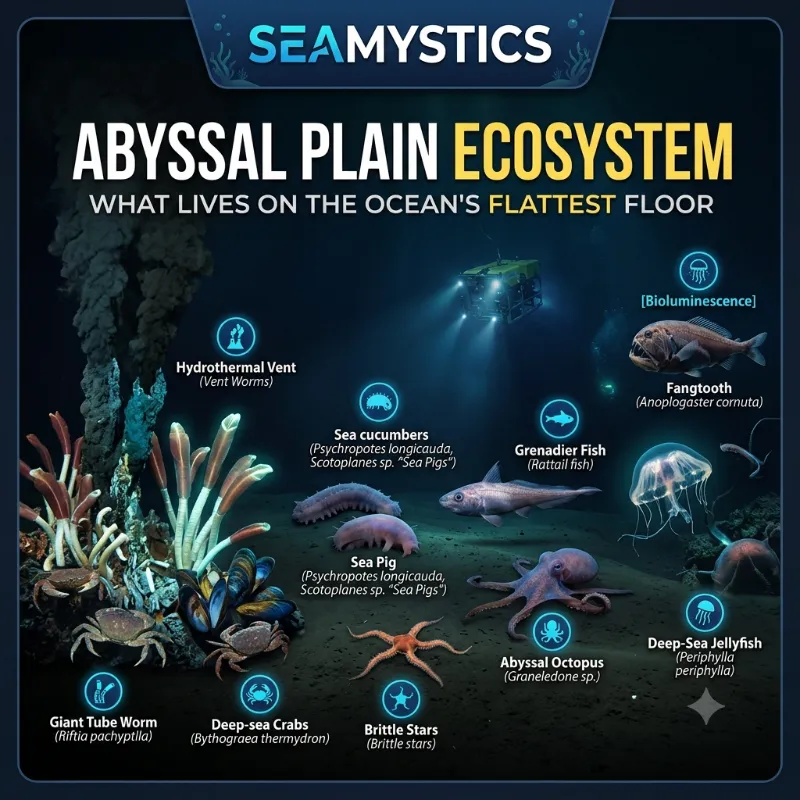
Life down here does not look like life anywhere else. Without sunlight, there is no photosynthesis, so nothing green grows on the seafloor. Instead, abyssal zone animals depend on a slow, steady rain of organic material called marine snow, made up of dead plankton, fecal pellets, and other debris drifting down from the sunlit layers above.
This is a low energy world, and its inhabitants have adapted accordingly.
Sediment Feeders and Scavengers
Sea cucumbers, often called sea pigs in their bloated pink form, are among the most common animals on the abyssal plain. They creep across the mud on stubby tube feet, hoovering up sediment and digesting whatever organic material it contains. In areas rich with food fall, sea cucumbers can outnumber almost every other visible animal group.
Amphipods, small shrimp-like crustaceans, act as the scavenger crew. When a whale carcass or large fish falls to the seafloor, amphipods can arrive within hours and strip it down with remarkable speed. A 2026 study published in ZooKeys described 24 new amphipod species from the Clarion Clipperton Zone alone, including an entirely new evolutionary lineage never documented before.
Strange and Specialized Predators
- Tripod fish balance on long, stiff fins like a camera on a tripod, facing into the current to ambush passing prey with almost no energy spent.
- Dumbo octopuses flap ear-like fins to hover just above the seafloor, hunting worms and crustaceans in near total darkness.
- Xenophyophores, giant single celled organisms that can grow larger than a fist, build intricate shells from sediment and provide shelter for smaller animals, functioning almost like coral does in shallower ecosystems, a comparison we explore further in our deep sea coral ecosystems guide.
Microbial Life You Cannot See but Cannot Ignore
The sediment itself is packed with bacteria and microbial eukaryotes that break down organic matter and cycle nutrients. Research published in the Proceedings of the National Academy of Sciences found striking patterns of microbial diversity across abyssal sediments, suggesting these tiny organisms are just as important to the ecosystem as anything visible to the naked eye.
A 2026 Discovery That Changed the Conversation
In early 2026, researchers working under the International Seabed Authority’s Sustainable Seabed Knowledge Initiative published findings from a taxonomic workshop that had taken place at the University of Lodz in Poland. The result was 24 newly described amphipod species from the Clarion Clipperton Zone, including a species that turned out to represent a completely new superfamily, essentially a new branch on the tree of life.
Lead researcher Thomas Dahlgren, who has studied the zone for more than 13 years, called it the largest biodiversity study conducted there to date. DNA sequencing was essential, since most of the species collected had never been described before and could not be identified through appearance alone.
This discovery landed at a politically sensitive moment. An estimated 90 percent of species in the Clarion Clipperton Zone remain unnamed, even as regulatory processes move toward streamlining deep sea mining permits in the same region. Earlier research published in Nature Ecology and Evolution in 2025 found that a single commercial mining trial reduced macrofaunal density by 37 percent and species richness by 32 percent within the machine’s tracks, with recovery expected to take decades or centuries rather than years.
The Dark Oxygen Debate
One of the strangest abyssal plain facts to emerge in recent years involves oxygen. In 2024, marine ecologist Andrew Sweetman and colleagues at the Scottish Association for Marine Science reported that polymetallic nodules in the Clarion Clipperton Zone appeared to be producing oxygen without any sunlight at all, a phenomenon nicknamed dark oxygen.
The leading theory is that the nodules act like natural batteries. As different metals accumulate in layers over millions of years, a small electrical charge builds up, potentially enough to split seawater into hydrogen and oxygen through electrolysis. Researchers measured close to a volt of charge on some nodule surfaces, not far off the 1.5 volts needed for the reaction to occur on its own.
The finding is genuinely contested. Some mining industry scientists have pushed back hard on the methodology, and independent teams have reported difficulty replicating the results consistently. Still, even the possibility that nodules generate oxygen raises an uncomfortable question for deep sea mining plans: if you remove the nodules, do you remove part of the oxygen supply that deep ocean floor life depends on?
Why the Abyssal Plain Ecosystem Matters More Than It Looks
It is easy to dismiss a flat, dark, muddy plain as empty space. It is anything but. The abyssal plain ecosystem plays a quiet but essential role in how the entire planet functions.
- Carbon storage. Organic material that sinks to the abyssal floor locks carbon away from the atmosphere for extremely long periods, making these plains a significant part of the ocean’s role in climate regulation.
- Genetic and biodiversity reservoir. With most species still undescribed, the abyssal plain may hold answers to questions in medicine, biotechnology, and evolutionary biology that we have not even thought to ask yet.
- Nutrient cycling. Microbial activity in abyssal sediment breaks down organic matter and recycles nutrients back into ocean systems, supporting food webs far beyond the seafloor itself.
This is a very different kind of extreme habitat compared to the ecosystems most people picture when they think of the ocean. If you are curious how other harsh environments support life, our polar ocean ecosystem guide covers a similarly punishing but very differently structured habitat.
The Push Toward Deep Sea Mining
The same features that make abyssal plains scientifically fascinating, namely those slow growing polymetallic nodules, also make them commercially valuable. The nodules are rich in nickel, cobalt, copper, and manganese, all critical for batteries used in electric vehicles and renewable energy storage.
In fall 2025, the USGS led the Hawaii Abyssal Nodules and Associated Ecosystems Expedition, working alongside NOAA, BOEM, and international partners including Japan’s JAMSTEC, to gather baseline data on the seabed south of Hawaii. It was described as the first study of its kind in that part of the ocean, covering water chemistry, sediment layers, and deep sea biology in an area that had never been systematically characterized before.
Organizations tracking this shift have raised concerns about the pace of development outstripping the pace of understanding. As Oceana has reported, the push to mine the deep sea is accelerating even as basic questions about ecosystem recovery remain unanswered. Oceans North has similarly argued that protective action needs to happen before large scale extraction begins, not after, given how slowly these habitats recover from disturbance.
A recent piece from Nautilus Live’s Ocean Exploration Trust put it plainly: each proposed nodule mining operation is expected to cover 8,000 to 9,000 square kilometers over a 30-year period, an area roughly the size of Puerto Rico. Sediment plumes stirred up during extraction can travel hundreds of kilometers, potentially smothering filter feeding animals and disrupting the sensory signals many deep sea species rely on to communicate.
How Abyssal Mining Compares to Other Threatened Habitats
Deep sea disturbance is not an isolated story. Coastal ecosystems face their own pressures, and the comparison is instructive. Our tide pool ecosystem guide and salt marsh ecosystem guide both cover shallow water habitats where human activity and slow recovery times create similar tension between use and conservation, just measured in years rather than centuries.
How Deep Ocean Floor Life Survives With So Little
Survival on the abyssal plain comes down to three main strategies, and most animals here use some combination of all three.
- Slow metabolism. Many abyssal species grow slowly, move rarely, and reproduce infrequently, conserving what little energy is available.
- Opportunistic feeding. Scavengers like amphipods can detect a food fall from a distance and arrive fast, since a single whale carcass might be the biggest meal an area sees in years.
- Chemosynthesis in isolated pockets. Near hydrothermal vents or cold seeps that occasionally dot abyssal terrain, bacteria convert chemical energy into food, supporting entire local food webs without any input from the sun at all, a strategy also seen in the seamount habitats covered in our seamount ecosystem facts guide.
Frequently Asked Questions
What is the difference between the abyssal plain and the abyssal zone?
The abyssal zone refers to the entire depth band between roughly 3,000 and 6,000 meters, while the abyssal plain is the specific flat, sediment covered terrain found within that zone.
Do any plants grow on the abyssal plain?
No. Without sunlight, photosynthesis is impossible, so there is no plant life. All energy enters the system through falling organic debris or localized chemosynthesis.
How deep is the average abyssal plain?
Most abyssal plains sit between 3,000 and 6,000 meters, or roughly 10,000 to 20,000 feet below the surface.
Is deep sea mining currently happening on abyssal plains?
Exploration contracts and test mining trials have already taken place, particularly in the Clarion Clipperton Zone, though large scale commercial extraction is still in early stages and remains heavily debated.
Why do scientists care so much about a flat, empty looking seafloor?
Because it is not empty. It is the largest habitat on Earth, home to enormous undiscovered biodiversity, and it plays a direct role in global carbon storage and nutrient cycling.
Conclusion
The abyssal plain ecosystem is proof that the most important places on our planet are not always the most dramatic looking. There are no coral towers or breaching whales down here, just soft sediment, total darkness, and an astonishing amount of life quietly doing the work of keeping the ocean, and by extension the planet, in balance. As mining interest accelerates and new species keep turning up faster than scientists can name them, the flattest floor on Earth has become one of the most urgent frontiers in ocean science. Understanding it properly, before large scale industrial activity reshapes it, may be one of the more consequential environmental challenges of this decade.
If you found this useful, you might also enjoy exploring how estuaries function as nurseries for coastal life in our estuary ecosystem guide, or how oyster reefs quietly filter entire bays in our oyster reef ecosystem guide, both very different but equally underappreciated corners of the marine world.
References
- Britannica, Abyssal Plain
- NOAA, Ocean Floor Features
- USGS, Hawaii Abyssal Nodules and Associated Ecosystems Expedition
- ZooKeys, New deep-sea Amphipoda from the Clarion-Clipperton Zone, 2026
- Nature Ecology and Evolution, Impacts of an industrial deep-sea mining trial on macrofaunal biodiversity, 2025
- Scientific American, Dark Oxygen Discovered Coming from Mineral Deposits on Deep Seafloor
- Oceana, Into the Abyss: The Race to Mine the Deep Sea
- Oceans North, Protecting the Deep Sea Before We’re in Too Deep
- Nautilus Live, Exploring the Largest and Least Known Habitats on Earth at a Critical Moment
- Proceedings of the National Academy of Sciences, Large-Scale Patterns in Biodiversity of Microbial Eukaryotes from the Abyssal Sea Floor