
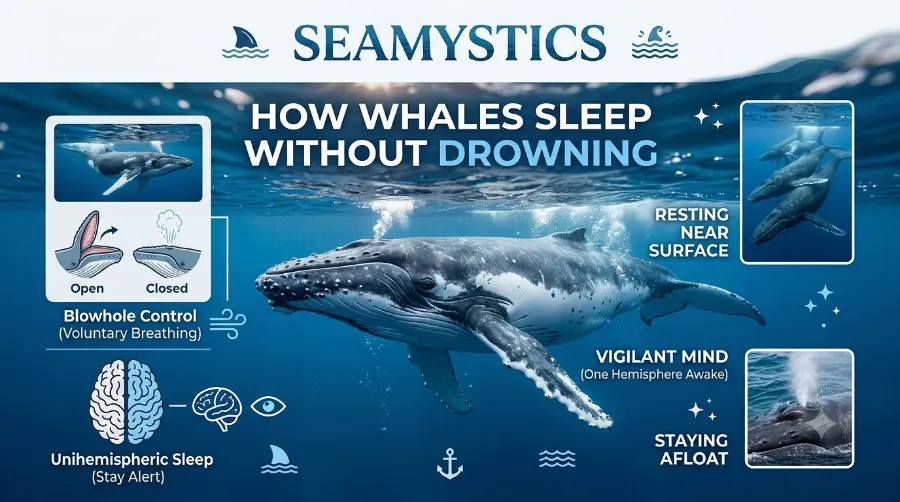

Picture a creature the size of a school bus. It floats motionless in pitch black water. It does not breathe for fifteen minutes at a stretch. That is not a horror movie scene. That is simply a sperm whale taking a nap. Understanding how whales sleep without drowning has puzzled scientists for decades. These massive mammals face a problem no land animal has to solve. They must keep breathing on purpose while also getting real rest.
Fin Whale Facts The Second Largest Animal on Earth
Humans just drift off and let the body handle breathing automatically. Whales cannot do that. Every breath a whale takes is a conscious choice. So when researchers first asked, do whales sleep, the honest answer turned out to be complicated. Marine mammal sleep looks nothing like ours. Once you see how it works, it changes the way you think about rest itself.
Gray Whale Migration The Longest Migration of Any Mammal Revisited
TL;DR
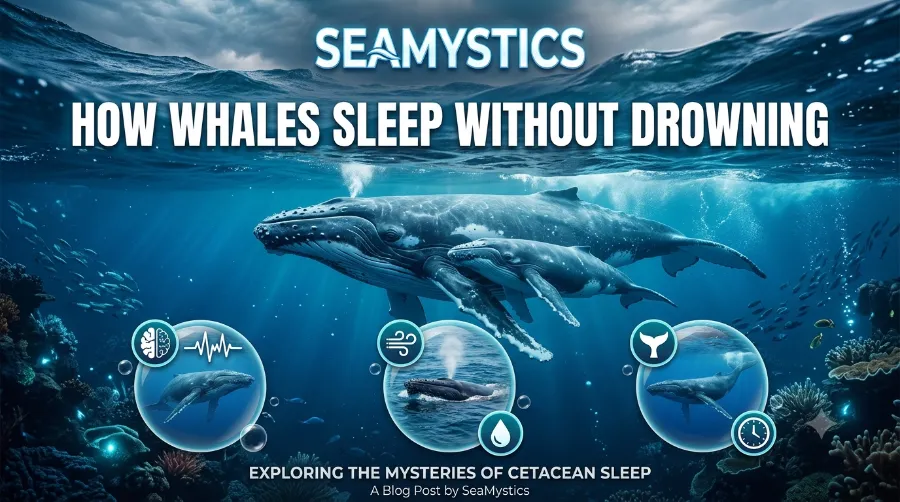
Whales sleep by shutting down only one half of the brain at a time. Scientists call this trick unihemispheric slow wave sleep. It lets whales keep breathing and stay alert to danger while still resting. Sperm whales break the pattern. They sometimes drift straight down into a vertical, almost fully unconscious sleep for about seven percent of the day. This whale sleeping behavior evolved because surfacing for air can never be left to chance.
Beluga Whale Facts The Arctic’s Most Vocal Marine Mammal
Key Takeaways
| Fact | Detail |
|---|---|
| Sleep method | Mostly unihemispheric slow wave sleep, one brain half rests at a time |
| Exception species | Sperm whales sometimes sleep with both hemispheres at once |
| Typical sleep time | Roughly 7 to 8 hours per day for many species, spread across short bouts |
| Sperm whale sleep amount | About 7 percent of the day, among the lowest of any mammal studied |
| Resting posture | Horizontal near the surface, or vertical for sperm whales |
| First scientific proof | Beluga EEG study in 2002, and sperm whale tag study in Current Biology, 2008 |
| Breath hold while resting | 45 minutes to 2 hours depending on species |
Why Whales Cannot Sleep Like Land Mammals
Whales breathe air. That single fact shapes almost everything about whale sleeping behavior. A dog or a deer breathes automatically, even in deep sleep, because the brainstem handles breathing without any conscious input.
Right Whale Facts Why This Species Is Critically Endangered
Whales do not have that option. A whale has to actively choose to open its blowhole and take a breath. So if a whale fell into a full, deep, unconscious sleep the way a human does, it would eventually stop breathing. It would drown.
This one evolutionary constraint explains almost every strange thing about how whales sleep. Nature had to find a workaround. It found a fairly elegant one.
How Whales Sleep Without Drowning: The Brain Trick
The main answer to how whales sleep without drowning is a process called unihemispheric slow wave sleep, often shortened to USWS. During USWS, one half of the whale’s brain slips into slow wave sleep. The other half stays awake and alert.
Because one hemisphere always stays active, the whale can keep swimming slowly. It can monitor its surroundings. Most importantly, it can keep surfacing to breathe. Meanwhile, the resting hemisphere still gets the restorative benefits of sleep. The whale essentially naps with half its brain while patrolling with the other.
Minke Whale Facts The Ocean’s Smallest Baleen Whale
Researchers first confirmed this pattern in captive dolphins decades ago. However, the clearest whale specific proof came from a beluga whale study published in 2002. Scientists recorded EEG brain activity in a sub adult male beluga over a four day period. They documented eyelid position alongside the readings at the same time.
Whale Blubber Explained How It Keeps a 100-Ton Animal Warm
The results were striking. When one hemisphere entered slow wave sleep, the eye on the opposite side of the body stayed closed roughly half the time. The eye on the same side as the resting hemisphere stayed open far more often. This beluga became the fifth cetacean species confirmed to use this sleep pattern, according to an EEG study that recorded eyelid state over a four day period and identified it as the fifth cetacean species shown to use unihemispheric slow wave sleep. PubMed
What Happens During Unihemispheric Sleep
During this half brain rest, a few things happen at once inside the whale’s body.
- One side of the brain shows slow, high amplitude waves typical of deep sleep
- The other side stays in a waking pattern, alert and responsive
- The eye linked to the resting hemisphere often closes or droops
- The eye linked to the active hemisphere usually stays open to watch for threats
- Swimming continues, often in slow, gentle circles near the surface
This setup means a resting whale is never fully unconscious. It is also never fully unaware. Think of it as a light doze rather than deep human sleep. It still delivers real physiological rest.
Whale Sleep Facts: How Different Species Rest
Not every whale sleeps the same way, and this is where things get genuinely interesting. Different species show slightly different whale sleeping behavior. Body size, habitat, and hunting demands all play a role.
Whale Stranding Causes Why Whales Beach Themselves
Dolphins and belugas can rest for a large chunk of the day. Recent research summaries on cetacean rest note that dolphins and belugas can spend more than 30 percent of their day in some form of sleep. That figure sits closer to what land mammals experience. These species tend to rest in short bouts throughout a 24 hour period rather than one long block, similar to how a new parent sleeps in fragments.
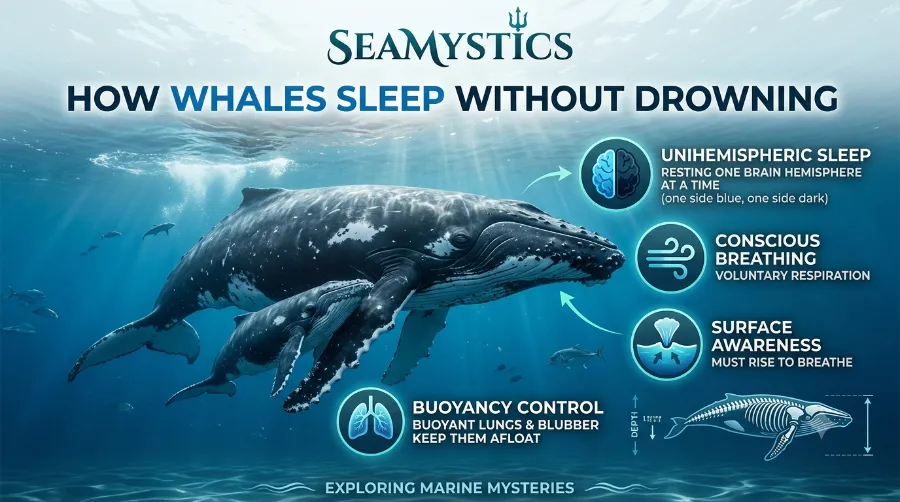
Baleen whales, such as humpbacks and gray whales, often show a behavior called logging. During logging, the whale floats motionless and horizontal at the surface. It looks a bit like a floating log. Many researchers believe this is a resting state, and it lines up with observations from whale researchers at Ocean Safaris, who note that during unihemispheric slow wave sleep whales rest one hemisphere while the other stays alert enough to keep surfacing for air and watching for danger. Ocean Safaris
Anyone planning a trip along the Pacific coast can actually watch this behavior firsthand. Spotting logging whales is one of the more reliable ways to witness whale sleeping behavior. Our /whale-watching-season-guide breaks down the best months and locations to see it.
Sperm Whales: The Strange Exception
Sperm whales do not follow the typical playbook, and this discovery genuinely surprised marine biologists. Their sleep looks almost nothing like the half brain pattern used by dolphins and belugas.
The 2008 Discovery
In 2008, a landmark study in Current Biology tagged 59 sperm whales across multiple ocean regions. Researchers used suction cup tags and recorded a combined 562.9 hours of underwater activity. The team found something nobody expected.
Pilot Whale Facts Why They’re Actually Giant Dolphins
Groups of sperm whales sometimes drift into a vertical, head up posture just beneath the surface. They remain almost completely still for 10 to 15 minutes at a time, sometimes up to 24 minutes. During these drift dives, the whales stop moving and stop clicking. In one encounter off northern Chile, a research vessel actually touched a resting whale before it reacted at all.
What the Drift Dives Revealed
According to the original findings, drift dive bouts made up 7.1 percent of the total tagged recording time, and 36.7 percent of the time when the whales were not actively foraging. That 7.1 percent figure explains why writers often describe sperm whales as needing less sleep than almost any other mammal ever studied. Cell Press
This behavior looks nothing like unihemispheric sleep. Researchers believe sperm whales may briefly rest both hemispheres of the brain at once during these drifts. Long, deep foraging dives leave very little spare time for anything else, so a short, deeper form of rest may simply work better for this species.
The 2026 Bubble Study
A newer study published in 2026 in the Journal of Experimental Biology dug even deeper into this mystery. Scientists Noémie Freymond, Alec Burslem, and Patrick Miller analyzed suction cup tag data from 42 sperm whales tracked off northern Norway. The tags recorded sound, depth, and three dimensional movement.
Baleen vs
Toothed Whales The Complete Comparison GuideTheir work solved a nagging physics problem. A sperm whale’s oil rich head is naturally buoyant, so something has to stop a motionless, sleeping whale from floating straight up. The tags revealed an answer. The whales release bubbles from their blowhole during these resting dives, and a physical simulation matched to depth profiles from ten tagged animals showed this bubble release helps manage the whale’s buoyancy while it drifts. Sleeping sperm whales appear to fine tune their own ballast so they can stay suspended at depth without any conscious effort. Silicon Canals
Table: Sleep Patterns Across Whale and Dolphin Species
| Species | Sleep Type | Typical Rest Time | Posture | Key Study Year |
|---|---|---|---|---|
| Bottlenose dolphin | Unihemispheric slow wave sleep | Up to 33 percent of day | Slow circular swimming | 1960s to 2000s |
| Beluga whale | Unihemispheric slow wave sleep | Multiple short bouts daily | Near surface, slow swim | 2002 |
| Humpback whale | Believed unihemispheric | Short logging bouts | Horizontal, motionless at surface | Ongoing observation |
| Gray whale | Believed unihemispheric | Short logging bouts | Horizontal, motionless at surface | Ongoing observation |
| Sperm whale | Possible bihemispheric | About 7 percent of day | Vertical, head up, near surface | 2008, updated 2026 |
| Northern fur seal | Unihemispheric, aquatic | Variable, monitored visually | Floating, intermittent eye opening | 2019 |
This table pulls together the clearest publicly available research on marine mammal sleep. Scientists still admit there are gaps, especially for large baleen whales that are hard to tag and observe over long periods.
Why Evolution Chose This Strange Sleep Style
At first glance, sleeping with half a brain sounds inefficient. However, once you consider what a whale actually needs to survive, it makes complete sense.
A whale that fell fully unconscious would stop breathing. It would drown within minutes. Many whales also live in open ocean environments with real predators, including orcas and, historically, whaling ships. Staying partially alert during rest offered a major survival advantage across millions of years of evolution.
There is also a practical parenting angle worth mentioning. Calves need to surface for air constantly during their first weeks of life. Mother whales often stay close, semi alert, and moving slowly even while resting, so they can guide a calf up for air. Whale watching guides across Baja California and the Pacific Northwest have documented this pattern for years.
A Real World Example from Baja California
San Ignacio Lagoon in Baja California Sur, Mexico sits among the more accessible places to actually witness resting whale behavior. This lagoon serves as a major nursery ground for gray whales each winter. Local guides frequently report gray whale mothers and calves resting motionless at the surface during calm midday hours, particularly between January and March.
Field observations from Baja Ex show whales in this region resting with only part of the brain active, which allows them to stay aware enough to breathe and detect approaching boats even while appearing completely still. This lines up almost exactly with the laboratory EEG findings from captive belugas. Field observation and controlled research rarely match this closely. ScienceDirect
Guides in British Columbia report a similar pattern among resident orca pods. Entire family groups surface, breathe, and travel together in a slow, synchronized rhythm for extended stretches. Researchers widely interpret this as a group resting state. Researchers studying eye state during aquatic unihemispheric sleep in marine mammals have noted that intermittent visual monitoring during rest appears to serve a genuine vigilance function, not just a passive side effect, which likely explains why orcas rest in tight, coordinated groups rather than scattering alone. nih
How Marine Biologists Actually Study Whale Sleep
Whales cannot hook up to a sleep lab the way humans can. Researchers have had to get creative. Here is a simplified look at the main methods used today.
- Suction cup tags that record depth, movement, sound, and orientation without harming the animal
- EEG recordings on cooperative, trained individuals under professional veterinary care
- Long term visual observation of eye closure and swimming posture from boats or shore stations
- Acoustic monitoring to track when whales stop echolocating or vocalizing, a strong hint of rest
- Physical simulations that combine tag data with buoyancy modeling, as used in the 2026 sperm whale bubble study
Each method has limits. Tags eventually fall off. EEG studies usually cover only a handful of cooperative animals. Pure visual observation cannot show what happens inside the brain. Most solid conclusions in this field come from combining several methods rather than relying on just one.
Readers curious about the tools researchers use to study cetacean behavior can check our /marine-research-methods-guide for more detail on tagging technology.
Common Misunderstandings About Whale Sleep
A few myths tend to circulate about marine mammal sleep. They are worth clearing up plainly.
- Whales do not sink to the ocean floor and sleep there for hours, except in the specific case of short sperm whale drift dives
- Whales are not unconscious the way a sleeping human is, since one brain half almost always stays alert
- Not all whales sleep the same way, and even close relatives like dolphins and belugas show real differences
- Sleep deprivation does not seem to worry whales the way it worries humans, largely because their sleep spreads across the day rather than concentrating at night
-
Baleen vs Toothed Whales The Complete Comparison Guide
These distinctions matter, especially for anyone writing or reading about ocean wildlife, since whale sleep facts get exaggerated online fairly often. Our /related-guide-to-whale-behavior covers other surprising whale behaviors, including feeding, migration, and social patterns.
FAQ: Whale Sleep Facts People Ask Most
Do whales sleep at night only, like humans do?
No. Most whales rest in short bouts spread across both day and night. They need to surface for air on a regular schedule regardless of the time.
How long can a whale hold its breath while resting?
This varies by species. Marine mammal researchers note that whales can generally hold their breath for 45 minutes up to two hours before needing to surface, depending on the species, with sperm whales and beaked whales typically holding the longest. marinemammalcenter
Can a whale drown while sleeping?
In theory yes, and that risk is exactly why unihemispheric sleep evolved. One brain half always stays alert enough to trigger breathing, so drowning during normal rest happens rarely.
Do baby whales sleep the same way as adults?
Not quite. Calves generally sleep less overall in their first few weeks, partly because they need to surface more often. Mothers often stay semi alert nearby to help guide them.
Why do sperm whales sleep vertically instead of horizontally?
Scientists believe the vertical posture, combined with controlled bubble release to manage buoyancy, may simply give a sperm whale’s naturally buoyant body the most energy efficient way to stay suspended at rest.
Charts and Data Snapshot
The studies referenced throughout this piece point to a simplified breakdown of estimated daily rest time across species.
| Species | Estimated Daily Sleep |
|---|---|
| Bottlenose dolphin | Up to 8 hours, in fragments |
| Beluga whale | Roughly 6 to 8 hours, in fragments |
| Sperm whale | Roughly 1.5 to 2 hours total |
| Northern fur seal (aquatic) | Variable, several short bouts |
Read these figures as scientific estimates rather than fixed numbers. Ongoing studies, including the 2026 Norway tagging project, continue to refine them.
What This Means for Ocean Conservation
Understanding whale sleeping behavior goes beyond fun trivia. It actually shapes real conservation decisions. Vessel strikes rank among the leading causes of injury and death for large whales, and resting whales near the surface face extra risk, since they move slowly and may respond less quickly to approaching boats.
Several regions with heavy whale traffic, including parts of the Pacific coast and the Salish Sea, now enforce reduced vessel speed zones during peak resting and calving seasons. This connects sleep science directly to practical policy, since knowing when and where whales rest helps regulators design better protections.
Readers who want to support these efforts can visit Sea Mystics at https://seamystics.com/, where we maintain an ongoing resource hub covering current whale protection zones and responsible whale watching tips.
Conclusion
Whales solved a problem no land mammal ever had to face. They split the job of sleeping in two. One half of the brain rests while the other keeps watch, keeps breathing, and keeps the animal safe. In the strange case of sperm whales, evolution even worked out how to manage buoyancy during a deeper, riskier form of sleep. The more researchers tag, track, and observe these animals, the clearer it becomes that whale sleep is not a lesser version of human sleep. It is a completely different survival strategy, shaped by millions of years in open water. Every drifting silhouette near the surface, every vertical pod of sperm whales, quietly reminds us how much adaptation it takes to simply close your eyes safely in the ocean.
References
- Lyamin, O.I. et al. (2002). Unihemispheric slow wave sleep and the state of the eyes in a white whale. PubMed, National Library of Medicine.
- Miller, P.J.O. et al. (2008). Stereotypical resting behavior of the sperm whale. Current Biology, Cell Press.
- Freymond, N., Burslem, A., Miller, P. (2026). Buoyancy control during resting dives in sperm whales. Journal of Experimental Biology.
- The Marine Mammal Center. How Do Whales Sleep? And Other Whale Trivia.
- Baja Ex. How Do Whales Sleep?
- BC Whales. Resting Whales.
- Lyamin, O.I. et al. (2019). Eye state asymmetry during aquatic unihemispheric slow wave sleep in northern fur seals.