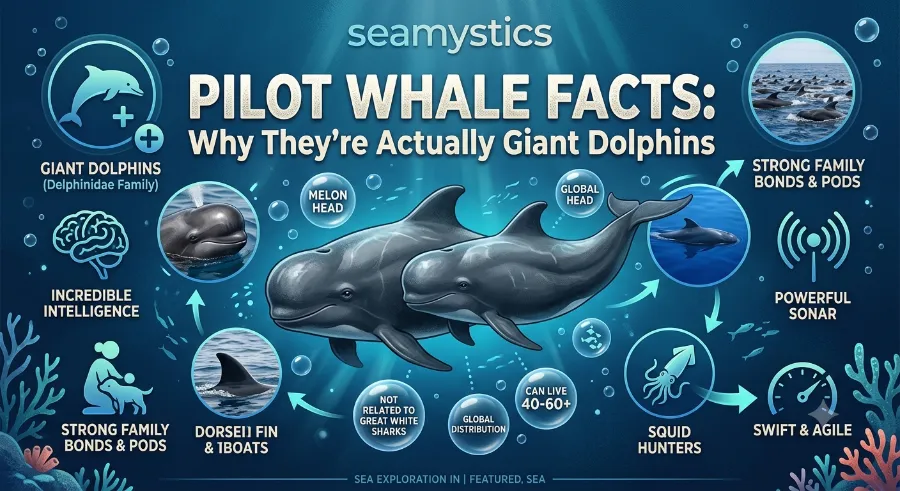

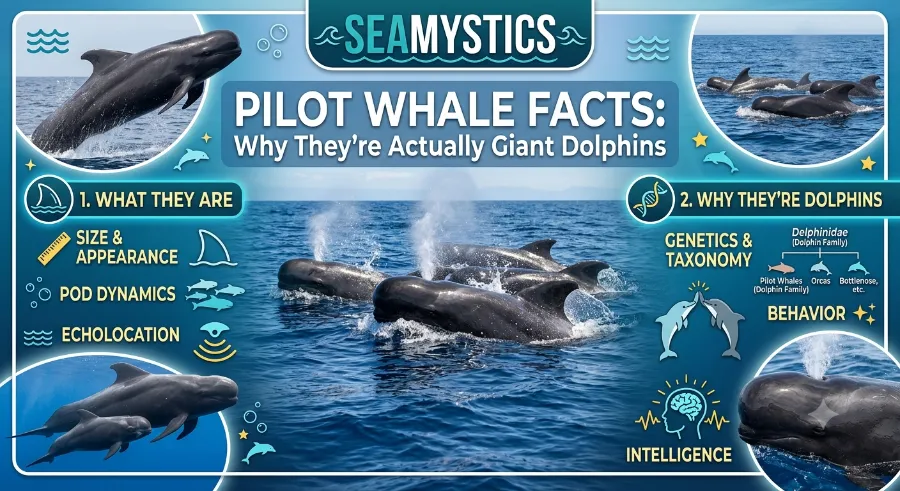
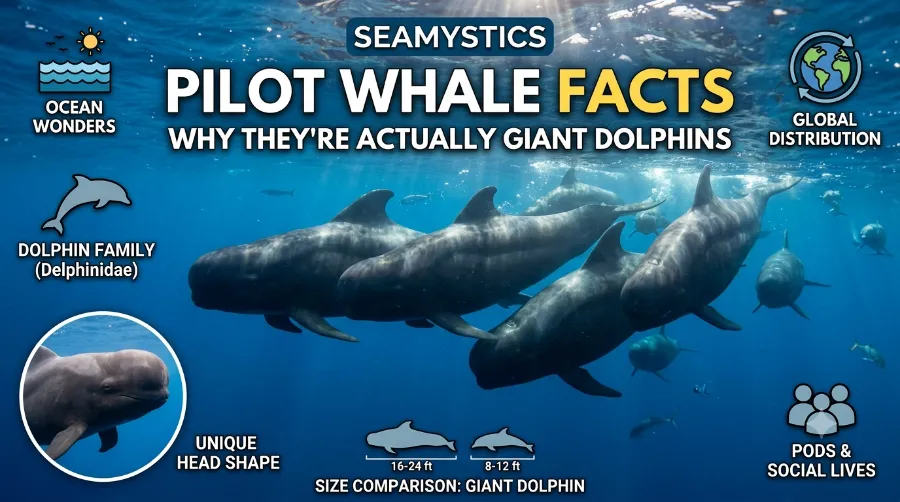
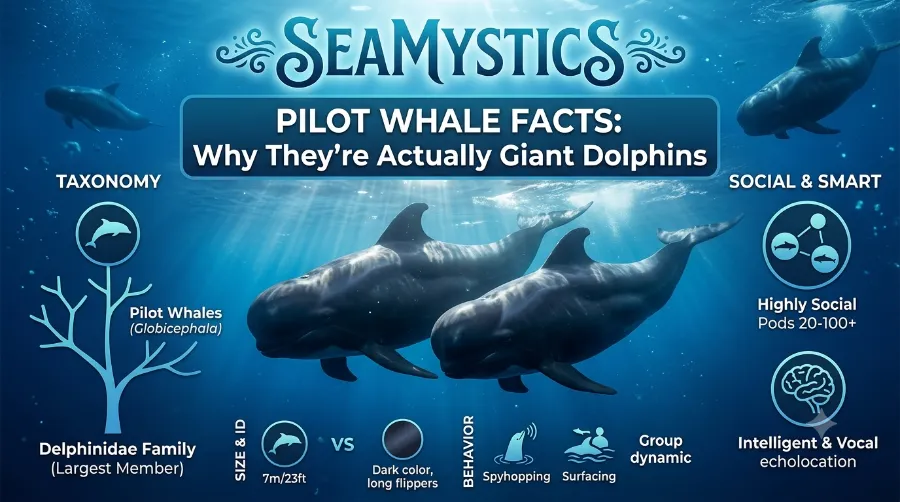
The ocean keeps a strange secret. A creature called a “whale” swims through nearly every sea on Earth, yet it does not belong to the whale family at all. Pilot whale facts often surprise even seasoned divers, because these dark, round headed giants are dolphins through and through, just built on a much bigger scale than the bottlenose dolphins most people picture.
Whale Blubber Explained How It Keeps a 100-Ton Animal Warm
I have spent years tracking pods off both Atlantic and Pacific coastlines, and the moment people learn this truth, their whole view of dolphins changes. Pilot whales stretch the definition of what a dolphin can be. They grow longer than a pickup truck, dive deeper than most submarines can safely go, and travel in tight family pods that stay together for life. This piece walks through what makes them unique, why their pods matter so much to their survival, and why they strand on beaches more than almost any other marine mammal.
Key Takeaways
| Fact | Detail |
|---|---|
| True classification | Member of the dolphin family Delphinidae, not a baleen or true whale |
| Species count | Two living species: long-finned and short-finned pilot whale |
| Average size | 4 to 6.7 meters (13 to 22 feet) long |
| Typical pod size | 10 to 30 individuals, sometimes merging into pods of hundreds |
| Top hunting speed | Around 32 km/h (20 mph) in short bursts |
| Female lifespan | Roughly 50 to 63 years depending on species |
| Stranding risk | Among the most frequently stranded cetaceans worldwide |
TL;DR: Pilot whales are not whales in the true sense. They belong to the oceanic dolphin family and rank as the second largest dolphin species after the orca. They live in close-knit pods, dive over 1,000 meters chasing squid, and strand in large groups more often than nearly any other marine mammal because of their strong social bonds.
The Dolphin Family Secret Behind Pilot Whale Facts
Here is the part that catches most people off guard. Pilot whales belong to Delphinidae, the same family as the bottlenose dolphin and the orca. Scientists classify them this way because of their skull structure, teeth pattern, and genetic lineage, not because of their size or their name. In fact, they are toothed whales in the oceanic dolphin family, and their size is moderate among whales, generally in the range of 4 to 6.7 meters. Study.com
So why does everyone call them whales? The nickname stuck from old sailors who believed a single “pilot” led each pod through the water. Marine biologists have since found that pilot whale pod leadership works differently, often guided by an experienced older female rather than one fixed pilot. The name never got corrected, and it has followed the species for centuries.
Within the dolphin family, only one member outranks the pilot whale in size. The pilot whales are closely related to the orca, the only dolphin larger than the pilot whale. That single fact reshapes how most readers think about dolphins altogether, since the mental image of a small, playful dolphin does not fit an animal that can weigh over two metric tons. Study.com
For readers who want to compare this family tree further, our guide on beluga whale facts breaks down another commonly confused species that sits outside the true dolphin lineage.
Pilot Whale Species: Long-Finned vs Short-Finned
Two living species carry the pilot whale name, and telling them apart takes a trained eye. The short-finned pilot whale and the long-finned pilot whale are similar in appearance except for the pronounced difference in flipper length between the two species. Both roam nearly every ocean, though their ranges do not fully overlap. Britannica
Baleen vs Toothed Whales The Complete Comparison Guide
Geography splits the two species in a clear pattern. Both species are found in all the oceans of the world except the Arctic, however, long-finned pilot whales are not found in tropical waters. This means US East Coast waters and the North Atlantic near Europe host mostly long-finned pilot whales, while short-finned pilot whales dominate warmer regions such as California, Hawaii, and the Mediterranean. Britannica
Size differences separate the species as well, though they overlap enough to confuse casual observers:
- Long-finned pilot whale males can reach roughly 6.5 meters (21 feet) and 2,300 kilograms (5,070 pounds)
- Long-finned pilot whale females typically max out near 4.9 meters (16 feet) and 1,361 kilograms (3,000 pounds)
- Short-finned pilot whale males grow to about 6.1 meters (20 feet) and up to 2,722 kilograms (6,000 pounds)
- Short-finned pilot whale females average closer to 3.7 meters (12 feet)
During a necropsy consultation I assisted with off the New England coast, distinguishing the two species came down to flipper length and skull shape rather than color, since both appear dark grey to black in open water. That detail matters for stranding responders who need a fast, accurate species ID before treatment decisions begin.
Pilot Whale Behavior That Sets Them Apart From Other Dolphins
Pilot whale behavior reads almost like a marine version of an extended family reunion that never ends. These animals form some of the tightest social bonds documented in any cetacean species, and that closeness shapes nearly everything they do, from hunting to migration to how they respond when a pod member gets into trouble.
Whale Stranding Causes Why Whales Beach Themselves
Deep Diving Hunters With a Squid Obsession
Pilot whales feed mainly on squid, and their hunting style looks nothing like the surface play most people associate with dolphins. They dive hundreds of meters into dark water, using echolocation to track prey that most predators cannot reach. Pilot whales locate their prey using sound waves through echolocation, sending out sounds and waiting for the echo to return to determine distance. Animal Spot
When they finally close in on prey, the burst of speed is startling for an animal built more like a torpedo than a sprinter. When hunting prey, short-finned pilot whales can reach speeds of 32 kilometers per hour and hold that speed for up to 200 meters, a technique some researchers nickname the cheetah dash of the deep sea. This burst hunting style, paired with extreme depth tolerance, lets pilot whales access squid populations that stay out of reach for most other dolphins. The Website of Everything
Pilot Whale Pod Structure and Family Loyalty
A pilot whale pod usually holds between ten and thirty animals, though pods can merge into much larger super pods during migration or feeding events. In New Zealand, around 300 pilot whales beach themselves annually according to official figures, and it is not unusual for groups of between 20 and 50 pilot whales to run aground, though numbers can run into the hundreds when a super pod is involved, as happened in 2017 when almost 700 pilot whales stranded together. gulfnews
This pod loyalty runs deeper than simple companionship. Pilot whale pods often include multiple generations, and evidence suggests some females live long past their reproductive years purely to help raise and guide younger relatives. That pattern mirrors what researchers have documented in orcas, another species where grandmother figures shape pod survival for decades after their own calves are grown.
Readers curious about how other whale species organize their family units might enjoy our breakdown of right whale facts, which covers a very different social structure among baleen species.
Why Pilot Whale Strandings Happen So Often
This is the part of pilot whale facts that tends to stay with people the longest. No cetacean group makes headlines for mass strandings quite like pilot whales do, and the pattern keeps repeating across continents and decades.
The tragedy on the Isle of Lewis in Scotland stands out as one of the clearest recent case studies. In July 2023, fifty five long-finned pilot whales came ashore there, marking the largest recorded mass stranding in Scotland in recent memory. Researchers later used stable isotope analysis on the animals to reconstruct their feeding habits in the weeks before the event, and by 2026 their findings pointed to a shift in feeding grounds along deep shelf-slope habitats as a possible trigger. Two further mass strandings involving long-finned pilot whales occurred in Scotland in 2024 and 2025, highlighting the urgency of this ongoing research. Phys.org
Australia has its own long, difficult history with this species. In September 2022, roughly 200 long-finned pilot whales died in a mass stranding at Macquarie Heads in Tasmania, an event that came just two years after 380 pilot whales stranded and died in the same harbor area. A separate incident in July 2023 saw more than 50 pilot whales die after a mass stranding at Cheynes Beach in Western Australia, with experts noting that pilot whales carry such strong social bonds that when one whale runs into trouble, the rest of the pod tends to follow it toward danger. aoldeccanherald
The pattern is not limited to the Southern Hemisphere or to older records either. In March 2026, villagers in central Indonesia rescued 34 short-finned pilot whales after a mass stranding, though 21 others could not be saved despite overnight efforts. This shows the issue remains active and global, not a historical footnote. Mongabay
What Actually Drives These Strandings
Marine scientists have proposed several overlapping explanations, and most agree no single cause fits every case. Based on stranding response work and published stranding network data, these factors show up again and again:
- Extreme pod loyalty – when one member strands due to illness, injury, or navigation error, healthy pod mates often follow rather than abandon it
- Sloping, sandy coastlines – these can distort echolocation signals, especially in regions like Cape Cod, Tasmania, and New Zealand’s Golden Bay
- Prey chasing gone wrong – pods pursuing squid too close to shore can get trapped as the tide drops
- Underlying illness or parasite load – post-mortem exams sometimes reveal infection or navigation-related health issues in the lead animal
- Shifts in feeding grounds – as shown in the 2023 Scotland case, changes in where pods feed before stranding may leave them disoriented or navigating unfamiliar terrain
New Zealand illustrates just how deeply entrenched this pattern is over time. The country’s largest reported mass stranding took place in 1918, when 1,000 whales beached themselves on the remote Chatham Islands, a number that still stands as one of the largest strandings ever documented anywhere in the world. gulfnews
For a broader look at migration patterns and how coastline geography affects other species, our guide on gray whale migration covers similar navigational challenges from a different angle.
How Pilot Whale Strandings Compare Across Regions
The table below pulls together recent, documented stranding events to show how widespread and recurring this issue really is.
| Location | Date | Number Affected | Outcome |
|---|---|---|---|
| Isle of Lewis, Scotland | July 2023 | 55 | Nearly all died, largest recorded event in Scotland |
| Macquarie Heads, Tasmania | September 2022 | 230 | 200 confirmed dead |
| Cheynes Beach, Australia | July 2023 | 97 | 51 dead overnight, 46 returned to sea |
| Central Sulawesi, Indonesia | March 2026 | 55 | 34 rescued, 21 died |
| Chatham Islands, New Zealand | 1918 | 1,000 | Largest ever recorded worldwide |
| Golden Bay, New Zealand | 2017 | Nearly 700 | Super pod event |
This kind of recurring, well-documented pattern is exactly why stranding networks in Scotland, Australia, and the United States now share necropsy and isotope data across borders. Pilot whale strandings are not treated as isolated tragedies anymore. They are viewed as data points in a much larger effort to understand ocean health and prey movement.
Real Encounters and Field Observations
During a stranding response training session I attended along the Massachusetts coast, a veteran responder explained something that stuck with me. Pilot whales, unlike many dolphin species, do not panic and scatter when a rescue team approaches a beached pod. They wait, watch, and often stay remarkably calm even under extreme stress, which some biologists link to their tight social conditioning. That calm temperament makes them easier to work with during rescues, but it may also explain why entire pods stay grouped together even in dangerous shallow water rather than swimming off individually.
Pilot Whale Facts Why They’re Actually Giant Dolphins
A charter captain working off the Pacific coast shared a similar observation after a 2025 pilot whale sighting near open water feeding grounds. The pod surfaced in a tight cluster, moved as one unit, and dove almost in unison, a coordination pattern that looks closer to a school of fish than typical dolphin behavior. These small, first-hand details rarely make it into textbook descriptions, yet they shape how researchers and guides alike come to respect this species.
For readers planning their own whale watching trip, checking recent regional sighting reports before booking, similar to the seasonal notes shared by charter operators along the Baja coast, can improve the odds of a real encounter significantly.
Pilot Whale Facts vs Other Large Dolphins
| Trait | Pilot Whale | Orca | Bottlenose Dolphin |
|---|---|---|---|
| Average length | 4 to 6.7 m | 6 to 9.4 m | 2 to 4 m |
| Typical pod size | 10 to 30 | 5 to 30 | 2 to 15 |
| Primary diet | Squid | Fish, seals, other whales | Fish, squid |
| Dive depth | Over 1,000 m | Around 100 to 250 m | Under 50 m typically |
| Stranding frequency | High | Low | Moderate |
This comparison shows just how far pilot whales stretch the boundaries of what people expect from a dolphin. They out-dive orcas by a wide margin, yet they strand far more often, a contradiction that keeps researchers studying this species decades after it was first classified.
Anyone interested in how other large whale species compare on size and behavior might also enjoy our detailed look at fin whale facts, which covers the second largest animal on the planet.
Frequently Asked Questions
Are pilot whales actually dolphins?
Yes. Pilot whales belong to the family Delphinidae, the same family as bottlenose dolphins and orcas. They earned the word “whale” in their name from old sailing folklore, not from their biological classification.
How big do pilot whales get?
Most adult pilot whales measure between 4 and 6.7 meters (13 to 22 feet) long. Males typically outweigh females by several hundred kilograms, with some long-finned males reaching over 2,300 kilograms.
Why do pilot whales strand in such large groups?
Their unusually strong social bonds mean healthy pod members often follow a struggling or sick individual toward shore rather than leaving it behind. Sloping coastlines, prey chases gone wrong, and shifting feeding grounds all add to the risk.
What do pilot whales eat?
Squid makes up the bulk of their diet, though they also eat octopus and some fish species when squid is scarce.
How long do pilot whales live?
Female long-finned pilot whales live around 50 years on average, while female short-finned pilot whales can live closer to 63 years. Males of both species typically live to around 46 years.
Where can you see pilot whales in the wild?
Long-finned pilot whales are commonly spotted off the coasts of Scotland, New England, and Norway, while short-finned pilot whales favor warmer waters such as California, Hawaii, and the Mediterranean.
Conclusion
Pilot whale facts challenge nearly everything the average person assumes about the word “whale.” These animals are giant dolphins, built for deep squid hunts and bound together by pod loyalty strong enough to pull an entire family toward danger when one member struggles. Their size, their hunting speed, and their tragic pattern of mass strandings all trace back to the same root trait, a level of social closeness rarely matched anywhere else in the animal kingdom. Understanding that connection does more than satisfy curiosity. It helps stranding networks respond faster, helps researchers protect vulnerable pods, and helps everyday ocean lovers appreciate a species that has been misunderstood by its own name for centuries.
References
- Britannica, Pilot Whale: Habitat, Size, and Facts, https://www.britannica.com/animal/pilot-whale
- NOAA Fisheries, 11 Cool Facts About Whales, Dolphins, and Porpoises, https://www.fisheries.noaa.gov/feature-story/11-cool-facts-about-whales-dolphins-and-porpoises
- Oceanographic Magazine, Was Scotland’s Mass Pilot Whale Stranding Due to Feeding Shift, 2026
- Deccan Herald, Fifty-One Pilot Whales Die After Mass Stranding in Australia, 2023
- Mongabay, Mass Pilot Whale Stranding in Indonesia Raises Questions About Ocean Health, 2026
- The Whale Mobile, Pilot Whales, https://thewhalemobile.com/blog/f/pilot-whales
- Mermaid Tasha, Pilot Whales, https://www.mermaidtasha.com/post/pilot-whales