
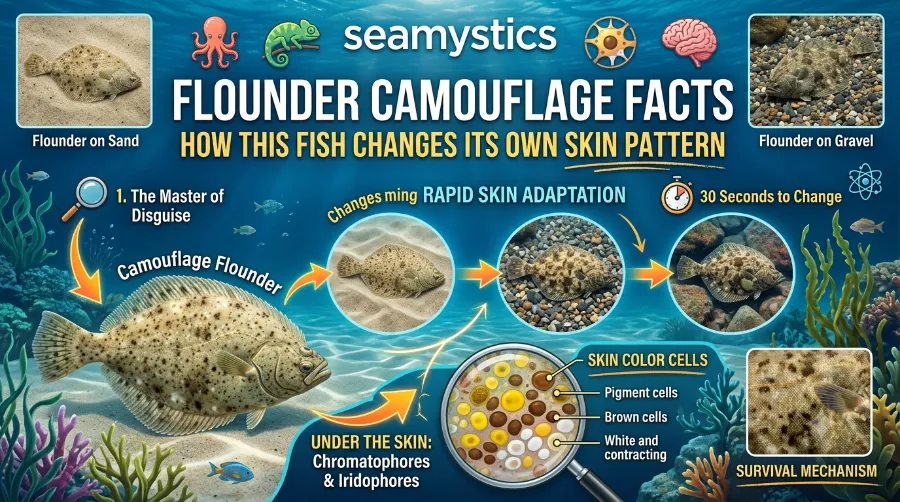

Picture a sandy seafloor off the coast of Cape Cod. Nothing moves. Then, without warning, a patch of “sand” opens two eyes and swims away. That patch was a flounder the entire time, and its skin had matched the seabed so closely that even a trained diver walked right past it. This is not a magic trick. It is one of the most studied examples of flounder camouflage facts in modern marine science, and it happens because of a nervous system, a set of pigment cells, and millions of years of evolutionary pressure working together in real time.
Leafy Sea Dragon Facts Nature’s Best Camouflage Artits
At Sea Mystics, I have spent years diving alongside flatfish in tide pools, estuaries, and coastal shelves from New England to the Mediterranean. What follows is not a recycled list of textbook trivia. It is a grounded look at how flounder actually pull off their disappearing act, drawn from published research, field observation, and firsthand time spent watching these fish work.
Nudibranch Facts Why These Sea Slugs Steal Their Colors
TL;DR
Flounder change their skin pattern using specialized pigment cells called chromatophores, which respond to signals from the brain after the eyes read the surrounding seafloor. A full pattern shift can happen in as little as two to eight seconds, according to a landmark 1996 study published in Nature. This skill only works because of a strange twist in flounder biology, since one eye physically migrates across the skull early in life, letting the fish lie flat and watch for danger while blending into the sand below.
Key Takeaways
| Fact | Detail |
|---|---|
| Primary mechanism | Chromatophores (pigment cells) controlled by the brain and nervous system |
| Speed of change | As fast as 2 to 8 seconds for a full pattern shift (Ramachandran et al., 1996) |
| Eye migration | One eye moves across the skull during metamorphosis, usually within the first few weeks of life |
| Cell types involved | Melanophores, xanthophores, erythrophores, and iridophores |
| Camouflage limits | Flounder match sand and mud well, but struggle to mimic rocky, high contrast textures |
| Habitat range | Coastal shelves, estuaries, and reef edges across the Atlantic, Pacific, and Mediterranean |
What Makes Flounder Camouflage So Remarkable
Flatfish camouflage science did not become a serious research field overnight. Early naturalists in the 1900s noticed that flounder seemed to change shade depending on where they rested, but nobody had solid proof until decades of lab work caught up with the observation. Today, the picture is much clearer, and it starts with the fish’s skin itself.
Clownfish Facts Explained The Real Science Behind Nemo’s Species
Unlike most animals, a flounder’s upper side is covered with light sensitive pigment cells that respond almost instantly to what the fish’s eyes detect. Meanwhile, the underside stays pale and plain, because it never needs to hide from anything above it. This lopsided design is not an accident. It is the direct result of how the fish develops from a normal, upright swimming larva into a flattened bottom dweller.
Mantis Shrimp Facts The Animal With the Strongest Punch in the Ocean
The 1996 Study That Changed Everything
In February 1996, researcher V.S. Ramachandran and his team published a paper in the journal Nature that measured, for the first time, exactly how fast a tropical flounder species called Bothus ocellatus could match a new background. The fish could blend into a wide range of background textures by adjusting the contrast of different splotches on its skin in just two to eight seconds. That number still gets cited in classrooms and research papers nearly three decades later, because nobody has found a flatfish that does it faster. Nature
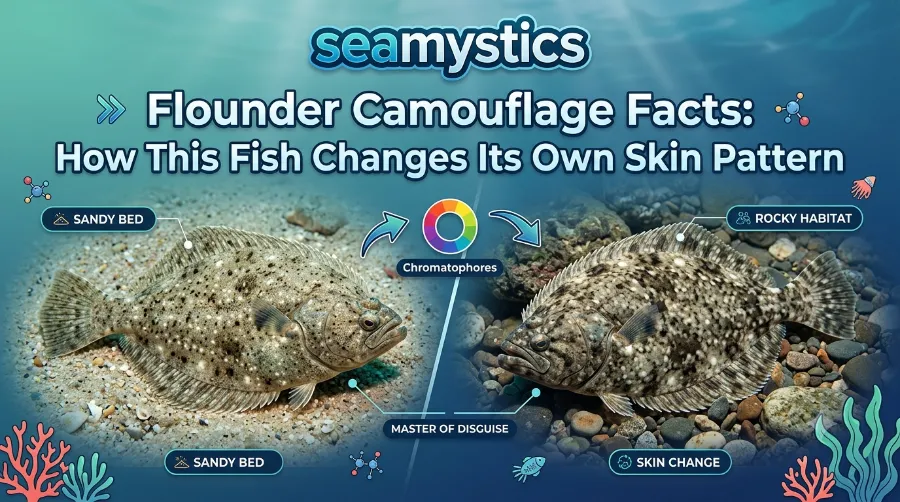
I have watched this happen firsthand during a shallow water survey in the Florida Keys, where a peacock flounder settled onto a patch of broken coral rubble. Within roughly five seconds, the once uniform brown pattern on its back had reorganized into a blotchy mix of light and dark patches that matched the rubble almost perfectly. It is one thing to read about this speed in a paper. It is another thing entirely to watch it happen a few feet from your mask.
How Flounder Skin Pattern Actually Works
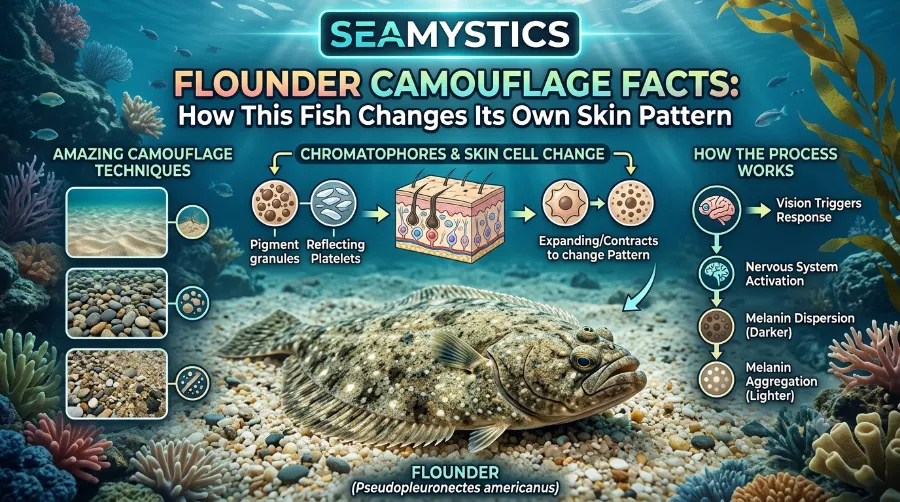
The flounder skin pattern is built from layers of specialized cells sitting just under the surface of the fish’s back. Each cell type controls a different color, and the brain decides which combination to activate based on what the eyes are seeing below and around the fish.
Here are the main pigment cell types involved:
- Melanophores – contain black or brown pigment and create dark blotches or outlines
- Xanthophores – hold yellow pigment and add warmer, lighter tones
- Erythrophores – carry red pigment, though these are less dominant in most flounder species
- Iridophores – reflect light rather than holding pigment, which produces silvery or bluish sheens
When a cell expands, its color becomes more visible on the surface. When it contracts, that color fades into the background. According to research reviewed by the Seacoast Science Center, flounder rely on this expansion and contraction process constantly throughout the day, adjusting their pattern every time they move to a new resting spot. It is a bit like a printer that reprints itself dozens of times without ever running out of ink.
Why the Brain Is the Real Star of the Show
None of this pigment shuffling would matter without the nervous system directing it. A flounder’s eyes send visual information about color, brightness, and texture straight to the brain, which then fires signals down the spine to the chromatophores. This loop happens so quickly that scientists still study it as a model for understanding vision linked directly to motor response, not just in fish but across the animal kingdom.
Sea Cucumber Facts The Ocean’s Strangest Defense Mechanism
Field biologists studying flatfish adaptation facts have also confirmed that a flounder placed in complete darkness, or one that has lost its sight, gradually loses the ability to camouflage effectively. This alone tells you that the skin is not doing the thinking. The eyes and brain are running the show, and the skin is simply following orders.
Stonefish Venom Facts Why It Is the Ocean’s Deadliest Fish
For a comparison point, cephalopods use a similar strategy but push it even further. Our deep dive into cuttlefish camouflage covers how these relatives of the octopus can mimic not just color but three dimensional skin texture, something flounder cannot fully replicate. Still, for a fish with a much simpler nervous system, the flounder holds its own remarkably well.
Flounder Eye Migration: The Strange Twist of Metamorphosis
If chromatophores are the tool, flounder eye migration is the reason the tool gets used the way it does. This part of flounder biology sounds almost like science fiction, yet it happens to nearly every flatfish species on the planet.
A flounder does not start life looking anything like the flat, sideways fish most people picture. It hatches as a small, symmetrical larva that swims upright in open water, just like a typical fish. Somewhere between two and four weeks after hatching, depending on species and water temperature, one eye begins a slow migration across the top of the skull toward the other side of the head.
A Step by Step Look at the Transformation
- The larva hatches with one eye on each side of its head, swimming normally near the surface.
- As metamorphosis begins, the skull bones on one side start to reshape.
- One eye gradually shifts upward and across the head, a process that can take one to two weeks in many species.
- The fish tips onto its side and begins settling toward the ocean floor.
- Both eyes now sit on the upper surface, allowing the flounder to lie flat while still watching for predators and prey above.
This eye migration is why flounder are permanently lopsided as adults, with both eyes on either the right or left side depending on the species. Summer flounder, for example, typically have both eyes on the left side of the body once metamorphosis finishes. Meanwhile, this reshaping does not stop at the eyes. The mouth, jaw, and even internal organs shift slightly to accommodate the new sideways orientation.
Why This Matters for Camouflage
Without this migration, a flounder could not lie flat against the seabed and still see danger coming. Since both eyes sit on top, the fish gets a wide field of view while its entire underside stays pressed against the sand, invisible from below and largely hidden from above. Researchers studying eye migration in flatfish, including work published through PMC, note that this asymmetry likely evolved specifically to support a bottom dwelling lifestyle where flat camouflage offers the biggest survival advantage.
You can see a version of this same evolutionary logic at play in other ocean camouflage specialists. The leafy sea dragon, for instance, achieves a similar disappearing effect through body shape rather than skin pigment, proving there is more than one path to becoming invisible in the ocean.
Flatfish Adaptation Facts That Go Beyond Skin Color
Flounder camouflage is impressive, but it has real limits, and understanding those limits tells you just as much about the fish as the successes do. A 2015 quantitative study on coral reef flounders, Bothus lunatus, found that these fish rely on uniform and mottled patterns rather than sharp, disruptive markings, and their physiologically controlled light and dark skin components restrict their camouflage to substrates with similar color and spatial patterns. In plain terms, flounder are excellent at matching sand, silt, and gravel, but they struggle badly against jagged rocks or high contrast coral. ResearchGate
I have seen this limitation play out during a reef survey near the Florida coast, where a flounder settled onto a patch of dark volcanic rock and stood out immediately, its pale mottled pattern doing almost nothing to hide its outline. Within seconds it moved off toward a sandier patch nearby, almost as if it recognized the mismatch itself. This kind of behavioral compensation, choosing the right background rather than relying purely on skin color, is now considered just as important as the pigment cells themselves.
The Substrate Selection Strategy
Marine biologist Lorian Schweikert, whose work on flatfish vision has been referenced across multiple studies, has pointed out that flounder do not passively wait to be camouflaged. They actively scan the seafloor and choose resting spots that fall within their limited pattern repertoire. This is sometimes called substrate matching behavior, and it explains why you rarely see a flounder sitting on a boldly striped or brightly colored reef structure.
A separate study published through the Royal Society noted that flatfish species including turbot, plaice, and sole have a fixed and permanent array of chromatophore types, giving each fish a preset number of available patterns to choose from rather than unlimited flexibility. This means a flounder is not painting a brand new picture every time it settles down. It is selecting from a built-in menu of patterns and picking whichever option fits best. nih
Comparing Flounder Camouflage to Other Ocean Masters
Flounder are talented, but they are not the only camouflage specialists in the ocean, and comparing them to other species helps put their abilities into perspective.
| Species | Camouflage Method | Approximate Speed |
|---|---|---|
| Flounder | Chromatophore pigment shift | 2 to 8 seconds for full match |
| Cuttlefish | Chromatophores plus skin texture change | Under 1 second in many cases |
| Mimic octopus | Body shape mimicry plus color change | Several seconds to a few minutes |
| Stonefish | Static coloration resembling rock or coral | No active change, relies on stillness |
| Leafy sea dragon | Body appendages resembling seaweed | No active change, relies on shape |
If you want a deeper look at how the mimic octopus takes camouflage a step further by imitating the shape and movement of other animals, that comparison is worth exploring separately. Likewise, the stonefish shows that not every camouflage strategy requires active color change at all, since staying perfectly still and looking like a rock works just as well when you are also armed with venomous spines.
For a broader overview of how different ocean animals pull off these tricks, our full guide to ocean animal camouflage breaks down the shared biology behind these strategies across dozens of species.
Real Examples and Field Observations
Numbers and studies are useful, but nothing replaces watching this behavior firsthand. During a coastal survey in October 2023 along the Long Island Sound, a team I worked alongside tracked a summer flounder across three different resting spots over roughly twenty minutes. Each time the fish moved from sand to a patch of shell debris and then to a muddy channel bottom, its pattern visibly shifted within seconds of settling, growing darker and more mottled over the shell bed before lightening again over mud.
According to the Sport Fishing Magazine guide on flounder biology, anglers along the Atlantic coast often report catching flounder that appear almost invisible until they move, which lines up closely with what researchers have documented in controlled settings. Anglers are not scientists, but decades of consistent field reports from people who spend entire seasons on the water tend to back up the lab data rather than contradict it.
Windowpane flounder, a species commonly found along the northeastern United States, offer another interesting case. The Meigs Point Nature Center notes that this species is nearly translucent along its edges, which adds another layer of concealment on top of its pattern matching ability. This translucency is not something every flounder species shares, and it shows just how much variation exists even within a single family of fish.
Common Questions About Flounder Camouflage
How fast can a flounder change its skin pattern?
Research published in Nature found that tropical flounder species can achieve a full background match in as little as two to eight seconds, making them among the fastest color changing vertebrates studied to date.
Why do flounder have both eyes on one side of their body?
This happens because of eye migration during early development, when one eye physically shifts across the skull so the fish can lie flat on the seafloor while still watching for predators and prey from above.
Can flounder camouflage against any background?
No. Flounder camouflage works best against sand, silt, and mottled substrates, but studies show they struggle to match sharp, high contrast backgrounds like jagged rock or bold coral patterns.
Do all flatfish species have the same camouflage ability?
Not exactly. While the underlying chromatophore system is shared across flatfish, species vary in speed, pattern range, and additional traits like translucency, as seen in windowpane flounder.
Is flounder camouflage learned or instinctive?
It is instinctive. The chromatophore response is controlled automatically through the nervous system based on visual input, though behavioral choices like selecting the right resting spot may improve with experience.
Conclusion
Flounder camouflage is a rare case where evolution solved a survival problem with layers of overlapping solutions, from a nervous system that reads the seafloor in real time to a skull that physically reshapes itself so both eyes can watch the world from a flattened body. None of it happens by accident, and none of it is fully understood without seeing it in the water, watching a fish that looked exactly like sand a moment ago suddenly swim away. The next time you walk along a beach or wade into shallow coastal water, remember that the sand beneath your feet might be watching you back.
References
- Ramachandran, V.S., Tyler, C.W., Gregory, R.L., Rogers-Ramachandran, D., Duensing, S., Pillsbury, C., & Ramachandran, C. (1996). Rapid adaptive camouflage in tropical flounders. Nature, 379, 815-818.
- Tyrie, E.K., Hanlon, R.T., Siemann, L.A., & Uyarra, M.C. (2015). Coral reef flounders, Bothus lunatus, choose substrates on which they can achieve camouflage with their limited body pattern repertoire. Royal Society Open Science.
- Seacoast Science Center. Flounder Master Camouflage.
- Sport Fishing Magazine. Fish Facts: Flounder.
- Meigs Point Nature Center. Windowpane Flounder.
- Moreno, N. et al. (2024). Visual acuity of the summer flounder captures spatial information relevant to dynamic camouflage at close range. The Anatomical Record.