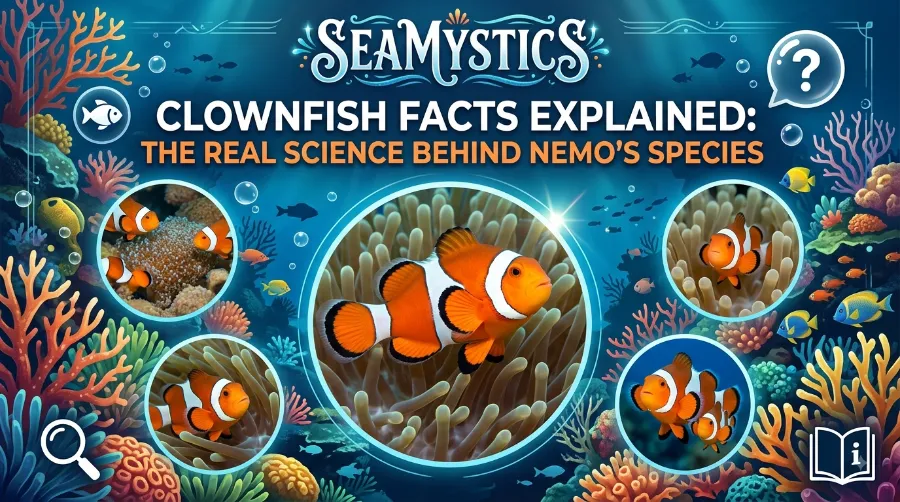

Picture a small orange fish tucked between the arms of a sea anemone. It stays safe there while danger surrounds it. That single image, made famous by a Pixar film, is one of the most misunderstood scenes in ocean science. However, these clownfish facts explained here show you what is real, what Hollywood simplified, and why the true biology beats the cartoon.
Nudibranch Facts Why These Sea Slugs Steal Their Colors
Clownfish are small reef fish from the subfamily Amphiprioninae. In fact, they are far more than a cute movie character. Their partnership with sea anemones, their unusual approach to gender, and their tiny home range make them one of the most studied fish families on the reef. Below, this guide breaks down clownfish anemone symbiosis, clownfish gender change, clownfish habitat facts, and how closely Finding Nemo really matches the real fish.
Key Takeaways
| Fact | Detail |
|---|---|
| Number of species | About 28 to 30 recognized species across two genera, with the genus Amphiprion comprising 28 to 30 species depending on the classification used, plus the single-species genus Premnas Fishes of AustraliaWikipedia |
| Real “Nemo” species | Amphiprion ocellaris, the orange clownfish or false clownfish |
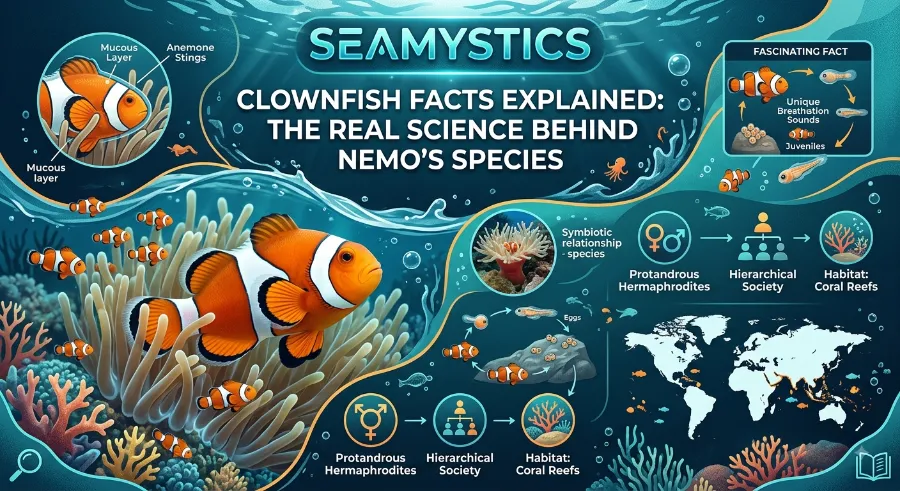
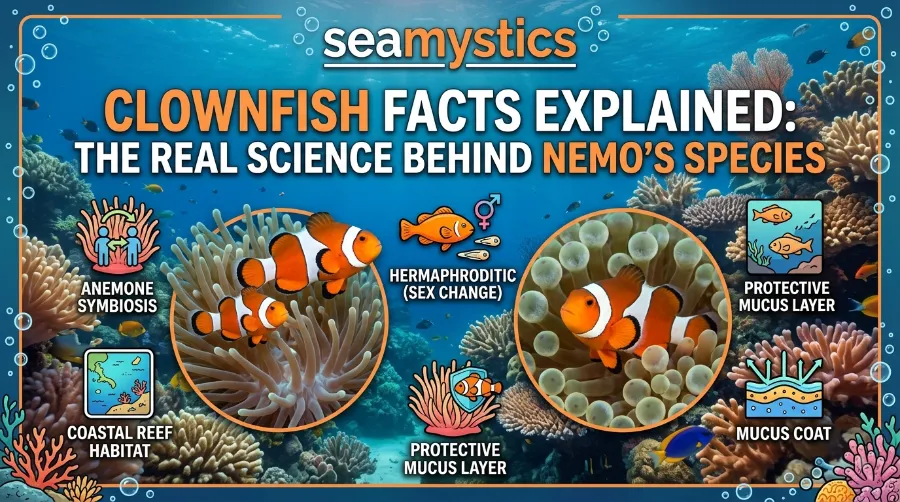
| Anemone protection | A mucus coating helps prevent the anemone’s stinging cells from firing, allowing safe contact with the tentacles after a period of acclimation Wikipedia |
| Gender system | Protandrous hermaphrodites. Every clownfish starts life male, and the dominant fish becomes female |
| Native range | Indo-Pacific reefs, from the Red Sea and East Africa to Japan and Australia |
| Max size | Roughly 90 to 110 millimeters, about the length of a finger, with a rounded caudal fin and a maximum length near 110 millimeters savingnemo |
| Conservation status | Most species are Least Concern. Habitat loss and coral bleaching are growing threats |
TL;DR: Clownfish live safely inside stinging sea anemones thanks to a protective mucus layer. Meanwhile, every clownfish is born male, and the dominant fish in a group later becomes female. The real Finding Nemo species is Amphiprion ocellaris. In real life, Marlin would likely have become Nemo’s new mother rather than searching the ocean alone.
What Exactly Is a Clownfish
Clownfish belong to the damselfish family Pomacentridae. Within that family sits the subfamily Amphiprioninae. Overall, most clownfish facts explained in guides and documentaries focus on one detail: their permanent bond with sea anemones. Even so, scientists currently recognize between 28 and 30 species in the genus Amphiprion, plus one unusual cousin.
The Maroon Outlier
That cousin is the maroon clownfish, Premnas biaculeatus. Unlike its relatives, it stands alone in its own genus rather than joining Amphiprion.It belongs to the class Actinopterygii and the order Perciformes, like the rest of its relatives. On average, clownfish grow no longer than about 11 centimeters. That is smaller than most people expect after seeing them on a movie screen. Wikipedia
A Range of Colors
Coloring varies widely across the group. For instance, the classic orange and white pattern is the most recognizable. Beyond that, some species appear yellow, deep red, maroon, or almost black, often with white bars or patches breaking up the body.Across the more than 30 recognized species, clownfish display a genuine range of colors and patterns rather than a single uniform look. For a broader look at how reef animals use color and pattern for survival, our guide on ocean animal camouflage covers several strategies beyond the clownfish’s bold warning colors.
Clownfish Anemone Symbiosis: How the Partnership Actually Works
This is the fact people ask about most. After all, sea anemones sting almost everything that touches them, using microscopic harpoon-like cells called nematocysts. Yet clownfish are one of the very few fish that live inside those tentacles without being killed.
Mantis Shrimp Facts The Animal With the Strongest Punch in the Ocean
The Mucus Shield
The secret lies in a specialized mucus coating on the clownfish’s skin. Essentially, this coating helps stop the anemone’s stinging cells from firing correctly against the fish. Still, the fish needs a period of careful acclimation before it is fully protected.Roughly one third of clownfish species pair with a host-specific anemone, showing that this relationship is highly selective rather than universal across every anemone on the reef. Saltwaterfishshop
What Each Side Gains
Because the relationship benefits both sides, it counts as a true example of mutualism rather than simple tolerance.
- First, the anemone gets a live-in bodyguard. The fish’s aggressive, territorial behavior helps protect the anemone from some of its predators. Saltwaterfishshop
- In return, the clownfish gets a nearly impenetrable fortress, since few predators chase a small fish into a bed of stinging tentacles.
- Additionally, waste from the clownfish can add nutrients that benefit the anemone over time.
- Finally, clownfish stay close to their anemone at night, because oxygen levels near the tentacles drop once photosynthesis stops after dark.This is one reason the fish nestle so tightly against their host anemone overnight. Wikipedia
Clearly, this is not an accidental friendship. Researcher Jeff Ollerton and colleagues studied this bond closely.Their 2007 paper described anemonefish and their hosts as a genuinely nested mutualistic system, and it remains a key reference for how scientists describe this relationship today. As a result, some anemonefish species can live with many anemone species, while others can only survive with one narrow host. If you enjoy stories of animals surviving through unlikely partnerships, our piece on cuttlefish facts explained covers a very different but equally clever survival trick. Wikipedia
Clownfish Gender Change: The Detail Finding Nemo Skipped
Here the science gets genuinely surprising, and the movie takes its biggest creative liberty right here. Specifically, clownfish are protandrous hermaphrodites, meaning every clownfish is born male. Within a small group living on one anemone, a strict hierarchy forms, and the largest, most dominant fish becomes female.
Clownfish Facts Explained The Real Science Behind Nemo’s Species
If that female dies or leaves, something remarkable happens next. The most dominant remaining male begins changing into a female, while the next male in line moves up to become the group’s new breeding male. However, this process is not instant, since it can take weeks to unfold as hormone levels shift and physical changes occur.
Sea Cucumber Facts The Ocean’s Strangest Defense Mechanism
In the real ocean, this detail flips the entire premise of the film. Consider Amphiprion ocellaris losing the female half of a breeding pair. In that case, the surviving male would not go looking for his lost mate. Instead, he would likely begin transitioning to female himself, while a young male from the group’s lower ranks stepped up as his new partner. For years, marine biologists have pointed this out as one of the more charming inaccuracies in an otherwise fairly reef-accurate film.
Scientists call this system sequential hermaphroditism. Although it is not unique to clownfish, their version is unusually well documented, mainly because clownfish groups stay small and easy to observe. They also tend to stay on one anemone for most of their lives, and that stability is part of why clownfish habitat facts stay so consistent across different research teams and decades of study.
Clownfish Habitat Facts: Where They Actually Live
Clownfish are native to the Indo-Pacific region, and despite their fame, they have never been naturally found in the Atlantic Ocean or the Caribbean. Instead, their range stretches from the Red Sea and East Africa to Southeast Asia, northern Australia, and the Ryukyu Islands of southern Japan.This range includes Northwest Australia, Southeast Asia, and areas as far north as Japan’s Ryukyu Islands. savingnemo
Reef Life, Up Close
Within that range, clownfish stick to shallow, warm-water reef environments.
- Generally, they favor coral reefs and sheltered lagoons, typically no deeper than about 15 meters.Amphiprion ocellaris in particular is found in coral reef habitats and protected lagoons down to roughly that depth. savingnemo
- Rarely do they stray far from their host anemone, and many spend their entire adult life within a few meters of the same coral head.
- Most commonly, they favor specific anemone species, including Heteractis magnifica, Stichodactyla gigantea, and Stichodactyla mertensii.These three anemone species are among the most frequently documented hosts for the false clownfish in the wild. savingnemo
- Occasionally, regional color variants exist. For example, a black and white form of Amphiprion ocellaris lives off Australia’s Northern Territory instead of the usual orange.This darker variant appears in that specific region while the species elsewhere keeps its typical orange coloring. savingnemo
Because of this small home range, real risk builds quickly. A single anemone bed can be destroyed by bleaching or storm damage, and consequently, an entire resident clownfish family can lose its only shelter at once. Readers interested in other reef dwellers with tightly linked habitats might enjoy our guide to the leafy sea dragon, another Indo-Pacific specialist with very particular habitat needs.
Finding Nemo Real Fish: How Close Did the Movie Get
The 2003 Pixar film introduced millions of people to clownfish, and in fairness, it got several details right. For example, Nemo and his father Marlin appear as orange clownfish with white bands, a look that lines up well with Amphiprion ocellaris, the species most people call the real Nemo fish.Amphiprion ocellaris is widely recognized as the species behind the film’s iconic look, and it became something of a cultural symbol for reef life afterward. Wikipedia
Where the Film Bent the Facts
The movie also got the anemone relationship broadly right, showing Nemo’s family living inside a sea anemone for protection. Even so, the story departs sharply from real biology in one key spot: the gender change detail explained above. On top of that, the film skips the small home range and territorial aggression real clownfish show toward intruders, including divers who get too close to a nest.
Notably, the film’s popularity had a real-world side effect worth mentioning. After the movie’s release, demand for pet clownfish rose sharply, which in turn increased pressure on wild reef collection in some regions.Fortunately, the ocellaris clownfish has become one of the most successfully captive-bred marine aquarium fish, which has helped reduce that pressure when fish are sourced responsibly from breeders rather than wild reefs. For anyone curious how other reef species get misrepresented in pop culture, our article on mimic octopus facts covers an animal whose real abilities are arguably even stranger than fiction. Wikipedia
A Quick Species Comparison
| Species | Common Name | Notable Trait |
|---|---|---|
| Amphiprion ocellaris | False clownfish, the real Nemo | 11 dorsal fin spines, orange with three white bars, distinguishable from its close relative by its higher dorsal fin Saltwaterfishshop |
| Amphiprion percula | True percula clownfish | Very similar look, but only 10, rarely 9, dorsal spines, which is the main way researchers tell the two species apart Saltwaterfishshop |
| Premnas biaculeatus | Maroon clownfish | The only species outside genus Amphiprion, known for a deep red color and a spine below the eye |
| Amphiprion latifasciatus | Madagascar anemonefish | Extremely limited range in the western Indian Ocean, and considered extremely rare within the aquarium trade because of that narrow habitat U.S. Fish & Wildlife Service |
| Amphiprion allardi | Allard’s clownfish | Found off East Africa and the Mascarene Islands, currently listed as Least Concern on the IUCN Red List |
Threats and Conservation Reality
Most clownfish species currently carry a Least Concern status from the IUCN, which is genuinely good news. Still, the picture is not entirely simple, since reef-specific pressures are building in several regions.
The Growing Risks
Above all, coral bleaching driven by ocean warming remains one of the biggest long-term risks, because a clownfish without a healthy host anemone has almost nowhere else to go. Meanwhile, habitat loss along coastlines adds further pressure, and unsustainable wild collection for the aquarium trade does too, though only in a handful of areas. For a deeper look at how ocean warming affects camouflage and habitat-dependent species more broadly, our guide on flounder camouflage facts explores a related set of environmental pressures on reef and seabed dwellers.
The Encouraging Trend
On a brighter note, captive breeding offers real hope, since clownfish breed relatively easily in controlled tanks. Today, a large share of clownfish sold for home aquariums come from breeders rather than wild collection, and that shift takes real pressure off natural reef populations when buyers choose responsibly sourced fish.
Frequently Asked Questions
Is the real Nemo fish actually called a clownfish?
Yes, Nemo appears as an orange clownfish. Specifically, he most closely matches Amphiprion ocellaris, sometimes called the false clownfish because of its close resemblance to Amphiprion percula.
Why don’t sea anemones sting clownfish?
A specialized mucus layer on the clownfish’s skin helps stop the anemone’s stinging cells from firing properly. Even so, the fish still needs a gradual acclimation period with a new anemone before it gains full protection.
Do all clownfish change gender?
Every clownfish is born male, and within a group, the dominant individual becomes female. If that female is lost, the next-ranking male typically transitions to take her place.
Where do clownfish live in the wild?
Clownfish live only in the Indo-Pacific region. There, they stick to shallow coral reefs and sheltered lagoons, generally no deeper than about 15 meters.
How many species of clownfish exist?
Most current sources place the number between 28 and 30 recognized species. Of those, most fall within the genus Amphiprion, with one additional species in genus Premnas.
Are clownfish endangered?
Most individual species currently carry a Least Concern listing, though habitat loss and reef degradation remain ongoing concerns for the group as a whole.
Conclusion
Clownfish prove that real ocean biology rarely needs exaggeration to be fascinating. Indeed, their partnership with sea anemones is a genuine, mutually beneficial survival strategy built on a protective mucus coating rather than luck. Meanwhile, their gender change system upends the entire premise of the film that made them famous, and their tight, anemone-bound habitat shows why local reef health matters so much to their survival. Ultimately, understanding the real science behind Nemo’s species does not make the movie less enjoyable. If anything, it makes the ocean feel a little more remarkable than fiction ever could.
For more reef biology deep dives, browse our full library on ocean animal camouflage and reef survival strategies, including our detailed looks at stonefish venom facts, sea cucumber facts, and nudibranch color facts.
References
- Barrier Reef Education, “Clownfish,” barrierreef.org/the-reef/animals/clownfish
- Oceana USA, “Creature Feature: Clownfish,” usa.oceana.org/blog/creature-feature-clownfish
- Deep Sea World, “Clownfish,” deepseaworld.com/discover/animals/clownfish
- Animal Diversity Web, “Amphiprion ocellaris,” animaldiversity.org/accounts/Amphiprion_ocellaris
- Fishes of Australia, “Genus Amphiprion,” fishesofaustralia.net.au/home/genus/68
- Ollerton, J., McCollin, D., Fautin, D. G., and Allen, G. R. (2007). “Finding NEMO: nestedness engendered by mutualistic organization in anemonefish and their hosts.”
- IUCN Red List species accounts for Amphiprion latifasciatus and Amphiprion allardi
About the Author
Dr. Rabica Farooq is a marine biologist with a background in coral reef ecology. Over more than a decade, she conducted fieldwork across Indo-Pacific reef systems, where anemonefish population studies formed a core part of her research. Today, she writes for Sea Mystics to turn peer-reviewed reef science into stories divers, aquarists, and ocean lovers can actually use.